 |
|
|
 |
|
 |
|
|||
|
||||
|
||||
|
Maryland State Archives Maryland Suffrage News Collection MSA SC 3286 msa_sc3286_scm7805-0027 Enlarge and print image (1M) |
|
|
|
|
|
|
|
|||
|
||||
|
||||
|
Maryland State Archives Maryland Suffrage News Collection MSA SC 3286 msa_sc3286_scm7805-0027 Enlarge and print image (1M) |
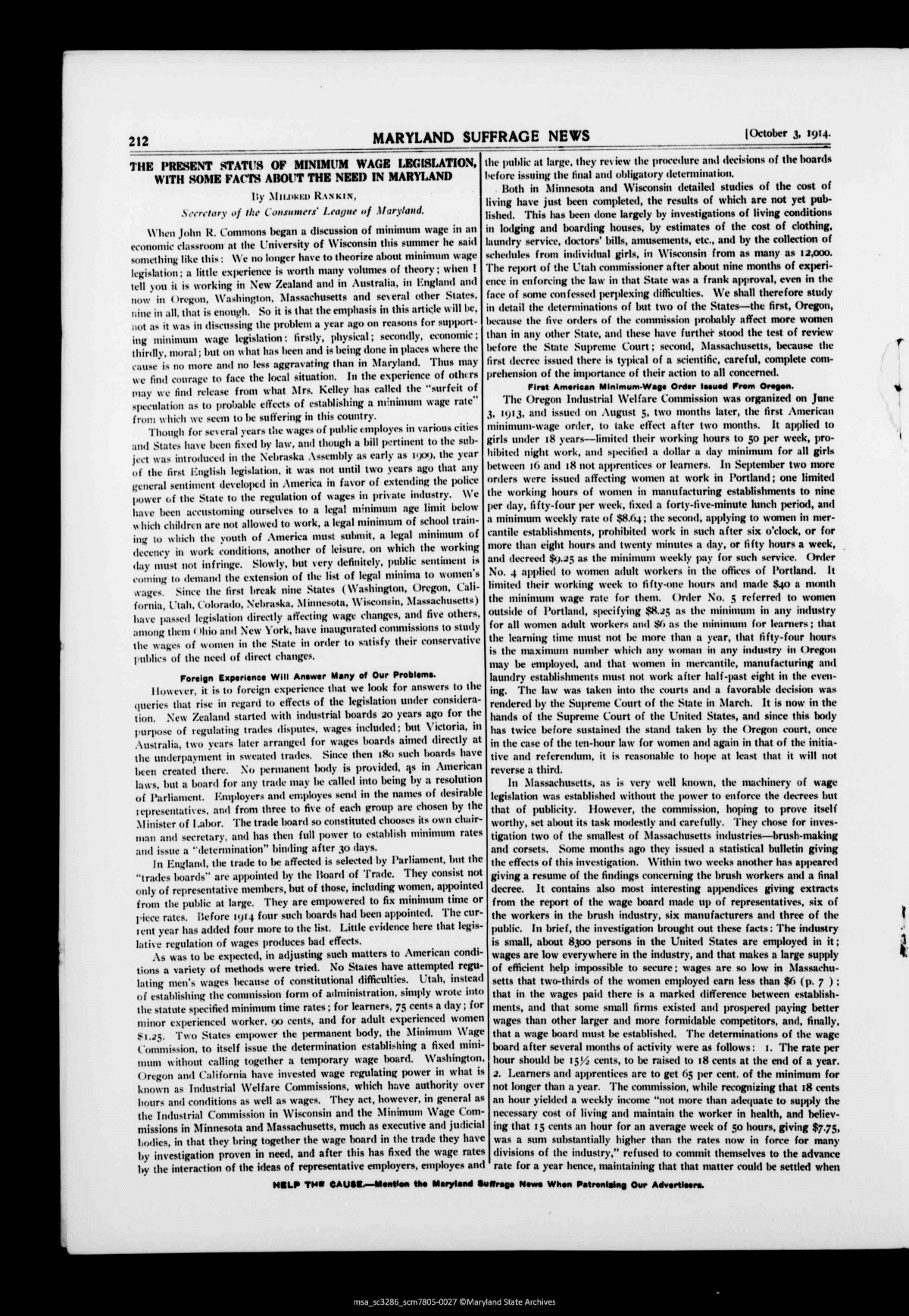
| 212 MARYLAND SUFFRAGE NEWS | October 3, 1914. THE PRESENT STATl'S OF MINIMUM WAGE LEGISLATION, WITH SOME FACTS ABOIT THE NEED IN MARYLAND liy MiiiikKn Rankin, .Si\Ti7(frv of the Consumers' l.riii/itc of Maryland. When Jului 1<. Commons began a discussion of minimum wage in an economic flmiraimi at the University of Wisconsin tliis slimmer lie said something like tilts : We no longer have to theorize about minimum wage legislation: a little cx|ierienee is worth many volumes of theory; when I tell you ii is working in New Zealand and in Australia, in England and now in t iregon, Washington, Massachusetts and sex era! other States, i.ine in all. that is enough. So it is that the emphasis in this article w ill he, not as it was in discussing the problem a year ago on reasons for support- ing minimum wage legislation: firstly, physical; secondly, economic; thirdly, moral; but on \\ bat has been and is being done in places where the cause is no more and no less aggravating than in Maryland. Thus may we find courage to face the local situation. In the experience of otlurs may we find release from what Mrs. Kelley has called the "surfeit of speculation as to probable effects of establishing a minimum wage rate" from which \\c seem to lie suffering in this country. Though for se\ eral years the wages of public employes in various cities and Slates have been fixed by law. anil though a bill pertinent to the sub- ject was introduced in the Nebraska Assembly as early as i'K». the year of the first English legislation, it was not until two years ago that any general sentiment developed in America in favor of extending the police power of the State to the regulation of wages in private industry. We have liecn accustoming ourselves to a legal minimum age limit below w hich children are nol allowed to work, a legal minimum of school train- ing to which the youth of America must submit, a legal minimum of decency in work conditions, another of leisure, on which the working day must not infringe. Slowly, but \ery definitely, public sentiment is coming to demand the extension of the list of legal minima to women's wages. Since the first break nine States (Washington, Oregon, Cali- fornia. Utah. Colorado, Nebraska. Minnesota, Wisconsin, Massachusetts) have passed legislation directly affecting wage changes, and five others. among them I »bio and New York, have inaugurated commissions to study the wages of women in the State in order to satisfy their conservative publics of the need of direct changes. Foreign Experience Will Aniwer Many Of Our Problem*. However, it is to foreign experience that we look for answers to the (|iieries that rise in regard to effects of the legislation under considera- tion. New Zealand started with industrial boards 20 years ago for the purpose of regulating trades disputes, wages included; but Victoria, in Australia, two years later arranged for wages boards aimed directly at the underpayment in sweated trades. Since then 180 such boards have bien created there. No {lerniaiieut lmdy is provided, :p> in American laws, but a board for any trade may be called into being by a resolution of Parliament. Employers and employes send in the names of desirable icprcsentatives. and from three to five of each group are chosen by ihc Minister of Labor. The trade lioard so constituted chooses its own chair- man and secretary, and has then full power to establish minimum rates and issue a "determination" binding after 30 days. In England, the trade to lie affected is selected by Parliament, but the "trades boards" arc appointed by the Hoard of Trade. They consist not only of representative members, hut of those, including women, appointed from the public at large. They are empowered to fix minimum time or piece rates. Before 1914 four such boards had been appointed. The ctir- lent year has added four more to the list. Little evidence here that legis- lative regulation of wages produces had effects. As was to be expected, in adjusting such matters to American condi- tions a variety of methods were tried. No States have attempted regu- lating men's wages liecausc of constitutional difficulties. I'tah, instead of establishing the commission form of administration, simply wrote into the statute specified minimum time rates; for learners. 75 cents a day; for minor experienced worker, ihj cents, and for adult experienced women ¥1.25. Two States empower the permanent body, the Minimum Wage ('iinunissiiin, to itself issue the determination establishing a fixed mini- mum without calling together a temporary wage lioard. Washington. < Iregon and California have invested wage regulating power in what is known as Industrial Welfare Commissions, which have authority over hours and conditions as well as wages. They act, however, in general as the Industrial Commission in Wisconsin and the Minimum Wage Com- missions in Minnesota and Massachusetts, much as executive and judicial bodies, in that they bring together the wage board in the trade they have by investigation proven in need, and after this has fixed the wage rates l>y the interaction of the ideas of representative employers, employes and the public at large, they review the procedure and decisions of the lioards before issuing the final ami obligatory determination. Both in Minnesota and Wisconsin detailed studies of the cost of living have just been completed, the results of which are not yet pub- lished. This has been done largely by investigations of living conditions in lodging and boarding houses, by estimates of the cost of clothing, laundry service, doctors' bills, amusements, etc., and by the collection of schedules from individual girls, in Wisconsin from as many as 12,000. The reiiort of the I'tah commissioner after aliotit nine months of exig- ence in enforcing the law in that State was a frank approval, even in the face of some confessed |>erplexiiig difficulties. We shall therefore study in detail the determinations of but two of the States—the first, Oregon, liceause the (\\v orders of the commission probably affect more women than in any other State, and these have further stood the test of review before the State Supreme Court; second, Massachusetts, because the first decree issued there is typical of a scientific, careful, complete com- prehension of the itniiortancc of their action to all concerned. First American Minimum-Wag* Order lasuad From Oregon. The Oregon Industrial Welfare Commission was organized on June 3, HJI3, and issued on August 5. two months later, the first American ininimuni-wage order, to take effect after two months. It applied to girls under 18 years—limited their working hours to 50 |>er week, pro- hibited night work, and specified a dollar a day minimum for all girls between id and 18 not apprentices or learners. In September two more orders were issued affecting women at work in Portland; one limited the working hours of women in manufacturing establishments to nine per day, fifty-four per week, fixed a forty-five-minute lunch period, and a minimum weekly rate of $8/14; the second, applying to women in mer- cantile establishments, prohibited work in such after six o'clock, or for more than eight hours and twenty minutes a day, or fifty hours a week, and decreed $ij.25 as the minimum weekly pay for such service. Order No. 4 applied to women adult workers in the offices of Portland. It limited their working week to fifty-one hours and made $40 a month the mininiuni wage rate for them. < Irder No. 5 referred to women outside of Portland, specifying $8.25 as the minimum in any industry for all women adult workers and ijVi as the minimum for learners; that the teaming time must not lie more than a year, that fifty-four hours is the maximum numlicr which any woman in any industry in < Iregon may lie employed, and that women in mercantile, manufacturing and laundry establishments must not work after half-past eight in the even- ing. The law was taken into the courts anil a favorable decision was rendered by the Supreme Court of the State in March. It is now in the hands of the Supreme Court of the United States, and since this body- has twice before sustained the stand taken by the (Iregon court, once in the case of the ten-hour law for women and again in that of the initia- tive and referendum, it is reasonable to hope at least that it will not reverse a third. In Massachusetts, as is very well known, the machinery of wage legislation was established without the jKiwer to enforce the decrees but that of publicity. However, the commission, hoping to prove itself worthy, set about its task modestly and carefully. They chose for inves- tigation two of the smallest of Massachusetts industries—brush-making and corsets. Some months ago they issued a statistical bulletin giving the effects of this investigation. Within two weeks another has appeared giving a resume of the findings concerning the brush workers and a final decree. It contains also most interesting appendices giving extracts from the report of the wage board made up of representatives, six of the workers in the brush industry, six manufacturers and three of the public. In brief, the investigation brought out these facts: The industry is small, about 8300 |iersons in the United States are employed in it; wages are low everywhere in the industry, and that makes a large supply of efficient help impossible to secure; wages arc so low in Massachu- setts that two-thirds of the women employed earn less than fS (p. f ) ; that in the wages paid there is a marked difference between establish- ments, and that some small firms existed and prospered paving better wages than other larger and more formidable competitors, and, finally, that a wage board must be established. The determinations of the wage board after several months of activity were as follows: 1. The rate per hour should be IJJ4 cents, to be raised to 18 cents at the end of a year. 2. Learners and apprentices are to get 05 ]>er cent, of the minimum for not longer than a year. The commission, while recognizing that 18 cents an hour yielded a weekly income "not more than adequate to supply the necessary cost of living and maintain the worker in health, and believ- ing that 15 cents an hour for an average week of 50 hours, giving $7.75, was a sum substantially higher than the rates now in force for many divisions of the industry," refused to commit themselves to the advance rate for a year hence, maintaining that that matter could lie settled when HILf TM» CAIIM.—Mant'on the Maryland •uffraga Newa Whan Patronising Our Advartlitra. |