 |
|
|
 |
|
 |
|
|||
|
||||
|
||||
|
Maryland State Archives Maryland Suffrage News Collection MSA SC 3286 msa_sc3286_scm7805-0075 Enlarge and print image (1M) |
|
|
|
|
|
|
|
|||
|
||||
|
||||
|
Maryland State Archives Maryland Suffrage News Collection MSA SC 3286 msa_sc3286_scm7805-0075 Enlarge and print image (1M) |
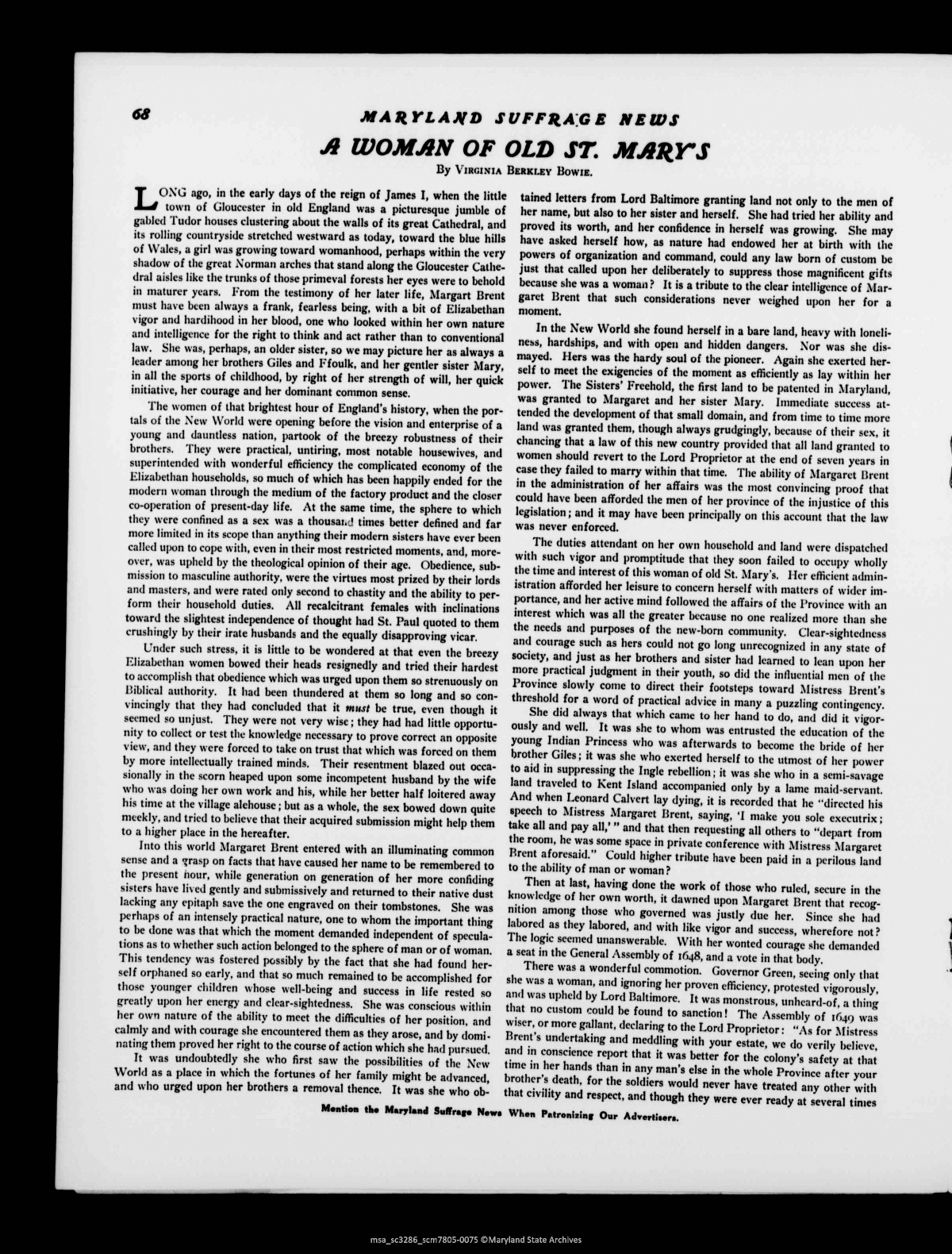
| 68 MARYLAND SUFFRAGE NEWS A WOMAN OF OLD ST. MARY'S By Virginia Berkley Bowie. LONG ago, in the early days of the reign of James I, when the little town of Gloucester in old England was a picturesque jumble of gabled Tudor houses clustering about the walls of its great Cathedral, and its rolling countryside stretched westward as today, toward the blue hills of Wales, a girl was growing toward womanhood, perhaps within the very shadow of the great Norman arches that stand along the Gloucester Cathe- dral aisles like the trunks of those primeval forests her eyes were to behold in maturer years. I'rom the testimony of her later life, Margart Brent must have been always a frank, fearless being, with a bit of Elizabethan vigor and hardihood in her blood, one who looked within her own nature and intelligence for the right to think and act rather than to conventional law. She was, perhaps, an older sister, so we may picture her as always a leader among her brothers Giles and Efoulk, and her gentler sister Mary, in all the sports of childhood, by right of her strength of will, her quick initiative, her courage and her dominant common sense. The women of that brightest hour of England's history, when the por- tals of the New World were opening before the vision and enterprise of a young and dauntless nation, partook of the breezy robustness of their brothers. They were practical, untiring, most notable housewives, and superintended with wonderful efficiency the complicated economy of the Elizabethan households, so much of which has been happily ended for the modem woman through the medium of the factory product and the closer co-operation of present-day life. At the same time, the sphere to which they were confined as a sex was a thousand times better defined and far more limited in its scope than anything their modern sisters have ever been called u|wn to cope with, even in their most restricted moments, and, more- over, was upheld by the theological opinion of their age. Obedience, sub- mission to masculine authority, were the virtues most prized by their lords and masters, and were rated only second to chastity and the ability to per- form their household duties. All recalcitrant females with inclinations toward the slightest independence of thought had St. Paul quoted to them crushingly by their irate husbands and the equally disapproving vicar. L'nder such stress, it is little to be wondered at that even the breezy Elizabethan women bowed their heads resignedly and tried their hardest to accomplish that obedience which was urged upon them so strenuously on Biblical authority. It had been thundered at them so long and so con- vincingly that they had concluded that it must be true, even though it seemed so unjust. They were not very wise; they had had little opportu- nity to collect or test the knowledge necessary to prove correct an opposite view, and they were forced to take on trust that which was forced on them by more intellectually trained minds. Their resentment blazed out occa- sionally in the scorn heaped upon some incompetent husband by the wife who was doing her own work and his, while her better half loitered away his time at the village alehouse; but as a whole, the sex bowed down quite meekly, and tried to believe that their acquired submission might help them to a higher place in the hereafter. Into this world Margaret Brent entered with an illuminating common sense and a <ğrasp on facts that have caused her name to be remembered to the present hour, while generation on generation of her more confiding sisters have lived gently and submissively and returned to their native dust lacking any epitaph save the one engraved on their tombstones. She was perhaps of an intensely practical nature, one to whom the important thing to be done was that which the moment demanded independent of specula- tions as to whether such action belonged to the sphere of man or of woman. This tendency was fostered possibly by the fact that she had found her- self orphaned so early, and that so much remained to be accomplished for those younger children whose well-being and success in life rested so greatly upon her energy and clear-sightedness. She was conscious within her own nature of the ability to meet the difficulties of her position, and calmly and with courage she encountered them as they arose, and by domi- nating them proved her right to the course of action which she had pursued. It was undoubtedly she who first saw the possibilities of the Xew World as a place in which the fortunes of her family might be advanced, and who urged upon her brothers a removal thence. It was she who ob- Mention Ilia Maryland Suffrage News tained letters from Lord Baltimore granting land not only to the men of her name, but also to her sister and herself. She had tried her ability and proved its worth, and her confidence in herself was growing. She may have asked herself how, as nature had endowed her at birth with the powers of organization and command, could any law born of custom be just that called upon her deliberately to suppress those magnificent gifts because she was a woman ? It is a tribute to the clear intelligence of Mar- garet Brent that such considerations never weighed upon her for a moment. In the New World she found herself in a bare land, heavy with loneli- ness, hardships, and with open and hidden dangers. Nor was she dis- mayed. Hers was the hardy soul of the pioneer. Again she exerted her- self to meet the exigencies of the moment as efficiently as lay within her power. The Sisters' Freehold, the first land to be patented in Maryland, was granted to Margaret and her sister Mary. Immediate success at- tended the development of that small domain, and from time to time more land was granted them, though always grudgingly, because of their sex, it chancing that a law of this new country provided that all land granted to women should revert to the Lord Proprietor at the end of seven years in case they failed to marry within that time. The ability of Margaret Drcnt in the administration of her affairs was the most convincing proof that could have been afforded the men of her province of the injustice of this legislation; and it may have been principally on this account that the law was never enforced. The duties attendant on her own household and land were dispatched with such vigor and promptitude that they soon failed to occupy wholly the time and interest of this woman of old St. Mary's. Her efficient admin- istration afforded her leisure to concern herself with matters of wider im- portance, and her active mind followed the affairs of the Province with an interest which was all the greater because no one realized more than she the needs and purposes of the new-born community. Clear-sightedness and courage such as hers could not go long unrecognized in any state of society, and just as her brothers and sister had learned to lean upon her more practical judgment in their youth, so did the influential men of the Province slowly come to direct their footsteps toward Mistress Brent's threshold for a word of practical advice in many a puzzling contingency. She did always that which came to her hand to do, and did it vigor- ously and well. It was she to whom was entrusted the education of the young Indian Princess who was afterwards to become the bride of her brother Giles; it was she who exerted herself to the utmost of her power to aid in suppressing the Ingle rebellion; it was she who in a semi-savage land traveled to Kent Island accompanied only by a lame maid-servant. And when Leonard Calvert lay dying, it is recorded that he "directed his speech to Mistress Margaret Brent, saying, 'I make you sole executrix; take all and pay all,'" and that then requesting all others to "depart from the room, he was some space in private conference with Mistress Margaret Brent aforesaid." Could higher tribute have been paid in a perilous land to the ability of man or woman? Then at last, having done the work of those who ruled, secure in the knowledge of her own worth, it dawned upon Margaret Brent that recog- nition among those who governed was justly due her. Since she had labored as they labored, and with like vigor and success, wherefore not? The logic seemed unanswerable. With her wonted courage she demanded a scat in the General Assembly of 1(148, and a vote in that body. There was a wonderful commotion. Governor Green, seeing only that she was a woman, and ignoring her proven efficiency, protested vigorously, and was upheld by Lord Baltimore. It was monstrous, unheard-of, a thing that no custom could be found to sanction! The Assembly of 1(149 was wiser, or more gallant, declaring to the Lord Proprietor: "As for Mistress Brent's undertaking and meddling with your estate, we do verily believe, and in conscience report that it was better for the colony's safety at that time in her hands than in any man's else in the whole Province after your brother's death, for the soldiers would never have treated any other with that civility and respect, and though they were ever ready at several times Whan Patronising Our Advertisers. |