 |
|
|
 |
|
 |
|
|||
|
||||
|
||||
|
Maryland State Archives Maryland Suffrage News Collection MSA SC 3286 msa_sc3286_scm7805-0092 Enlarge and print image (1M) |
|
|
|
|
|
|
|
|||
|
||||
|
||||
|
Maryland State Archives Maryland Suffrage News Collection MSA SC 3286 msa_sc3286_scm7805-0092 Enlarge and print image (1M) |
|
6 MARYLAND SUFFRAGE NEWS
MRS. ROBINS TELLS HOW ILLINOIS WOMEN USE THEIR VOTES
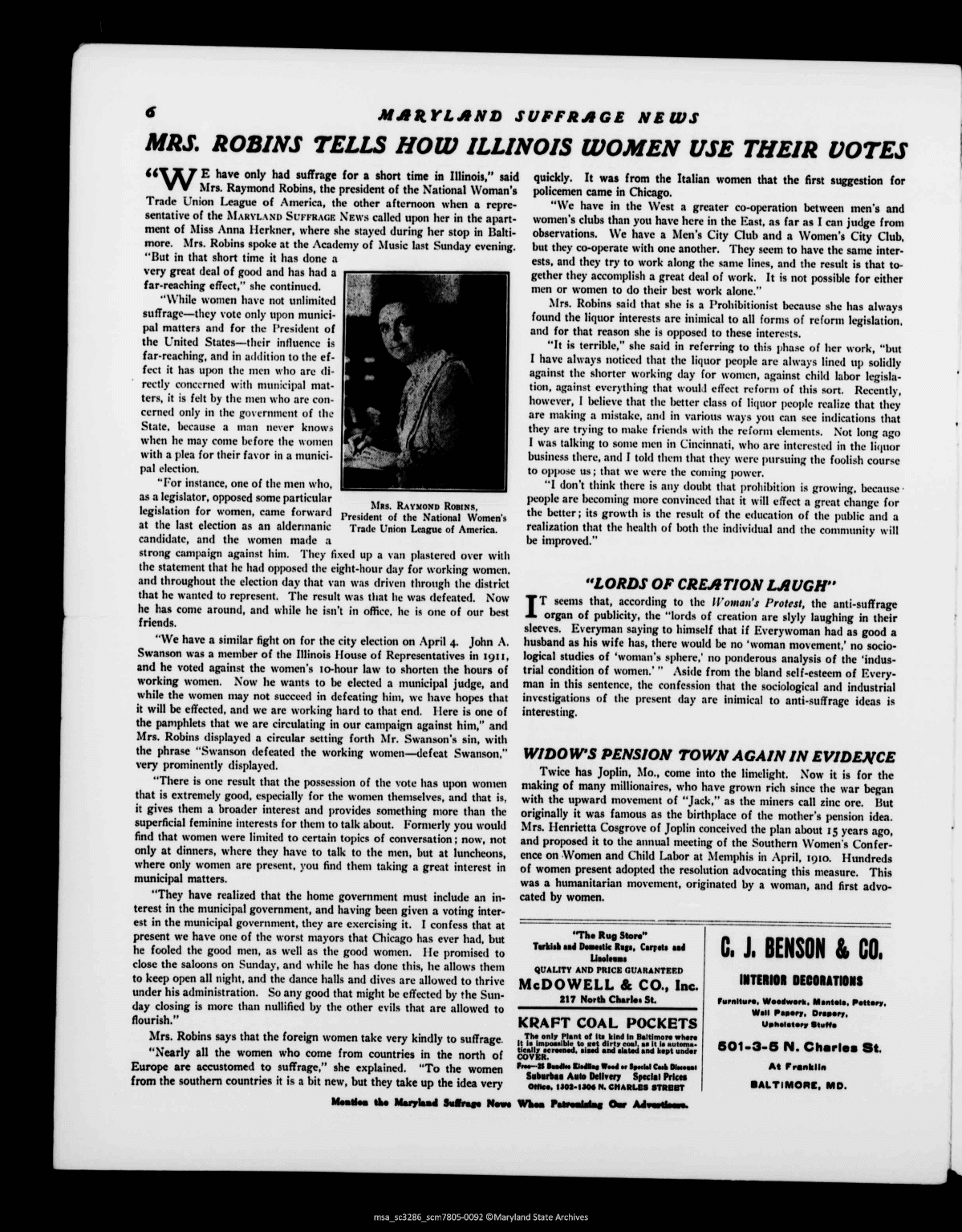
Mrs. Raymond Robins,
President of the National Women's
Trade Union League of America.
KTI7 E have only had suffrage for a short time in Illinois," said
V V Mrs. Raymond Robins, the president of the National Woman's
Trade Union League of America, the other afternoon when a repre-
sentative of the Maryland toffragk News called upon her in the apart-
ment of Miss Anna Uerkncr, where she stayed during her stop in Balti-
more. Mrs. Robins spoke at the Academy of Music last Sunday evening.
"But in that short time it has done I
very great deal of good and has had a
far-reaching effect," she continued.
"While women have not unlimited
suffrage—they vote only upon munici-
pal matters and for the President of
the United States—their influence is
far-reaching, and in addition to the ef-
fect it has upon the men who arc di-
rectly concerned with municipal mat-
ters, it is felt by the men who arc con-
cerned only in the government of the
State, because I man never knows
when he may come before the women
with a plea for their favor in a munici-
pal election.
"For instance, one of the men who,
as a legislator, opposed some particular
legislation for women, came forward
at the last election as an aldcrmanic
candidate, and the women made a
strong campaign against him. They fixed up a van plastered over with
the statement that he had opposed the eight-hour day for working women,
and throughout the election day that van was driven through the district
that he wanted to represent. The result was that he was defeated. Now
he has come around, and while he isn't in office, he is one of our best
friends.
"We have a similar fight on for the city election on April 4. John A.
Swanson was a member of the Illinois House of Representatives in 1911,
and he voted against the women's to-hour law to shorten the hours of
working women. Now he wants to be elected a municipal judge, and
while the women may not succeed in defeating him, we have hopes that
it will be effected, and we are working hard to that end. Here is one of
the pamphlets that wc are circulating in our campaign against him," and
Mrs. Robins displayed a circular setting forth Mr. Swanson's sin, with
the phrase "Swanson defeated the working women—defeat Swanson,"
very prominently displayed.
"There is one result that the possession of the vote has upon women
that is extremely good, especially for the women themselves, and that is,
it gives them a broader interest and provides something more than the
superficial feminine interests for them to talk about. Formerly you would
find that women were limited to certain topics of conversation; now, not
only at dinners, where they have to talk to the men, but at luncheons,
where only women are present, you find them taking a great interest in
municipal matters.
"They have realized that the home government must include an in-
terest in the municipal government, and having been given a voting inter-
est in the municipal government, they are exercising it. I confess that at
present we have one of the worst mayors that Chicago has ever had, but
he fooled the good men, as well as the good women. I Ie promised to
close the saloons on Sunday, and while he has done this, he allows them
to keep open all night, and the dance halls and dives are allowed to thrive
under his administration. So any good that might be effected by the Sun-
day closing is more than nullified by the other evils that arc allowed to
flourish."
Mrs. Robins says that the foreign women take very kindly to suffrage
"Nearly all the women who come from countries in the north of
Europe are accustomed to suffrage," she explained. "To the women
from the southern countries it is a bit new, but they take up the idea very
M.aH.n lb* MaryU.c! StuYnf* Km
quickly. It was from the Italian women that the first suggestion for
policemen came in Chicago.
"We have in the West a greater co-operation between men's and
women's clubs than you have here in the East, as far as I can judge from
observations. Wc have a Men's City Club and a Women's City Club,
but they co-operate with one another. They seem to have the same inter-
ests, and they try to work along the same lines, and the result is that to-
gether they accomplish a great deal of work. It is not possible for cither
men or women to do their best work alone."
Mrs. Robins said that she is a Prohibitionist because she has always
found the liquor interests are inimical to all forms of reform legislation,
and for that reason she is opposed to these interests.
"It is terrible," she said in referring to this phase of her work, "but
I have always noticed that the liquor people are always lined up solidly
against the shorter working day for women, against child labor legisla-
tion, against everything that would effect reform of this sort. Recently,
however, I believe that the better class of liquor people realize that they
are making a mistake, and in various ways you can sec indications that
they are trying to make friends with the reform elements. Not long ago
I was talking to some men in Cincinnati, who are interested in the liquor
business there, and I told them that they were pursuing the foolish course
to oppose us; that we were the coining power.
"1 don't think there is any doubt that prohibition is growing, because
people are becoming more convinced that it will effect a great change for
the better; its growth is the result of the education of the public and a
realization that the health of both the individual anil the community will
be improved."
"LORDS OF CREATION LAUGH"
IT seems that, according to the Woman's Protest, the anti-suffrage
organ of publicity, the "lords of creation are slyly laughing in their
sleeves. Everyman saying to himself that if Everywoman had as good a
husband as his wife has, there would be no 'woman movement,' no socio-
logical studies of 'woman's sphere,' no ponderous analysis of the 'indus-
trial condition of women.' " Aside from the bland self-esteem of Every-
man in this sentence, the confession that the sociological and industrial
investigations of the present day arc inimical to anti-suffrage ideas is
interesting.
WIDOWS PENSION TOWN AGAIN IN EVIDENCE
Twice has Joplin, Mo., come into the limelight. Now it is for the
making of many millionaires, who have grown rich since the war began
with the upward movement of "Jack." as the miners call zinc ore. But
originally it was famous as the birthplace of the mother's pension idea.
Mrs. Henrietta Cosgrove of Joplin conceived the plan about 15 years ago,
and proposed it to the annual meeting of the Southern Women's Confer-
ence on Women and Child Labor at Memphis in April, 19.10. Hundreds
of women present adopted the resolution advocating this measure. This
was a humanitarian movement, originated by a woman, and first advo-
cated by women.
"The Rug StcW
Tarkirk ¦¦< Daamtic Rail, C.rr.li aid
Lisolcam
QUALITY AND PRICE GUARANTEED
Mcdowell & co., inc.
217 North Charlea St
KRAFT COAL POCKETS
The only Plant of Ita kind In Baltimore whore
It la Impoaalble to Rot dirty eool. M it U automa-
tically acrooaad. olaod and alatod and kopt undor
COVER.
rioo-n «.. |