 |
|
|
 |
|
 |
|
|||
|
||||
|
||||
|
Maryland State Archives Jeffersonian, Towson, Maryland mdsa_sc3410_1_63-0373 Enlarge and print image (6M) |
|
|
|
|
|
|
|
|||
|
||||
|
||||
|
Maryland State Archives Jeffersonian, Towson, Maryland mdsa_sc3410_1_63-0373 Enlarge and print image (6M) |
|
NOTHING IS TRIVIAL THAT CONTRIBUTES TO A BIG AMBITION.
IT WILL PAY YOU TO
PATRONIZE OUR
ADVERTISERS
RSONIAN
Equal and exact justice to all men of whatever state or persuasion, religious Or political. —Jefferson.
"WITH THE PEOPLE, BY THE PEOPLE, FOR THE PEOPLE"
VOL. IX. No. 50
"It Covers The Community Like The Dew"
TOWSON, MARYLAND, SATURDAY, DECEMBER 4, 1920
MARYLAND JOURNAL ESTABLISHED 18651 CONSOLIDATED 1915
BALTIMORE CO. DEMOCRAT ESTAB. 1885 f WITH THE JEFFERSONIAN.
Work Begun On Jeffersonian's Community Christmas Tree And Realistic Garden
Setting Will Portray Vividly Peace Palace At Versailles
SCOPE OF DECLINE IN PRICES HAS BEEN
UNEXPECTEDLY AND UNUSUALLY GREAT
Tumble Has Come With Such Suddenness And Ss Entangled With
Other Economic Movements, Not Bearing Directly On Living Costs,
That Its Significance Has Nut Been Easy To Measure.
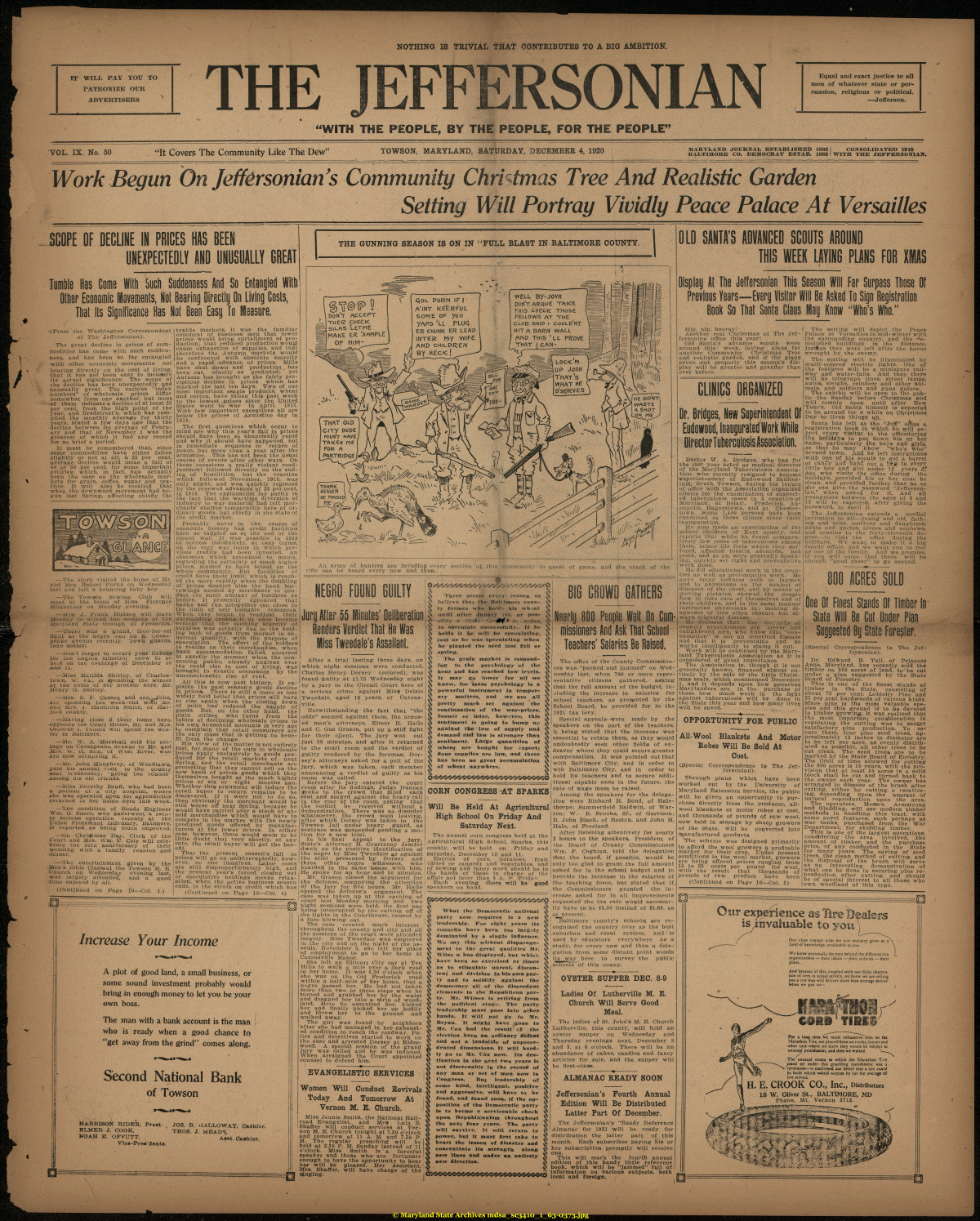
THE GUNNING SEASON IS ON IN "PULL BLAST IN BALTIMORE COUNTY.
(From the "Washington Correspondent of The Jeffersonian). The great decline in prices of commodities has come with such sudden-
.ness, and has been so far entangled with other economic movements not bearing directly on the cost of living, that it has not been easy to measiure its actual significance. The scope of the decline has been unexpectedly and unusually great. The various "index numbers" of wholesale prices differ somewhat from one another, but most of them indicate a decline of at least 25 per cent, from the high point of the year, and Bradstreet's, which has compiled the monthly average for thirty years, stated a few days ago that the
-decline between its average of February and that of November 1 was the greatest of which it had any record for so brief a period.
It must be remembered that, since some commodities have either fallen slightly or not at all, a 25 per cent, average decline would mean a fall of 40 or 50 per cent, for some important articles; which, in fact, has. actually been the case on the wholesale markets for grain, coffee, sugar and textiles. It will also be recalled that when the downward movement had begun last Spring, affecting chiefly the
¦—The stork visited the home of Mr, . and Mrs. Robert ' Parks on Wednesday last and left a bouncing baby boy.
—The' Towsjon Sewing Club will meet at the home of Miss Florence Hiigartner on Monday evening.
-—Mrs. J. Frank Hudson will leave Monday to attend tne sessions of tne Maryland State Grange, at .fredericK.
—There was a grand, free-for-all fig.it at the negro aau on E. Cnesa-peake avenue recently. Town guards, take notice!
—Don't forget to secure your tickets for tne i_.egion minstrel snow to ue heid on tne evenings of December 10 and If.
—-Miss Matilda Shirley, of Charles-town, W. Va., is spending the winter at tne nome of her Drotner here, Mr. Henry G. Sniriey.
—Mrs. S. F. Cassen and son, .John, ai e spending tne week-end wixn Mr. ana Mrs. j. Hamilton Smitn, of Harford county.
—Having close d their home here, opposite tne Court House, Mr. and Mrs. Osoorne i. ieiiott will spend tne winter in Baltmore.
—Mr. W. A. -Marshall, sold his cottage on Chesapeake avenue to Mr. and .Mrs. W. H, yu4, of West River, who .are now occupying it.
—Mr. John Hunphrey, of Woodlawn, paid nis annual visit to the county seat Wednesday, •going tne rounds' ..among nis olu iriends.
—Miss Dorothy Bruff, who had been a patient at a city nospital, wnere .she was operated upojj for appendicitis returned to her home here tnis week.
—The condition of Roads Engineer Wm. G. Sucro, wno underwent a ratn-er serious operation reeenty at the Union Protestant Infirmary, Batimore, is reported as being mucn improved.
—On Christmas Day, Clerk of the Court and Mrs. Wm. P. Cole will celebrate tne isotn anniversary of tneir wedding with a family reunion and dinner.
—The entertainment given by the Men's Bible Class, at the Towson M. E. Cnurch on Wednesday evening last, was largely attended, and a good time enjoyed by all.
(Continued on Page 10—Col. 1.)
textile markets, it was the familiar comment of business men that lower prices would bring curtailment of production; that reduced production woubd cause exhaustion of supplies, and that therefore the Autumn markets would be confronted with absolute scarcity and a rapid advance of prices. Mills have shut down and production y has been cut, efactly as predicted: yet Autumn has brought us the fairly precipitous decline in prices which has marked the last ten days. Two of our most important ssaple products, wheat and cotton, have fallen this past week to the lowest prices since the United States went to war in April, 1917. With few important exceptions all are below the prices of Armisjtice day in 1918.
The first questions which occur to mind are why this year's fall in prices should have been so abnormally rapid and why it should have happened, not in immediate sequence to return of peace, but more tnan a year after the armistice. This has not been the usual course of events after other wars. O'n those occasions a really violent readjustment followed directly on the ending of hostilities, but the reaction which followed November, 1918, was only slight, and was quickly replaced by the renewed advances of 25 per cent, in 1919. The explanation lay partly in the fact that the wartime diversion of industry to war material had left merchants' shelves temporarily bare of ordinary goods, but chiefly in the state of the credit market.
Probably never in the course of economic history had credit facilities been so inflated as at the end of the recent war. It was possible in 1919 to borrow indefinitely, at easy terms, on the very war loans in which previous credits had been invested. An obsession which amounted to mania, regarding the certainty of much higher prices, seemed to have seized on the whole community. But facilities of credit have their limit, which is reached the more rapidly when the doubling of prices doubles also the bank borrowings needed by merchants to conduct the same amount of business as before. It presently appeared that banks had run altogether too close to the limit of heir loanable resources. When they began to readjust their outstanding credits, it at once became evident that the seeming scarcity of supplies was actually due to the holding back of goods from market in abnormal quantity, with the purpose of speculation. The effort of the holders to realize on their merchandise, when bank accommodation failed, occurred at exactly the moment when the consuming public, already anxious over the rapid rise in cost of living, was brought to drastic economics by the unconscionable rise of rent.
All this is now past history. It explains the past season's great decline in pricest There is still a more or less widely held belief that prices will have to rise again when the closing down of mills has' reduced the supply of goods. But, on the other hand, the plain citizen who turns from the tables of declining wholesale prices to his own, household accounts is very apt to complain that retail consumers are the only class that is getting no benefit from the change.
His view of the matter is not entirely just,, for many of the cuts in wholesale prices apply exclusively to goods produced for the retail markets of. next Spring, and the retail merchants are protesting that they cannot sell on the new basis of prices goods which they themselves bought at the much higher prices of six or eight months ago. Whether thisj argument will induce the retail buper to return remains to be discovered. If it were not to do so, then obviously the merchant would be still Worse off next Spring, because he would have carried over a stock of unsold merchandise which would have to compete in the market with the newly produced goods offered by manufacturers at the lower prices. In either case, however, there would Seem to be little doubt that very shortly, at any rate, the retail buyer will get the benefit.
That the present season's fall in prices will go on uninterruptedly, however, no one imagines. Labor costs are still disproportionately high, and the present year's forced closing out of speculative holdings means relaxation, when the active business season ends, in the strain on credit which has (Continued on Page 10—Col. 4)
don't accept
THER CHECK SlUAS LETME
make er. Sample
OF HIN)-
OLD SANTA'S ADVANCED SCOUTS AROUND
THIS WEEK LAYING PLANS FOR XMAS
Display At The Jeffersunian This Seasnn Will Far Surpass Thuse Of
Previuus Years—Every Visiter Will Be Asked Tu Sign Registration
Buck Su That Santa Claus May Knew "Who's Who."
Hip, hip, hooray!
Another real Christmas at The Jef-fersonian office thisi year!
Old Santa's advance scouts were around this1 week, laying plans for another Community Christmas Tree and realistic garden, and if the plans prove .out properly this season's display will be greater and grander than ever before.
An army of hunters are invading every section "of, this community rifle can be heard every now and then.
in quest of game, and the crack of the
Increase Your Income
A plot of good land, a small business, or some sound investment probably would bring in enough money to let you be your own boss.
The man with a bank account is the man who is ready when a good chance to "get away from the grind" comes along.
Second National Bank
of Towson
HARRISON RIDER, Prest. ELMER J. COOK, NOAH E. OF PUTT.
Vlee-Pr«»'dent«.
JOS. B. GALLOWAY, Cashier. THOS. J. MEADS,
Aast. Cashier.
NEGRO FOUND GUILTY
Jury After 55 Minnies' Deliberatiun Benders Verdict That He Was Miss Tweedale's Assailant.
After a trial lasting three days, on which night sessions were conducted, Charles Henry Dorsey (colored), was found guilty at 11.15 Wednesday night by a jury in the Circuit Court here of a serious crime against Miss) Delsie Tweedale, aged 16 years, of Catons-ville.
Notwithstanding the fact that "the odds" seemed against them, the accused man's attorneys, Elmer R. Haile and C. Gus Grason, put up a stiff fight for their client. The jury was out just 55 minutes, and after it returned to the court room and the verdict of guilty rendered by the foreman, Dor-sey's attorneys asked for a poll of the jury, which was taken, each member announcing a verdict of guilty as his name was called.
Before the jury entered the court room after its findings, Judge Duncan Efpoke to the crowd that filled each seat and surged against the heavy rail in the rear of the room, asking that the verdict be received without a demonstration. There was no disorder whatsoever, the crowd soon leaving, after which Dorsey was taken to the Towson Jail under heavy guard, as sentence was suspended pending a motion for a new trial.
In his final appeal to the , jury, State's Attorney H. Courtenay Jenifer dwelt on the positive identification of the negro by Miss Tweedale as against the alibi presented by Dorsey and three other negro witnesses, who boarded in the same house with him. He spoke for an hour and 50 minutes.
Mr. Grason closed the argument for the defense, occupying the attention of the jury for five hours. Mr. Haile opened the defense's argument. The case was taken up at the opening of court last Monday morning and two night sessions! were held, the first one being interrupted by the cutting off o'f the lights in the Courthouse, caused by a fuse blowing out.
The case created much interest •throughout the county and city and all the sessions of the court were attended largely. Miss Tweedale was employed in the city and on the night of the assault, November 5, she left her place of employment to go to her home at Catonsville Manor.
She left an Ellicott City car at Ten Hills to walk a mile over a dark road to her home. It was 6.30 o'clock when she was on the Old Frederick road within a half-mile of her home, that a negro passed her. He had not taken more than two or three steps when he turned and grabbed her by the waist and dragged her into a sitrip of woodland. Here he assaulted her, kicked her and finally picked her up bodily and threw her to the ground and walked away.
The girl was found by neighbors after she had managed in her exhausted condition to reach the roadway. Police and detectives started to work on the case and arrested Dorsey at Rider-wood. A special session of the grand jury was called and he was indicted. When arraigned the Court appointed counsel to defend him.
Q ^^^$$^$$=
W$S |