 |
|
|
 |
|
 |
|
|||
|
||||
|
||||
|
Maryland State Archives Jeffersonian, Towson, Maryland mdsa_sc3410_1_63-0426 Enlarge and print image (5M) |
|
|
|
|
|
|
|
|||
|
||||
|
||||
|
Maryland State Archives Jeffersonian, Towson, Maryland mdsa_sc3410_1_63-0426 Enlarge and print image (5M) |
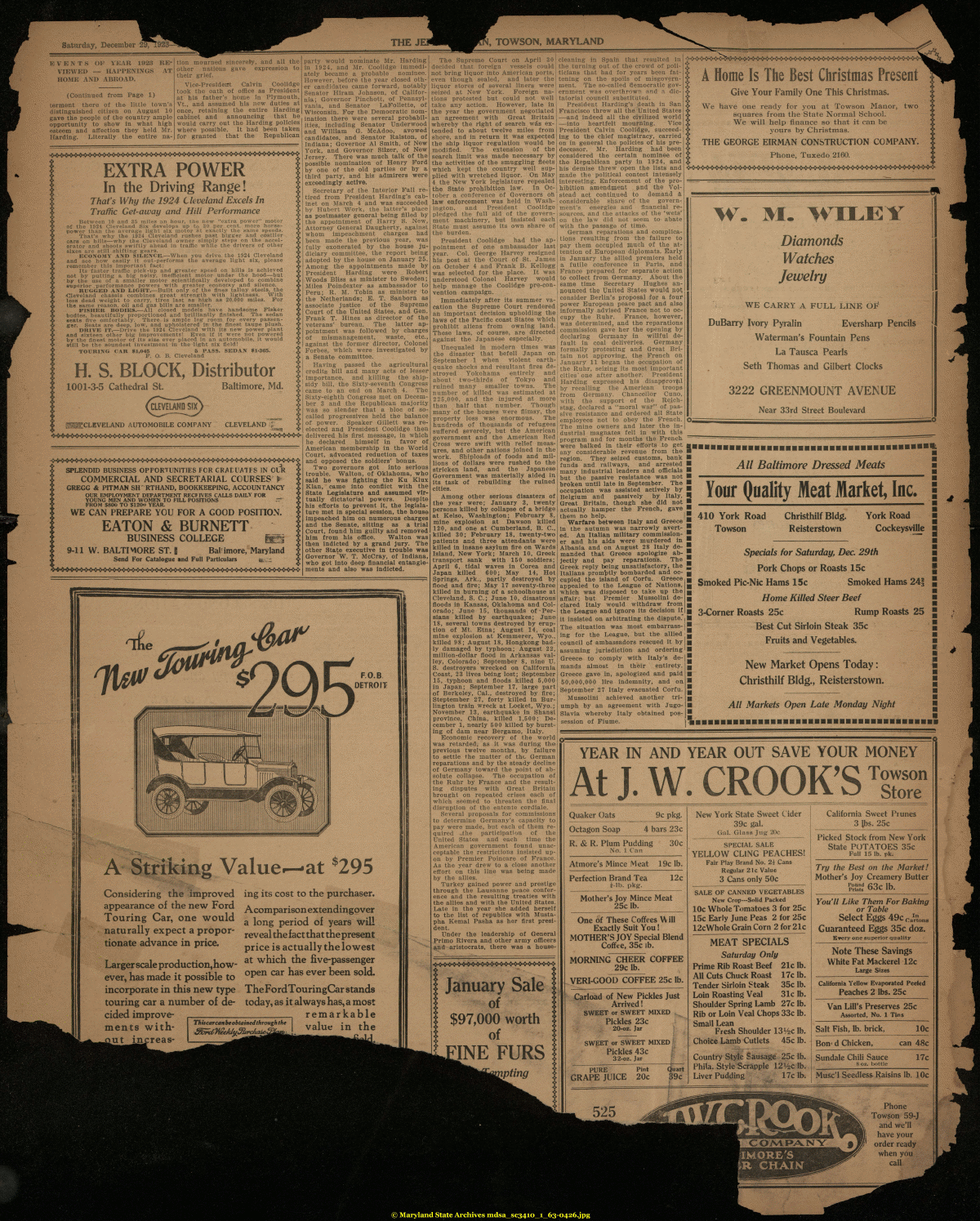
| Saturday, December 297l923-^ THE Jl I, TOWSON, MARYLAND EVENTS OP YEAR 1923 REVIEWED — HAPPENINGS AT HOME AND ABROAD. (Continued from Page 1) terment there of the little town's distinguished citizen on August 10 gave the people of the country ample opportunity to show in what high esteem and affection they held Mr. Harding. Literally the entire na- tion mourned sincerely, and all the other nations gave expression to their grief. Vice-President Calvin Coolidge took the oath of office as President at his father's home in Plymouth, Vt., and assumed his new duties at once, retaining the entire Harding cabinet and announcing that he would carry out the Harding policies where possible. It had been taken for granted that the Republican **?????????*????**??????*??***?*????****?*?***?*??** EXTRA POWER In the Driving Range! That's Why the 1924 Cleveland Excels In Traffic Get-away and Hill Performance Between 10 and 35 miles an hour, the new "extra power" motor of the 1924 Cleveland Six develops up to 30 per cent, more horsepower than the average light six motor at exactly the same speeds. That's why the 1924 Cleveland rushes past bigger and costlier cars on hills—why the Cleveland owner simply steps on the accelerator and shoots swiftly ahead in traffic while the drivers of other sixes are still shifting gears. ECONOMY AND SILENCE.—When you drive the 1924 Cleveland and see how easily it out-performs the average light six, please remember this important fact: Its faster traffic pick-up and greater speed on hills is achieved not by putting a big noisy, inefficient motor under the hood—but by the use of a smaller motor scientifically developed to combine superior performance powers with greater economy and silence. RUGGED AND LIGHT.—Built only of the fines talloy steels, the Cleveland chassis combines great strength with lightness. With less dead weight to carry, tires last as high as 20,000 miles. For the same reason, oil and gas bills are smaller. FISHER BODIES.—All closed models have handsome Fisher bodies, beautifully proportioned and brilliantly finished. The sedan seats five omfortably. There is ample leg room for every passenger. Seats are deep, low, and upholstered in the finest taupe plush. DRIVE IT.—Drive the 1924 Cleveland with its new power plant and sixteen other big improvements! Even if it were not powered by the finest motor of its size ever placed in an automobile, it would still be the soundest investment in the light six field! TOURING CAR $1,045 5 PASS. SEDAN $1-365. F. O. B. Cleveland H. S. BLOCK, Distributor 1001-3-5 Cathedral St. Baltimore, Md. CLEVELAND SIX ^HgCLEVELAND AUTOMOBILE COMPANY CLEVELAND *£ ?{? SPLENDID BUSINESS OPPORTUNITIES FOR CRAEUATFS IN OCR COMMERCIAL AND SECRETARIAL COURSES ?¦¦ | GREGG & PITMAN SH' RTHAND, BOOKKEEPING, ACCOUNTANCY Y OUR EMPLOYMENT DEPARTMENT RECFIVES CALLS DAILY FOR ? YOUNG MEN AND WOMEN TO FILL POSITIONS ST V FROM $800 TO $120» YEAR. WE CAN PREPARE YOU FOR A GOOD POSITION. | EATON & BURNETT I BUSINESS COLLEGE KS I 9-11 W. BALTIMORE ST. 1 Bal imore, Maryland Send For Catalogue and Full Particulars fc££ < ? < ? < ? < ? < ? «> < > 4 > « > party would nominate Mr. Harding in 1924, and Mr. Coolidge immediately became a probable nominee. However, before the year closed other candidates came forward, notably Senator Hiram Johnson, of California; Governor Pinchott, of Pennsylvania, and Senator LaFollette, of Wisconsin. For the Democratic nomination there were several probabilities, including Senator Underwood and William G. McAdoo, avowed candidates, and Senator Ralston, of Indiana; Governor Al Smith, of New York, and Governor Silzer, of New Jersey. There was much talk of the possible nomination of Henry Ford by one of the old parties or by a third party, and his admirers were exceedingly active. Secretary of the Interior Fall retired from President Harding's cabinet on March 4 and was succeeded by Hubert Work, the latter's place as postmaster general being filled by the appointment of Harry S. New, Attorney General Daugherty, against whom impeachment charges had been made the previous year, was fully exonerated by the house judiciary committee, the report being adopted by the house on January 25. Among the appointments made by President Harding were Robert Woods Bliss as minister to Sweden; Miles Poindexter as ambassador to Peru; R. M. Tobin as minister to the Netherlands; E. T. Sanborn as associate justice of the Supreme Court of the United States, and Gen. Frank T. Hines as director of the veterans' bureau. The latter appointment was followed by charges of mismanagement, waste, etc., against the former director, Colonel Forbes, which were investigated by a Senate committee. Having passed the agricultural credits bill and many acts of lesser importance, and killing the ship-sidy bill, the Sixty-seventh Congress came to an end on March 4. The Sixty-eighth Congress met on December 3 and the Republican majority was so slender that a bloc of so-called progressives held the balance of power. Speaker Gillett was reelected and President Coolidge then delivered his first message, in which he declared himself in favor of American membership in the World Court, advocated reduction of taxes and opposed the soldiers' bonus. Two governors got into serious trouble. Walton, of Oklahoma, who said he was fighting the Ku Klux Klan, came into conflict with the State Legislature and assumed virtually dictatorial powers. Despite his efforts to prevent it, the legislature met in special session, the house impeached him on numerous charges and the Senate, sitting as a trial Court, found him guilty and removed him from his office. Walton was then indicted by a grand jury. The other State executive in trouble was Governor W. T. McCray, of Indiana, who got into deep financial entanglements and also was indicted. =il F.O.B DETROIT A Striking Value—at $295 Considering the improved ing its cost to the purchaser. appearance of the new Ford Acomparisonextendingover Touring Car, one would a long period of year§ wiU naturally expect a propor- reveal the fact that the present tionate advance in price. prke fa actually the lowegt Larger scale production,how- at which the five-passenger ever, has made it possible to °Pen car has ever been solA incorporate in this new type TheFordTouringCar stands touring car a number of de- today, as it always has, a most cided improve- t__ remarkable value in the ments with-LUt increas- Thiscarcanbeobtainedthrough the Jta&el The Supreme Court on April 30 decided that foreign vessels could not bring liquor into American ports, even though sealed, and later the liquor stores of several liners were seized at New York. Foreign nations protested but could not well take any action. However, late in the year the government negotiated an agreement with Great Britain whereby the right of search w£s extended to about twelve miles from shore, and in return it was expected the ship liquor regulation would be modified. The extension of the search limit was made necessary by the activities of the smuggling fleets which kept the country well supplied with wretched liquor. On May 4 the New York legislature repealed the State prohibition law. In October a conference of Governors on law enforcement was held in Washington, and President Coolidge pledged the full aid of the government machinery, but insisted each State must assume its own share of the burden. President Coolidge had the appointment of one ambassador last year. Col. George Harvey resigned his post at the Court of St. James on October 4 and Frank B. Kellogg was selected for the place. It was understood Colonel Harvey would help manage the Coolidge pre-con-vention campaign. Immediately after its summer vacation the Supreme Court rendered an important decision upholding the laws of the Pacific coast States which prohibit aliens from owning land. These laws, of course, are directed against the Japanese especially. Unequaled in modern times was the disaster that befell Japan on September 1 when violent earthquake shocks and resultant fires destroyed Yokohama entirely and about ¦ two-thirds of Tokyo and ruined many smaller towns. The number of killed was estimated at 225,000, and the injured at more than half that number. Though many of the houses were flimsy, the property loss was enormous. The hundreds of thousands of refugees suffered severely, but the American government and the American Red Cross were swift with relief measures, and other nations joined in the work. Shiploads of foods and millions of dollars were rushed to the stricken land, and the Japanese Government was materially aided in its task of rebuilding the ruined cities. Among other serious disasters of the year were; January 3, twenty persons killed by collapse of a bridge at Kelso, Washington; February 8, mine explosion at Dawson killed 120, and one at Cumberland, B. C, killed 30; February 18, twenty-two patients and three attendants were killed in insane asylum fire on Wards Island, New York; March 10, Greek transport sank with 150 soldiers; April 6, tidal waves in Corea and Japan killed 600; May 14, Hot Springs, Ark., partly destroyed by flood and fire; May 17 seventy-three killed in burning of a schoolhouse at Cleveland, S. C; June 10, disastrous floods in Kansas, Oklahoma and Colorado; June 15, thousands of-Persians killed by earthquakes; June 18, several towns destroyed by eruption of Mt. Etna; August 14, coal mine explosion at Kemmerer, Wyo., killed 98; August 18, Hongkong badly damaged by typhoon; August 22, million-dollar flood in Arkansas valley, Colorado; September 8, nine U. S. destroyers wrecked on California Coast, 23 lives being lost; September 15, typhoon and floods killed 5,000 in Japan; September 17, large part of Berkeley, Cal., destroyed by fire; Steptember 27, forty killed In Burlington train wreck at Locket, Wyo.; November 13, earthquake in Shansi province, China, killed 1,500; December 1, nearly 500 killed by bursting of dam near Bergamo, Italy. Economic recovery of the world was retarded, as it was during the previous twelve months, by failure to settle the matter of the German reparations and by the steady decline of Germany toward the point of absolute collapse. The occupation of the Ruhr by France and the resulting disputes with Great Britain brought on repeated crises each of which seemed to threaten the final disruption of the entente cordiale. Several proposals for commissions to determine Germany's capacity to pay were made, but each of them required .the participation of the United States and each time the American government found unacceptable the restrictions insisted upon by Premier Poincare of France. As the year drew to a close another effort on this line was being made by the allies. Turkey gained power and prestige through the Lausanne peace conference and the resulting treaties with the allies and with the United States. Late in the year she added herself to the list of republics with Musta-pha Kemal Pasha as her first president. Under the leadership of General Primo Rivera and other army officers and aristocrats, there was a house- ^•?«"^&***4****K~K«*«***«*« January Sale of $97,000 worth of iNE FURS ipting cleaning in Spain that resulted in the turning out of the crowd of politicians that had for years been fattening on the spoils of misgovern-ment. The so-called democratic government was overthrown and a dictatorial council substituted. President Harding's death in San Francisco threw all the United States —and indeed all the civilized world —into heartfelt mourning. Vice President Calvin Coolidge, succeeding to the chief magistracy, carried on in general the policies of his predecessor. Mr. Harding had been considered the certain nominee of the Republican party in 1924, and his demise threw open the lists and made the political contest intensely interesting. Enforcement of the prohibition amendment and the Volstead act continued to demand a considerable share of the government's energies and financial resources, and the attacks of the 'wets' on the law did not seem to abate with the passage of time. German reparations and complications resulting from the failure to pay them occupied much of the attention of European diplomats. Early in January the allied premiers held a futile conference in Paris, and France prepared for separate action to collect from Germany. About the same time Secretary Hughes an-j nounced the United States would not consider Berlin's proposal for a four power European peace pact and also informally advised France not to occupy the Ruhr. France, however, was determined, and the reparations commission gave her the opening by declaring Germany in willful default in coal deliveries. Germany formally protesting and Great Britain not approving, the French on January 11 began the occupation of the Ruhr, seizing its most important cities" one after another. President Harding expressed! his disapproval by recalling the American troops from Germany. Chancellor Cuno, with the support of the Reichstag, declared a "moral war" of passive resistance and ordered all State employees not to obey the French. The mine owners and later the industrial magnates fell in with this program and for months the French were balked in their efforts to get any considerable revenue from the region. They seized customs, bank funds and railways, and arrested many industrial leaders and officials but the passive resistance was not broken until late in September. The occupation was assisted actively by Belgium and passively by Italy. Great Britain, though she did not actually hamper the French, gave them no help. Warfare between Italy and Greece in the autumn was narrowly averted. An Italian military commissioner and his aids were murdered in Albania and on August 28 Italy demanded that Greece apologize abjectly and pay reparations. The Greek reply being unsatisfactory, the Italians promptly bombarded and occupied the island of Corfu. Greece appealed to the League of Nations, which was disposed to take up the affair; but Premier Mussolini declared Italy would withdraw from the League and ignore its decision if it insisted on arbitrating the dispute. | The situation was most embarrass-j ing for the League, but the allied council of ambassadors rescued it by assuming jurisdiction and ordering' Greece to comply with Italy's demands almost in their entirety. Greece gave in, apologized and paid 50,000,000 lire indemnity, and on September 27 Italy evacuated Corfu. Mussolini achieved another triumph by an agreement with Jugoslavia whereby Italy obtained possession of Fiume. c~k*:~>£^^ A Home Is The Best Christmas Present ? % Give Your Family One This Christmas. f We have one ready for you at Towson Manor, two ? squares from the State Normal School. We will help finance so that it can be % yours by Christmas. v THE GEORGE EIRMAN CONSTRUCTION COMPANY. | Phone, Tuxedo 2160. | ^- W. M. WILEY Diamonds Watches Jewelry WE CARRY A FULL LINK OF DuBarry Ivory Pyralin Eversharp Pencils Waterman's Fountain Pens La Tausca Pearls Seth Thomas and Gilbert Clocks 3222 GREENMOUNT AVENUE Near 33rd Street Boulevard o. iG ill All Baltimore Dressed Meats Your Quality Meat Market, Inc. 410 York Road Towson Christhilf Bldg. Reisterstown York Road Cockeysville Specials for Saturday, Dec. 29th Pork Chops or Roasts 15c Smoked Pic-Nic Hams 15c Smoked Hams 24§ Home Killed Steer Beef 3-Corner Roasts 25c Rump Roasts 25 Best Cut Sirloin Steak 35c Fruits and Vegetables. New Market Opens Today: Christhilf Bldg., Reisterstown. All Markets Open Late Monday Night l YEAR IN AND YEAR OUT SAVE YOUR MONEY Towson Store At J. W. CROOK'S Quaker Oats 9c pkg. Octagon Soap 4 bars 23c R. & R. Plum Pudding 30c No. 1 Can Atmore's Mince Meat 19c lb. Perfection Brand Tea 12c i-lb. pkg-. Mother's Joy Mince Meat ________25c lb. One of These Coffees Will Exactly Suit You! MOTHER'S JOY Special Blend Coffee, 35c lb. MORNING CHEER COFFEE 29c lb. VERI-GOOD COFFEE 25c lb. Carload of New Pickles Just Arrived! SWEET or SWEET MIXED Pickles 23c 20-oz. Jar SWEET or SWEET MIXED ' Pickles 43c 32-oz. Jar PURE Pint Quart GRAPE JUICE 20c 39c New York State Sweet Cider 39c gal. Gal. Glass Jug- 20c SPECIAL SALE YELLOW CLING PEACHES! Fair Play Brand No. 2i Cans Regular 21c Value 3 Cans only 50c SALE OF CANNED VEGETABLES New Crop—Solid Packed 10c Whole Tomatoes 3 for 25c 15c Early June Peas 2 for 25c 12cWhole Grain Corn 2 for 21c MEAT SPECIALS Saturday Only Prime Rib Roast Beef 21c lb. All Cuts Chuck Roast 17c lb. Tender Sirloin Steak 35c lb. Loin Roasting Veal 31c lb. Shoulder Spring Lamb 27c lb. Rib or Loin Veal Chops 33c lb. Small Lean Fresh Shoulder 13y2c lb. Choice Lamb Cutlets 45c lb. Country Style Sausage 25c lb. Phila. Style Scrapple 12V2c lb. Liver Pudding 17c lb. California Sweet Prunes _________3 tbs. 25c_________ Picked Stock from New York State POTATOES 35c Full 15 lb. pk. Try the Best on the Market! Mother's Joy Creamery Butter P°ra63clb._____ You'll Like Them For Baking or Table Select Eggs 49c cX. Guaranteed Eggs 35c doz. Every one superior quality Note These Savings White Fat Mackerel 12c Large Sizes California Yellow Evaporated Peeled Peaches 2 lbs. 25c Van Lill's Preserves 25c Assorted, No. 1 Tins Salt Fish, lb. brick, 10c Bon* d Chicken, can 48c Sundale Chili Sauce 8 oz. bottle 17c Musc'l Seedless Raisins lb. 10c 525 **tr£Qo COMPANY IMORE'S IR CHAIN Phone Towson 59-J and we'll have your %W order ready W when you call |