|
PnuMml
eosrs
LIFE MM/SMMNT MORE
CERTIAN MP SCIENTIFIC PUNISHMENT
^K K]M»g[°$
BY - LOQIE BONNETT -
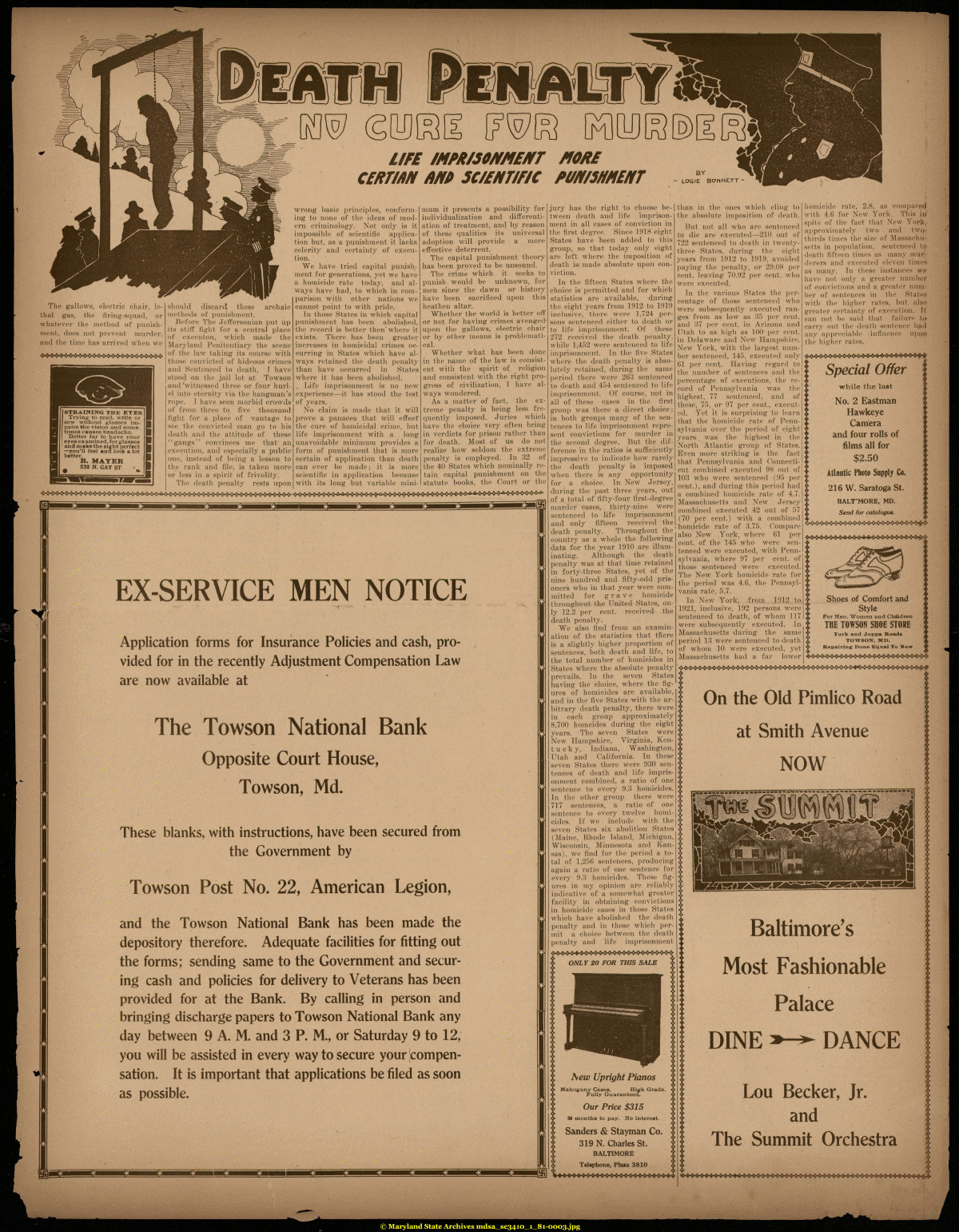
The gallows, electric chair, lethal gas, the firing-squad, or whatever the method of punishment, does not prevent, murder, and the time has arrived when we
STRAINING THE KTES Trying to read, write or sew without glasses impairs the vision and sometimes causes headache.
Better far to have your eyes examined, for glasses and make the sight perfect —you'll feel and look a lot better.
B. MAYER 532 N. GAY ST
should discard! these archaic methods of punishment.
Bef ore The Jeffersonian put up its stiff fight for a central place of executon, which made the Maryland Penitentiary the scene of the law taking its course with those convicted of hideous crimes and Sentenced to death, I have stood on the jail lot at Towson and'witnessed three or four hurl-el into eternity via the hangman's rope. I have seen morbid crowds of from three to five thousand fight for a place of vantage to see the convicted man go to his death and the attitude of these "gangs" convinces me that an execution, and especially a public one, instead of being a lesson to the rank and file, is taken more or less in a spirit of frivolity.
The death penalty rests upon
wrong basic principles, conforming to none of the ideas of modern criminology. Not only is it impossible of scientific application but, as a punishment it lacks celerity and certainty of execution.
We have tried capital punishment for generations, yet we have a homicide rate today, and always have had, to which in comparison with other nations we cannot point to with pride.
In those States in which capital punishment has been abolished, the record is better then'where it exists. There has been greater increases in homicidal crimes occurring in States which have always retained the death penalty than have occurred in States where it has been abolished. , Life imprisonment is no new experience—it has stood the test of years.
No claim is made that it will prove a panacea that will effect the cure of homicidal crime, but life imprisonment with a long unavoidable minimum provides a form of punishment that is more certain of application than death can ever be made; it is more scientific in application because with its long but variable mini-
mum it presents a possibility for individualization and differentiation of treatment, and by reason of these qualities its universal adoption will provide a more effective deterrent.
The capital punishment theory has been proved to be unsound.
The crime which it seeks to punish would be unknown, for men since the dawn or history have been sacrificed upon this heathen altar.
Whether the world is better off or hot for having crimes avenged upon the gallows, electric chair or by other means is problematical.
Whether what has been done in the name of the law is consistent with the spirit of religion and consistent with the right progress of civilization, 1 have always wondered.
As a matter of fact, the extreme penalty is being less frequently imposed. Juries which have the choice very often bring in verdicts for prison rather than for death. Most of us do not realize how seldom the extreme penalty is employed. In 32 of the 40 States which nominally retain capital punishment on the statute books, the Court or the
*x^
m
EX-SERVICE MEN NOTICE
Application forms for Insurance Policies and cash, provided for in the recently Adjustment Compensation Law are now available at
The Towson National Bank
Opposite Court House, Towson, Md.
These blanks, with instructions, have been secured from
the Government by
Towson Post No. 22, American Legion,
and the Towson National Bank has been made the depository therefore. Adequate facilities for fitting out the forms; sending same to the Government and securing cash and policies for delivery to Veterans has been provided for at the Bank. By calling in person and bringing discharge papers to Towson National Bank any day between 9 A. M. and 3 P. M., or Saturday 9 to 12, you will be assisted in every way to secure your jcompen-sation. It is important that applications be filed as soon as possible.
jury has the right to choose between death and life imprisonment in all eases of conviction in the first degree. Since 1918 eight States have been added to this group, so that today only eight are left where the imposition of death is< made absolute upon conviction.
In the fifteen States where the choice is permitted and for which statistics are available, during the eight years from 1912 to 1919 inclusive, there were 1,724 persons sentenced either to death or to life imprisonment. Of these 272 received the death penalty, while 1,452 were sentenced to life imprisonment. In the five States where the death penalty is absolutely retained, during the same period there were 263 sentenced to death and 454 sentenced to life imprisonment. Of course, not in all of these cases in the first group was there a direct choice; in both groups many of the sentences to life imprisonment represent convictions for murder in the second degree. But the difference in the ratios is sufficiently impressive to indicate how rarely the death penalty is imposed when there is any opportunity for a choice. In New Jersey, during the past three years, out of a total of fifty-four first-degree murder cases, thirty-nine were sentenced to life imprisonment and only fifteen received the death penalty. Throughout the country as a whole the following data for the year 1910 are illuminating. Although the death penalty was at that time retained in forty-three States, yet of the nine hundred and fifty-odd prisoners who in that year were committed for grave homicide throughout the United States, only 12.2 per cent, received the death penalty.
We also find from an examination of the statistics that there is a slightly higher proportion of sentences, both death and life, to the total number of homicides in States where the absolute penalty prevails. In the seven States having the choice, where the figures of homicides are available, and in the five States with the arbitrary death penalty, there were in each group approximately 8,700 homcides during the eight years. The seven States were New Hampshire, Virginia, Ken-t u c k y, Indiana, Washington, Utah and California. In these seven States there were 930 sentences of death and life imprisonment combined, a ratio of one sentence to every 9.3 homicides. In the other group there were 717 sentences, a ratio of one sentence to every twelve homicides. If we include with the seven States six abolition States (Maine, Rhode Island, Michigan, Wisconsin, Minnesota and Kansas), we find for the period a total of 1,256 sentences, producing again a ratio of one sentence for every 9.3 homicides. These figures in my opinion are reliably indicative of a somewhat greater facility in obtaining convictions in homicide cases in those States which have abolished the death penalty and in those which permit a choice between the death penalty and life imprisonment
ONLY 20 FOR THIS SALE
than in the ones which cling to the absolute imposition of death.
But not all who are sentenced to die are executed—210 out of 722 sentenced to death in twenty-three States, during the eight years from 1912 to 1919, avoided paying the penalty, or 29.08 per cent, leaving 70.92 per cent, who were executed.
In the various States the percentage of those sentenced who were subsequently executed ranges from as low as 35 per cent. and 37 per cent, in Arizona and Utah to as high as 100 per cent, in Delaware and New Hampshire. New York, with the largest number sentenced, 145, executed only 61 per cent. Having regard to the number of sentences and the percentage of executions, the record of Pennsylvania was the highest, 77 sentenced, and of these, 75, or 97 per cent., executed. Yet it is surprising to learn that the homicide rate of Pennsylvania over the period of eight-years was the highest in the North Atlantic group of States. Even more striking is the fact that Pennsylvania and Connecticut combined executed 98 out of 103 who were sentenced (95 per cent.), and during this period had a combined homicide rate of 4.7. Massachusetts and New Jersey combined executed 42 out of 57 (70 per cent.) with a combined homicide rate of 3.75. Compare also New York, where 61 per cent, of the 145 who were sentenced were executed, with Pennsylvania, where 97 per cent, of those sentenced were executed. The New York homicide rate for the period was 4.6, the Pennsylvania rate, 5.7.
In New York, from 1912 to 1921, inclusive, 192 persons were sentenced to death, of whom 117 were subsequently executed. In Massachusetts during the same period 13 were sentenced to death of whom 10 were executed, yet Massachusetts had a far lower
homicide rate, 2.8, as compared with 4.6 for New York. This \n spite of the fact that New York, approximately two and two-thirds times the size of Massachusetts in population, sentenced to death fifteen times as many mur derers and executed eleven times as many. In these instances we have not only a greater number of convictions and a greater number of sentences in the States with the higher rates, but also greater certainty of execution. It can not be said that failure 1<> carry out the death sentence liad any appreciable influence upon the higher rates.
Special Offer
while the last
No. 2 Eastman
$ Hawkeye
Camera
and four rolls of
films all for
$2.50
Atlantic Photo Supply Co.
216 W.Saratoga St.
BALT'MORE, MD. Send for catalogue.
4t
,,
Shoes of Comfort and Style
X For Men, Women and Children
I THE TOWSON SHOE STORE
y York and Joppa Roads
X TOWSON, MD.
V Repairing: Done Kauai To New
^????^^?^???^?^?????????^??^^^^????MHy
New Upright Pianos
Mahogany Cases, Higvh Grade,
Fully Guaranteed.
Our Price $315
39 months to pay. No interest.
Sanders & Stayman Co. 319 N. Charles St.
BALTIMORE Telephone, Plata 3810
On the Old Pimlico Road
at Smith Avenue
NOW
Baltimore's Most Fashionable
%
Palace
DINE
DANCE
i
I
1
I I
y
% I
V ?
Lou Becker, Jr.
and
The Summit Orchestra
|