 |
|
|
 |
|
 |
|
|||
|
||||
|
||||
|
Maryland State Archives Jeffersonian, Towson, Maryland mdsa_sc3410_1_81-0075 Enlarge and print image (6M) |
|
|
|
|
|
|
|
|||
|
||||
|
||||
|
Maryland State Archives Jeffersonian, Towson, Maryland mdsa_sc3410_1_81-0075 Enlarge and print image (6M) |
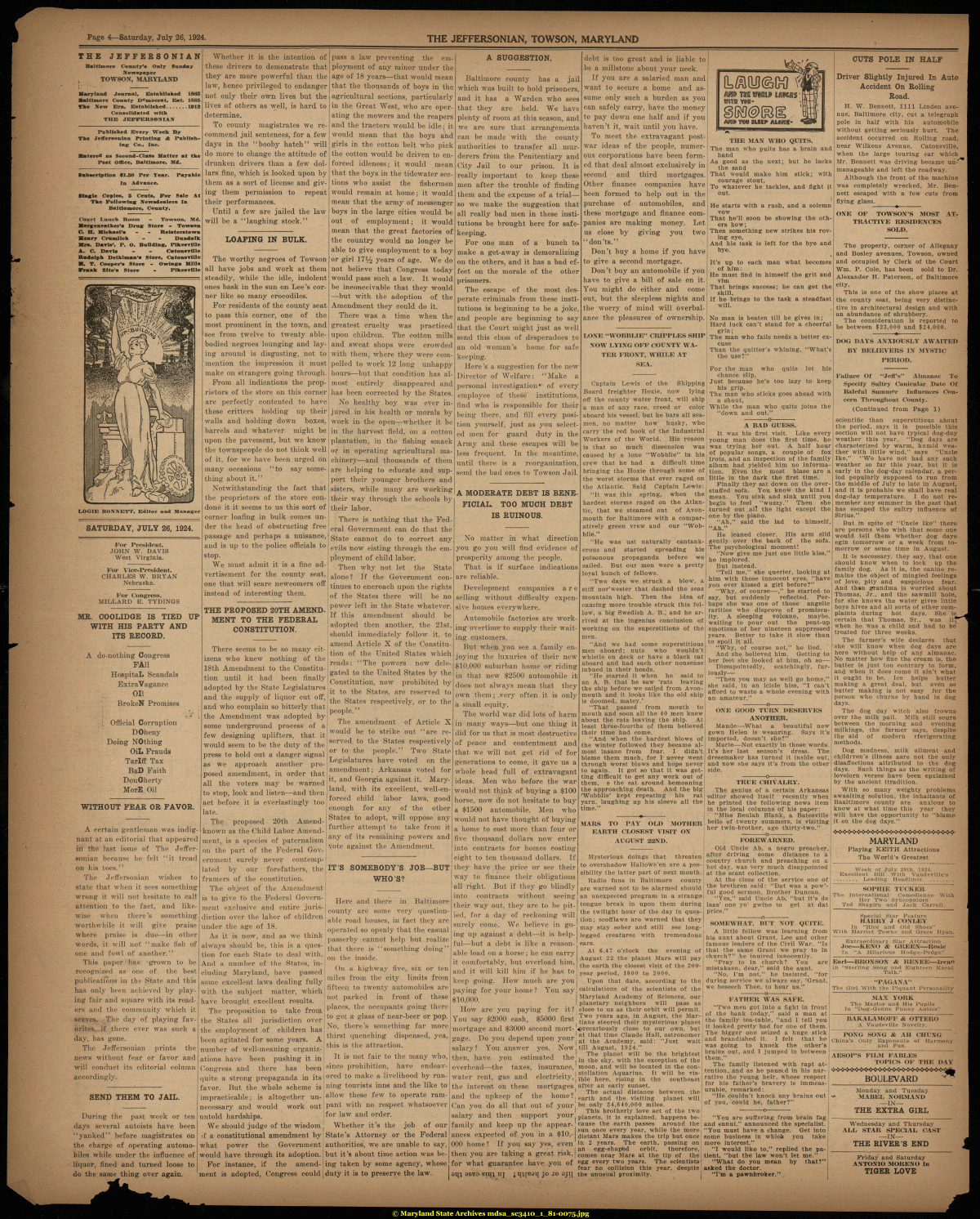
| Page 4^-Saturday, July 26, 1924. THE JEFFERSONIAN, TOWSON, MARYLAND THE JEFFERSONIAN Baltimore County's Only Sunday Newspaper TOWSON, MARYLAND Maryland Journal, Established 1865 Baltimore County Democrat, E*t. 1885 The New Bra, Established.......191S Consolidated with THE JEFFERSONIAN Published Every Week By The Jeffersonlan Printing & Publishing Co., Inc. itered as Second-Class Blatter at the Post Office, Baltimore, Md. ¦¦ascription $1.50 Per Tear. In Advance. Payable Siaa-Ie Copies, 5 Cents, For Sale At The Following? Newsdealers In Baltlomore, County. Court Lunch Room - Towson, Md. ¦erarenrather's Drug; Store - Towson C. H. Michael'* - - Relsterstown Henry Crumllch - - Dundalk Mrs. Darts', P. O. Building, Pihesvllle A. C. Davis - - Catonsville Rudolph Delhlman'a Store, Catonsville M. T. Cooper's Store - Owing* Mills Zlto's Store - Pihesvllle LOGIE BONNETT, Editor and Manager SATURDAY, JULY 26, 1924. For President. JOHN W. DAVIS West Virginia. For Vice-President. CHARLES W. BRYAN Nebraska. For Congress. MILLARD E. TYDINGS MR. COOLIDGE IS TIED UP WITH HIS PARTY AND ITS RECORD. A do-nothing Congress FA11 HofepitaL Scandals ExtraVagance Oil BrokeN Promises Official Corruption DOheny Doing NOthing OiL Frauds Tariff Tax BaD Faith DouGherty MorE Oil WITHOUT FEAR OR FAVOR. A certain gentleman was indignant at an editorial that appeared in the last issue of The Jeffer-sonian because he felt "it tread on his toes." The Jeffersonlan wishes to state that when it sees something wrong it will not hesitate to call attention to the fact, and likewise when there's something worthwhile it Avill give praise where praise is due—in other words, it will not "make fish of one and fowl of another." This paper has grown to be recognized as one of the best publications in the State and this has only been achieved by playing fair and square with its readers and the community which it serves. The day of playing favorites, if there ever was such a day, has gone. The Jeffersonian prints the news without fear or favor and will conduct its editorial column accordingly. Whether it is the intention of these drivers to demonstrate that they are more powerful than the law, hence privileged to endanger not only their own lives but the lives of others as well, is hard to determine. To county magistrates we recommend jail sentences, for a few days in the "booby hatch" will do more to change the attitude of drunken drivers than a few dollars fine, which is looked upon by them as a sort of license and giving them permission to repeat their performances. Until a few are jailed the law will be a "laughing stock." LOAFING IN BULK. The worthy negroes of Towson all have jobs and work at them steadily, while the idle, indolent ones bask in the sun on Lee's corner like so many crocodiles. For residents of the county seat to pass this corner, one of the most prominent in the town, and see from twelve to twenty able-bodied negroes lounging and laying around is disgusting, not to mention the impression it must make on strangers going through. From all indications the proprietors of the store on this corner are perfectly contented to have these critters holding up their walls and holding down boxes, barrels and whatever might be upon the pavement, but we know the townspeople do not think well of it, for we have been urged on many occasions "to say something about it." Notwithstanding the fact that the proprietors of the store condone it it seems to us this sort of corner loafing in bulk comes under the head of obstructing free passage and perhaps a nuisance, and is up to the police officials to stop. We must admit it is a fine advertisement for the county seat, one that will scare newcomers off instead of interesting them. THE PROPOSED 20TH AMENDMENT TO THE FEDERAL CONSTITUTION. SEND THEM TO JAIL. During the past week or ten days several autoists have been "yanked" before magistrates on the charge of operating automobiles while under the influence of liquor, fined and turned loose to do the same thing over again. There seems to be so many citizens who knew nothing of the 18th Amendment to the Constitution until it had been finally adopted by the State Legislatures and the supply of liquor cut off, and who complain so bitterly that the Amendment was adopted by some underground process of a few designing uplifters, that it would seem to be the duty of the press to hold out a danger signal as we approach another proposed amendment, in order that all the voters may be Avarned to stop, look and listen—and then act before it is everlastingly too late. The proposed 20th Amend-known as the Child Labor Amendment, is a species of paternalism on the part of the Federal Government surely never contemplated by our forefathers, the framers of the constitution. The object of the Amendment is to give to the Federal Government exclusive and entire jurisdiction over the labor of children under the age of 18. As it is now, and as we think always should be, this is a question for each State to deal with. Ami a number of the States, including Maryland, have passed some excellent laws dealing fully with the subject matter, which have brought excellent results. The proposition to take from the States all jurisdiction over the employment of children has been agitated for some years. A number of well-meaning organizations have been pushing it in Congress and there has been quite a strong propaganda in its favor. But the whole scheme is impracticable; is altogether unnecessary and would work out untold hardships. We should judge of the wisdom pass a law preventing the employment of any minor under the age of 18 years—that would mean that the thousands of boys in the agricultural sections, particularly in the Great West, who are operating the mowers and the reapers and the tractors would be idle; it would mean that the boys and girls in the cotton belt who pick the cotton would be driven to enforced idleness; it would mean that the boys in the tidewater sections who assist the fishermen would remain at home; it would mean that the army of messenger boys in the large cities would be out of employment; it would mean that the great factories of the country would no longer be able to give employment to a boy or girl liy2 years of age. We do not believe that Congress today would pass such a law. It would be inconceivable that they would —but with the adoption of the Amendment they could do it. There was a time when the greatest cruelty was practiced upon children. The cotton mills and sweat shops were crowded with them, where they were compelled to work 12 long unhappy hours—but that condition has almost entirely disappeared and has been corrected by the States. No healthy boy was ever injured in his health or morals by work in the open—whether it be in the harvest field, on a cotton plantation, in the fishing smack or in operating agricultural machinery—and thousands of them are helping to educate and support their younger brothers and sisters, while many are working their way through the schools by their labor. There is nothing that the Federal Government can do that the State cannot do to correct any evils now eisting through the employment of child labor. Then why not let the State alone? If the Government continues to encroach upon the rights of the States there will be no power left in the State whatever. If this amendment should be adopted then another, the 21st, should immediately follow it, to amend Article X of the Constitution of the United States which reads: "The powers now delegated to the United States by the Constitution, now prohibited by it to the States, are reserved to the States respectively, or to the people." The amendment of Article X would be to strike out "are reserved to the States respectively or to the people." Two State Legislatures have voted on the amendment; Arkansas voted for it, and Georgia against it. Maryland, with its excellent, well-enforced child labor laws, good enough for any of the other States to adopt, will oppose any further attempt to take from it any of its remaining powers and vote against the Amendment. A SUGGESTION. Baltimore county has a jail which was built to hold prisoners, and it has a Warden who sees that they are held. We have plenty of room at this season, and we are sure that arrangements can be made with the county authorities to transfer all murderers from the Penitentiary and City Jail to our prison. It is really important to keep these men after the trouble of finding them and the expense of a trial— so we make the suggestion that all really bad men in these institutions be brought here for safekeeping. For one man of a bunch to, make a get-away is demoralizing on the others, and it has a bad effect on the morale of the other prisoners. The escape of the most desperate criminals from these institutions is beginning to be a joke, and people are beginning to say that the Court might just as well send this class of desperadoes to an old woman's home for safe keeping. Here's a suggestion for the new Director of Welfare : '' Make a personal investigation* of every employee of these institutions, find who is responsible for their being there, and fill every position yourself, just as you selected men for guard duty in the Army and these escapes will be less frequent. In the meantime, until there is a reorganization, send the bad ones to Towson Jail. IT'S SOMEBODY'S WHO'S? JOB—BUT Here and there in Baltimore county are some very questionable road houses, in fact they are operated so openly that the casual passerby cannot help but realize that there is "something doing" on the inside. On a highway five, six or ten miles from the city limits from fifteen to twenty automobiles are not parked in front of these places, the occupants going there to get a glass of near-beer or pop. No, there's something far more thirst quenching dispensed, yea, this is the attraction. It is not fair to the many who, since prohibition, have endeavored to make a livelihood by running tourists inns and the like to allow these few to operate rampant with no respect whatsoever for law and order. A MODERATE DEBT IS BENE FICIAL. TOO MUCH DEBT IS RUINOUS. Whether it's the job of our >f a constitutional amendment by j State's Attorney or the Federal what power the Government j authorities, we are unable to say would have through its adoption. For instance, if the amendment is adopted, Congress could but it's about time action was being taken by some agency, whose duty it is to preserve the law. No matter in what direction you go you will find evidence of prosperity among the people. That is if surface indications are reliable. Development companies are selling without difficulty expensive homes everywhere. Automobile factories are working overtime to supply their Waiting customers. But when you see a family enjoying the luxuries of their new $10,000 suburban home or riding in that new $2500 automobile it does not always mean that they own them; .very often it is only a small equity. The world war did lots of harm in many ways—but one thing it did for us that is most destructive of peace and contentment and that we will not get rid of for generations to come, it gave us a whole head full of extravagant ideas. Men who before the war would not think of buying a $100 horse, now do not hesitate to buy a $1500 automobile. Men who would not have thought of buying a home to cost more than four or five thousand dollars now enter into contracts for homes costing eight to ten thousand dollars. If they have the price or see their way to finance their obligations all right. But if they go blindly into contracts without seeing their way out, they are to be pitied, for a day of reckoning will surely come. We believe in going up against a debt—it is helpful—but a debt is like a reasonable load on a horse; he can carry it comfortably, but overload him, and it will kill him if he has to keep going. How much are you! paying for your home? You sayj $10,000. How are you paying for it? You say $2000 cash, $5000 first; mortgage and $3000 second mort-J gage. Do you depend upon your, salary? You answer yes. Now, then, have you estimated the: overhead—the taxes, insurance, water rent, gas and electricity,! the interest on these mortgages! and the upkeep of the home ?, Can you do all that out of your| salary and then support your, family and keep up the appearances expected of you in a $10,-000 home? If you say yes, even then you are taking a great risk,! for what guarantee have you of ai^ 9ST29 siu;.nj |,trrp?ail jo jo airp debt is too great and is liable to be a millstone about your neck. If you are a salaried man and want to secure a home and assume only sueh a burden as you can safely carry, have the money to pay down one half and if you haven't it, wait until you have. To meet the extravagant postwar ideas of the people, numerous corporations have been formed that deal almost exclusively in second and third mortgages. Other finance companies have been formed to help out in the purchase of automobiles, and these mortgage and finance companies are making money. Let us close by giving you two "don'ts." Don't buy a home if you have to give a second mortgage. Don't buy an automobile if you have to give a bill of sale on it. You might do either and come out, but the sleepless nights and the worry of mind will overbalance the pleasures of ownership. B,$y©irfl\' m® WU SUSP AL0HK gsa—Ift LONE "WOBBLIE" CRIPPLES SHIP NOW LYING OFF COUNTY WATER FRONT, WHILE AT SEA. Captain Lewis of the Shipping Board freighter Hoxie, now lying off the county water front, will ship a man of any race, creed or color aboard his vessel, but he bars all seamen, no matter how husky, who carry the red book of the Industrial Workers of the World. His reason is that so much dissension was caused by a lone "Wobblie" in his crew that he had a difficult time bringing the Hoxie through some of the worst storms that ever raged on the Atlantic. Said Captain Lewis: "It was this spring, when the hardest storms raged on the Atlantic, that we steamed out of Avon-mouth for Baltimore with a comparatively green vrew and our "Wobblie." "He was ust naturally cantankerous and started spreading his poisonous propaganda before we sailed. But our men were a pretty loyal bunch of fellows. "Two days we struck a blow, a stiff nor'wester that dashed the seas mountain high. Then the idea of causing more trouble struck this fellow, a big Swedish A. B., and he arrived at the ingenius conclusion of working on the superstitions of the men. "And we had some superstitious men aboard; nuts who wouldn't whistle on deck or have a black cat aboard and had such other nonsense inbued in their heads. "He started it when he said to an A. B. that he saw 'rats leaving the ship before we sailed from Avon-mouth and it looks like the old ship is doomed, matey.' "That passed from mouth to mouth and soon all the 40 men knew about the rats leaving the ship. At least three-fourths of them believed their time had come. "And when the hardest blows of the winter followed they became almost insane from fear. I didn't blame them much, for I never went through worst blows and hope never to again. It got so that it was getting difficult to get any work out of them, s the sat around bemoaning the approaching death. And the big 'Wobblie' kept repeating his rat yarn, laughing up his sleeve all the time." THE MAN WHO QUITS. The man who puits has a brain and hand As good as the next; but he lacks the sand That would make him stick; with courage stout, To whatever he tackles, and fight it out. He starts with a rush, and a solemn vow That he'll soon be showing the others how; Then something new strikes his roving eye, And his task is left for the bye and bye. It's up to each man what becomes of him: He must find in himself the grit and vim That brings success; he can get the skill, If he brings to the task a steadfast will. No man is beaten till he gives in; Hard luck can't stand for a cheerful grin; The man who fails needs a better excuse Than the quitter's whining, "What's the use?" For the man who quits let his chance slip, Just because he's too lazy to keep his grip. The man who sticks goes ahead with a shout, While the man who quits joins the "down and out." ----------o---------- A BAD GUESS. It was his first visit. Like every young man does the first time, he was trying her out. A half hour of popular songs, a couple of fox trots, and an inspection of the family album had yielded him no information. Even the most blase are a little in the dark the first time. Finally they sat down on the overstuffed sofa. You know the kind I mean. You sink and sink until you begin to feel "wuzzy." Then she turned out all the light except the one by the piano. "Ah," said the lad to himself, "Ah." He leaned closer. His arm slid gently over the back of the sofa. The psychological moment! "Now give me just one little kiss," he implored. But instead. "Tell me," she querier, looking at him with those innocent eyes, "have you ever kissed a girl before?" "Why, of course—," he started to say, but suddenly reflected. Perhaps she was one of those angelic rarities who disprove of promiscuity. A sleeping volcano, maybe, waiting to pour out the pent-up emotions of her nineteen suppressed years. Better to take it slow than to spoil it all. "Why, of course not," he lied. And she believed him. Getting to her feet she looked at him, oh so— Dissapointedly, scatchingly, furiously— "Then you may as well go home," she said, in an icicle hiss, "I can't afford to waste a whole evening with an amateur." CUTS POLE IN HALF Driver Slightly Injured In Auto Accident On Rolling Road. H. W. Bennett, 1111 Linden avenue, Baltimore city, cut a telegraph pole in half with his automobile without getting seriously hurt. The accident occurred on Rolling road, near Wilkens Avenue, Catonsville, when the large touring car which Mr. Bennett was driving became unmanageable and left the roadway. Although the front of the machine was completely wrecked, Mr. Bennett escaped with a few cuts from flying glass. -----------?----------- ONE OF TOWSON'S MOST ATTRACTIVE RESIDENCES SOLD. The property, corner of Allegany and Bosley avenues, Towson, owned and occupied by Clerk of the Court Wm. P. Cole, has been sold to Dr. Alexander H. Paterson, of Baltimore city. This is one of the show places at the county seat, being very distinctive in architectural design and with an abundance of shrubbery. The consideration is reported to be between $23,000 and $24,000. DOG DAYS ANXIOUSLY AWAITED BY BELIEVERS IN MYSTIC PERIOD. MARS TO PAY OLD MOTHER EARTH CLOSEST VISIT ON AUGUST 22ND. Mysterious doings that threaten to overshadow Hallowe'en are a possibility the latter part of next month. Radio fans in Baltimore county are warned not to be alarmed should an unexpected program in a strange tongue break in upon them during the twilight hour of the day in question; scoff laws are warned that they may stay sober and still see long-legged creatures with tremendous ears. At 6.47 o'clock the evening of August 2 2 the planet Mars will pay the earth the closest visit of the 200-year period, 1800 to 2000. Upon that date, according to the calculations of the scientists of the Maryland Academy of Sciences, our planetary neighbors will pass as close to us as their orbit will permit. Two years ago, in August, the Martians steered their mysterious planet precariously close to our own, but at that time Claude Hall, astronomer at the Academy, said: "Just wait till August, 1924." The planet will be the brightest in the sky, with the exception of the moon, and will be located in the constellation Aquarius. It will be visible here, rising in the southeast after an early sunset. The actual distance between the earth and the visiting planet will be only 34,640,000 miles. This brotherly love act of the two j planets, it is explained, happens be-j cause the earth passes around the j sun once every year, while the more, distant Mars makes the trip but once in 2 years. The earth, passing on! an egg-shaped orbit, therefore, j comes near Mars at the tip of the \ egg every two years. The scientists j fear no collision this year, despite the unusual proximity. ONE GOOD TURN DESERVES ANOTHER. Maude—What a beautiful new gown Helen is weaaring. Says it's imported, doesn't she?" Marie—Not exactly in those words. It's her last season's dress. The dressmaker has turned it inside out, and now she says it's from the other side. ----------o---------- TRUE CHIVALRY. The genius of a certain Arkansas editor showed itself recently when he printed the following news item in the local columns of his paper: "Miss Beulah Blank, a Batesville belle of twenty summers, is visiting her twin-brother, age thirty-two." ----------o---------- FOREWARNED. Old Uncle Ab, a negro preacher, after driving some distance to a country church and preaching on a hot day, was very much disappointed at the scant collection. At the close of the service one of the brethren said: "Dat was a pow'-ful good sermon, Brother Duncan. "Yes," said Uncle Ab, "but it's de laas' one yo' gwine to get at dat price." ----------o---------- SOMEWHAT, BUT NOT QUITE. A little fellow was learning from his aunt about Grant, Lee and other famous leaders of the Civil War. "Is that the same Grant we pray to in church?" he inuired innocently. "Pray to in church? You are mistakaen, dear," said the aunt. "No, I'm not," he insisted, "for during service we always say, 'Grant, we beseech Thee, to hear us." ----------o---------- FATHER WAS SAFE. "Two men got into a fight in front of the bank today," said a man at the family tea-table, "and I tell you it looked pretty bad for one of them. The bigger one seized a huge stick and brandished it. I felt that he was going to knock the other's brains out, and I jumped in between them." The family listened with rapt attention, and as he paused in his narrative the young heir, whose respect for his father's bravery is immeasurable, remarked: "He couldn't knock any brains out of you, could he, father?" Failure Of "Jeff's" Almanac To Specify Sultry Canicular Date Of Baleful Summer Influences Concern Throughout County. (Continued from Page 1) scientific than superstitious about the period, says it is possible this section will not have typical dog-day weather this year. "Dog days are characterized by warm, humid weather with little wind," says "Uncle Ike." "We have not had any such weather so far this year, but it is early in the dog-day calendar, a period popularly supposed to run from the middle of July to late in August, and it is probable we shall have real dog-day temperature. I do not remember any summer in the past that has escaped the sultry influence of Sirius." But in spite of "Uncle Ike" there are persons who wish that some one would tell them whether dog days egin tomorrow or a week from tomorrow or some time in August. It is necessary, they say, that one should know when to lock up the family dog. As it is, the canine remains the object of mingled feelings of love, pity and suspicious fear. And then grandma is worried about Thomas, Jr., and the sawmill hole, for she knows the water gives little boys hives and all sorts of other complaints during hot days. She is certain that Thomas, Sr., was il* when he was a child and had to be treated for three weeks. The farmer's wife declares that she will know when dog days are here without help of any almanac. No matter how fine the cream is, the butter is just too contrary to form, and when it does come it ain't what it ought to be. Ice helps butter making a great deal, but even so butter making is not easy for the person who churns by hand in dog days. The dog day witch also frowns over the milk pail. Milk still sours between the morning and evening milkings, the farmer says, despite the aid of modern rferigerating methods. Dog madness, milk ailment and childrren's illness aare not the only disaffections attributed to the dog days. Such things as the writing of lovelorn verses have been epxlained by the ancient ttradition. With so many weighty problems awaaiting solution, the inhaitants of | Baaltimore county are anxious to know at what time this year they will have the opportunity to "blame it on the dog days." MARYLAND Playing KEITH Attractions The World's Greatest " Week of July 28th, 1924. Excellent Bill With Vaudeville's ...... Leading- Headliner........ SOPHIE TUCKER The International Comedienne With Her Two Syncopators Ted Shapiro and Jack Carroll. Special Star Feature HARRY J CONLEY In "Rice and Old Shoes" With Harriet Towne and Grace Ryan. Extraordinary Star Attraction joe—KENO & GREEN—Rosie In "A Hilarious Hodge-Podge" Earl—BRONSON & RENEE—Irene in "Sterling Song ond Eighteen Karat Talk." "You are suffering from brain fag and ennui," announced the specialist. "You must have a change. Get into some business in which you take more interest." "I would like to," replied the patient, "but the law won't let me." "What do you mean by that?" asked the doctor. "I'm a pawnbroker." "PAGANA" The Girl With the Piquant Personality MAX YORK The Master and His Pupils In "Dog-Gonne Funny Antics" BAKALAMOFF & OTTERO A Vaudeville Novelty. PONG SONG & AH CHUNG China's Only Exponents of Harmony and Fun. AESOP'S FILM FABLES TOPICS OF THE DAY BOULEVARD * • Monday and Tuesday MABEL NORMAND —IN— THE EXTRA GIRL Wednesday and Thursday ALL STAR SPECIAL OAST —IN— THE RIVER'S END Friday and Saturday ANTONIO MORENO In TIGER LOVE |