 |
|
|
 |
|
 |
|
|||
|
||||
|
||||
|
Maryland State Archives Jeffersonian, Towson, Maryland mdsa_sc3410_1_81-0201 Enlarge and print image (6M) |
|
|
|
|
|
|
|
|||
|
||||
|
||||
|
Maryland State Archives Jeffersonian, Towson, Maryland mdsa_sc3410_1_81-0201 Enlarge and print image (6M) |
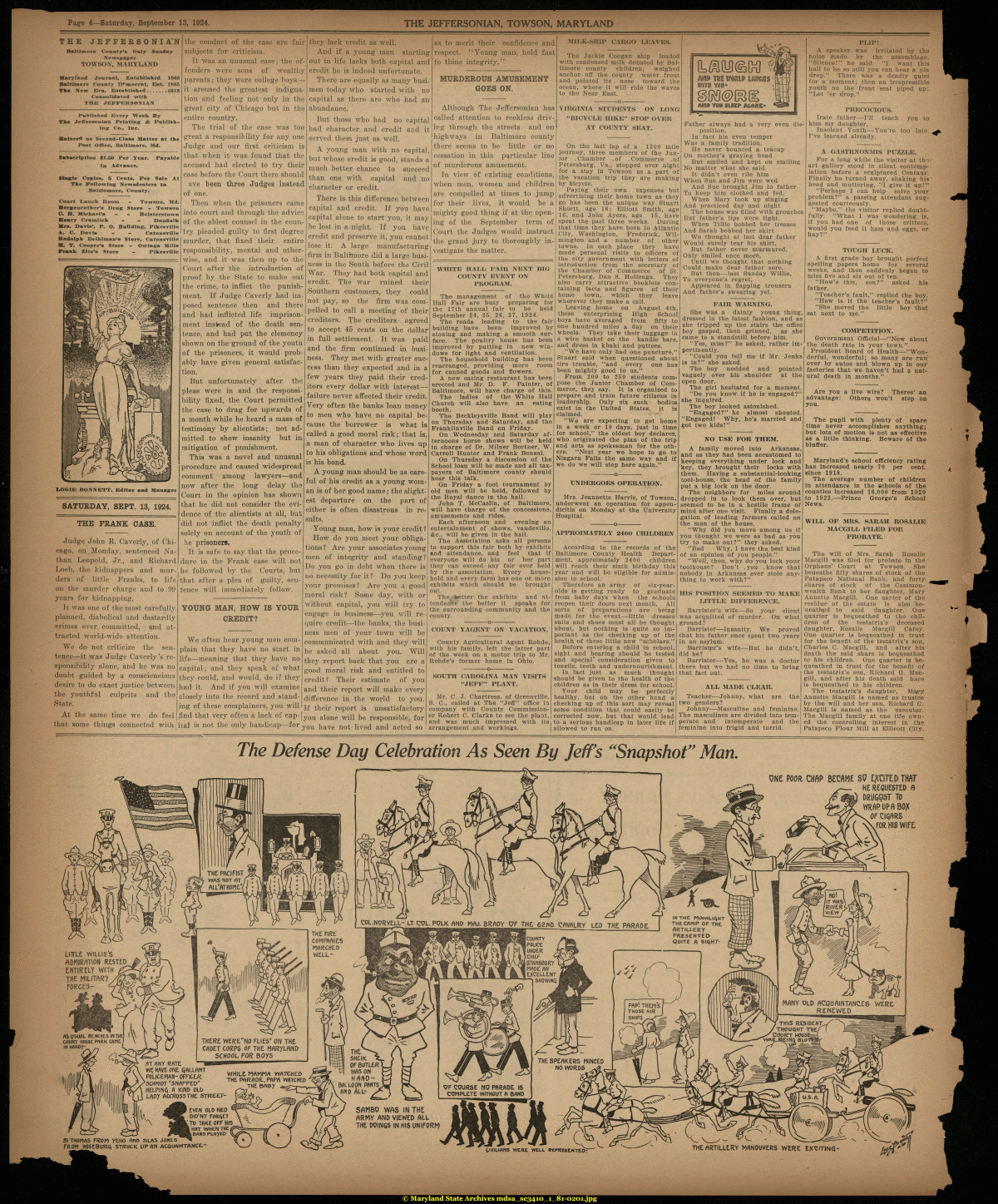
| Page 4—Saturday, September 13, 1924. THE JEFFERSONIAN, TOWSON, MARYLAND THE JEFFERSONIAN Baltimore County's Only Sunday Newspaper TOWSON, MARYLAND Maryland Journal, Established 1865 Baltimore County Democrat, Est. 1885 The New Era, Established.......1913 Consolidated with THE JEFFERSONIAN Published Every Week By The Jeffersonian Printing: & Publishing; Co., Inc. Kmtered as Second-Class Matter at the Post Office, Baltimore, Md. Subscription $1.50 Per Year. In Advance. Payable Slna-Ie Copies, 5 Cents, For Sale At The Following Newsdealers In Baltlomore, County. Court Lunch Room - Towson, Md. Hergenratber'N Drug; Store - Towson O. H. Michael's - - Reisterstown Henry Crumlich - - Dundalk Mrs. Davis', P. O. Building;, Pikesville A. C. Davis - - Catonsville Rudolph Deihlman's Store, Catonsville M, T. Cooper's Store - Owings Mills Frank Zlto's Store - Pikesville the conduct of the case are fair they lack credit as well. IiOGIE BONNETT, Editor and Manager SATURDAY, SEPT. 13, 1924. THE FRANK CASE. subjects for criticism. It was an unusual case; the offenders were sons of wealthy parents; they were college boys—> it aroused the greatest indignation and feeling not only irr the great city of Chicago but in the entire country. The trial of the case was too great a responsibility for any one Judge and our first criticism is that when it was found that the accused had elected to try their case before the Court there should ave been three Judges instead of one. Then when the prisoners came into court and through the advice of the ablest counsel in the country pleaded guilty to first degree murder, that fixed their entire responsibility, mental and otherwise, and it was then up to the Court after the introduction of proof by the State to make out the crime, to inflict the punishment. If Judge Caverly had imposed sentence then and there and had inflicted life imprisonment instead of the death sentence, and had put the clemency shown on the ground of the youth, of the prisoners, it would probably have given general satisfaction. But unfortunately after the pleas were in and the responsibility fixed, the Court permitted the case to drag for upwards of a month while he heard a mass of testimony by alientists; not admitted to show insanity but in mitigation of punishment. This was a novel and unusual procedure and caused widespread comment among lawyers—and now after the long delay the Court in the opinion has shown that he did not consider the evidence of the alientists at all, but did not inflict the death penalty solely on account of the youth of he prisoners. It is safe to say that the proee- Judge John R. Caverly, of Chi cago, on Monday, sentenced Na than Leopold, Jr., and Richard,! dure in the Frank case will not Loeb, the kidnappers and mur- be followed by the Courts, but ders of little Franks, to life on the murder charge and to 99 years for kidnapping. It was one of the most carefully planned, diabolical and dastardly crimes ever committed, and attracted world-wide attention. We do not criticize the sentence—it was Judge Caverly's responsibility alone, and he was no doubt guided by a consciencious desire to do exact justice between the youthful culprits and thei State. At the same time we do feei that after a plea of guilty, sentence will immediately follow. YOUNG MAN, HOW IS YOUR CREDIT? We often hear, young men complain that they have no start in life—meaning that they have no capital; and they speak of what they could, and would, do if they had it. And if you will examine closely into the record and stand- ing of these complainers, you will find that very often a lack of cap-|you alone will be responsible, for And if a young man starting out in life lacks both capital and credit he is indeed unfortunate. There are equally as many busi-men today who started with no capital as there are who had an abundance. But those who had no capital had character and credit and it served them just as well. A young man with no capital, but whose credit is good, stands a much better chance to succeed than one with capital and no character or credit. There is this difference between capital and credit. If you have capital alone to start you, it may be lost in a night. If you have credit and preserve it, you cannot lose it. A large manufacturing firm in Baltimore did a large business in the South before the Civil War. They had both capital and 'credit. The war ruined their Southern customers, they could not pay, so the firm was compelled to call a meeting of their creditors. The creditors agreed to accept 45 cents on the dollar in full settlement. It was paid and the firm continued in business. They met with greater success than they expected and in a few years they paid their creditors every dollar with interest—¦ failure never affected their credit. Very often the banks loan money to men who have no capital because the borrower is what is called a good moral risk; that is, a man of character who lives up to his obligations and whose word is his bond. A young man should be as careful of his credit as a young woman is of her good name; the slightest departure on the part of either is often disastrous in results. Young man, how is your credit ? How do you meet your obligations ? Are your associates young men of integrity and standing? Do you go in debt when there is no necessity for it? Do you keep your promises? Are you a good moral risk? Some day, with or without capital, you will try to engage in business—you will require credit—the banks, the business men of your town will be communicated with and they will, be asked all about you. Will they report back that you are a good moral risk and entitled to credit? Their estimate of you and their report will make every difference in the world to you. If their report is unsatisfactory as to merit their confidence and respect. "Young man, hold fast to thine integrity." MURDEROUS AMUSEMENT GOES ON. Although The Jeffersonian has j called attention to reckless driv- lir.g through the streets and on i highways in Baltimore county there seems to be little or no cessation in this particular line of murderous amusement. In view of existing conditions, when men, women and children are compelled at times to jump for their lives, it would be a mighty good thing if at the opening of the September term of Court the Judges would instruct the grand jury to thoroughly investigate the matter. MILK-SHIP CARGO LEAVES. The Jackie Coogan ship loaded with condensed milk donated by Baltimore county children, weighed anchor off the county water front and pointed its nose toward the ocean, where it will ride the waves to the Near East. (k/SHUKSKj * VIRGINIA STUDENTS ON LONG "BICYCLE HIKE" STOP OVER AT COUNTY SEAT. WHITE HALL FAIR NEXT BIG COUNTY EVENT ON PROGRAM. that some things connected with; ital is not the only handicap—for you }lave no^ ]jve(j an(j acted so The management of the White Hall Pair are busy preparing for the 17th annual fair to be held September 24, 25, 26, 27, 1924. The roads leading to the fair building have been improved by stoning and making a smooth surface. The poultry house has been improved by putting in new windows for light and ventilation. The household building has been rearranged, providing more room for canned goods and flowers. A new eating restaurant has been erected and Mr. D. F. Painter, of Baltimore, will have charge of this. The ladies of the White Hall Church will also have an eating booth. The Beckleysville Band will play on Thursday and Saturday, and the Pranklinville Band on Friday. On Wednesday and Saturday afternoons horse shows will be held in charge of Dr. Milner Bortner, W. Carroll Hunter and Frank Bonsai. On Thursday a discussion of the School loan will be made and all taxpayers of Baltimore county should hear this talk. On Friday a foot tournament by old men will be held, followed by the Royal dance in the hall. John T. McCaslin, of Baltimore, will have charge of the concessions, amusements and rides. Each afternoon and evening an entertainment of shows, vaudeville, &c, will be given in the hall. The Association asks all persons to support this fair both by exhibits and attendance, and feel that if everyone will do his or her part they can exceed any fair ever held by the association. Every household and every farm has one or. more exhibits which should be brought out. The?%etter the exhibits and attendance the better it speaks for the surrounding community and the county. ----------o---------- COUNT YAGENT ON VACATION. On the last lap of a 1200 mile journey, three members of the Junior .Chamber .of .Commerce .of Petersburg, Va., stopped over night for a stay in Towson as a part of the vacation trip they are making by bicycle. Paying their own expenses but advertising their home town as they go has been the unique way Stuart Shortt, age 18; Elliott Smith, age 16, and John Ayers, age 15, have spent the past three weeks. During that time they have been to Atlantic City, Washington, Frederick, Wilmington and a number of other towns. In each place they have made personal visits to officers of the city government with letters of introduction from the secretary of the Chamber of Commerce of St. Petersburg, Dan S. Hollenga. They also carry attractive booklets containing facts and figures of their home town, which they leave wherever they make a call. Leaving home on August 4th, these enterprising High School; boys have averaged from fifty to one hundred miles a day on their wheels. They take their luggage in a wire basket oh the handle bars, and dress in khaki and puttees. "We have only had one puncture," Stuart said when questioned about tire trouble, "and every one has been mighty good to us." From 200 to 250 students compose the Junior Chamber of Commerce, they say. It is organized to prepare and train future citizens in leadership. Only six such bodies exist in the United States, it is claimed. "We are expecting to get home in a week or 10 days, just in time for school," the oldest boy declares, who originated the plan of the trip and acts as spokesman for the others. "Next year we hope to go to Niagara Falls the same way and if we do we will stop here again." Father always had a very even disposition, In fact his even temper Was a family tradition. He never bounced a teacup On mother's graying head But smiled and kept on smiling No matter what she said. It didn't even rile him When Sue and Jim were wed And Sue brought Jim to father To keep him clothed and fed. When Mary took up singing And practiced day and night The house was filled with grouches But father's lips were tight. When Tillie bobbed her tresses And Sarah bobbed her skirt We thought at last dear father Would surely tear his shirt, But father never murmured, Only smiled once more, Until we thought that nothing Could make dear father sore. But then—last Sunday Willie, To everyone's regret, Appeared in flapping trousers And father's swearing yet. UNDERGOES OPERATION. Mrs. Jeannette Harris, of Towson, underwent an operation for appendicitis on Monday at the University Hospital. -o- APPROIMATELY 2400 CHILDREN County Agricultural Agent Rohde, with his family, left the latter part of the week on a motor trip to Mr. Rohde's former home in Ohio. SOUTH CAROLINA MAN VISITS "JEFF" PLANT. Mr. C. J. Chartress, of Greenville, S. C-, called at The "Jeff" office in company with County Commissioner Robert C. Clarke to see the plant, and was much impressed with its arrangement and workings. According to the records of the Baltimore County Health Department, approimately 2400 children will reach their sixth birthday this year and will be eligible for admission to school. Therefore an army of six-year-olds is getting ready to graduate from baby days when the schools reopen their doors next month. All sorts of preparations are being made for the event—little dresses suits and shoes must all be thought about, but nothing is quite so important as the checking up of the health of these little new "scholars." Before entering a child in school, sight and hearing should be tested and special* consideration given to tonsils, teeth and undernourishment. In fact just as much thought should be given to the health of the j children as in their dress for school. Your child may be perfectly healthy, but on the other hand a checking up of this sort may reveal some condition that could easily be corrected now, but that would lead to a serious handicap in later life if allowed to run on. FAIR WARNING. She was a dainty young thing, dressed in the latest fashion, and as she tripped up the stairs the office boy gasped, then grinned, as she came to a standstill before him. "Yes, miss?" he asked, rather impertinently. "Could you tell me if Mr. Jenks is in?" she asked. The boy nodded and pointed vaguely over his shoulder at the open door. The girl hesitated for a moment. "Do you know if he is engaged?" she inquired. The boy looked astonished. "Engaged?" he almost shouted. "Engaged! Why, he's married and got two kids!" PLIP! A speaker was irritated by the noise made by the assemblage. "Silence!" he said. "I want this hall to be so still you can hear a pin drop." There was a deadly quiet for a moment; then an irrepressible youth on the front seat piped up: "Let 'er drop." PRECOCIOUS. Irate father—I'll teach you to kiss my daughter. Insolent Youth—You're too late, ^ I've learned already. A GASTRNONMIS PUZZLE. For a long while the visitor at tho art gallery stood in silent contemplation before a sculptured Centaur. Finally he turned away, shaking his head and muttering, "I give it up!" "Perhaps I can help solve your problem?" a passing attendant suggested courteously. "Maybe," the visitor replied doubtfully. "What I was wondering is, if you had one of those critters, would you feed it ham and eggs, or hay?" TOUGH LUCK. A first grade boy brought perfect spelling papers home for several weeks, and then suddenly began to miss five and six out of ten. "How's this, son?" asked his father. "Teacher's fault," replied the boy. "How is it the teacher's fault?" "She moved the little boy that sat next to me." NO USE FOR THEM. A family moved into Arkansas, and as they had been accustomed to keeping everything under lock and key, they brought their locks with them. Having a substantial-looking tool-house, the head of the family put a big lock on the door. The neighbors for miles around dropped in to look them over, but seemed to be in a hostile frame of mind after one visit. Finally a delegation of leading farmers called on the man of the house. "Why did you move among us if you thought we were as bad as you try to make out?" they asked. "Bad Why, I have the best kind of an opinion of you people." "Well, then, why do you lock your toolhouse? Don't .you .know that nobody in Arkansas ever stole anything to work with?" COMPETITION. Government Official—"Now about the death rate in your town." President Board of Health—"Wonderful, wonderful; so many are run| over by autos and blown up in our factories that we haven't had a natural death in months." Are you a live wire? Theres' an advantage: Others won't step on you. The pupil with plenty of spare time never accomplishes anything; but lots of motion is not as effective as a little thinking. Beware of the bluffer. Maryland's school efficiency rating has increased nearly 70 per cent, since 1918. The average number of children in attendance in the schools of the counties increased 16,000 from 1920 to 1923.—Prince George's School News. HIS POSITION SEEMED TO MAKE LITTLE DIFFERENCE. Barrister's wife—So your client was acquitted of murder. On what ground? Barrister—Insanity. We proved that his father once spent two years in an asylum. Barrister's wife—But he didn't, did he? Barrister—Yes, he was a doctor there but we had no time to bring that fact out. ALL MADE CLEAR. Teacher—Johnny, what are the two genders? Johnny—Masculine and feminine. The masculines are divided into temperate and intemperate and the feminine into frigid and torrid. WILL OF MRS. SARAH ROSALIE MACGILL FILED FOR PROBATE. The will of Mrs. Sarah Rosalie Macgill was filed for probate in the Orphans' Court at Towson. She beueaths fifty shares of stock of the Patapsco National Bank, and forty shares of stock of the Commonwealth Bank to her daughter, Mary Annette Macgill. One uarter of the residue of the estate is also be-ueathed to said daughter. One quarter is bequeathed to the children of the testatrix's deceased daughter, Rosalie Macgill Carey. One quarter is bequeathed in trust for the benefit of the testatrix's son, Charles C. Macgill, and after his death the said share is bequeathed to his children. One quarter is bequeathed in trust for the benefit of the testatrix's son, Richard G. Macgill, and after his death said hare is bequeathed to his children. The testatrix's daughter, Mairy Annette Macgill is named as trustee by the will and her son, Richard C. Macgill is named as the executor. The Macgill family at one tife owned the controlling interest in the Patapsco Flour Mill at Ellicott City. The Defense Day Celebration As Seen By Jeff's "Snapshot" Man. WE POOR. CHAP BECAME Stf EXCITED THAT HE REQUESTED Pi DRuqqisr to WRAP UP A BOX OF CIQARS FOR HIS WIFE SI THOMAS FROM YEHO AND F&0M WISEBURQ STRUCK EVEN OLD NED DID"NT F0RQE7 ;to take off his HAT WHEN TriE __BA«DPLAy£D SILAS JONES UP AN ACQUAINTANCE. " CIVILIANS WERE WELL REPRESENTED^ THE ARTILLERY MAN0UVERS WERE EXCITINq- A |