 |
|
|
 |
|
 |
|
|||
|
||||
|
||||
|
Maryland State Archives Jeffersonian, Towson, Maryland mdsa_sc3410_1_81-0485 Enlarge and print image (2M) |
|
|
|
|
|
|
|
|||
|
||||
|
||||
|
Maryland State Archives Jeffersonian, Towson, Maryland mdsa_sc3410_1_81-0485 Enlarge and print image (2M) |
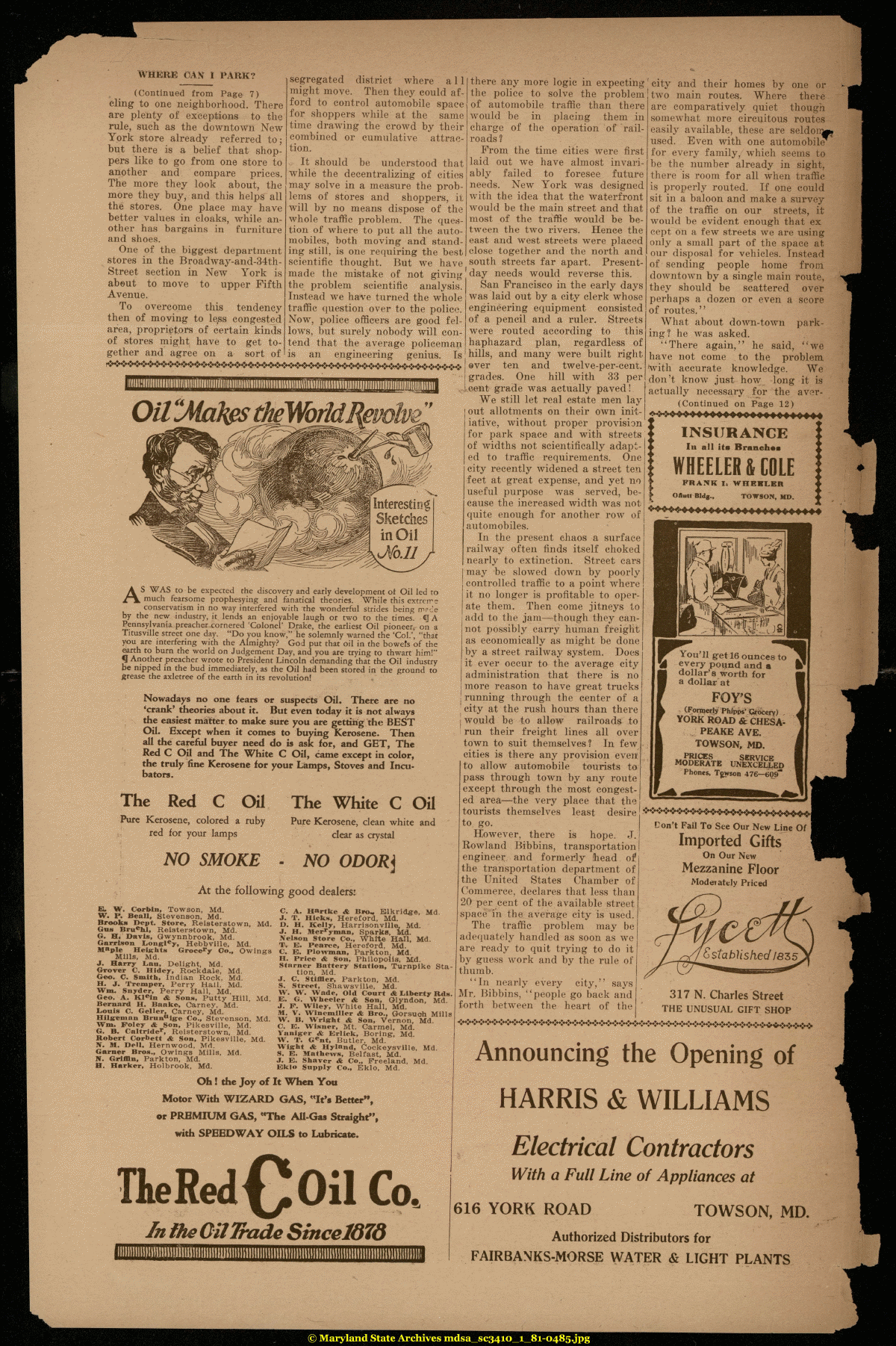
| WHERE CAN I PARK? (Continued from Page 7) cling to one neighborhood. There are plenty of exceptions to the rule, such as the downtown New York store already referred to; but there is a belief that shoppers like to go from one store to another and compare prices. The more they look about, the more they buy, and this helps all the stores. One place may have better values in cloaks, while another has bargains in furniture and shoes. One of the biggest department stores in the Broadway-and-34th-Street section in New York is abeut to move to upper Fifth Avenue. To overcome this tendency then of moving to le^s congested area, proprietors of certain kinds of stores might have to get together and agree on a sort of segregated district where all might move. Then they could afford to control automobile space for shoppers while at the same time drawing the crowd by their combined or cumulative attraction. It should be understood that while the decentralizing of cities may solve in a measure the problems of stores and shoppers, it will by no means dispose of the whole traffic problem. The question of where to put all the automobiles, both moving and standing still, is one requiring the best scientific thought. But we have made the mistake of not giving the problem scientific analysis. Instead we have turned the whole traffic question over to the police. Now, police officers are good fellows, but surely nobody will contend that the average policeman is an engineering genius. Is rffniirfffiiiiifiiiwuuinfiiififfirfniiifin^iiiinuiHiuii^iiuut^fiHffE^iiifiiiiiiififffuiiiiiiftnr/mNiiiuii Oil "Makes theWoMBgw< ft AS WAS to be expected the discovery and early development or Oil led to much fearsome prophesying and fanatical theories. While this extreme conservatism in no way interfered with the wonderful strides being mrce by the new industry, it lends an enjoyable laugh or two to the times. ^ A Pennsylvania preacher cornered 'Colonel' Drake, the earliest Oil pioneer, on a Titusville street one day. "Do you know," he solemnly warned the 'Col.', "that you are interfering with the Almighty? God put that oil in the bowers of the earth to burn the world on Judgement Day, and you are trying to thwart him!" •J Another preacher wrote to President Lincoln demanding that the Oil industry be nipped in the bud immediately, as the Oil had been stored in the ground to grease the axletree of the earth in its revolution! Nowadays no one fears or suspects Oil. There are no 'crank* theories about it. But even today it is not always the easiest matter to make sure you are getting the BEST Oil. Except when it comes to buying Kerosene. Then all the careful buyer need do is ask for, and GET, The Red C Oil and The White C Oil, came except in color, the truly fine Kerosene for your Lamps, Stoves and Incubators. The Red C Oil The White C Oil Pure Kerosene, colored a ruby red for your lamps Pure Kerosene, clean white and clear as crystal NO SMOKE ¦ NO ODORj At the following good dealers: EL W. Corbin, Towson, Md. W. P. Beall, Stevenson, Md. Brooks I>ept. Store, Reisterstown, Md. Gub Bruehl, Reisterstown, Md. G. H. Davis, Gwynnbrook, Md. Garrison L.ongrley, Hebbville, Md. M«ple Heights Grocery Co., Owings Mills, Md. J. Harry Lau, Delight, Md. Grover C. Hidey, Rockdale, Md. Geo. C. Smith, Indian Rock, Md. H. J. Tremper, Perry Hall, Md. Wm. Snyder, Perry Hall, Md. Geo. A. Kl^n & Sons, Putty Hill, Md. Bernard H. Baake, Carney, Md. Louis C. Geller, Carney, Md. Hilgreman Brunaige Co., Stevenson, Md. Wm. Foley & Son, Pikesville, Md. G. B. Caltride*", Reisterstown, Md. Robert Corbett & Son, Pikesville, Md. N. M. Dell. Hernwood, Md. Garner Bros., Owings Mills, Md. N. Griffin, Parkton, Md. H. Harker, Hoi brook, Md. C. A. Hartke & Bro^ Elkridge, Md. J. T. Hicks, Hereford, Md. D. H. Kelly, Harrisonville, Md. J. H. Mer'yman, Sparks, Md. Nelson Store Co., White Hall, Md. T. E. Pearce, Hereford, Md. C. E. Plowman, Parkton, Md. H. Price & Son, Philopolis, Md. Starner Battery Station, Turnpike Station, Md. J. C. Stiflier, Parkton, Md. S. Street, Shawsville, Md. W. W. Wade, Old Court & Liberty Rds. E. G. Wheeler & Son, Qlyndon, Md. J. P. Wiley, White Hall, Md. M. V. Winemiller & Bro., G-orsuoh Mills W. B. Wrigrht & Son, Vernon, Md. C. E. Wlsner, Mt. Carmel, Md. Yaniger & Erlick, Boring, Md. W. T. Gent, Butler, Md. Wight & Hyland, Cockeysville, Md. S. E. Mathews, Belfast, Md. J. E. Shaver & Co., Preeland, Md. Eklo Supply Co., Eklo, Md. Oh! the Joy of It When You Motor With WIZARD GAS, "It's Better", or PREMIUM GAS, "The All-Gas Straight", with SPEEDWAY OILS to Lubricate. TkeRedŁ!Oil Co, In the Gil Trade Since 1073 there any more logic in expecting the police to solve the problem of automobile traffic than there would be in placing them in charge of the operation of railroads ? From the time cities were first laid out we have almost invariably failed to foresee future needs. New York was designed with the idea that the waterfront would be the main street and that most of the traffic would be between the two rivers. Hence the east and West streets were placed close together and the north and south streets far apart. Present-day needs would reverse this. San Francisco in the early days was laid out by a city clerk whose engineering equipment consisted of a pencil and a ruler. Streets were routed according to this haphazard plan, regardless of hills, and many were built right ©ver ten and twelve-per-cent. grades. One hill with 33 per cent grade was actually paved! We still let real estate men lay out allotments on their own initiative, without proper provision for park space and with streets of widths not scientifically adapted to traffic requirements. One city recently widened a street ten feet at great expense, and yet no useful purpose was served, because the increased width was not quite enough for another row of automobiles. In the present chaos a surface railway often finds itself choked nearly to extinction. Street cars may be slowed down by poorly controlled traffic to a point where it no longer is profitable to operate them. Then come jitneys to add to the jam—though they cannot possibly carry human freight as economically as might be done by a street railway system. Does it ever occur to the average city administration that there is no more reason to have great trucks running through the center of a city at the rush hours than there would be to allow railroads to run their freight lines all over town to suit themselves? In few cities is there any provision even to allow automobile tourists to pass through town by any route except through the most congested area—the very place that the tourists themselves least desire to go. However, there is hope. J. Rowland Bibbins, transportation engineer and formerly (head of the transportation department of the United States Chamber of Commerce, declares that less than 20 per cent of the available street space in the average city is used. The traffic problem may be adequately handled as soon as we are ready to quit trying to do it by guess work and by the rule of thumb. "In nearly every city," says Mr. Bibbins, "people go back and forth between the heart of the city and their homes by one or two main routes. Where there are comparatively quiet though somewhat more circuitous routes easily available, these are seldomjpj used. Even with one automobile for every family, which seems to be the number already in sight, there is room for all When traffic is properly routed. If one could sit in a baloon and make a survey of the traffic on our streets, it would be evident enough that ex cept on a few streets we are using only a small part of the space at our disposal for vehicles. Instead of sending people home from downtown by a single main route, they should be scattered over perhaps a dozen or even a score of routes." What about down-town parking? he was asked. "There again," he said, "we have not come to the problem 'with accurate knowledge. We don't know just how long it is actually necessary for the aver-(Continued on Page 12) INSURANCE In all its Branches ,, WHEELER & COLE ;; FRANK I. WHEILER Ofiiitt Bldg., TOWSON, MD. < > « i You'll gfetl6 ounces to every pound and a dollar's worth for a dollar at FOY'S (Formerly Phipps* Grocery) YORK ROAD & CHESAPEAKE AVE. TOWSON, MD. . PRICES SERVICE MODERATE UNEXCELLED Phones, Towson 476—609" Don't Fail To See Our New Line Of Imported Gifts On Our New Mezzanine Floor Mode>attly Priced 317 N. Charles Street THE UNUSUAL GIFT SHOP Announcing the Opening of HARRIS & WILLIAMS Electrical Contractors With a Full Line of Appliances at 616 YORK ROAD TOWSON, MD. Authorized Distributors for FAIRBANKS-MORSE WATER & LIGHT PLANTS |