 |
|
|
 |
|
 |
|
|||
|
||||
|
||||
|
Maryland State Archives Jeffersonian, Towson, Maryland mdsa_sc3410_1_81-0638 Enlarge and print image (6M) |
|
|
|
|
|
|
|
|||
|
||||
|
||||
|
Maryland State Archives Jeffersonian, Towson, Maryland mdsa_sc3410_1_81-0638 Enlarge and print image (6M) |
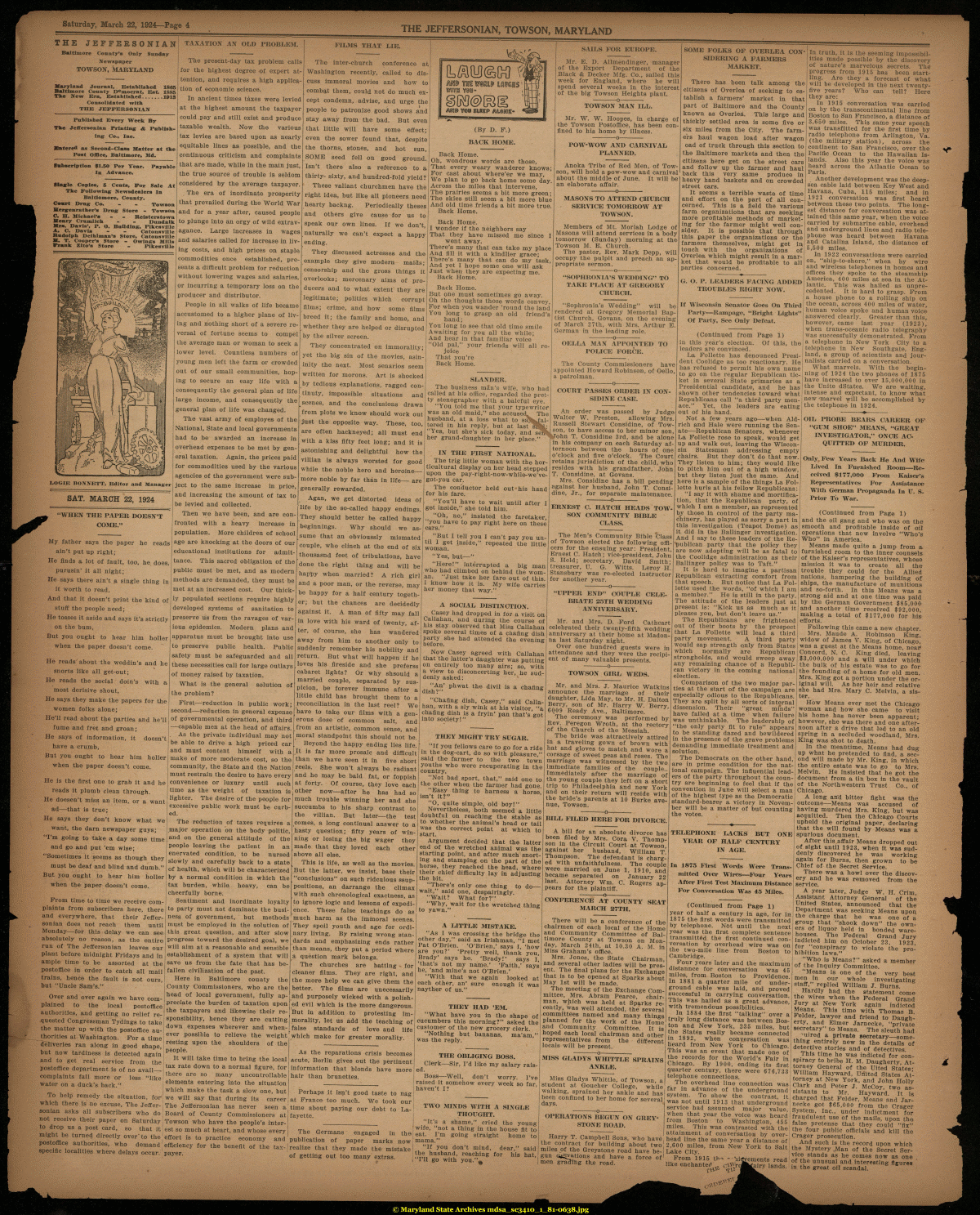
| Saturday, March 22, 1924^-Page 4 THE JEFFERSONIAN, TOWSON, MARYLAND THE JEFFERSONIAN Baltimore County's Only Sunday Newspaper TOWSON, MARYLAND Maryland Journal, Established 1865 Baltimore County Democrat, Eat. 1885 Tke New Era, Established.......1913 Consolidated with THE JEFFERSONIAN Published Every Week By The Jeflersonian Printing: & Publishing; Co., Inc. Entered as Second-Class Matter at the Post Office, Baltimore, Md. Subscription f 1.50 Per Year. Iu Advance. Payable Single Copies, 5 Cents, For Sale At The Following Newsdealers In Baltlomore, County. Court Drug- Co. - - Towson Hera-enrather's Drug: Store - Towson O. H. Michael's - - Relsterstown Henry Crumllch - - Dundalk Mrs. Davis', P. O. Building, Pikesvllle A. C. Davis - - Catonsville Rudolph Deihlman's Store, Catonsville M. T. Cooper's Store - Owings Mills Frank Zlto's Store - Pikesvllle L.OGIE BONNETT, Bditor and Manager SAT. MARCH 22, 1924 •WHEN THE PAPER DOESN'T COME." My father says the paper he reads ain't put up right; He finds a lot of fault, too, he does, purusin' it all night; He says there ain't a single thing in it worth to read, And that it doesn't print the kind of stuff the people need; He tosses it aside and says it's strictly on the bum, But you ought to hear him holler when the paper doesn't come. He reads about the weddin's and he snorts like all get-out; He reads the social doin's with a most derisive shout, He says they make the papers for the women folks alone; He'll read about the parties and he'll fume and fret and groan; He says of information, it doesn't have a crumb, But you ought to hear him holler when the paper doesn't come. He is the first one to grab it and he reads it plumb clean through. He doesen't miss an item, or a want ad—that is true; He says they don't know what we want, the darn newspaper guys; "I'm going to take a day some time and go and put 'em wise; "Sometimes it seems as though they must be deaf and blind and dumb." But you ought to hear him holler when the paper doesn't come. From time to time we receive complaints from subscribers here, there and everywhere, that their Jeffersonian does not reach them until Monday—for this delay we can see absolutely no reason, as the entire run of The Jeffersonian leaves our plant before midnight Fridays and in ample time to be assorted at the postoffice in order to catch all mail trains, hence the fault is not ours, but "Uncle Sam's." Over and over again we have complained to the local postoffice authorities, and getting no relief requested Congressman Tydings to take the matter up with the postoffice authorities at Washington. For a time deliveries ran along in good shape, but now tardiness is detected again and to get real service from the postoffice department is of no avail— complaints fall more or less "like water on a duck's back." To help remedy the situation, for1 which there is no excuse, The Jeffersonian asks all subscribers who do not receive their paper on Saturday to drop us a post card, so that it might be turned directly over' to the postoffice authorities, who demand specific localities where delays occur. TAXATION AN OLD PROBLEM. The present-day tax problem calls for the highest degree of expert attention, and requires a high application of economic science. In ancient times taxes were levied at the highest amount the taxpayer could pay and still exist and produce taxable wealth. Now the various tax levies are based upon as nearly equitable lines as possible, and the continuous criticism and complaints that are made, while in the main just, the true source of trouble is seldom considered by the average taxpayer. , The era of inordinate prosperity that prevailed during the World War and for a year after, caused people to plunge into an orgy of wild extravagance. Large increases in wages and salaries called for increase in living costs, and high prices on staple commodities once established, presents a difficult problem for reduction without lowering wages and salaries, or incurring a temporary loss on the producer and distributor. People in all walks of life became accustomed to a higher plane of living and nothing short of a severe reversal of fortune seems to compel the average man or woman to seek a lower level. Countless numbers of young men left the farm or crowded out of our small communities, hoping to secure an easy life with a consequently the general plan of life large income, and consequently the general plan of life was changed. The vast army of employes of the National, State and local governments had to be awarded an increase in overhead expenses to be met by general taxation. Again, the prices paid for commodities used by the various agencies of the government were subject to the same increase in price, and increasing the amount of tax to be levied and collected. Then we have been, and are confronted with a heavy increase in population. More children of school age are knocking at the doors of our educational institutions for admittance. This sacred obligation of the public must be met, and as modern methods are demanded, they must be met at an increased cost. Our thickly populated sections require highly developed systems of sanitation to preserve us from the ravages of various epidemics. Modern plans and apparatus must be brought into use to preserve public health. Public safety must be safeguarded and all these necessities call for large outlays of money raised by taxation. What is the general solution of the problem? First—reduction in public work; second—reduction in general expense of governmental operation, and third —capable men at the head of affairs. As the private individual may not be able to drive a high priced car and must content himself with a make of more moderate cost, so the community, the State and the Nation must restrain the desire to have every convenience or luxury until such FILMS THAT LIE. The inter-church conference at, Washington recently, called to discuss immoral movies and how to combat them, could not do much except condemn, advise, and urge the t people to patronize good shows and stay away from the bad. But even that little will have some effect; even the sower found that, despite the thorns, stones, and hot sun, SOME seed fell on good ground. Isn't there also a reference to a thirty- sixty, and hundred-fold yield? These valiant churchmen have the right idea, but like all pioneers need hearty backng. Periodically theses and others give cause for us to speak our own lines. If we don't, naturally we can't expect a happy ending. They discussed actresses and the example they give modern maids; censorship and the gross things it overlooks; mercenary aims of producers and to what extent they are legitimate; politics which corrupt films; crime, and how some films breed it; the family and home, and whether they are helped or disrupted by the silver screen. They concentrated on immorality; yet the big sin of the movies, asin-inity the next. Most senarios seem written for morons. Art is shocked by tedious explanations, ragged con-tinuty, impossible situations and scenes, and the conclusions drawn from plots we know should work out just the opposite way. These, too, are often hackneyed; all must end with a kiss fifty feet long; and it is astonishing and delightful how the villian is always worsted for good while the noble hero and heroine— more noble by far than in life— are generally rewarded. Agan, we get distorted ideas of life by the so-called happy endings. They should better be called happy beginnings. Why should we assume that an obvioussly mismated couple, who clinch at the end of six thousasnd feet of tribulations, have done the right thing and will be happy when married? A rich girl and a poor man, or the reverse, may be happy for a half century together; but the chances are decidedly against it. A man of fifty may fall in love with his ward of twenty, after, of course, she has wandered away from him to another only to suddenly remember his nobility and return. But what will happen if he loves his fireside and she preferss cabaret lights? Or why shsould a married couple, separated by suspicion, be forever immune after a little child has brought them to a reconciliation in the last reel? We have to take our films with a generous dose of common salt, and from an artistic, common sense, and moral standpoint this should not be. Beyond the happy ending lies life. It is far more prosaic and difficult than we have seen it in five short reels. She won't always be radiant and he may be bald fat, or foppish at forty. Of course, they love each (L/aoj)©(>o ? WITH V@EJ!» (By D. F.) BACK HOME. Back Home. Oh, wondrous words are those, That every weary wanderer knows; For cast about where'er we may, We plan to go back home some day. Across the miles that intervene, The prairies seems a bit more green; The skies still seem a bit more blue And old time friends a bit more true. Back Home. Back Home. I wonder if the neighbors say That they have missed me since I went away. There's many that can take my place And fill it with a kindlier grace; There's many that can do my task, And yet I hope some one will ask Just when they are expecting me. Back Home. Back Home. But one must sometimes go away. Oh the thoughts those words convey, For when you wander 'round the land You long to grasp an old friend's hand; You long to see that old time smile Awaiting for you all the while; And hear in that familiar voice "Old pal," your friends will all rejoice That you're Back Home. SLANDER. The business man's wife, who had called at his office, regarded the pretty stenographer with a baleful eye. "You told me that your typewriter was an old maid," she accused- The husband, at a loss what to saj^^al-tered in his reply, but at last st -'¦: "Yes, but she's sick today, and sen*'1 her grand-daughter in her place." SAILS FOR EUROPE. Mr. E. D. Allmendinger, manager of the Export Department of the Black & Decker Mfg. Co., sailed this week for England, where he will spend several weeks in the interest of the big Towson Heights plant. ----------o---------- TOWSON MAN ILL. Mr. W. W. Hoopes, in charge of the Towson Postoffice, has been confined to his home by illness. ----------o---------- POW-WOW AND CARNIVAL PLANNED. Anoka Tribe of Red Men, of Towson, will hold a pow-wow and carnival about the middle of June. It will be an elaborate affair. ----------o---------- MASONS TO ATTEND CHURCH SERVICE TOMORROW AT TOWSON. SOME FOLKS OF OVERLEA CONSIDERING A FARMERS MARKET. Members of Mt. Moriah Lodge of Masons will attend services in a body tomorrow (Sunday) morning at the Towson M. E. Church. The pastor, Rev. Mark Depp, will occupy the pulpit and preach an appropriate sermon. ----------o---------- "SOPHRONIA'S WEDDING" TO TAKE PLACE AT GREGORY CHURCH. "Sophronia's Wedding" will be rendered at Gregory Memorial Baptist Church, Govans, on the evening of March 27th, with Mrs. Arthur E. German in the leading role. ----------o---------- OELLA MAN APPOINTED TO POLICE FORCE. The County Commissioners have appointed Howard Robinson, of Oello, a patrolman. COURT PASSES ORDER IN CON-SIDINE CASE. time as the weight of taxation is other now—after he has had so lighter. The desire of the people for excessive public work must be curbed. The reduction of taxes requires a major operation on the body politic, and on the general attitude of the people leaving the patient in an enervated condition, to be nursed slowly and carefully back to a state of health, which will be characterized by a normal condition in which the tax burden, while heavy, can be cheerfully borne. Sentiment and inordinate loyalty to party must not dominate the business of government, but methods must be employed in the solution of this great question, and after slow progress toward the desired goal, we will aim at a reasonable and sensible establishment of a system that will save us from the fate that has befallen civilization of the past. Here in Baltimore county the County Commissioners, who are the head of local government, fully appreciate the burden of taxation upon the taxpayers and likewise their responsibility, hence they are cutting down expenses wherever and whenever possible to relieve the weight resting upon the shoulders of the people. It will take time to bring the local tax rate down to a normal figure, for there are so many uncontrollable elements entering into the situation which make the task a slow one, but Perhaps it isn't good taste to nag we will say that during its career, at France too much. We took our The Jeffersonian has never seen a time about paying our debt to La-Board of County Commissioners atifayette. Towson who have the people's inter- ------------------------ est so much at heart, and whose every i The Germans engaged in the effort is to practice economy and publication of paper marks now efficiency for the benefit of the tax-! realize that they made the mistake payer. of getting out too many extras. much trouble winning her and she succumbs to his sharp contrast to the villian. But later—the test comes, a long continual answer to a hasty question; fifty years of winning or losing the big wager they made that they loved each other above all else. This is life, as well as the movies. But the latter, we insist, base their "conclusions" on such ridculous ssup-positions, an darrange the climax with such chronological exactness, as to ignore logic and lessons of expedience. These false teachings do as much harm as the immoral scenes. They spoil youth and age for ordinary living. By raising wrong standards and emphasizing ends rather than means, they put a period where a question mark belongs. The churches are batting for cleaner films. They are right, and the more help we can give them the better. The films are unecessarily and purposely wicked with a polished evil which is the more dangerous. But in addition to protesting immorality, let us add the teaching of false standards of love and life which make for greater morality. As the reparations crisis becomes acute, Berlin gives out the pertinent information that blonds have more hair than brunettes. IN THE FIRST NATIONAL. The trig little woman with the horticultural display on her head stepped upon the pay-right-now-while-we've-got-you car. The conductor held out his hand for his fare. "You'll have to wait until after I get inside," she told him. "Oh, no," insisted the faretaker, "you have to pay right here on these cars." "But I tell you I can't pay you until I get inside," repeated the little woman. "Yes, but—" "Here!" interrupted a big man who had climbed on behind the woman. "Just take her fare out of this. 1 know how it is. My wife carries her money that way." An order was passed by Judge Walter W. Preston, allowing Mrs. Russell Stewart Considine, of Towson, to have access to her minor son, Tohn T. Considine 3rd, and be alone in his company on each Saturday afternoon between the hours of one o'clock and five o'clock. The Court retains jurisdiction of the child, who resides with his grandfather, John T. Considine, at Govans. Mrs. Considine has a bill pending against her husband, John T. Considine, Jr., for separate maintenance. ----------o---------- ERNEST C. HATCH HEADS TOWSON COMMUNITY BIBLE CLASS. There has been talk among the citizens of Overlea of seeking to establish a farmers' market in that part of Baltimore and the County known as Overlea. This large and thickly settled area is some five or six miles from the City. The farmers haul wagon load after wagon oad of truck through this section to the Baltimore markets and then the citizens here get on the street cars and follow up the farmer and haul back this very same produce in heavy hand baskets and on crowded street cars. It seems a terrible waste of time and effort on the part of all concerned. This is a field the various farm organizations that are seeking more profitable methods of marketing for the farmer might well consider. It is possible that through this paper the organizations or the farmers themselves, might get in touch with the organizations of Overlea which might result in a market that would be profitable to all parties concerned. G. O. P. LEADERS FACING ADDED TROUBLES RIGHT NOW. If Wisconsin Senator Goes On Third Party—Rampage, "Bright Lights" Of Party, See Only Defeat. A SOCIAL DISTINCTION. Casey had dropped in for a visit on Callahan, and during the course of his stay observed that Miss Callahan spoke several times of a chafing dish party she had attended the evening before. Now Casey agreed with Callahan that the latter's daughter was putting on entirely too many airs; so, with a view to disconcerting her, he suddenly asked: "An' phwat the divil is a chafing dish?" "Chafing dish, Casey," said Callahan, with a sly wink at his visitor, "a chafing dish is a fryin' pan that's got into society!" THEY .MIGHT TRY SUGAR. "If you fellows care to go for a ride in the dog-cart, do so with pleasure," said the farmer to the two town youths who were recuperating in the country. "Not bad sport, that," said one to the other when the farmer had gone. "Easy thing to harness a horse, isn't it?" "O, quite simple, old boy!" Nevertheless, both seemed a little doubtful on reaching the stable as to whether the animal's head or tail was the correct point at which to start. Argument decided that the latter end of the wretched animal was the starting point, and after much snorting and stamping on the part of the horse, they reached the head, where their chief difficulty lay in adjusting the bit. "There's only one thing to do— wait," said one, despairingly. "Wait? What for?" "Why, wait for the wretched thing to yawn." A LITTLE MISTAKE- "As I was crossing the bridge the other day," said an Irishman, "I met Pat O'Brien. 'O'Brien,' says I, 'how are you?' 'Pretty well, thank you, Brady' says he. 'Brady!' says I, 'that's not my name.' 'Faith,' says he, 'and mine's not O'Brien.' "With that we again looked at each other, an' sure enough it was nayther of us." THEY HAD 'EM. "What have you in the shape of cucumbers this morning?" asked the customer of the new grocery clerk. "Nothing but bananas, ma'am," was the reply. THE OBLIGING BOSS. Clerk—Sir, I'd like my salary raised. Boss—Well, don't worry. I've raised it somehow every week so far, haven't I? TWO MINDS WITH A SINGLE THOUGHT. "It's a shame," cried the young wife, "not a thing in the house fit to eat. I'm going straight home to mama." "If you don't mind, dear," said the husband, reaching for his hat, "I'll go with you."^ The Men's Community Bible Class of Towson elected the following officers for the ensuing year: President, Ernest C. Hatch; vice-president, John S. Held; secretary, David Smith; treasurer, U. G. Witts. Leroy H. Stansbury was re-elected instructor for another year. ----------o---------- "UPPER END" COUPLE CELEBRATE 25TH WEDDING ANNIVERSARY. Mr. and Mrs. D. Ford Cathcart celebrated their twenty-fifth wedding anniversary at their home at Madonna last Saturday night. Over one hundred guests were in attendance and they were the recipient of many valuable presents. ----------o---------- TOWSON GIRL WEDS. Mr. and Mrs. J. Maurice Watkins announce the marriage of their daughter, Lida May, to Mr. H. Dalton Berry, son of Mr. Harry W. Berry, 6009 Ready Ave., Baltimore. The ceremony was performed by Rev. Peregon Wroth, at the rectory of the Church of the Messiah. The bride was attractively attired in a traveling gown of brown with hat and gloves to match and wore a corsage of sweet peas and roses. The marriage was witnessed by the two immediate families of the couple.. Immediately after the marriage of the young couple they left on a short trip to Philadeelphia and new York and on their return will reside with the bride's parents at 10 Burke avenue, Towson. ----------o---------- BILL FILED HERE FOR DIVORCE. A bill for an absolute divorce has been filed by Mrs. Cora V. Thompson in the Circuit Court at Towson, against her husband, William T. Thompson. The defendant is charged with unfaithfulness. The couple were married on June 1, 1910, and became separated on January 22 last. Attorney Wm. C. Rogers appears for the plaintiff. ----------o---------- CONFERENCE AT COUNTY SEAT MARCH 27TH. There will be a conference of the chairmen of each local of the Home and Community Committee of Baltimore County at Towson on Monday, March 24th, at 10.30 A. M. in Miss Graham's office. Mrs. Jones, the State Chairman, and several other ladies will be present. The final plans for the Exchange that is to be opened at Sparks about May 1st will be made. The meeting of the Exchange Committee, Mrs. Abram Pearce, chairman, which was held at Sparks recently, was well attended, the several committees named and many things planned for the work of the Home and Community Committee. It is hoped each local chairman and other representatives from the different locals will be present. ----------o------------- MISS GLADYS WHITTLE SPRAINS ANKLE. Miss Gladys Whittle, of Towson, a student at Goucher College, while walking, sprained her ankle and hasj been confined to her home for several days. ----------o---------- OPERATIONS BEGUN ON GREY-STONE ROAD. (Continued from Page 1) in this year's election. Of this, the leaders are convinced. La Follette has denounced President Coolidge as too reactionary. Hq has refused to permit his own name to go on the regular Republican ticket in several State primaries as a Presidential candidate, and he has shown other tendencies toward what Republicans call "a third party menace." Yet, the leaders are eating out of his hand. Not a few years ago—when Aid-rich and Hale were running the Senate—Republican Senators, whenever La Follette rose to speak, would get up and walk out, leaving the Wisconsin Statesman addressing empty chairs. But they don't do that now. They listen to him; they would like to pitch him out of a high window, but they listen just the same. And here is a sample of the things La Follette hurls at his fellow Republicans: "I say it with shame and mortification, that the Republican party, of which I am a member, as represented by those in control of the party machinery, has played as sorry a part in this investigation (Teapot Dome) as it did in the Ballinger investigation. And I say to these leaders of the Republican party that the policy they are now adopting will be as fatal to the Coolidge administration as their Ballinger policy was to Taft." It is hard to imagine a partisan Republican extracting comfort from that speech. But notice that La Follette used the words, "of which I am a member." He is still in the party. The attitude of the leaders just at present is: "Kick us as much as it pleases you, but don't leave us." The Republicans are frightened out of their boots by the prospect that La Follette will lead a third party movement. A third party would sap strength only from States which normally are Republican strongholds, and would sweep away any remaining chance of a Republican victory in the coming national election. Comparison of the two major parties at the start of the campaign are especially odious to the Republicans. They are split by all sorts of internal dissension. Their "great minds" have failed at a time when failure was unthinkable. The leadership of "the only party fit to rule" appears to be standing dazed and bewildered in the presence of the grave problems demanding immediate treatment and solution. The Democrats on the other hand, are in prime condition for the national campaign. The influential leaders of the party throughout the country are beginning to feel that if the convention in June will select a man of the highest type as the Democratic standard-bearer a victory in November will be a matter of but counting the votes. In truth, it is the seeming impossibilities made possible by the discovery of nature's marvelous secrets. The progress from 1915 has been startling. Are they a forecast of what will be developed in the next twenty-five years? Who can tell? Here they are: In 1915 conversation was carried on by the transcontinental line from Boston to San Francisco, a distance of 3,650 miles. This same year speech was transfitted for the first time by radio telephone from Arlington, Va. (the military station), across the continent to San Francisco, over the Pacific Ocean to the Hawaiian Islands. Also this year the voice was heard across the Atlantic Ocean to Paris. Another development was the deep-sea cable laid between Key West and Havana, Cuba, 115 miles; and in 1921 conversation was first heard between these two points. The longest distance for conversation was attained this same year, when the voice carried by submarine cable, overhead and underground lines and radio telephone was heard between Havana and Catalina Island, the distance of 5,500 miles. In 1922 conversations were carried on, "ship-to-shore," when by wire and wireless telephones in homes and offices they spoke to the steamship America, 400 miles at sea in the Atlantic. This was hailed as unprecedented. It is hard to grasp. From a house phone to a rolling ship on the ocean, across 400 miles of water, human voice spoke and human voice answered clearly. Greater than this, however, came last year (1923), when trans-oceanic radio telegraphy was successfully demonstrated. From a telephone in New York City to a telephone in New Southgate, England, a group of scientists and journalists carried on a conversation. What marvels. With the beginning of 1924 the two phones of 1875 have increased to over 15,000,000 in the Unite dStates. We are waiting, intense and expectant, to know what new -marvel will be accomplished by the telephone in 1924. OIL PROBE BEARS CAREER OF "GUM SHOE" MEANS, "GREAT INVESTIGATOR," ONCE ACQUITTED OF MURDER. Only Few Years Back He And Wife Lived In Furnished Room—Received $177,0©0 From Kaiser's Representatives For Assistance With German Propaganda In U. S. Prior To War. TELEPHONE LACKS BUT ONE YEAR OF HALF CENTURY IN AGE. In 1875 First Words Were Transmitted Over Wires—Four Years After First Test Maximum Distance For Conversation Was 45 Miles. Harry T. Campbell Sons, who have the contract for building about two miles .of the Greystone road have begun emigrations and have a force of men grafting the road. (Continued from Page 1) year of half a century in age, for in 1875 the first words were transmitted by telephone. Not until the next year was the first complete sentence transmitted the first continued conversation by overhead wire was on the two-mile line from Boston to Cambridge. Four years later and the maximum distannce for conversation was 45 miles, from Boston to Providence. In 1881 a quarter mile of underground cable was laid, and proved successful in carrying conversation. This was hailed as a great advance, with tremendous possibilities. In 1884 the first "talking" over a truly long distance was between Boston and New York, 235 miles, but the States really became connected in 18 92, when conversation was heard from New York to Chicago. This was an event that made one of the records for the World's Fair in Chicago. By 1900, ending its first quarter century, there were 676,733 telephone connections. The overhead line connection was far in advance of the underground system. To show the contrast, it was not until 1913 that underground service had assumed major value, when that year the voice was heard from Boston to Washington, 455 miles. This was contrasted with the attainment of conversation by overhead line the same year a distance of 2,600 miles, from New York to Salt Lake City. From 1915 tb^ "Movements read like enchanted T, cV^roJfctfairv lands (Continued from Page 1) and the oil gang and who was on the smooth and profitable inside of oil operations that now involve "Who's Who" in America. Means made quite a jump from a furnished room to the inner counsels of the Kaiser's representatives, whose mission it was to create all the trouble they could for the Allied nations, hampering the building of ships, the manufacture of munitions and so-forth. In this Means was a strong aid and at one time was paid by the German Government $85,00Q and another time received $92,000, making a total of $177,000 for his efforts. Following this came a new chapter. Mrs. Maude A. Robinson King, widow of James V. King, of Chicago, was a guest at the Means home, near* Concord, N. C. King died, leaving $3,000,000 and a will under which the bulk of his estate was to go for the founding of a home for old men. Mrs. King got a portion under the original will. As her heir and relative she had Mrs. Mary C. Melvin, a sister. How Means ever met the Chicago woman and how she came to visit his home has never been apparent; however, she was there and one afternoon after a drive that led to an old spring in a secluded woodland, Mrs. King was shot to death. In the meantime, Means had dug up what he pretended to find, a second will made by Mr. King, in which the entire estate was to go to Mrs. Melvin. He insisted that he got the document from a tin box in the vault of the Northwestern Trust Co., of Chicago, A long an'd bitter fight was the outcome—Means was accused of having murdered Mrs. King, but was acquitted. Then the Chicago Courts upheld the original paper, declaring that the will found by Means was a spurious document. After this affair Means dropped out of sight until 1923, when it was suddenly discovered he was working again for Burns, then grown to be Chief of the Secret Service. There was a howl over the discovery and he was removed from the service. A year later, Judge W. H. Crim, Assistant Attorney General of the United States, announced that the Department was seeking Means upon, the charge that he was one of a group that "shook down" the owners of liquor held in bonded warehouses. The Federal Grand Jury indicted him on October 23, 1923, for "conspiracy to violate the prohibition laws." "Who is Means?" asked a member of the Inquiry Committee. "Means is one of the very best men in our whole investigating staff," replied William J. Burns. Hardly had the statement come the wires when the Federal Grand Jury at New York again indicted Means. This time with Thomas B. Felder, lawyer and friend to Daugh-erty, and Elmer Jarnecke, "private secretary" to Means. The sleuth had ^uired a private secretary—something entirely new in the details of detective stories and of detectives. This time he was indicted for conspiracy to bribe H. M. Daugherty, Attorney General of the Uited States; William Hayward, United States Attorney at New York, and John Holly Clark and Peter J. McCoy, two assistants to Mr. Hayward. It is charged that Felder, Means and Jarnecke got $65,000 from the Crager System, Inc., under indictment for fraudulent use of the mails, upon the false pretense that they could "fix" the four public officials and kill the Crager prosecution. And such is the record upon which the Mystery .Man of the Secret Service stands as he comes now as one of the unusual and interesting figures in the great oil scandal. |