 |
|
|
 |
|
 |
|
|||
|
||||
|
||||
|
Maryland State Archives Jeffersonian, Towson, Maryland mdsa_sc3410_1_81-0763 Enlarge and print image (3M) |
|
|
|
|
|
|
|
|||
|
||||
|
||||
|
Maryland State Archives Jeffersonian, Towson, Maryland mdsa_sc3410_1_81-0763 Enlarge and print image (3M) |
|
THE JEFFERSONIAN NEWSGRAVURE AND MAGAZINE SECTION.
ORIENTAL RUGS The
PERSIAN RUG CO.
Importers 919 N. Calvert St.
BALTIMORE, MD. Established 1900
Cleaning, Scouring, Renovating, Repairing and Weaving, Crooked Rugs Straightened and Sized.
? ?"? ? ? *VVW\
«? Straw Rides Prompt Service y
I RUPPERT BROS. f
Govans Transfer y Y
*> Local & Long Distance Moving y
Y Y
i* 6000 YORK ROAD ?>
Y Y ?i GOVANS, MD. y
y Telephone, Tuxedo 2143 ?$<
?X^~X~X~XK"X~X~X^~X~x4
wk/ amies to you at I? J T V'O
136 W. Payette St.
Baltimore, Md.
tiadarty those Fa, Sea Fond Disfuis
.x~xK"X~x«xk~x~X"X"X~x»
THE PLACE TO BUY PHOTOGRAPHIC MATERIAL
| Atlantic Photo Supply Co. |
| 216 W.Saratoga St. $
Y I
J BALTIMORE, MD. %
X Send /or catalogue. «??
$> v
Patapsco Granite Co.
iCHAS. F. PEACH)
Woodlawn 55-M. Oppoute Woodlawn Cemetery
Polishing Qranlte and JtCarble, Coping,
Bases and Steps
The_Ari Photo-Engraving Co., Inc.
MAKERS OF PRINTING PLATES
ARTISTS-ENGRAVERS
109 S. Charles St. Baltimore, Md.
Plaza 3004
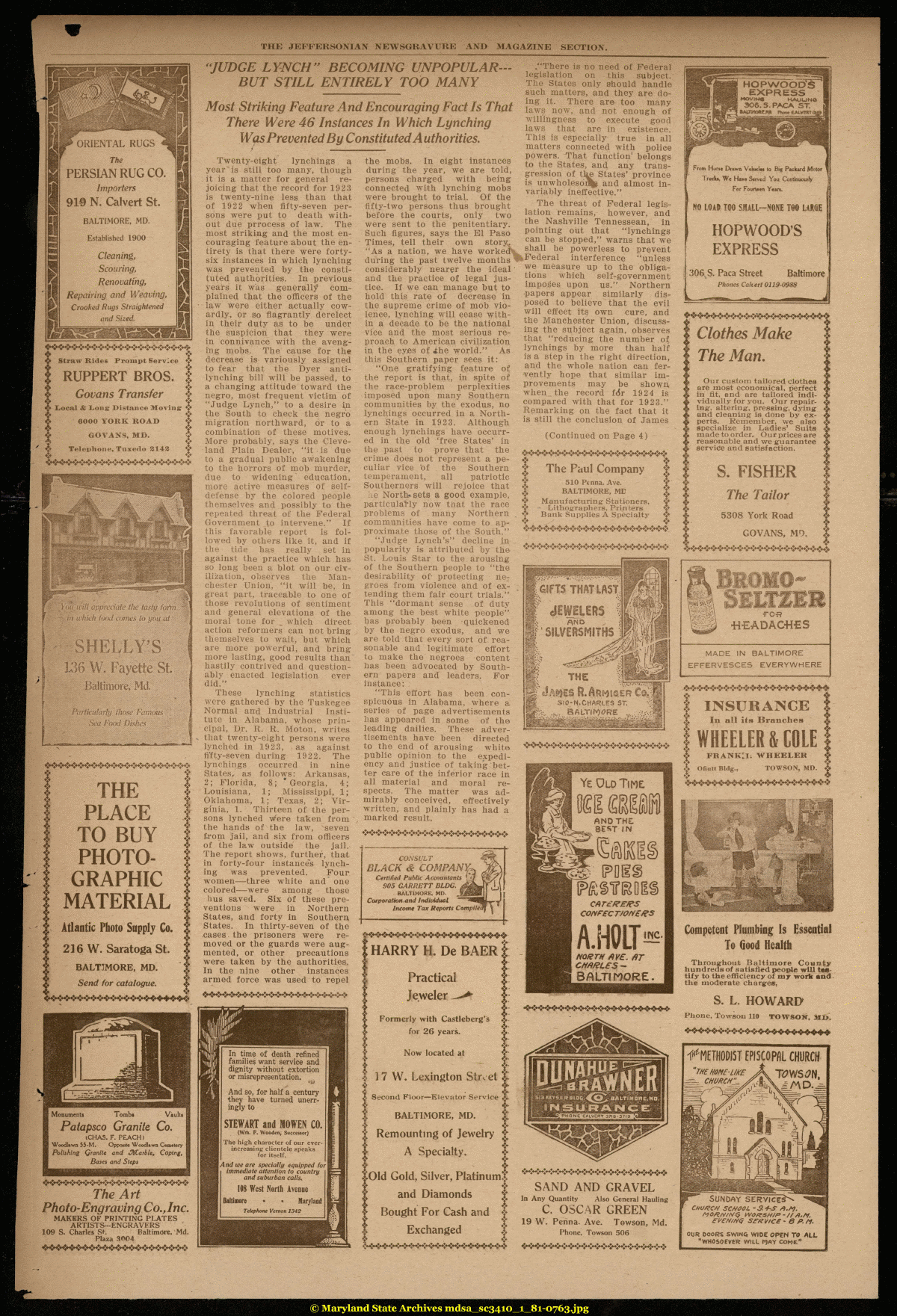
'JUDGE LYNCH" BECOMING UNPOPULAR— BUT STILL ENTIRELY TOO MANY
There Were 46 Instances In Which Lynching Was Prevented By Constituted A uthorities.
."There is no need of Federal legislation on this subject. The States only should handle ___'.___________ such matters, and they are do-
Most Striking Feature And Encouraging Fact Is That laws1 now, and n™ enougTof
willingness to execute good laws that are in existence. This is especially true in all matters connected with police powers. That function' belongs to the States, and any transgression of the States' province is unwholesdn^ and almost invariably ineffective."
The threat of Federal legislation remains, however, and the Nashville Tennessean, in pointing out that "lynchings can be stopped," warns that we shall be powerless to prevent a%Federal interference "unless we measure up to the obligations which self-government imposes upon us." Northern •papers appear similarly disposed to believe that the evil will effect its own cure, and the Manchester Union, discussing the subject again, observes that "reducing the number of lynchings by more than half is a step in the right direction, and the whole nation can fervently hope that similar improvements may be shown, when the record frir 1924 is compared with that for 1923." Remarking on the fact that it is still the conclusion of James
Twenty-eight lynchings a year is still too many, though it is a matter for general rejoicing that the record for 1923 is twenty-nine less than that of 1922 when fifty-seven persons were put to death without due prrocess of law. The most striking and the most encouraging feature about the entirety is that there were forty-six instances in which lynching was prevented by the constituted authorities. In previous years it was generally" complained that the officers of the law were either actually cowardly, or so flagrantly derelect in their duty as to be under the suspicion that they were in connivance with the avenging mobs. The cause for the decrease is variously assigned to fear that the Dyer anti-lynching bill will be passed, to a changing attitude toward the negro, most frequent victim of "Judge Lynch," to a desire in the South to check the negro migration northward, or to a combination of these motives. More probably, says the Cleveland Plain Dealer, "it ¦ is due to a gradual public awakening to the horrors of mob murder, due to widening education, more active measures of self-defense by the colored people themselves and possibly to the repeated threat of the Federal Government to intervene." If this favorable report is followed by others like it, and if the tide has really set in against the practice which has so long been a blot on our civilization, observes the Manchester Union, "it will be, in great part, traceable to one of those revolutions of sentiment and general elevations of the moral tone for . which direct action reformers can not bring themselves to wait, but which are more powerful, and bring more lasting, good results than hastily contrived and questionably enacted legislation ever did."
These lynching statistics were gathered by the Tuskegee Normal and Industrial Institute in Alabama, whose principal, Dr. R. R. Moton, writes that twenty-eight persons were lynched in 1923, as against fl'fty-seven during 1922. The lynchings occurred in nine States, as follows: Arkansas 2; Florida, 8; "Georgia, 4 Louisiana, 1; Mississippi, 1 Oklahoma, 1; Texas, 2; Virginia, 1. Thirteen of the persons lynched "Were taken from the hands of the law, seven from jail, and six from officers of the law outside the jail. The report shows, further, that in forty-four instance's lynching was prevented. Four women—three white and" one colored—were among those hus saved. Six of these preventions were in Northern States, and forty in Southern, States. In thirty-seven of the cases the prisoners were removed or the guards were augmented, or other precautions were taken by the authorities. In the nine other instances armed force was used to repel
the mobs. In eight instances during the year, we are told, persons charged with being connected with lynching mobs were brought to trial. Of the fifty-two persons thus brought before the courts, only two were sent to the penitentiary. Such figures, says the El Paso Times, tell their own story.^ "As a nation, we have worke during the past twelve months considerably nearer the ideal and the practice of legal justice. If we can manage but to hold this rate of decrease in the supreme crime of mob violence, lynching will cease within a decade to be the national vice and the most serious reproach to American civilization in the eyes of ihe world." As this Southern paper sees it:
"One gratifying feature of the report is that, in spite of the race-problem perplexities imposed upon many Southern communities by the exodus, no lynchings occurred in a Northern State in 1923. Although enough lynchings have occurred in the old 'free States' in the past to prove that the crime does not represent a peculiar vice of the Southern temperament, all patriotic Southerners will rejoice that ie North* sets a good example, particularly now that the race problems of many Northern communities have come to approximate those of the South."
"Judge Lyneh's" decline in popularity is attributed by the St. Louis Star to the arousing of the Southern people to "the desirability of- protecting negroes from violence and of extending them fair court trials." This "dormant sense of duty among the best white people" has probably been quickened by the negro exodus, and we are told that every sort of. reasonable and legitimate effort to make the negroes content has been advocated by Southern papers and leaders. For instance:
"This effort has been conspicuous in Alabama, where a series of page advertisements has appeared in some of the leading dailies. These advertisements have been directed to the end of arousing white public opinion to the expediency and justice of taking better care of the inferior race in all material and moral respects. The matter was admirably conceived, effectively written, and plainly has had a marked result.
|