 |
|
|
 |
|
 |
|
|||
|
||||
|
||||
|
Maryland State Archives Jeffersonian, Towson, Maryland mdsa_sc3410_1_81-0920 Enlarge and print image (6M) |
|
|
|
|
|
|
|
|||
|
||||
|
||||
|
Maryland State Archives Jeffersonian, Towson, Maryland mdsa_sc3410_1_81-0920 Enlarge and print image (6M) |
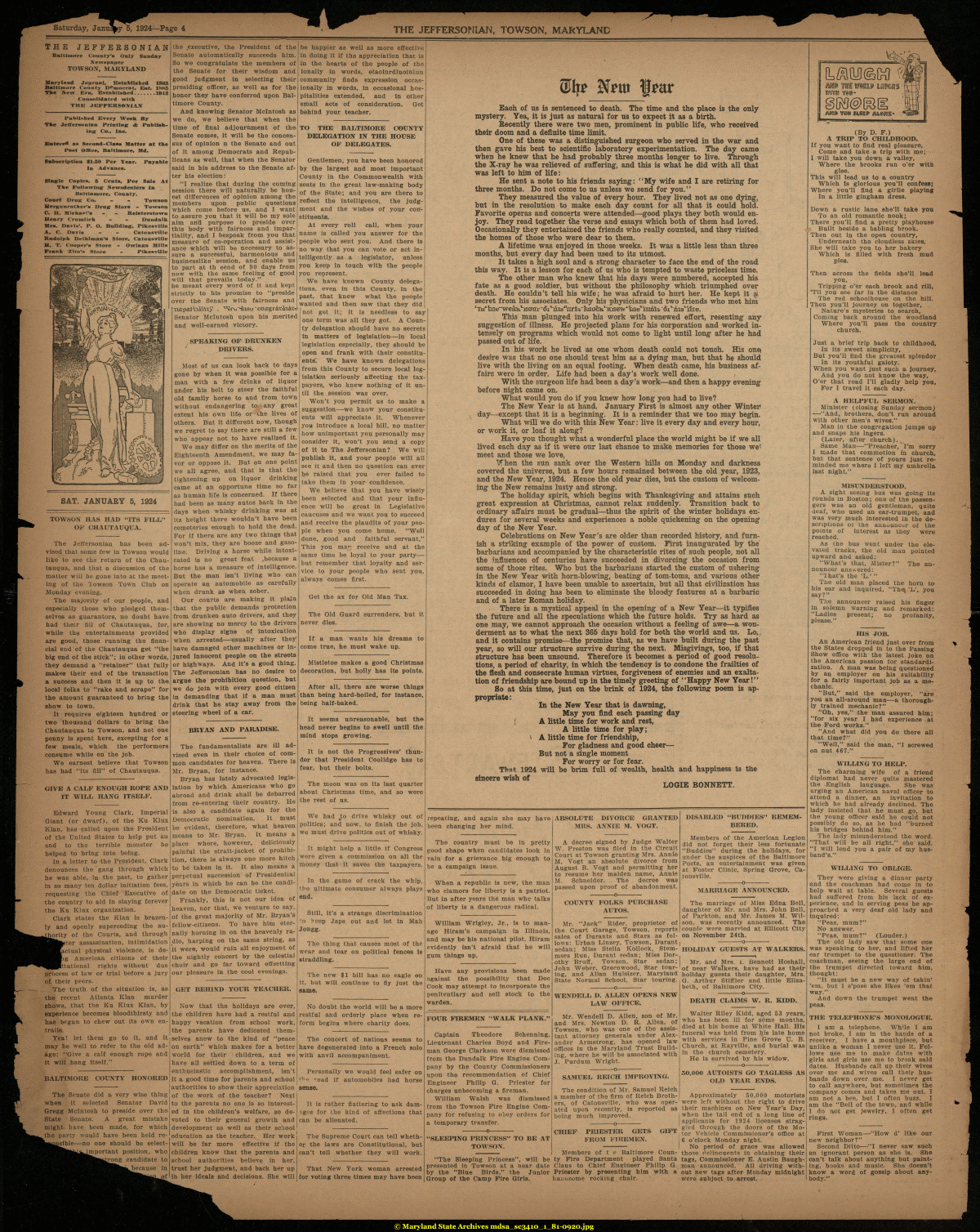
| Saturday, Janu»y 5, 1924—Page 4 THE JEFFERSONIAN, TOWSON, MARYLAND THE JEFFERSONIAN Baltimore County's Only Sunday Newspaper TOWSON, MARYLAND Maryland Journal, Established 1865 Baltimore County Democrat, Est. 1SS5 The New Bra, Established.......1913 Consolidated with THE JEFFERSONIAN Published Every Week By The Jeiiersonian Printing: & Publishing Co., Inc. Entered as Seeond-Class Matter at the Post Oftic-e, Baltimore, Md. Subscription $1.50 Per Year. In Advance. Payable Single Copies, 5 Cents, For Sale At The Following Newsdealers In Baltiomore, County. Court Drus Co. - - Towson Mergenratber's Drug Store - Towson C. H. MichaePs - - Relsterstown Henry Crumlieh - - Dundalk Mrs. Davis', P. O. Building, Pikesville A. C. Davis - - Catonsvtlle Rudolph Deihlntan's Store, Catonsville H. T. Cooper's Store - Owings Mills Frank Zlto's Store - Pikesville SAT. JANUARY 5, 1924 TOWSON HAS HAD "ITS FILL" OF CHAUTAUQUA. The Jeffersonian has been advised that some few in Towson would like to see the return of the Chautauqua, and that a discussion of the matter will be gone into at the meeting of the Towson Town Club on Monday evening. The majority of our people, and especially those who pledged themselves as guarantors, no doubt have had their fill of Chautauqua, for, while the entertainments provided are good, those running the financial end of the Chautauqua get "the big end of the stick"; in other words, they demand a "retainer" that fully makes their end of the transaction a success and then it is up to the local folks to "rake and scrape" for the amount guaranteed to bring the show to town. It requires eighteen hundred or two thousand dollars to bring the Chautauqua to Towson, and not one penny is spent here, excepting for a few meals, which the performers consume while on the job. We earnest believe that Towson has had "its fill" of Chautauqua. the ^executive, the President of the Senate automatically succeeds him. So we congratulate the members of the Senate for their wisdom and good judgment in selecting their presiding officer, as well as for the honor they have conferred upon Baltimore County. And knowing Senator Mcintosh as we do, we believe that when the time of final adjournment of the Senate comes, it will be the concensus of opinion n the Senate and out of it among Democrats and Republicans as well, that when the Senator said in his address to the Senate after his election: "I realize that during the coming session there will naturally be honest differences of opinion among the members upon public questions which come before us, and I want to assure you that it will be my sole aim and purpose to preside over this body with fairness and impartiality, and I bespeak from you that measure of co-operation and assistance which will be necessary to assure a successful, harmonious and businesslike session, and enable us to part at th eend of 90 days from now with the same feeling of good will that prevails today." he meant every word of it and kept strictly to his promise to "preside over the Senate with fairness and impartiality". We also congratulate Senator Mcintosh upon his merited and well-earned victory. SPEAKING OF DRUNKEN DRIVERS. GIVE A CALF ENOUGH ROPE AND IT WILL HANG ITSELF. Edward Young Clark, Imperial Giant (or dwarf), of the Ku Klux Klan, has called upon the President of the United States to help put an end to the terrible monster he helped to bring into being. In a letter to the President, Clark denounces the gang through which he was able, in the past, to gather in so many ten dollar initiation fees, requesting the Chief Executive of the country to aid in slaying forever the Ku Klux organization. Clark states the Klan is brazenly and openly superceding the authority of the Courts, and through pter assassination, intimidation [actual physical violence, is de-American citizens of their litutional rights without due process of law or trial before a jury of their peers. The truth of the situation is, as the recent Atlanta Klan murder shows, that the Ku Klux Klan, by experience becomes bloodthirsty and has begun to chew out its own entrails. Yea! let them go to it, and it may be well to refer to the old adage: "Give a calf enough rope and It will hang itself." Most of us can look back to days gone by when it was possible for a man with a few drinks of liquor under his belt to steer the faithful old family horse to and from town without endangering to any great extent his own life or the lives of others. But it different now, though we regret to say there are still a few who appear not to have realized it. We may differ on the merits of the Eighteenth Amendment, we may favor or oppose it. But on one point we all agree, and that is that the tightening up on liquor drinking came at an opportune time so far as human life is concerned. If there had been as many autos back in the days when whisky drinking was at its height there wouldn't have been cemeteries enough to hold the dead. For if there are any two things that won't mix, they are booze and gasoline. Driving a horse while intoxicated is no great feat .because a horse has a measure of intelligence. But the man isn't living who can operate an automobile as carefully when drunk as when sober. Our courts are making it plain that the public demands protection from drunken auto drivers, and they are showing no mercy to the drivers who display signs of intoxication when arrested—usually after they' have damaged other machines or injured innocent people on the streets or highways. And it's a good thing. The Jeffersonian has no desire to argue the prohibition question, but we do join with every good citizen in demanding that if a man must drink that he stay away from the steering wheel of a car. be happier as well as more effective in doing it if the appreciation that is in the hearts of the people of the ionally in words, etaoinrdluoinlun community finds expression occasionally in words, in occasional hospitalities extended, and in other small acts of consideration. Get behind your teacher. TO THE BALTIMORE COUNTY DELEGATION IN THE HOUSE OF DELEGATES. BRYAN AND PARADISE. Gentlemen, you have been honored by the largest and most important County in the Commonwealth with seats in the great law-making body of the State; and you are there to reflect the intelligence, the judgment and the wishes of your constituents. At every roll call, when your name is called you answer for the people who sent you. And there is no way that you can vote or act intelligently as a legislator, unless you keep in touch with the people you represent. We have known County delegations, even in this County, in the past, that knew what 'the people wanted and then saw that they did not get it; it is needless to say one term was all they got. A County delegation should have no secrets in matters of legislation—in local legislation especially, they should be open and frank with their constituents; We have known delegations from this County to secure local legislation seriously affecting the taxpayers, who knew nothing of it until the session was over. Won't you permit us to make a suggestion—we know your constituents will appreciate it. Whenever you introduce a local bill, no matter how unimportant you personally may consider it, won't you send a copy of it to The Jeffersonian? We will publish it, and your people will all see it and then no question can ever be raised that you ever failed to take them in your confidence. We believe that you have wisely been selected and that your influence will be great in Legislative caucuses and we want you to succeed and receive the plaudits of your people when you come home. "Well done, good and faithful servant," This you ma" receive and at the same time be loyal to your party— but remember that loyalty and service to your people who sent you, always comes first. Get the ax for Old Man Tax. The Old Guard surrenders, but it never dies. If a man wants his dreams come true, he must wake up. to Mistletoe makes a good Christmas decoration, but holly has its points. After all, there are worse things than being hard-boiled, for instance, being half-baked. The fundamentalists are ill advised even in their choice of common candidates for heaven. There is Mr. Bryan, for instance. Bryan has lately advocated legislation by which Americans who go abroad and drink shall be debarred from re-entering their country. He is also a candidate again for the Democratic nomination. It must be evident, therefore, what heaven means to Mr. Bryan. It means a place where, however, deliciously painful the strait-jacket of prohibition, there is always one more hitch to be taken in it. It also means a perpetual succession of Presidential years in which he can be the candidate on the Democratic ticket. Frankly, this is not our idea of heaven, nor that, we venture to say, of the great majority of Mr. Bryan's fellow-citizens. To have him eternally horning in on the heavenly radio, harping on the same string, as it were, would ruin all enjoyment of the nightly concert by the celestial choir and go far toward offsetting our pleasure in the cool evenings. It might help a little if Congress were given a commission on all the money that it saves the taxpayers. GET BEHIND YOUR TEACHER. Now that the holidays are over, the children have had a restful and happy vacation from school work, the parents have dedicated themselves anew to the kind of "peace on earth" which makes for a better world for their children, and we have all settled down to a term of enthusiastic accomplishment, isn't BALTIMORE COUNTY HONORED it a good time for parents and school [authorities to show their appreciation sense, It seems unreasonable, but the head never begins to swell until the mind stops growing. It is not the Progressives' thunder that President Coolidge has to fear, but their bolts. The moon was on its last quarter about Christmas time, and so were the rest of us. We had &to drive whisky out of politics; and now, to finish the job, we must drive politics out of whisky. In the game of crack the whip, the ultimate consumer always plays end. Still, it's a strange discrimination to freep Japs out and let in Mah Jongg. The thing that causes most of the wear and tear on political fences is straddling. The new $1 bill has no eagle on it. but will continue to fly just the same. No doubt the world will be a more restful and orderly place when reform begins where charity does. The concert of nations seems to have degenerated into a French solo with anvil accompaniment. Personally we would feel safer on fha v0a(j if automobiles had horse The Senate did a very wise thing when it selected Senator David Gregg Mcintosh to preside over the State Senate. A great mistake might have been made, for which the party would have been held re-jsible—no one should be select-Jmportant position, who trong candidate to ^because in _of of the work of the teacher? Next to the parents no one is so interested in the children's welfare, so devoted to their general growth and development as well as their school education as the teacher. Her work will be far more effective if the children know that the parents and school authorities believe in her, trust her judgment, and back her up in her ideals and decisions. She will It is rather flattering to ask damages for the kind of affections that can be alienated. The Supreme Court can tell whether the laws are Constitutional, but can't tell whether they will work. That New York woman arrested for voting three times may have been QHjf Efaro §mv Each of us is sentenced to death. The time and the place is the only mystery. Yea, it is just as natural for us to expect it as a birth. Recently there were two men, prominent in public life, who received their doom and a definite time limit. One of these was a distinguished surgeon who served in the war and then gave his best to scientific laboratory experimentation. The day came when he knew that he had probably three months longer to live. Through the X-ray he was relieved of suffering, and this is what he did with all that was left to him of life: He sent a note to his friends saying: "My wife and I are retiring for three months. Do not come to us unless we send for you.'' They measured the value of every hour. They lived not as one dying, but in the resolution to make each day count for all that it could hold. Favorite operas and concerts were attended—good plays they both would enjoy. They read together the verse and essays which both of them had loved. Occasionally they entertained the friends who really counted, and they visited the homes of those who were dear to them. A lifetime was enjoyed in those weeks. It was a little less than three months, but every day had been used to its utmost. It takes a high soul and a strong character to face the end of the road this way. It is a lesson for each of us who is tempted to waste priceless time. The other man who knew that his days were numbered, accepted his fate as a good soldier, but without the philosophy which triumphed over death. He couldn't tell his wife; he was afraid to hurt her. He kept it a\ secret from his associates. Only his physicians and two friends who met him in the weak hour of his first shock knew the limit of his life. This man plunged into his work with renewed effort, resenting any suggestion of illness. He projected plans for his corporation and worked intensely on programs which would not come to light until long after he had passed out of life. In his work he lived as one whom death could not touch. His onet desire was that no one should treat him as a dying man, but that he should live with the living on an equal footing. When death came, his business affairs were in order. Life had been a day's work well done. With the surgeon life had been a day's work—and then a happy evening before night came on. What would you do if you knew how long you had to live? The New Year is at hand. January First is almost any other Winter? day—except that it is a beginning. It is a reminder that we too may begin. What will we do with this New Year: live it every day and every hour, or work it, or loaf it along? Have you thought what a wonderful place the world might be if we all lived each day as if it were our last chance to make memories for those we* meet and those we love, When the sun sank over the Western hills on Monday and darkness covered the universe, but a few hours remained between the old year, 1923, and the New Year, 1924. Hence the old year dies, but the custom of welcoming the New remains lusty and strong. The holiday spirit, which begins with Thanksgiving and attains such great expression at Christmas, cannot relax suddenly. Transition back to ordinary affairs must be gradual—thus the spirit of the winter holidays endures for several weeks and experiences a noble quickening on the opening* day of the New Year. Celebrations on New Year's are older than recorded history, and furnish a striking example of the power of custom. First inaugurated by the barbarians and accompanied by the characteristic rites of such people, not all the influences of centuries have succeeded in divorcing the occasion from some of those rites. Who but the barbarians started the custom of ushering in the New Year with horn-blowing, beating of tom-toms, and various other kinds of clamor, I have been unable to ascertain, but all that civilization has succeeded in doing has been to eliminate the bloody features at a barbaric and of a later Roman holiday. There is a mystical appeal in the opening of a New Year—it typifies the future and all the speculations which the future holds. Try as hard as one may, we cannot approach the occasion without a feeling of awe—a wonderment as to what the next 365 days hold for both the world and us. La, and it contains promise—the promise that, as we have built during the past year, so will our structure survive during the next. Misgivings, too, if that structure has been unsound. Therefore it becomes a period of good resolutions, a period of charity, in which the tendency is to condone the frailties of the flesh and consecrate human virtues, forgiveness of enemies and an exaltation of friendship are bound up in the timely greeting of "Happy New Year!" So at this time, just on the brink of 1924, the following poem is appropriate: In the New Year that is dawning, May you find each passing day ! A little time for work and rest, A little time for play; s A little time for friendship, For gladness and good cheer— But not a single moment For worry or for fear. That 1924 will be brim full of wealth, health and happiness is the sincere wish of LOGIE BONNETT. repeating, and again she may have been changing her mind. The country must be in pretty good shape when candidates look in vain for a grievance big enough to be a campaign issue. When a republic is new, the man who clamors for liberty is a patriot. But in after years the man whc talks of liberty is a dangerous radical. William Wrigley, Jr., is to manage Hiram's campaign in Illinois, and may be his national pilot. Hiram evidently isn't afraid that he will gum things up. ABSOLUTE DIVORCE GRANTED MRS. ANNIE M. VOGT. A decree signed by Judge Walter W. Preston was filed in the Circuit Court at Towson granting Mrs. Annie M. Vogt an absolute divorce from August R. Vogt and permitting her to resume her maiden name, Annie M. Schneider. The decree was passed upon proof of abandonment. ----------o---------- COUNTY FOLKS PURCHASE AUTOS. DISABLED 'BUDDIES' BERED. REMEM- Members of the American Legion did not forget their less fortunate "Buddies" during the holidays, for under the auspices of the Baltimore Posts, an entertainment was given at Poster Clinic, Spring Grove, Catonsville. ----------o---------- MARRIAGE ANNOUNCED. The marriage of Miss Edna Bell, daughter of Mr. and Mrs. John Bell, of Parkton, and Mr. James M. Wilson, was recently announced. The couple were married at Ellicott City Have any provisions been made against the possibility that Doc Cook may attempt to incorporate the penitentiary and sell stock to the warden. FOUR FIREMEN "WALK PLANK. Captain Theodore Schenning, Lieutenant Charles Boyd and Fireman George Clarkson were dismissed from the Dundalk Fire Engine Company by the County Commissioners upon the recommendation of Chief Engineer Philip G. Priester for charges unbecoming a fireman. William Walsh was dismissed from the Towson Fire Engine Company for refusing to obey orders for a temporary transfer. ----------o———— "SLEEPING PRINCESS" TO BE AT TOWSON. Mr. "Jack" Rider, proprietor of the Court Garage, Towson, reports sales of Durants and Stars as fol- on November 24th. lows: Urban Linzey, Towson, Durant| ----------o— sedan; Miss Stella Kollock, Stem- HOLIDAY GUESTS AT WALKERS. mers Run, Durant sedan; Miss Dor-, t othy Bruff, Towson, Star sedan; Mr. and Mrs. 1. Bennett Hoshall, John Weber, Greenwood, Star tour-'0f near Walkers, have had as their ing, and Allan Hulsizer, Maryland holiday guests their daughter, Mrs State Normal School, ----------o----- Star touring. WENDELL D. ALLEN OPENS NEW LAW OFFICE. Mr. Wendell D. Allen, son of Mr. and Mrs. Newton D. R. Allen, of Towson, who was one of the assistant attorney generals under Alex G. Arthur Stiffler and little Elizabeth, of Baltimore City. ----------o---------- DEATH CLAIMS W. R. KIDD. Walter Riley Kidd, aged 53 years, who has been ill for some months, died at his home at White Hall. His funeral was held from his late home ander Armstrong, has opened lawj with services in Pine Grove U. B offices in the Maryland Trust Building, where he will be associated with J. Purdum Wright. ----------o---------- SAMUEL REICH IMPROVING. Church, at Rayville, and burial was in the church cemetery. He is survived by his widow. ----------o---------- 50,000 AUTOISTS GO TAGLESS AS OLD YEAR ENDS. The condition of Mr. Samuel Reich a member of the firm of Reich Broth- Approximately 50,000 motorists ers, of Catonsville, who was oper- were left without the right to drive ated upon recently, is reported as their machines on New Year's Day, being much improved. i when the tail end of a long line of _______0_______ j applicants for 1924 licenses strag- „_____,,„.,*„ ^,-™,o ^,T™n gl^d. through the doors of the Mo- CHIEF PRIESTER GETS GIFT, fQT vehicle Commissioner's office at FROM FTREMEN. • 6 o'clock Monday night. ---------- No period of grace was allowed Members of t e Baltimore Coun- those delinauents in obtaining their "The Sleeping Princess", will be ty Fire Department played Santa tags, Commissioner E. Austin Baugh- presented in Towson at a near date Claus to Chief Engineer Philip G. man announced. All driving with- by the "Blue Birds," the Junior Priester by presenting him with a out new tags after Monday midnight Group of the Camp Fire Girls. hanusome rocking chair. were subject to arrest. (L/AlQJftgsfrO * (By D. F.) A TRIP TO CHILDHOOD. If you want to find real pleasure, Come and take a trip with me; I will take you down a valley, Where the brooks run o'er with glee. This will lead us to a country Which is glorious you'll confess; Where you'll find a girlie playing In a little gingham dress. Down a rustic lane she'll take you To an old romantic nook; There you'll find a pretty playhouse Built beside a babling brook. Then out in the open country, Underneath the cloudless skies, She will take you to her bakery Which is filled with fresh mud pies. Then across the fields she'll lead you, Tripping o'er each brook and rill, 'Til you see far in the distance The red schoolhouse on the hill. Then you'll journey on together, Nature's mysteries to search, Coming back around the woodland Where you'll pass the country church. Just a brief trip back to childhood, In its sweet simplicity, But you'll find the greatest splendor In its youthful gaiety. When you want just such a journey, And you do not know the way, O'er that road I'll gladly help you, For I travel it each day. A HELPFUL SERMON. Minister (closing Sunday sermon) —"And, brothers, don't run around with other men's wives." Man in the congregation jumps up and snaps his lngers. (Later, after church). Same Man—"Preacher, I'm sorry I made that commotion in church, but that sentence of yours just reminded me where I left my umbrella last night." MISUNDERSTOOD. A sight seeing bus was going its rounds in Boston; one of the passengers was an old gentleman, quite aeaf, who used an ear-trumpet, and was very much interested in the descriptions 01 the announcer of the points of interest as they were reached. As the bus went under the elevated tracks, the old man pointed upward and asked: "What's that, Mister?" The announcer answered: "1 hat's the 'L.' " The old man placed the horn to his ear and inquired, "The$ 'L', you say?" The announcer raised his finger in solemn warning and remarked: "Ladies present; no profanity, please." HIS JOB. An American friend just over from the States dropped in to the Passing Show office with the latest joke on the American passion for standardization. A man was being questioned by an employer on his suitability for a fairly important job as a mechanic. "But," said the employer, "are you an all-around man—a thoroughly trained mechanic?" "Oh, yes," the man assured him; "for six year I had experience at the Ford works." "And what did you do there all that time?" "Well," said the man, "I screwed on nut 467." WILLING TO HELP. The charming wife of a friend diplomat had never quite mastered the English language. She was urging an American naval officer to attend a dinner, an invitation to which he had already declined. The lady insisted that he must go, but the young officer said he could not possibly do so, as he had "burned his bridges behind him." The lady misunderstood the word. "That will be all right," she said. "I will lend you a pair of my husband's." WILLING TO OBLIGE. They were giving a dinner party and the coachman had come in to help wait at table. Several guests had suffered from his lack of experience, and in serving peas he approached a very deaf old lady and inquired: "Peas, mum?" No answer. "Peas, mum?" (Louder.) The old lady saw that some one was speaking to her, and lifted her ear trumpet to the questioner. The coachman, seeing the large end of the trumpet directed toward him, thought: "It must be a new way of takin' 'em, but I s'pose she likes 'em that way." And down the trumpet went the peas. THE TELEPHONE'S MONOLOGUE. I am a telephone. While I am not broke, I am in the hands of a receiver. I have a mouthpiece, but unlike a woman I never use it. Fellows use me to make dates with girls and girls use me to break said dates. Husbands call up their wives over me and wives call their husbands down over me. I never get to call anywhere, but sometimes the company comes and takes me out. I am not a bee, but I often buzz. I am the "Bell of the town, and while I do not get jewelry, I often get rings. First Woman—"How d' like our new neighbor?" Second Ditto—"I never saw such an ignorant person as she is. She can't talk about anything but painting, books and music. She doesn't know a word of gossip about anybody." © Maryland State Archives mdsa_sc3410_1_81-0920.jpg |