 |
|
|
 |
|
 |
|
|||
|
||||
|
||||
|
Maryland State Archives Jeffersonian, Towson, Maryland mdsa_sc3410_1_81-0929 Enlarge and print image (3M) |
|
|
|
|
|
|
|
|||
|
||||
|
||||
|
Maryland State Archives Jeffersonian, Towson, Maryland mdsa_sc3410_1_81-0929 Enlarge and print image (3M) |
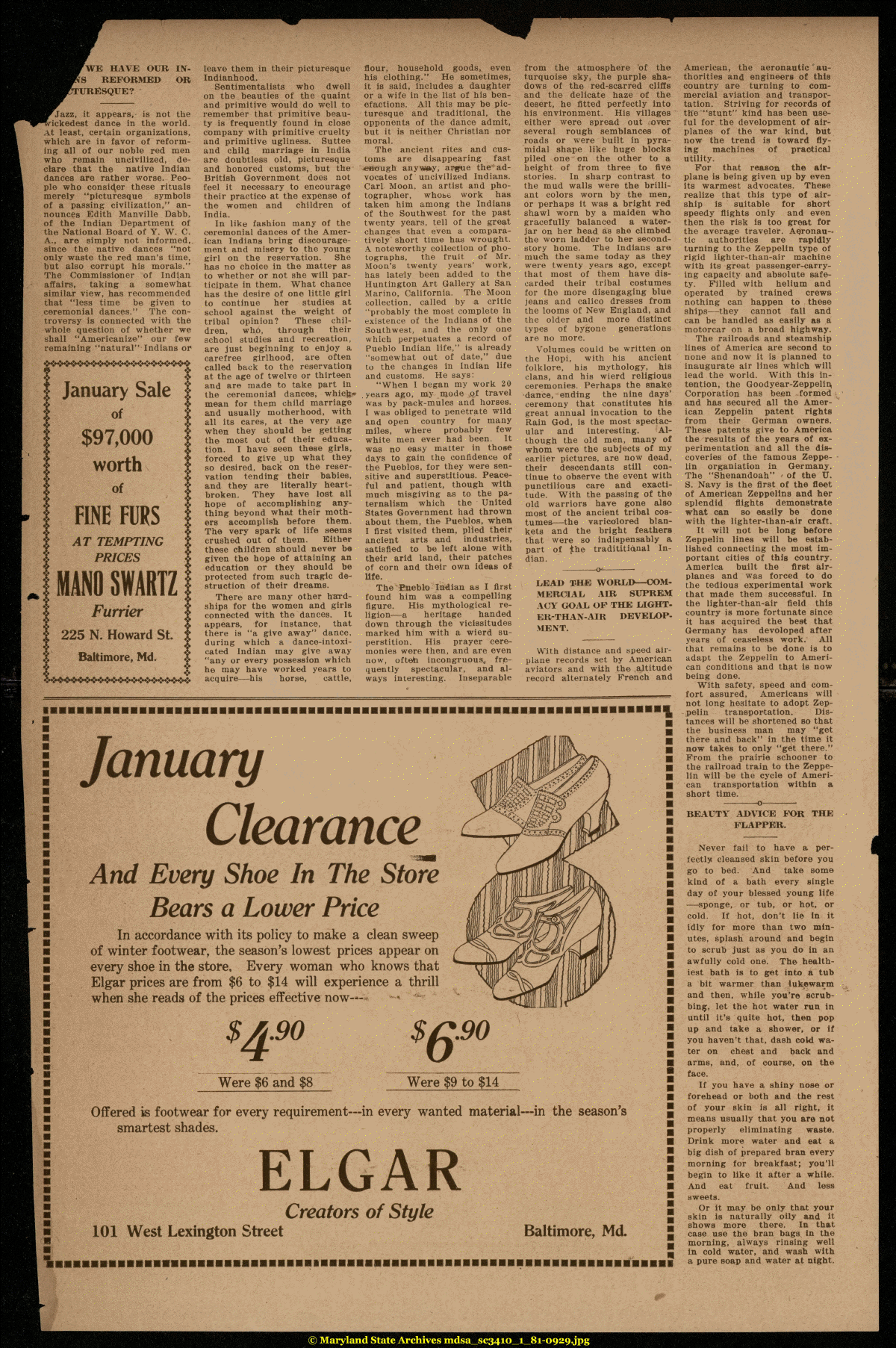
| WE HAVE OUR IN-S REFORMED OR URESQUE? Jazz, it appears, is not the ickedest dance in the world. At least, certain organizations, which are in favor of reforming all of our noble red men who remain uncivilized, declare that the native Indian dances are rather worse. People who consider these rituals merely "picturesque symbols of a passing civilization," announces Edith Manville Dabb, of the Indian Department of the National Board of Y. W. C. A., are simply not informed, since the native dances "not only waste the red man's time, but also corrupt his morals." The Commisskmer of Indian affairs, taking a somewhat similar view, has recommended that "less time be given to ceremonial dances." The controversy is connected with the whole question of whether we shall "Americanize" our few remaining "natural" Indians or 1 January Sale f of I I $97,000 | worth I of I FINE FURS | AT TEMPTING $ PRICES | | MANO SWARTZ Furrier t % I 225 N. Howard St. I 1 f X Baltimore, Md. X y t $4 .............? VVVVVVVVVVWWWWWW leave them in their picturesque Indianhood. Sentimentalists who dwell on the beauties of the quaint and primitive would do well to remember that primitive beauty is frequently found in close company with primitive cruelty and primitive ugliness. Suttee and child marriage in India are doubtless old, picturesque and honored customs, but the British Government does not feel it necessary to encourage their practice at the expense of the women and children of India. In like fashion many of the ceremonial dances of the American Indians bring discouragement and misery to the young girl on the reservation. She has no choice in the matter as to whether or not she will participate in them. What chance has the desire of one little girl to continue her studies at school against the weight of tribal opinion? These children, who, through their school studies and recreation, are just beginning to enjoy a carefree girlhood, are often called back to the reservation) at the age of twelve or thirteen and are made to take part in the ceremonial dances, which-mean for them child marriage and usually motherhood, with all its cares, at the very age when they should be getting the most out of their education. I have seen these girls, forced to give . up what they so desired, back on the reservation tending their babies, and they are literally heartbroken. They have lost all hope of accomplishing anything beyond what their mothers accomplish before them. The very spark of life seems crushed out of them. Either these children should never be given the hope of attaining an education or they should be protected from such tragic destruction of their dreams. There are many other hardships for the women and girls connected with the dances. It appears, for instance, that there is "a give away" dance, during which a dance-intoxicated Indian may give away "any or every possession which he may have worked years to acquire—his horse, cattle, flour, household goods, even his clothing." He sometimes, it is said, includes a daughter or a wife in the list of his benefactions. All this may be picturesque and traditional, the opponents of the dance admit, but it is neither Christian nor moral. The ancient rites and customs are disappearing fast •enough anyway, argue the advocates of uncivilized Indians. Carl Moon, an artist and photographer, whose work has taken him among the Indians of the Southwest for the past twenty years, tell of the great changes that even a comparatively short time has wrought. A noteworthy collection of photographs, the fruit of Mr. Moon's twenty years' work, has lately been added to the Huntington Art Gallery at San Marino, California. The Moon collection, called by a critic "probably the most complete in existence of the Indians of the Southwest, and the only one which perpetuates a record of Pueblo Indian life," is already "somewhat out of date," due to the changes in Indian life and customs. He says: "When I began my work 20 .years ago, my mode of travel was by pack-mules and horses. I was obliged to penetrate wild and open country for many miles, where probably few white men ever had been. It was no easy matter in those days to gain the confidence of the Pueblos, for they were sensitive and superstitious. Peaceful and patient, though with much misgiving as to the paternalism which the United States Government had thrown about them, the Pueblos, when I first visited them, plied their ancient arts and industries, satisfied to be left alone with their arid land, their patches of corn and their own ideas of life. The Pueblo Indian as I first found him was a compelling figure. His mythological religion—a heritage handed down through the vicissitudes marked him with a wierd superstition. His prayer ceremonies were then, and are even now, ofteb incongruous,, frequently spectacular, and always interesting. Inseparable from the atmosphere 'of the turquoise sky, the purple shadows of the red-scarred cliffs and the delicate haze of the desert, he fitted perfectly into his environment. His villages either were spread out .over several rough semblances of roads or were built in pyramidal shape like huge blocks piled one on the other to a height of from three to five stories. In sharp contrast to the mud walls were the brilliant colors worn by the men, or perhaps it was a bright red shawl worn by a maiden who gracefully balanced a water-jar on her head as she climbed the worn ladder to her second-story home. The Indians are much the same today as they were twenty years ago, except that most of them have discarded their tribal costumes for the more disengaging blue jeans and calico dresses from the looms of New England, and the older and more distinct types of bygone generations are no more. Volumes could be written on the Hopi, with his ancient folklore, his mythology, his clans, and his wierd religious ceremonies. Perhaps the snake dance, ending the nine days' ceremony that constitutes his great annual invocation to the Rain God, is the most spectacular and interesting. Although the old men, many of whom were the subjects of my earlier pictures, are now dead, their descendants still continue to observe the event with punctilious care and exactitude. With the passing of the old warriors have gone also most of the ancient tribal costumes—the varicolored blankets and the bright feathers that were so indispensably a part of £he tradititiomal Indian. ----------------ch--------------- LEAD THE WORLD—COMMERCIAL AIR SUPREM ACY GOAL OP THE LIGHTER-THAN-AIR DEVELOPMENT. With distance and speed airplane records set by American aviators and wLth the altitude record alternately French and American, the aeronautic authorities and engineers of this country are turning to commercial aviation and transportation. Striving for records of the "stunt" kind has been useful for the development of airplanes of the war kind, but now the trend is toward flying machines of practical utility. For that reason the airplane is being given up by even its warmest advocates. These realize that this type of airship is suitable for short speedy flights only and even then the risk is too great for the average traveler. Aeronautic authorities are rapidly turning to the Zeppelin type of rigid lighter-than-air machine with its great passenger-carrying capacity and absolute safety. Filled with helium and operated by trained crews nothing can happen to these ships—they cannot fall and can be handled as easily as a motorcar on a broad highway. The railroads and steamship lines of America are second to none and now it is planned to inaugurate air lines which will lead the world. With this intention, the Goodyear-Zeppelin, Corporation has been formed and has secured all the American Zeppelin patent rights from their German owners. These patents give to America the results of the years of experimentation and all the discoveries of the famous Zeppe- -lin organiation in Germany. The "Shenandoah" > of the U. S. Navy is the first of the fleet of American Zeppelins and her splendid flights demonstrate what can so easily be done with the lighter-than-air craft. It will not be long before Zeppelin lines will be established connecting the most important cities of this country. America built the first airplanes and was forced to do the tedious experimental work that made them successful. In the lighter-than-air field this country is more fortunate since it has acquired the best that Germany has devoloped after years of ceaseless work. All that remains to be done is to adapt the Zeppelin to American conditions and that is now being done. With safety, speed and comfort assured, Americans will not long hesitate to adopt Zeppelin transportation. Distances will be shortened bo that the business man may "get there and back" in the time it now takes to only "get there." From the prairie schooner to the railroad train to the Zeppelin will be the cycle of American transportation within a short time. ----------o----------- BEAUTY ADVICE FOR THE FLAPPER. Never fail to have a perfectly cleansed skin before you go to bed. And take some kind of a bath every single day of your blessed young life —sponge, or tub, or hot, or cold. If hot, don't lie In it idly for more than two minutes, splash around and begin to scrub just as you do in an awfully cold one. The healthiest bath is to get into a tub a bit warmer than lukewarm and then, while you're scrubbing, let the hot water run in until it's quite hot, then pop up and take a shower, or if you haven't that, dash cold water on chest and back and arms, and, of course, on the face. If you have a shiny nose or forehead or both and the rest of your skin is all right, it means usually that you are not properly eliminating waste. Drink more water and eat a big dish of prepared bran every morning for breakfast; you'll begin to like it after a while. And eat fruit. And less sweets. Or it may be only that your skin iB naturally oily and it shows more there. In that case use the bran bags in the morning, always rinsing well in cold water, and wash with a pure soap and water at night. January Clearance And Every Shoe In The Store Bears a Lower Price In accordance with its policy to make a clean sweep of winter footwear, the season's lowest prices appear on every shoe in the store. Every woman who knows that Elgar prices are from $6 to $14 will experience a thrill when she reads of the prices effective now— $A.90 4 $aso 6 Were $6 and $8 Were $9 to $14 Offered is footwear for every requirement—in every wanted material—in the season's smartest shades. ELGAR 101 West Lexington Street Creators of Style Baltimore, Md. #" |