 |
|
|
 |
|
 |
|
|||
|
||||
|
||||
|
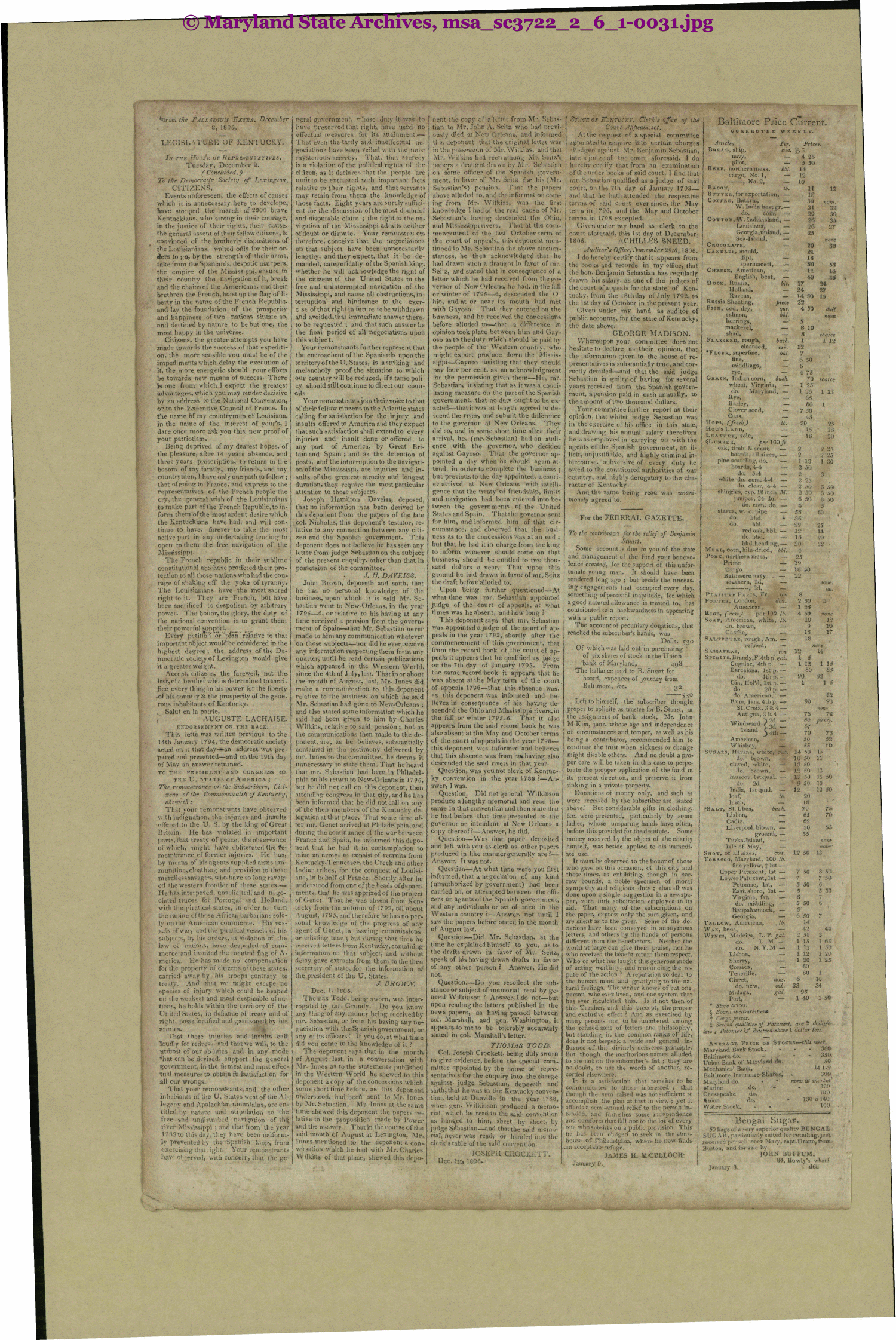
Federal Gazette & Baltimore Daily Advertiser 1807/01-1807/06 msa_sc3722_2_6_1-0031 Enlarge and print image (4M) |
|
|
|
|
|
|
|
|||
|
||||
|
||||
|
Federal Gazette & Baltimore Daily Advertiser 1807/01-1807/06 msa_sc3722_2_6_1-0031 Enlarge and print image (4M) |
|
**irom the Palladium Extra. December
8, 1806,
LEGISLATURE OF KENTUCKY.
In the ktb'st: op REPHEsExrArirES.
Tuesday, December 2.
(Concluded.)
To the Democratic Society of Lexington.
CITIZENS,
Events unforeseen, the effecis of causes
which it is unnecessary here to develope,
have sto-ped the march of 2300 brave
Kentuckiaiis, who strong in their courage,
in the justice of their rights, their cause,
the general assent of thejr fellow citizens, &
convinced of the brotherly dispositions of
the Louisianians, waited only for their or-
ders to go, by the strength of their- arms,
take from the Spaniards, despotic usurpers,
the empire of the Mississippi, ensure to
their country the navigation of it, break
and tiie chains of the Americans, and their
brethren the French, hoist up the (lag of li-
berty in the name of the French Republic
and lav the foundation of the prosperity
and happiness of (wo nations situate so,
and destined by nature to be but one, the
most happy in the universe.
Citizens, the greater attempts you have
made towards the success of that expediti-
on, the more sensible you must be of the
impediments which delay the execution of
it, the more energetic should your efforts
be towards new means of success. There,
is one from which I expect the greatest
advantages, which you may render decisive
by an address to the National Convention,
or to the Executive Council of France. In
the name of my countrymen of Louisiana,
in the name of the interest of yonr's, I
dare once more ask you this new proof of
your patriotism.
Being deprived of my dearest hopes, of
the pleasure, after 14 years absence, and
three years proscription, to return to the
bosom of my family, my friends, and my
countrymen, I have only one path to follow;
that of going to France, and express to the
representatives of the French people the
cry, the general wish of the Louisianians
to make part of the French Republic, to in-
form them of the most ardent desire which
the Kentuckians have had, and will con-
tinue to have, forever to take the most
active part in any undertaking tending to
open to them the free navigation of the
Mississippi.
The French republic in their sublime
constitutional act,"have proffered their pro-
tection to all those nations who had the cou-
rage of shaking off the yoke of tyranny.
The Louisianians have the most sacred
right to it. They are French, but have
been sacrificed to despotism by arbitrary
power. The honor, the glory, the duty of
the national convention is to grant them
their powerful support.
Every petitiorf'or 'plan relative to that
important object would'be considered in the
highest degree; the address of the De-
mocratic society of Lexington would give
it a greater weight.
Accept, citizens, the farewell, not the
last,ol'a brother who:is determined to sacri-
fice every thing in his power for the liberty
• of his country & the prosperity of the gene-
rous inhabitants of Kentucky.
k Salut en la patrie,
AUGUSTS LACHAISE.
F.KDORSEMKNT ON THE BACK.
This iette was written previous to the
14th January 1794, the democratic society
acted on it that day-*an address was pre-
pared and presented—and on the 19th day
of May an answer returned.
TO THE PRESIDENT A NO CONGRESS OF
the U. States of America, ;
T!ie remonstrance of the Subscribers, Citi-
zens of ike Commonwealth of Kentucky,
shciecth :
That your remonstrants have observed
with indignation, the injuries and insults
offered to the U. S. by the king of Great
Britain. He has violated in important
parts, that treaty of peace, the observance
of which, might have obliterated the Re-
membrance of former injuries. He has,
by means of his agent;, supplied arms am-
mujiition, cloathing and provision to those
merciless savages, who have so long ravag-
ed the western frontier of these states —
He lias interposed, uns- licked, and nego-
ciated truces for Portugal and Holland,
with the piratical states, in o'-cler to turn
the rapine ofthose Africai, barbarians sole-
ly on the American commerce. His ves-
sels i f war, and the piratical vessels of his
subiec.ts, by his orders, in violation of the
law of nations, have despoiled of com-
merce and insulted the neutral flag of A-
jnerica. Be has made no compensation
for the property of citizens of these states,
carried away by his troops contrary to
treaty. And that we might escape no
species of injury which could be heaped
on the weakest and most despicable of na-
tions, he holds within the territory of the
United States, in defiance of treaty and of
right, posts fortified and garrisoned by his
jinnies.
That these injuries and insults call
loudly for redrcv and that we will, to the
utmost of our ab lilies and in any" mode
?hat can he devised, support the general
government, in the firmest and most effec-
tu il measures to obtain fullsatisfaction for
all our wrongs.
That your rerr.onst+ants, and the other
inliabiants of the U. States west of the Al-
legany and ApalachfSn mountains, are en-
titled by¦ nature and stipulation to the
free and undistHibed navigation of the
river Mississippi ; and that from the year
1783 to this day, they have been uniform-
ly prevented by the Spanish king, from
exercising thai ighfc Your remonstrants
hem o:'^rved, with concern, that the ge-
nera! government, wliosc duty it was to
have preserved that right, have used no
effectual measures for its attainment.—
That even the tardy and inneifectual ne-
gociations have been veiled with the most
mysterious secrecy. That, that secrecy
is a violation of the political rights of the
citizen, as it declares that the people are
unfit to be entrusted with important facts
relative to their rights, and that servants
may retain from them the knowledge of
those facts. Eight years are surely suffici-
ent for the discussion of the most doubtful
and disputable claim ; the right to the na-
vigation of the Mississippi admits neither
of doubt or dispute. Your remonstra; cts
therefore, conceive that the negsciations
on that subject have been unnecessarily
lengthy, and they expect, that it be de-
manded, categorically of the Spanish king,
whether he will acknowledge the rignt of
the citizens of the United States to the
free and uninterrupted navigation of the
Mississippi, and cause all obstructions, in-
terruption and hindrance to the exer-
c se of that right in future to be withdrawn
and avoided, that immediate answer there-
to be requested ; and that such answer be
the final period of all negociations upon
this subject.
Your remonstaants further represent that
tht encroachent of the Spaniards upon the
territory of the U. States, is a striking and
melancholy proof the situation to which
our country will be reduced, ifatamepoli
cy should still coniinue to direct our coun-
cils
Your remonstrants join their voice to that
of their fellow citizens in the Atlantic states
calling for satisfaction for the injury and
insults offered to America and they expect
that such satisfaction shall extend to every
injuries and insult done or offered to
any part of America, by Great Bri-
tain and Spain ; and as the detention of
posts, and the inturruption to the navigati-
on of the Mississispi, are injuries and in-
sults of the greatest atrocity and longest
duration, they require the most particular
attention to those subjects.
Joseph Hamilton Daveiss, deposed,
that no information has been derived by
this deponent from the papers of the late
col. Nicholas, this deponent's testator, re-
lative to any connection between any citi-
zen and the Spanish government. This
deponent does not believe he has seen any
letter from judge Sebastian on the subject
of the present enquiry, other than that in
possession of the committee.
J. H. DAVEISS.
John Brown, creposelh and saith, that
he has no personal knowledge of the
business, upon which it is said Mr. Se-
bastian went to New-Orleans, in the year
1795—6, or relative to his having at any
time received a pension from the govern-
ment of Spain—that Mr. Sebastian never
made to him any communication whatever
on those subjects—nor did he ever receive
any information respecting them from any
quarter, until he read certain publications
which appeared in the Western World,
since the 4th of July, last. That in or about
the month of August, last, Mr. Innes did
make a corrrtiun'cation to this deponent
relative to the business on which he said
Mr. Sebastian had gone to New-Orleans ;
and also stated some information which he
said had been given to him by Charles
Wilkins, relative to said pension ; but as
the communications then made to the de-
ponent, are, as he believes, substantially
contained in the testimony delivered by
mr. Innes to the committee, he deems it
unnecessary to state them. That he heard
that mr. Sebastian had been in Philadel-
phia on his return to New-Orleans in 1796,
but he did not call on this deponent, then
attending congress in that city, and he has
been informed that he (lid not call on any
of the then members of the Kentucky de-
legation at that place. That some time af-
ter mr. Genet arrived r.t Philadelphia, and
during the continuance of the war between
France and Spain, he informed this depo-
nent that he had it in contemplation to
raise an army, to consist of recruits from
Kentucky,Tennessee, the Creek and other
Indian tribes, for the conquest of Louisi-
ana, in behalf of France- Shortly after he
understood from one ofthe heads of depart-
ments, that he was apprized of the-project
of Genet That he was absent from Ken-
tucky from the autumn of 1792, till about
August, 1795, and therefore he has no per-
sonal knowledge of the progress of any
agent of Genet, in issuing commissions
or blisting men ; but during that time he
received letters from Kentucky, containing
information on that subject; and without
delay gave extracts from them to the then
secretary of state, for the information of
the president ofthe U. States.
J. DROWJV.
Dec. 1, 1806.
Thomas Todd, being sworn, was inter-
rogated by mr. Grundy. Do you know
any thing of any money being received by
mr. Sebastian, or from his having any ne-
gociation with the Spanish government, or
any of its officers ?. If you do, at what time
did yen come to the knowledge of it ?
The deponent says that in the month
of August last, in a conversation with
Mr. Innes as to the statements published
in the Western World he shewed to this
deponent a copy of the concessions which
some short time before, as this deponent
understood, had been sent to Mr. Innes
by Mr. Sebastian. Mr. Innes at the same
time shewed this deponent the papers re-
lative to the proposition made by Power
and the answer. That in the course of the
said month of August at Lexington, Mr.
Innes mentioned to the deponent a con-
versation which he had with Mr. Charles
Wilkins of that place, shewed this depo-
nent the copy of'a'Vtter from Mr. Sebas-
tian to Mr. John A. Seitz who had previ-
ously died at New Orleans, and informed
this deponent that the original letter was
in the possession of Mr. Wilkins, and that
Mr, Wilkins had seen among Mr. Seitz's
papers a draught drawn by Mr. Sebastian
on some officer of the Spanish govern-
ment, in favor of Mr. Seitz f>r his (Mr.
Sebastian's) pension. That the papers
above alluded to, and the information com-
ing from Mr. Wilkins, was the first
knowledge I had of the real cause of Mr.
Sebastian's having descended the Ohio,
and Mississippi rivers. That at the com-
mencement of the last October term of
the court of appeals, this deponent men-
tioned to Mr. Sebastian the above circum-
stances, he then acknowledged that he
had drawn such a draught in favor of mr.
Sei'z, and stated that in consequence of a
letter which he had received from the go-
vernor of New Orleans, he had, in the fall
or winter of 1795—6, descended the O
hio, and at or near its mouth had met
with Gayoso. That they entered on the
business, and he received the concessions
before alluded to—that a difference in
opinion took place between him and Gay-
oso as to the duty which should be paid by
the people of the Western country, who
might export produce down the Missis-
sippi—Gayoso insisting that they should
pay four per cent, as an acknowledgment
for the permission given them—He, mr.
Sebastian, insisting that as it was a conci-
liating measure on the part of the Spanish
government, that no dutv ought to be ex-
acted—that it was at length agreed to de-
scend the river, and submit the difference
to the governor at New Orleans. They
did so, and in some short time after their
arrival, he, (mr. Sebastian) had an audi-
ence with the governor, who decided
against Gayoso. That the governor ap-
pointed a day when he should again at-
tend, in older to complete the business ;
but previous to the day appointed, a couri-
er arrived at New Orleans with intelli-
gence that the treaty of friendship, limits
and navigation had been entered into be-
tween the governments of the United
States and Spain. That the governoi sent
for him, and informed him of that cir-
cumstance, and observed that the bu?-i
ness as to the concessions was at an end ;
but that he had it in charge from the king-
to inform whoever should come on that
business, should be entitled to two thou-
sand dollars a year. That upon this
ground he had drawn in favor of mr, Seitz
the draft before alluded to.
Upon being further questioned—At
what lime was mr. Sebastian appointed
judge of the court of appeals, at what
times was he absent, and how long ?
This deponent says that mr. Sebastian
was appointed a judge of the court of ap-
peals in the year 1792, shortly after the
commencement of this government, that
from the record book of the court of ap-
peals it appears that he qualified as judge
on the 7th day of January 1793. From
the same record book it appears that he
was absent at the May term of the court
of appeals 1796—that this absence was,
as this deponent was informed and be-
lieves in consequence of his having de-
scended the Ohio and Mississippi rivers, in
the fall or winter 1795-6. That it also
appears from the said record book he was
also absent at the May and October terms
of the court of appeals in the year 1 798—
this deponent was informed and believes
that this absence was from hi*having also
descended the said rivers in thai year.
Question, was you not clerk of Kentuc-
ky convention in the year 1788 ?—An-
swer, I was.
Question. Did not general Wilkinson
produce a lengthy memorial and read the
same in that convention and then slate that
he had before that lime presented to the
governor or intendant at New Orleans a
copy thereof?—Answer, he did.
Question—Was that paper deposited
and left with you as clerk as other papers
produced in like manner generally are ?—
Answer, It was not.
Quesiittn—At what time were you first
informed, that a negociation of any kind
(unauthorized by government) had been
carried on, or attempted between the offi-
cers or agents ofthe Spanish government,
and any individuals or set of men in the
Western country ?—Answer, not until I
saw the papers before stated in the month
of August last.
Question—Did Mr. Sebastian, at the
time he explained himself to you, as to
the drafts drawn in favor of Mr. Seitz,
speak of his having drawn drafts in favor
of any other person -? Answer, He did
not.
Question.—Do you recollect the sub-
stance or subject of memorial read by ge-
neral Wilkinson ? Answer, I do not—but
upon reading the letters published in the
news papers, as having passed between
col. Marshall, and gen. Washington, it
appears to me to be tolerably accurately
stated in col. Marshall's letter.
THOMAS TODD.
Col. Joseph Crockett, being duly sworn
to give evidencs, before the special com-
mittee appointed by the house of repre-
sentatives for the enquiry into the charge
against- judge Sebastian, deposeth and
saith, that he was In the Kentucky conven-
tion, held at Danville in the year 1788,
when gen. Wilkinson produced a memo-
rial which he read to the said convention
as handed to him, sheet by sheet, by
judge Sebastian—and that the said memo
rial, never was read, or handed into the
clerk's table ofthe said convention.
JOSEPH CROCKETT.
Dec. 1st, 1606..
Sr/.rn of Exvfuczr, Clerk's office oj the
Court A/ifieals,scl.
At the request of a special committee
appointed to enquire into certain charges
alledged against Mr. Benjamin Sebastian,
late a judge of the court aforesaid, I do
hereby certify that from an examination
ofthe order books of said court, I find that
mr. Sebastian qualified as a judge of said
court, oi the 7th day of January 1793—
and that he hath attended the respective
terms of said court ever since, the May
term in 1796, and the May and October
terms in 1798 excepted.
Given under'my hand as clerk to the
court aforesaid, this 1st day ot December,
1806. ACHILLAS 8NEED.
Auditor's Office,.\ovembcrc29th, 1806.
I do hereby certify that it appears from
the books and records in my office, that
the hon. Benjamin Sebastian has regularly
drawn his salary, as one of the judges of
the court of appeals for the state of Ken-
tucky, from the 18th day of July 1792, to
the 1st day of October in the present year,
Given under my hand as auditor of
public accounts, for the staie of Kentucky,
the date above.
GEORGE MADISON.
Whereupon your committee does not
hesitate to declare as their opinion, that
the information given to the house of re-
presentatives is substantially true, and cor-
rectly detailed—and that the said judge
Sebastian is guilty of having for several
years received from the Spanish govern-
ment, a pension paid in cash annually, to
the amount of two thousand dollars.
Your committee further report as their
opinion, that whilst judge Sebastian was
in the exercise of his office in this state,
and drawing his annual salary therefrom
he was employed in carrying on with the
agents of the,Spanish government, an il-
licit, unjustifiable, and highly criminal in-
tercourse, subversive of every duty he
owed to the constituted authorities of our
country, and highly derogatory to the cha-
racter of Kentucky.
And the same being read was unani-
mously agreed to.
Baltimore Price Current.
CORRECTED W E E K I. V.
For the FEDERAL GAZETTE.
To the contributors for the relief of Benjamin
Stuart.
Some account is due to you of the state
and management of the fund your benevo-
lence created, for the support of this unfor-
tunate young man. It should have been
rendered long ago ; but beside the unceas-
ing engagements that occupied every day,
something of personal inaptitude, for which
a good natiired allowance is trusted to, has
contributed to a backwardness in appearing
with a public report.
The account of pecuniary donations, that
reached the subscriber's hands, was
Dolls. 530
Of which was laid out in purchasing
of six shares of stock in the Union
bank of Maryland, ' 498
The ballance paid to B. Stuart for
board, expences of journey from
Baltimore, &e. 33
-------53°
Left to himself, the subscriber thought
proper to solicite as trustee forB. Stuart, in
the assignment of bank stock, Mr. John
M Kim, junr. whose age and independence
of circumstances and temper, as well as his
being a contributor, recommended him to
continue the trust when sickness or change
might disable others. And no doubt a pro-
per care will be taken in this case to perpe-
tuate the propper application of the fund in
its present direction, and preserve it from
sinking in a private property.
Donations of money only, and such as
were received by the subscriber are stated
above. But considerable gifts in clothing,
&c. were presented, particularly by some
ladies, whose unsparing hands have often,
before this provided for thedestitute. Some
money received by the object of the charity
himself, was beside applied to his immedi-
ate use.
It must be observed to the honor of those
who gave on this occasion, of this city and
these times, as exhibiting, though in, nar-
row bounds, a noble specimen of moral
sympathy and religious duty; that all was
done upon a single suggestion in a newspa-
per, with little solicitation employed in its
aid. That many of the subscriptions on
the paper, express only the sum given, and
are silent as to. the giver. Some of the -do-
nations have been conveyed in anonymous
letters, and others by the hands of persons
different from the benefactors. Neither the
world at large can give them praise, nor he
who received the benefit return them respect.
Who or what has taught this generous mode
of acting worthily, and renouncing the re-
pute of the action ? A reputation so dear to
the human mind and gratifying to the na-
tural feelings. The writer knows of but one
person who ever lived, and one system that
has ever inculcated this. Is it not then of
this Teacher, and this precept, the proper
and exclusive effect ? And as exercised by
many persons not to be numbered among
the refined sons of letters ant! philosophy,
but standing in. the common ranks of life,
does it not bespeak a wide and general in-
fluence of this divinely delivered principle.
But though the meritorious names alluded
to are not on the subscriber's- list ; they are
no doubt, to use the words of another, re-
corded elsewhere.
It is a satisfaction that remains to be
communicated to those interested ; that
though the sum raised was not sufficient to
accomplish the plan at first in view ; yet it
affords a semi-annual relief to the person in-
tended, and furnishes some independence
and comforts that fall not to the lot of nvery
one whosubslsts on a public provision. This
he has been obliged to seek in the alms-
house of Philadelphia, where he now finds
an acceptable -refuge.
JAMES H. M'CULLOCH-
January 9.,
Articles. Per. Prices.
Bbead, ship, cat S3
mivy, — 4 25
pilot, — 5 50
Beef, northern mess, bbl. 14
cargo, No. 1, — 12
-----~, No. 2, — 10
Bacon-, lb. 11 12
Butter, for exportation, — 18
Cotfee, Batavia, — 30 nam.
W. India bestgr.— 31 32
do. com. — 39 30
Cotton, W. India island, — 26 35
Louisiana, —, 26 27
Georgia, upland, — 25
Sea-Island, — none
Chocolate, — 20 30
Candles, mould, 21
dipt, — 18
spermaceti, — 50 53
Cheese, American, — 11 U
English, best, — 40 45
Duck, Russia, bit. 17 24
Holland, _ 24 sr
Havens, — 14 50 15
Russia Sheeting, piece 2'2
Fish, ccd, dry, qut. 4 50 dull
salmon, bbl. none
herrings, — 5
mackerel, — 8 10
shad, — 8 scarce
Flaxseed, rough, bush. 1 1 12
cleansed, csi. 12
•Flour, superfine, bbl 7
fine, — 6 50
middlings, — 6
rye, — 4 75
Grain, Indian corn, bush. 70 scarce
wheat, Virginia, — 1 25
do. Maryland, — 1 25 1 33
Rye, _ 65
Barley, — SO 1
Clover seed, — 7 50
Oats, — 45
Hops, (fresh) lb. 20 25
Hog's Lard, — 15 ' 18
Leather, sole, — 18 20
^Lumber, per 100 ft.
oak, timb. & scant. — 2 2 25
boards, all si^es, — 2 2 25
pine scantling, do. — 1 12 1 30
boards, 4-4 — 2 50
do. 5-4 — 2 3
white do. com. 4-4 — 2 25
do. clear, 4-4 — 2 50 3 50
shingles, cyp. 18 inch M. 2 50 3 50
juniper, 24 do. — 6 50 8 50
do. com. do. ,— 4 5
staves, w. 0. pipe — 55 60
- do. hlid. 36
do. bbl. — 22 25
red oak, bbl. — 12 14
do. Mid. — 16 20
hlul. heading,— SO 32
Meal, corn,kiln-dried, bbl. 4. 1
Point, northern mess, — 25
Prime — 19
Cargo — lo' 50
Baltimore navy . „ — 22 .
southern, gd, — none.
3-1 do.
--, ou,
Platster Paris, Fr. ton 8
Porter, London, doz. 2 50 3
Americas!, — 1 25
Rice, (new) per 100 lb. 4 50 none
Soap, American, white, lb. 10 12
do. brown, —¦ 9 10
Castile, — 15 17
Saltpetre, rough, Am. — 18
refined, —- none
Sassafras, ton 12 14
Spirits,Brandy, F.'4th p'.gal. 1 5
Cog-iiiac, 4th p. — 1 12 1 15
Barcelona, 1st p. — 80 85
do. 4th p.— 90 92
Gin, Hol'd, 1st p. —- 1 1 5
do. 2d p. —
do. American, — 62
Hum, Jam. 4th p. —r §0 93
St. Croix, 3 & 4 — none
Antigua, 3 & 4 — 76 7H
--\ o.| __ Windward- ( Ti Island §m_ 62 67 70 plenty. 75
American, — 50 52
Whiskey, — 55 to
Sugars, Havana, white, rair. 14 50 15
do. brown, — 10 50 H
clayed, white, — 13 50
do. ore wn, — 12 50 13
muscov. 1st qual. — 1? 50 33 50
do; 2d — !> 50 10
India, Istqrial, — 12. U 50
loaf, lb. 20
lump, — 18
fSALT.St. Ubes, bush. 70 7&
Lisbon, — 65 70
Cadiz, — 62
Liverpool, blown, — 50 5$
ground, — 55
Turks-Island, — none
Isle of May, — none"
Shot, of all sizes, ewt. 12 50 13
Tobacco, Maryland, 100 Ih.
fine yellow, i. 1st —
Upper PStuxent, 1st — 7 50 8 50
Lower Patuxent,.l«t — 7 7 50-
Potomac, 1st, — 5 50 6
East, shore, 1st — 5 5 50
Virginia, fat, — 6 1
do. middling', — 5 50 6
Rappahannock, — 5
Georgia^ — 6 50 7
Tallow, American, , lb. 14
Wax, bees, — 42 44
Wines, Madeira, L. P. gal. 2 50 3
do. L- M. — 1 15 1 as
do. N.Y.M — 1 12 1 50
Lisbon, — 1 12 1 20
Sherry, -r- 1 20 1 25
Corsica, — 60
Teneriffe, — 80 1
Claret, doz. 6 10
do. new, csi. 33 34
Malaga, gal. 95
Port, — 1 40 1 5©
* Store prices.
§ Board measurement.
f Cargo prices.
1 Second qualities of Patuxcnt ate?, chllar*
less ; Potomac i$ Eastern-shore 1 dollar less.
Average Price of Stocks.—tA« vieet.
Maryland Bank Stock, - 360-
Baltimore do. * 350
Union Bank of Maryland |