 |
|
|
 |
|
 |
|
|||
|
||||
|
||||
|
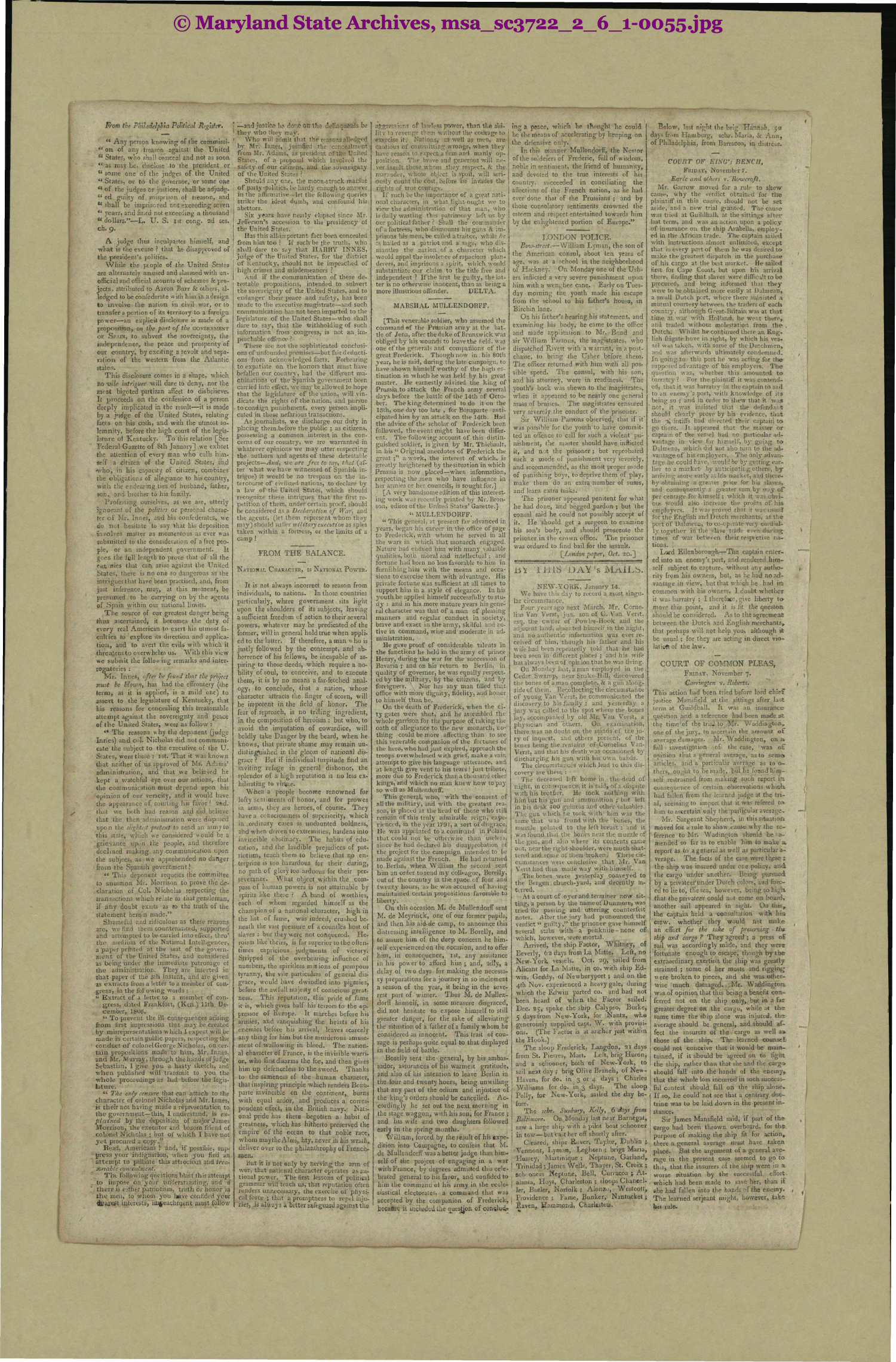
Federal Gazette & Baltimore Daily Advertiser 1807/01-1807/06 msa_sc3722_2_6_1-0055 Enlarge and print image (4M) |
|
|
|
|
|
|
|
|||
|
||||
|
||||
|
Federal Gazette & Baltimore Daily Advertiser 1807/01-1807/06 msa_sc3722_2_6_1-0055 Enlarge and print image (4M) |
| From the Philadelphia Political Router. " Any person knowing of (lie commissi- " on of any treason against the United " States, who shall conceal and not as soon *' as may bo, disclose to the president or " some one of the judges of the United "States, or to the governor, or some one " of the judges or justices, shall be adjudg- " ed guilty of, misprison of treason, and *' shall be imprisoned not exceeding seven " years, and fined not exceeding a thousand ** dollars."—L. U. S. 1st cong. 2d ses. ch. 9. A judge thus inculpartes himself, and what is the excuse \ that he disapproved of the president's politics.. While the ptople of the United States are alternately amused and alarmed with un- official and official acounts of schemes & pro- jects, attributed to Aaron Burr & others, al- ledgcd to be confederate with him in a design to involve the nation in civil war, or to transfer a portion of its territory to a foreign power—an explicit disclosure is made of a proposition, on the part of the government of Spain, to subvert the sovereignty, the independence, the peace and prosperity of ©ur country, by exciting a revolt and sepa- ration of the western from tire Atlantic states. Tiiis disclosure comes in a shape, which no •vile intriguer will dare to deny, nor the most biroted partizan affect to disbelieve. It proceeds on the confession of a person deeply implicated in the result—it is made by a j'idge of the United States, relating facts on his oath, and with the utmost so- lemnity, before the high court of the legis- lature of Kentucky. To this relation [^See Federal Gazette of 8th January] we exhort the attention of every man who calls him- self a citizen of the United States, and "who, in his capacity of citizen, combines the obligations of allegiance to his country, with the endearing ties of husband, father, son. and brother to his family. Professing ourselves, as we are, utterly ignorant of the politics or personal charac- ter if Mr. Lines, and his confederates, we do not hesitate to say that his deposition involves malter as momentous as ever was submitted to the consideration of a free peo- ple, or an independent government. It goes the lull length to prove that of all the r.ifc-.nies that can arise against the United States, there is no one so dangerous as the intrigues that have been practised, and, from just inference, may, at this moment, be presumed to be carrying on by the agents of Spain within our national limits. The source of our greatest danger being thus ascertained, it becomes the duty of every real American to exert his utmost fa- culties to explore its direction and applica- tion, and to avert the evils with which it threatens to overwhelm us. With this view we submit the following remarks and inter- rogatories : Mr. Inncs, after he found that the project must be blown, has had the effrontery (the term, as it is applied, is a mild one) to assert to the legislature of Kentucky, that his reasons for concealing this treasonable attempt against the sovereignty and peace of the United States, were as follow : " The reasons » hy the deponent (judge Innes) and col. Nicholas did not communi- cate the subject to the executive of the U. States, were these : 1st. That it was known that neither of us approved of Mr. Adams' administration, and that we believed be kept a watchful eye over our actions, that the communication must depend upon his opinion of our veracity, and it would have the appearance of courting his favor ! 2nd. that we both had reason and did believe that the then administration were disposed upon the slightest pretext to send an army to this state, which we considered would be a grievance upon the people, and therelore declined making any communication upon the subject, as we apprehended no danger from the Spanish government! " This deponent requests the committee to summon Mr. Morrison to prove the de- claration of Col. Nicholas respecting the transactions which relate to that gentleman, if any doubt exists as to the truth of the statement here n made." Shameful and ridiculous as these reasons are, we find them countenanced, supported ami attempted to be carried into effect, thro' the medium of the National Intelligencer, a paper printed at the seat of the govern- ment of the United States, and considered as being under the immediate patronage of the administration. They are inserted in that paper of the Sth instant, and are given as extracts from a letter to a member of con- gress, in the fol owing words : " Extract of a letter to a member of con- gress, dated Frankfort, (Ken.) 11th. De- cember, 1800'- " To prevent the ill consequences arising from first iinpn ssions that may be created by misrepresentations which I expect will be made in certain public papers, respecting the conduct of colonel George Nicholas, oncer- tain propositions made to him, Mr, Innes, and Mr. Ivnirray, through the hands of judge Sebastian, I give you a hasty sketch, and when published will transmit to you the whole proceedings as had before the legis- lature. " The only censure that can attach to the character of colonel Nicholas and Mr. Lines, is their not having made a representation to the government—this, I understand, is ex- plained by the deposition of major James Morrison, the executor and bosom friend of colonel Nicholas ; but of which I have not yet procured a copy." Bead, Americans ! and, if possible, sup- press your indignation, when you find an attempt to palliate this attiocious and trea- sonable concealment. The following questions blast this attempt to impose on your understanding, and if there is either patriotism, truth or honor in the men, to whom you have confided your tfeaitst interests, iajfeachiQent must follow —and jus tie.,-- !>j rJane on the delinquent be they who they may. Who will admit that the reasons all by Mr. Innes, justified the a from Mr. Adams, as president of the United States, of a proposal which involved th< safety of our citizens, and the aoveicigniy of the United States ? Should any one, the moon-struck maniac of party -politics, be hardy enough to answer in the affirmative—let the following queries strike the ideot dumb, and confound his abettors. Six years have nearly elapsed since Mr. Jefferson's accession to the presidency of the United States. Has this all-important fact been concealed from him too ! If such be the truth, wdro shall dare to say that HARRY INNES, judge of the United States, for the district of Kentucky1, should not be impeached of high crimes and misdemeanors ? And if the communication of these de- testable propositions, intended to subvert the sovereignty of the United States, and to endanger their peace and safety, has been made to the executive magistrate—and such communication has not been imparted to the legislature of the United States—who shall dare to say, that the withholding of such information from congress, is not an. im- peachable offence ? These are not the sophisticated conclusi- ons of unfounded premises—but fair deducti- ons from acknowledged facts. Forbearing to expatiate on the horrors that must have befallen our country, had the different ma- chinations of the Spanish government been carried into effect, we may be allowed Jo hope that the legislature of the union, will vin- dicate the rights of the nation, and pursue to condign punishment, every person impli- cated in these nefarious transactions. As journalists, we discharge our duty in placing them before the public ; as citizens, possessing a common interest in the con- cerns of our country, we are warranted in whatever opinions we may utter respecting the authors and agents of these detestable projects—And, we are free to say, that (af- ter what we have witnessed of Spanish in- trigue) it would be no trespass on the in- tercourse of civilized nations, to declare by a law of the United States, which should recognize these intrigues that the first re- petition of them, under certain proof, should be considered as a Declaration of War, and the agents, (let them represent whom they may) should suffer military execution as spies taken within a fortress, or the limits of a camp ! FROM THE BALANCE. National Character, is National Power. It is not always incorrect to reason from individuals, to nations. In those countries particularly, where government sits light upon the shoulders of its subjects, leaving a sufficient freedom of action to their several powers, whatever may be predicated of the former, will in general hold true when appli- ed to the latter. If therefore, a roan w ho is justly followed by the contempt, and ab- horrence of his fellows, be incapable of as- piring to those deeds, which require a no- bility of soul, to conceive, and to execute them, it is by no means a far-fetched anal- ogy, to conclude, that a nation, whose character attracts the finger of scorn, will be impotent in the field of honor. The fear of reproach, is no trifling ingredient, in the composition of heroism : but who, to avoid the imputation of cowardice, will boldly take Danger by the beard, when he knows, that private shame may remain un- distinguished in the gloom of national dis- grace ? But if individual turpitude find an inviting refuge in general dishonor, the splendor of a high reputation is no less ex- hilirating to virtue. When a people become renowned for lofty sciiiiments of honor, and for provves in arms, they are heroes, of course. They have a consciousness of superiority, which in ordinary cases is undaunted boldness, and when driven to extremities, hardens into invincible obstinacy. The habits of edu- cation, and the laudible prejudices of pat- liotism, teach them to believe that no en- terprize is too hazardous for their daring, no path of glory too arduous for their per- severance. What object within the corn- pass of human powers is not attainable by spirits like these ? A band of worthies, each of whom regarded himself as the champion of a national character, high in the list of fame, was indeed, crushed be- neath the vast pressure of a counties host of slaves : but they were not conquered. He- roism like theirs, is far superior to the.often- times capricious judgments of victory. Stripped of the overbearing influence of numbers, the spiritless coitions of pompous tyranny, the vile particulars of general dis- grace, would have dwindled into pigmies, before the awiull majesty of conscious great- ness.. This reputation, this pride of fame it is, which gives half his terrors to the sp- pressor of Europe. It marches before his armies, and vanquishing the hearts of his enemies before his arrival, leaves scarcely 1 any thing for him but the murderous amuse- ment of wallowing in blood. The nation- al character of France, is the invisible warri- or, who fust disarms the foe, and then gives him up defenceless to the sword. Thanks to the sameness of the human character, that inspiring principle which renders Bona- parte invincible on the continent, burns with equal ardor, and produces a corresl pondent effect, ia the British navy. Nati- onal pride has there begotten a habit of greatness, which has hitherto preserved the empire of the ocean to that noble race, whom may the AJmit hty, never in his wrath,. deliver over to the philanthrophy of French- men. But it is not only by nerving the arm of war, that national character operates as na- tional power. The first lessons of political grammar will teach us, that reputation often renders unnecessary, the exercise of physi- cal force ; that a promptness to repel inju- ries, is always a better safeguard against the sions of1 lawless jwwer, than the abi- ¦. ithout'he courage to se it. Nations* as well as men, are cautious of 1 '¦; wrongs, when they have re I a fini) and manly op- position. The brave and generous will ne- ver insult these whom they respect, & the ider, whose object is spoil, will seri- ously count the cost, before he invades the rights of true courage. 1 If such be the importance of a great nati- onal character, in what light ought we to view the administration of that man, who is daily wasting this patrimony left vis by our political father :' Shall the commander of a fortress, who dismounts his guns &. im- prisons his men, be called a traitor, while he :s hailed as a patriot and a sage, who dis- mantles the nation of a character which would appal the insolence of rapacious plun- derers, and imprisons a spirit, which would substantiate our claim to the title free and independent ? If the first be guilty, the lat- i ter is no otherwise innocent, than as being a more illustrious offender. DELTA. mg tt pence, which he tnonght he could he the means of accelerating by keeping on the defensive cn'.y. In this manner Mullondorff, the Nestor of the soldciers of Frederic, full of wisdom, noble in sentiment, the friend of humanity, and devoted to the true interests of his country, succeeded in conciliating the rns of the French nation, as he had ever done that of the Prussians ; and by those consolatory sentiments crowned the esteem and respect entertained towards him by the enlightened portion of Europe." MARSHAL MULLENDORFF. [This venerable soldier, who assumed the command »f the Prussian army at the bat- tle of Jena, after the duke of Brunswick was obliged by his wounds to leave the field, was one of the generals and companions of the great Frederick. Though now in his 80th year, he is said, during the late campaign, to have shown himself worthy of the high es- timation in which he was held by his great master. He earnestly advised the king of Prussia to attack the French army several days before the battle of the I4th of Octo- ber. The king determined to do it on the 1.1th, one day too late , for Bonaparte anti- cipated him by an attack on the 14th. Had the advice of the scholar of Frederick been followed, the event might have been differ- ent. The following account of this distin- guished soldier, is given by Mr. Thiebault, in his " Original anecdotes of Frederick the great ;" a work, the interest of which, is greatly heightened by thesituation in which Prussia is now placed—when information, respecting the men who have influence in her armies or her councils, is sought for.] [A very handsome edition of this interest- ing work was recently painted by Mr. Bran- Son, editor of the United States' Gazette.} " MULLENDORFF. " This general, at present far advanced in years, began his career in the office of page to Frederick, with whom he served in all the wars in which that monarch engaged. Nature had endued him with many valuable qualities, both moral and intellectual ; and fortune had been no less favorable to him in furnishing him with the means and occa- sions to exercise them with advantage. His private fortune was sufficient at all times to support him in a style of elegance. In his youth he applied himself successfully to stu- dy : and in his more mature years his gene- ral character was that of a man of pleasing manners and regular conduct iu society, brave and exact in the army, skilful and ac- tive in command, wise and moderate in ad- ministration. He gave proof of considerable talents in the functions he held in the army of prince Henry, during the war for the succession of Bavaria ; and on his return to Berlin, in quality of governor, he was equally respect- ed by the military, by the citizens, and by foreigners. Nor has any man filled that office with more dignity, fidelity, and honor to himself than he. On the death of Frederick, when the ci- ty gates were shut, and he assembled the whole garrison for tire purpose of taking the oath of allegiance to the new monarch, Bo- ttling could be more affecting than to see this venerable companion of the fortunes of the hero, who had just expired, approach the troops overwhelmed with grief, make a vain attempt to give his language utterance, and at length give vent to his tears! just tribute, more due to Frederick than,a thousand other kings, and which no man knew how to pay so well as Mullendoiff. This general, who, with the eonsent of nil the military, and with the greatest rea- son, is placed at the head of those who still remain of this truly admirable reign, expe- rienced, in the year 1791, a sort of disgrace. He was appointed to a command in Poland that could not be otherwise than useless^ since he had declared his disapprobation el the project for the campaign intended to be made against the French. He had returned to Berlin, ,when William the second sent him an order to send my c.oll<-agiie, Borelly, out of the country in the space of four and twenty hours, a.-> he was accused of having maintained certain propositions favorable to liberty. On this occasion Mi de Mullondorff sent M. de Meyrinek, one of our former pupils, and then his aid-de camp, to announce this distressing intelligence to M. Borelly, and to assure him of the deep concern he him- self experienced on the occasion, and to offer him, in consequence, 1st, any assistance in his power to afford him : and, ad!y, a delay of two days for making the necessa- ry preparations for a journey in so inclement a season of the year, it being in the seve- rest part of winter. Thus M. de Mullen- dorft himself, in some measure disgraced, did not hesitate to expose himself to still greater danger, for the sake of alleviating the situation of a father of a family whom he considered as innocent. This trait of cou- rage is perhaps quite equal to that displayed in the field of battle. Borelly sent the general, by his ambas- sador, assurances of his warmest gratitude, and also of Lis intention to leave Berlin in the four and twenty hours, being unwilling that any part of the odium and injustice of the king's orders should be cancelled. Ac- cordingly he set out the next morning in the stage waggon, with his son, for France ; and his wife and two daughters followed earlT in the spring munths. "Wilham, forced by the result of his expe- dition into Campagiie, to confess that M. de Mullendorff was a better judge than him- self of the project of engaging in a war with France, by degrees admitted this cele- brated general to his favor, and confided to him the command ot his army in the eccle- siastical electorates, a command that was accepted by the companion of Frederick, because, it included the quesjjor. of conslud,-. LONDON POLICE. Bom-street.—William Lyman, the son of the American consul, about ten years of age. was at a school in the neighborhood of Hackney. On Monday one of the Ush- ers inflicted a very severe punishment upon him with a we.ngb.ee cane. Early on Tues- day morning the youth made his escape from the school to his father's house, in Birchin lane. On his father's hearing his statement, and examining his body, he came to the office and made application to Mr. Bond and sir William Parsons, the magistrates, who dispatched Rivett with a warrant, in a post- chaise, to bring the Usher before them. The officer returned with him with all pos- sible speed,. The consul, with his son, and his attorney, were in readiness. The youth's back was shewn to the magistrates, when it appeared to be nearly one general mass of bruises. The magistrates censured very severely the conduct of the prisoner. Sir William Parsons observed, that if it' was possible for the youth to have commit- ted an offence to call for such a violent pu- nishment, the master should have inflicted it, and not the prisoner; but reprobated such a mode of punishment very severely, and recommended, as the most proper mode of punishing boys, to deprive them of play, make them do an extra numher of sums, and learn extra tasks. The prisoner appeared penitent for what he had done, and begged .pardon ; but the consul said he could not possibly accept of it. He should get a surgeon to examine his son's body, and should prosecute the prisoner in the crown office. The prisoner was ordered to find bail for the assault. [London paper, Oct. 20.^) ti\ ' 1 hi IS DAY's MAIL b. NEW-YORK, January 14. We have this day to record a most singu- lar circumstance. Four years ago next March, Mr, Corne- lius Van Vi-rst, jen. son of C. Van Verst, esq. the owner of Powlos-Hook and the lit laud, absented himself in the night, and no authentic information was ever re- ceived of him, though his father and his wife had been repeatedly told that he had been seen in different places ; and his wife has always been of opinion that he was living. On Monday last, a man employed in the Cedar Swamp, near Snake-Hill, discovered the bones of a man complete, & a gun along- side of them. Recollecting the circumstance of young Van Verst, he communicated the discovery to his family ; and yesterday a jury was called to the spot where tlie bones lay, accompanied by old Mr. Van Verst, a physician and others. On examination, there was no doubt on the minds of the ju- ry of inquest, and others present, of the hones being the it mains of Cornelius Van- Versi, and that his death v;as occasioned by discharging his gun with Ids. own bands. The circumstances which lead to this dis- covery are these : The deceased left home in the dead of night, in consequehfce; it is said, of a dispute with his brother. Me took nothing with him but his gun and ammunition ; but left in his desk 4G0 guineas and other valuables. The gun which be took with him was the same that was found with the bories, the muzzle pointed to the left breast : and it was found that tjhe bones near the muzzle ofi the gun, and also where its contents came out, nearthe right shoulder, were much shat- tered and some of then broken. These cir- cumstances weie conclusive that Mr. Van Verst had thus made way with himself. The bones were yesterday conveyed to the Beigen church-yard, and decently in- terred. At a court of oyer and terminer now sit- ting, a person by the name of Dunmore, was tried for passing and uttering counterfeit notes. After the jury had pronounced the verdict " guilty," the prisoner gave himself several stabs with a penkniie - none of which, however, were mortal. Arrived,, the ship Factor, Whitney, of Beverly, 62 days from La Matte. Left.no New-York vessels. Oct. 29, sailed from Alicant for La Matte, in co. with ship Ed- win, Geddy, of Newburyport ; and on the 4th Nov. experienced a heavy gale, during which the Edwin parted co. and had not been heard of when the Factor sailed. Dec. 25, spoke the ship Calypso, Burke, 5 days from New-York, for Nantz, who generously supplied capt. W. with provisi- ons. (The Factor is at anchor just within the Hook.) The sloop Frederick, Langdon, 21 days from St. Pierres, Mart. Left, brig Fluron, and a schooner, both of New-York, to sail next day ; brig Olive Branch, of New- Haven, for do. in 3 or 4 days ; Charles Williams for do. in 3 days. The sloop Polly, tor- New-York, sailed the day he- fore. The schr. Sunbury, Kelly, 6 days from Baltimore. On.Monday last near Barnegat, saw a large ship with a pilot boat schooner in tow—but cast her off shortly after. Cleared, ships Rover, Taylor, Dublin ;. Vermont, Lyman, Leghorn ; brigs Maria, Hussey, Martinique ; Neptune, Garland, Trinidad ; James Wells, Thayer, St. Croix ; schi oners Neptune, Bell, Curracoa ; At- aianiu, Hoyt, Charleston ; sloops Chaneel- ler, Butler,' Norfolk ; Alonzo, Westcott, Providence ; Fame, Bunker, Nantucket; Haven,. Hammond, Charlestos, Below, hist night the brig Hannah days from Hamburg, schr. Maria, & Ann, of Philadelphia, from Barracoa, in distress. covnr of Krmrs bench, Friday, November 7. Earlc and others v. Hewcroft. Mr. Garrow moved for a rule to shew cause, why the verdict obtained for the plaintiff in this cause, should not be set aside, and a new trial granted. The cause was tried at Guildhall, at the sittings after last term, and was an action upon a policy of insurance on the ship Ai-abella, employ- ed in the African trade. The captain sailed with instructions almost unlimited, except that in every part of them he was desired to make the greatest dispatch in the purchase of his cargo at the best market. He sailed first for Cape Coast, but upon his arrival there, finding that slaves were difficult to be procured, and being informed that they were to be obtained more easily at Dalmean, a small Dutch port, where there subsisted .v mutual courtesy between the traders of each country, although Great-Britain was at that time at war with Holland, he went there,, and traded without molestation from the , Dutch. Whilst he continued there an Eng- lish frigate hove in sight, by which his ves- sel was taken, with some of the Dutchmen, and was afterwards ultimately condemned. In going to this port lie was acting for the supposed advantage of his employers. The question was, whether this amounted to barratry ? For the plaintiff it was contend- ed, that it was barratry in the captain to sail to an enemy's port, with knowledge of its being so ; and in order to shew that ft was not, it was insisted that the defendant should clearly prove by his evidence, that the ;\1 intiffs had directed their captain to go th re. It appeared that the master or captain of the vessel had no particular ad- vantage in view for himself, by going to Palmena, which did »ot also turn to the ad- vantage of his employers. The only advan- tage he could have, would be by getting ear- lier to a market by anticipating; others, by arriving more early at Ms market, and there- by obtaining a greater price for bis slave?, and conseqnently a greater sum by way of per centage for himself; which it was obvi- ous would also increase the profits of his employers. It was proved that it was usual for the English and Dutch merchants, at the port of Dalrriena, to co-Operate very cordial- ly together in the slave trade even during times of war between their resptctive na- tions. ] Lard Ellenborough—The captain enter- ed into an enemy's port, and rendered him- self subject to capture, without any autho- rity from his ow7ners, but, as he bad no ad- vantage in view, but that which lie had m common with his owners, I doubt whethe? it was barratry ; I theref«c, give liberty to> move this point, and it is fit the qne^ton should be considered. As to tfiG agreement between the Dutch and English merchants, that perhaps will not help you, although it be usual ; for they are acting in direct vio- lation of the law. COURT OF COMMON PLEAS, Friday, November 7. Carringten v. Roberts. This action had been tried before lord chief justice Mansfield at the sittings after last term at Guildhall. It was an insurance question and a reference had been made at the timefof the trial to Mr. Waddington, one of the jury, to ascertain the amount ok overage damages. Mr. Waddington, on a full investigation of the ease, 'was of opinion that a general average, as to some* articles, and a. particular average as to ci- thers, ought to be made, but he fo»nclhir§- self restrained from making such report in conseouence of certain observations which* had fallen from the learned judge at the tri- al, seeming to import that it was refered to him to ascertain only the particular av< Mr. Sargeant Shepherd, in this situation* moved fon a rule to show cause why the re- ference to Mr. Wadington should be a- mended so far as to enable him to make a report as to a general as well as particular a- verage. The facts of the case were tli^se ; the ship was insured under one policy, and the cargo under another. Being pursued by a privateer under Duleh colors, and foi-c- ed to lie to, the sea, however, being so high that the privateer could net come on board, another sail appeared in sight. On this, the captain held a consultation witk his crew, whether they would not make an effort for the sake of preserving tl» ship and cargo ? They agreed ; a press o£ sail was accordingly made, and they wers fortunate enough to escape, though by the extraordinary exertion the ship was greatly strained ; some of her masts and rigging were broken to pieces, and she was other- •wise'much damaged. Mr. Waddington was of opinion that this being a benefit con- ferred not on the ship only, but in a far greater degree on the cargo, while at the same time the ship alone was injured, the average should be general, and should af- fect the insurers of the cargo as well a» those of the ship. The learned counsel could not conceive that it would be main- tained, if it should be agreed on to light the ship, rather than that she and the cargo should fall into the hands ot the enemy,, that the whole loss incurred in such success- ! ful contest should fall on the ship alone. If so,, he could not see that a contrary doc- trine was to be laid down in the present in- stance. Sir James Mansfield said, if part of tha cargo had been thrown overboard, for th«. purpose of making the ship fit for action, there a general average must have taken place. But the argument of a general ave- rage in the present case seemed to go to this, that the insurers of the ship were in a worse situation by the successful, effort which had been made to save her, than if she had fallen into the hands of the enemy. The learned Serjeant might, however, tail his mle- |