 |
|
|
 |
|
 |
|
|||
|
||||
|
||||
|
Federal Gazette & Baltimore Daily Advertiser 1807/01-1807/06 msa_sc3722_2_6_1-0059 Enlarge and print image (4M) |
|
|
|
|
|
|
|
|||
|
||||
|
||||
|
Federal Gazette & Baltimore Daily Advertiser 1807/01-1807/06 msa_sc3722_2_6_1-0059 Enlarge and print image (4M) |
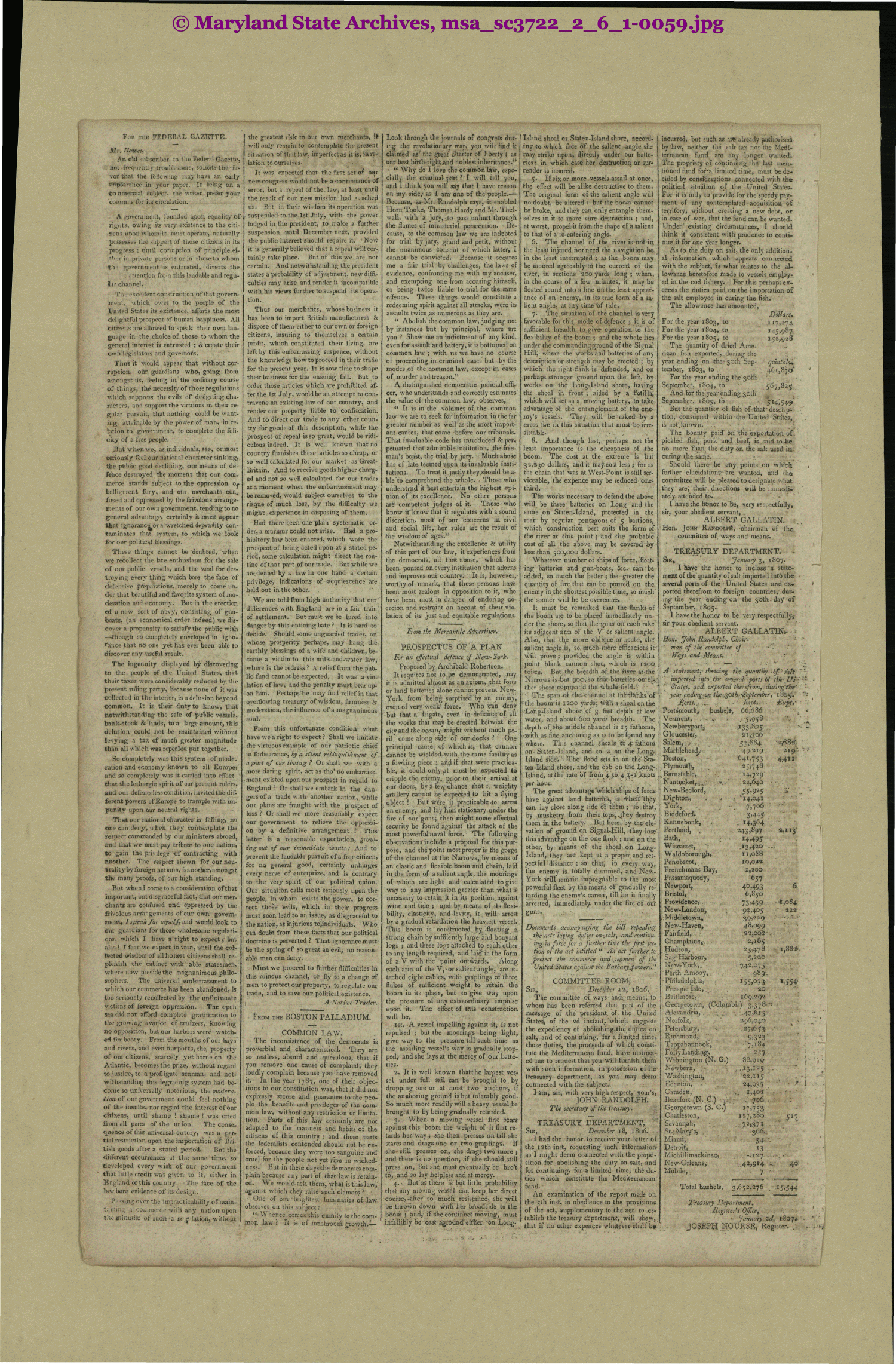
| For the FEDEtlAL GAZETTE. Mr. fleiues, An old subscribe): to the Federal Gazette, not frequently troablesarae, solicits the fa- vor that: the following may have an early rmpearance ill your paper. It being on a Co nmercial subject, the writer prefer your columns for ils circulation. A government, founded upon equslity of riguts, owing its very existence to the citi- zens upon whom it. must operate, naturally possesses the support of those citizens in its progress ; until corruption of principle ei- ther in private persons or in those to whom ti' government is entrusted, diverts the 5 attention fit a this laudable and regu- lar channel. lae excellent construction of that govern- ment, which owes to the people of the United States its existence, affords the most delightful prospect of human happiness. All citizens are allowed to speak their own lan- guage in the choice of those to whom the general interest is entrusted ; & create their own'legislators and governors. Thus it would appear that without cor- ruption, our guardians who, going from amongst us, feeling in the ordinary course of things, the necessity of those regulations ¦which suppress the evils of designing cha- racters, and support the virtuous in their re- gular pursuit, that nothing could be want- ing, attainable by the power of man, in re- lation to government, to complete the feli- city of a free people. Hut when we, as.individuals, see, or most seriously feel our national character sinking, the public good declining, our means of de- fence destroyed the moment that our com- merce stands subject to the oppression o^ belligerent fury, and otir merchants con., fused and oppressed by the frivolous arrange- ments of our own government, tending to no general advantage, certainly it must appear that ignorance or a wretched depravity con- taminates that system, to which we look for our political blessings. These things cannot be doubted, when we recollect the late enthusiasm for the sale of our public vessels, and the zeal for des- troying every thing which bore the face of defensive preparations, merely to come un- der that beautiful and favorite system of mo- deration and economy. But in the erection of a new sort of navy, consisting of gun- boats, (an economical order indeed) we dis- cover a propensity to satisfy the public wish --though so completely enveloped in igno- rance that no one yet has ever been able to discover any useful result. , The ingenuity displayed by discovering to the people of the United States, that their taxes were considerably reduced by the present ruling party, because none of it was collected in the interior, is a delusion beyond common. It is their duty to know, that notwithstanding the sale of public vessels, bank-stock & lands, to a large amount, this delusion could not be maintained without levying a tax of much greater magnitude than all which was repealed put together. So completely was this system of mode- ration and economy known to all Europe) and so completely was it carried into effect that the lethargic spirit of our present rulers, and our defenceless condition, invited the dif- ferent powers of Europe to trample with im- punity upon our neutral rights. That our national character is Killing, no one can deny, when they contemplate the respect commanded by our ministers abroad, and that we must pay tribute to one nation, to gain the privilege of contracting with another. The respect shewn for our neu- trality by foreign nations, isannther,amongst the many proofs, of our high standing. But whenl come to a consideration of that important, but disgraceful fact, that our mer- chants are confused and oppressed by the frivolous arrangements of our own govern- ment, I speak for myself, and would look to ©nr guardians for those wholesome regulati- ons, which I have a'right to expect; but alas ! I fear we expect in vain, until the col- lected wisdom of all honest citizens shall re- plenish the cabinet with able statesmen, where now preside the magnanimous philo- sophers. The universal embarrassment to which our commerce has been abandoned, is too seriously recollected by the unfortunate victims of foreign oppression. The open sea did not afford complete gratification to the growing avarice of cruizers, knowing no opposition, but our harbors were watch- ed for booty. From the mouths of our bays and rivers, and even ourports, the. property of our citizens, scarcely yet borne on the Atlantic, becomes the prize, without regard to justice, to a profligate seaman, and not- withstanding this degrading system had be- come so universally notorious, the modera- tion of our government could feel nothing of the insults, nor regard the interest of our citizens, until shame ! shame I was cried from all parts of the. union. The conse- quence of this universal outcry, was a par- tial restriction upon the importation of Bri- tish ;;oods after a stated pcrioek But the different occurrences at the same time, so" developed every wish of our government that little credit was given to it, either in England or this country. The face of the law bora evidence of its design. Passing over the impracticability of main- taining a commerce with any nation upon the jjiinutia; of such a r> e Union, without the greatest risk to our own merchants, it will only remain to contemplate the present situation ofthatlaW, imperfect as it is, in re-1 lation to ourselves- It was expected that the first act of our new congress would not be a continuance of error, but a repeal of the. law, at least until the result of our new mission had Reached us. But in their wisdom its operation was suspended to the 1st July, with the power lodged in the president, to make a further suspension until December next, provided the public interest should require it. ' Now it is generally believed that a repeal will cer- tainly take place. But of this we are not certain. And notwithstanding the president states a probability of adjustment, new diffi- culties may arise and render it incompatible with his views further to suspend its opera- tion. Thus our merchants, whose business it has been to import British manufactures & dispose of them either to our own or foreign citizens, insuring to themselves a certain profit, which constituted their living, are left by this embarrassing suspence, without the knowledge how to proceed in their trade for the present year. It is now time to shape their business for the ensuing fall. But to order those articles which are prohibited af- ter the 1st July, would be an attempt to con- travene an existing law of our country, and render our propert}' liable to confiscation. And to direct our trade to any other coun- try for goods of this description, while the prospect of repeal is so great, would be ridi- culous indeed. It is well known that no country furnishes these articles so cheap, or so well calculated for our market as Great- Britain. And to receive goods higher charg- ed and not so well calculated for our trade> at a moment when the embarrassment may be removed, would subject ourselves to the risque of much loss, by the difficulty we might experience in disposing of them. Had there been one plain systematic or- der, a murmur could not arise. Had a pro- hibitory law been enacted, which wore the prospect of being acted upon at a stated pe- riod, some calculation might direct the rou- tine of that part of our trade. But while we are. denied by a law in one hand a certain privilege, indications of acquiescence are held out in the other. We are told from high authority that our differences with England are in a fair train' of settlement. But must we be lured into danger by this enticing bate ? It is hard to decide. Should some unguarded trader, on whose prosperity perhaps, may hang the earthly blessings of a wife and children, be- come a victim to this milk-and-water law, where is the redress ? A relief from the pub- lic fund cannot be expected. It was a vio- lation of law, and the penalty must bear up- on him. Perhaps he may find relief in that overflowing treasury of wisdom, firmness & moderation, the influence of a magnanimous soul. From this unfortunate condition what have we a right to expect ? Shall we imitate the virtuous example of our patriotic chief in forbearance, by a silent relinquishment of a part of our living ? Or shall we with a more daring spirit, act as tho' no embarrass- ment existed upon our prospect in regard to England '. Or shall we embark in the dan- gers of a trade with another nation, while our plans are fraught with the prospect of loss ? Or shall we more reasonably expect our government to relieve the oppressi- on by a definitive arrangement ? . This latter is a reasonable expectation, grow- ing out of our immediate 'wants : And to prevent the laudable pursuit of a free citizen, for no general good, certainly unhinges every nerve of enterprize, and is contrary to the very spirit of our political union. Our situation calls most seriously upon the people, in whom exists the power, to cor- rect those evils, which in their progress must soon lead to an issue, as disgraceful to the nation, as injurious toiindividua'ls. Who can doubt from these facts that our political doctrine is perverted ? That ignorance must be the spring of so great an evil, no reason- able man can deny. Must we proceed to further difficulties in this ruinous channel, or fly to a change of men to protect our property, to regulate our trade, and to save our political existence. A Native Trader. From the BOSTON PALLADIUM. COMMON LAW. The inconsistence of the democrats is proverbial and characteristical. They are so restless, absurd and querulous, that if you remove one cause of complaint, they loudly complain because you have removed it. In the year 1787, one of their objec- tions to our constitution was, that it did not expressly secure and guarantee to the peo- ple the benefits and privileges of the com- mon law, without any restriction or limita- tion. Parts of this law certainly are not adapted to the manners and habits of the citizens of this country ; and those parts ths federalists contended should not be en- fotced, because they were too sanguine and cruel for the people not yet ripe in wicked- ness. But in these days the democrats com- plain because any part of that law is retain- ed. We would ask them, what/is this law, against which they raise such clamors ? : One of our brightest luminaries of law observes on this subject: " Whence, comes this enmity to the com- mon, law I It « ef mnshroom growth.-^— Look through the journals of congress dur- ing the revolutionary war, you will find it claimed as the great charter of liberty 5 as our best birfh-right.and noblest inheritance." " Why do I love the common law, espe- cially the criminal part ? I will tell you, and I think you will say that I have reason on my side,' as I am one of the people.—¦* Because, as Mr. Randolph says, it enabled Horn Tqoke, Thomas Hardy and Mr. Theh wall, with a. jury, to pass unhurt through the flames of ministerial persecution. Be- cause, to the common law we are indebted for trial by jury, grand and petit, without the unanimous consent of which latter, I cannot be convicted. Because it secures me a fair trial by challenges, the laws of evidence, confronting me with my accuser, and exempting one from accusing himself, or being twice liable to trial for the same offence. These things would constitute a redeeming spirit against all attacks, were its assaults twice as numerous as they are. " Abolish the common law, judging not by instances but by principal, where are you ? Shew me an indictment of any kind, even for assault and battery, it is bottomed on common law ; with us we have no course of proceeding in criminal cases but by the modes of the common law, except in cases of murder and treason." A distinguished democratic judicial offi- cer, who understands and correctly estimates the value of the common law, observes, " It is in the volumes of the common law we are to seek for information in the far greater number as well'asthe most import- ant causes, that come before our tribunals. That invaluable code has introduced & per- petuated that admirable institution, the free- man's boast, the trial by jury. Much abuse has of late teemed wpon its invalnable insti- tutions. To treat it justly they.should be a- ble to comprehend the whole. • Those who understrnd it best entertain the highest opi- nion of its excellence, No other persons are competent judges of it. Those who know if know that it regulates with a sound discretion, most of our concerns in civil and social life, her rules are the result of the wisdom of ages." Notwithstanding the excellence & utility of this part of our law, it experiences from the democrats, all that abuse, which has been poured on every institution that adorns and improves our country. ..It is, however,- worthy of remark, that those persons have been most zealous in opposition to it, who have been most in danger of enduring co- ercion and restraint on accout of their vio- lation of its just and equitable regulations. From the Mercantile Advertiser. PROSPECTUS OF A PLAN For an effectual defence of New-York. . Proposed by Archibald Robertson. It requires not to he demonstrated, nay it is admitted almost as an axiom, that forts or land batteries alone cannot prevent New- York from being surprised by an enemy, even of very weak force. Who 'Call deny but that a frigate, even in defiance of all the xvorks that may be erected betwixt the city and the ocean, might without much pe- ril, come along side of our docks ? : One principal cause... of which is, that cannon cannot be wielded-with. the-same facility as a fowling piece ; and if that were practica- ble, it could only pt most be expected to cripple-the enemy, prior to their arrival at our doors, by a few chance shot:, weighty artillery cannot be expected to hit a flying object ! But were it practicable to arrest an enemy, and lay him stationary under the fire of our guns; then might some effectual security be found against the attack of the most powerfulnaval force. The following observations include a proposal for this pur- pose, and the point most proper is the gorge of the channel at the Narrows,, by means of an elastic and flexible boom and chain, laid in the form of a salient angle, the moorings of which are light and calculated to give way to any impression greater than what is necessary to retain it in its position.against wind and tide ; and by means of its flexi- bility, elasticity, and levity, it will arrest by a gradual retardation the heaviest vessel. This boom is constructed by floating a strong chain by suffiiently large and bouyant logs ; and these logs attached to each other to any length required, and laid in the form of a V with the point outwards." Along each arm of the V, ¦ or salient angle, are at- tached eight cables, with graplings of three flukes of sufficient weight to retain the boom in its place, but to give way upon the pressure of any extraordinary impulse upon it. The effect of this construction wdl be, 1st. A vessel impelling against it, is not repulsed ; but the moorings being light, give way to the pressure till such time as the assailing vessel's way is gradually stop- ped, and she lays at the mercy of Our batte- ries. 2. It is well known that the largest ves- sel under full sail can be brought to by dropping one or at most two anchors, if the ansboring ground is but tolerably good. So much more readily will a heavy vessel be brought to by being gradually retarded. 3. When a moving vessel first bears against this boom the weight of it first re- tards her way-; she then presses on till she starts and drags one or two graplings. If she still presses on, she drags two more ; and there is no question, if she should still press on, but she, must eventually be bro't to, and so lay helpless and at mercy. 4. But as there is but little probability that any moving vessel can keep.her direct course, ¦after so much resistance, she will be thrown down with her br'uadside to'the boom ; and, if she continues moving, must infallibly be least agrdiind''-eitfcer an Long- Island shoal or Staten-Island shore, accord- ing to which face of the salient angle she may strike upon, directly under our batte- ries J in which case her destruction or sur- render is insured. 5. If six or more vessels assail at once, the effect will be alike destructive to them. The original form of the salient angle will no doubt, be altered : but the boom cannot be broke, and they can only entangle them- selves in it to more sure destruction ; and, at worst, propel it from the shape of a salient to that of a re-entering angle. 6. The channel of the river is not in the least injured nor need the navigation be in the least interrupted ; as the boom may be moored agreeably to the current of the river, in sections 2O0 yards, long ; when, in the course of a few minutes, it may be floated round into a line on the least appear- ance of an enemy, in its true form of a sa- lient angle, at any. time of tide. 7. The situation of the channel is very favorable for this mode of defence ; it is of sufficient breadth to give- operation to the flexibility of the boom ; and the whole lies under the commandingground of the Signal Hill, where the works and batteries of any description or strength mav be erected ; by which the right flank is defended, and on perhaps, stronger ground upon the left, by works on the Long-Island shore, having the shoal in front ; aided by a fotilla, which will act as a moving battery, to take advantage of the entanglement of the ene- my's vessels. They, will be raked by a ' cross fire in this situation that must be-irre- sistable- , • . , 8. And though last, perhaps not the least importance is the cheapness of the boom. The cost at the extreme is but 32,230 dollars, audit may. cost less ; for as the chain that was at West-Point is still ser- viceable, the expence may be reduced one- third. The works necessary to defend the above will be three batteries on Long and the same on Staten-Island, protected in the rear by regular pentagons of 5 bastions, which construction best suits the form of the river at this point ; and the probable cost of all the above may be covered -by less than 500,000 dollars. Whatever number of ships of force, float- ing batteries and gun-boats, &c. can.be added, so much the better; the greater the quantity of fire that can be poured' on the enemy in the shortest possible time, so much the sooner will he he overcome. It must be remarked that the flanks of the boom are to be placed immediately un- der the shore, so that, the guns on each rake its adjacent arm of the V or salient: angle. Also, that the. more oblique ,or acute, the salient nagle.is, so, much more efficacious if will prove; provided the angle is within point blank cannon shot, which is 1200 toises. But. the breadth of the river at-the Narrows is hut 900, so that batteries on'ej-,' tber shore command the whols-field.'; ' The span of the. channel at the-flahks'af the boom is 1200 yards; wiffi a shoal on the LohgJsland shore of 3 feet depth at low Water, and about 600 yards breadth. The depth of the middle channel is 15 fathoms, ¦ with as fine anchoring as is to be found any where. This channel shoals to 4 fathom on Staten-Island, and to 2 on the Long-, Island side.' The flood sets in on the Sta- ten-Island shore, and the ebb on the Long-. Island, at the rate of from 4 jib 4. 1-2 knots per hour. The great advantage which ships of force have against land batteries, is Whetf they can lay close along side of them ; so that, by musketry from their tops, .they destroy them in the battery. But here, by the ele- vation of ground on Signal-Hill, they lose this advanthge on the one flank ; and on the other, by means of the shoal on Long- Island, they are kept at a proper and res- pectful'distance ; so that, in every way, the enemy is totally disarmed, and New- York will remain impregnable to the most powerful fleet by the means of gradually re- tarding the enemy's career, till he is finally arrested, immediately, under the fire of our guns. ,: Documents accompanying the bill repealing the acts laying Allies on-.salt, and continu- ing in force for a further time the first sec- tion of the act intitled " An act further, to . protect the commerce and seamen of the United States against the Barbary.po'wers." COMMITTEE ROOM-; •' Sir, December 12, 1806. The committee of ways ¦ and., means, to whom has been referred that part of the message of the president, of. the United States, of the 2d instant, which suggests the expediency of abolishingwthe duties- on salt, and of continuing, for a limited time, those duties, the proceeds of which consti- tute the Mediterranean fund, have instruct- ed me to request that you Will-furnish. tliem with such information, in possession of the treasuary department, as you may deem connected with, the subject.. 1 am, sir, with very high respect, your's, JOHN RANDOLPH. The secretary of the treasury. TREASURY DEPARTMENT, Sir, December 18, 1806. I had the honor to receive your letter of the 12th inst, requesting such information- as I might deem connected with the propo- sition for abolishing the duty on salt, and for continuing, for a limited time, the du- ties which constitute the Mediterranean fund. . An examination of the report made on the Cth inst. in obedience to the provisions of the act, supplementary to the act to es- tablish the treasury department, will shew, that if no other expences whatever shall b# incurred, but such as are already authorised by law, neither the salt tax nor the Medi- terranean fund are any longer wanted. The propriety of continuing the last men- tioned fund for'a limited time, must be de- cided by considerations connected with the political situation of the United States. For it is only to provide for the speedy pay- ment of any contemplated acquisition of territory, without creating a new debt, or in case of war, that the fund can be wanted. Under existing circumstances, I should think it' consistent with prudence to conti- nue it for one year longer. As to the duty on salt, the only addition- al information wh ch appears connected with the subject, is what relates to the al- lowance heretofore made to vessels employ- ed in the cod fishery. For this perhaps ex- ceeds the duties paid on the importation of the salt employed in curing the fish. The allowance has amounted, Dollars. "7»*74 145,987 152,928 quintals* 461,87a" 56.7^25:. 5U,S19 For the year 1803, to For the year 1804, to For the year 1805, to ¦ The quantity of dried Ame- rican fish exported, during the year -ending on the; 30th Sep- tember, 1803, to. For the year ending the 30th September, 1804, to And for the year "ending. 30th September, 1805, to But the.quantity of fish of-that" descrip- tion, consumed within the United States, is not.kmwn. The bounty paid on the exportation of- pickled fish, pork'and beef, is said to-be- no more than the duty on the salt used in. curing the same. Should there- -be any points on which further elucidations'-are wanted, and she committee will be pleased to designate •. :,at they are, their directions will be immedi- ately attended to.. I have the honor to be, very respectfully, sir, your obedient servant, ALBERT GALLATIN. I, Hon. John Randolph", -chairman of the, committee of ways and means. TREASURY DEPARTMENT. - Sir,. January 3, 1807. I have the honor to inclose a state- ment of the quantity of salt imported into the ¦ several ports of the United States and ex- ported therefrom to foreign countries, dur- ing the year ending on the 30th day" of September, 1805. I have the hone* to be very respect fully-j sir your obedient servant. ALBERT GALLATIN* Hon. John Randolph, Chair- ' man of the committee oj - , Ways and Means. •.-"'„! A statement,-she-w'nrg the'quaiitny-bf-shlt imported into the several"ports of the- Ut '" States, and exported therefrom, durhig'fbe' year .ending-on tlx -,30/6.^September, 1805. :P,orts.-.„ . Impt. ¦ ¦-¦¦ Expt.- Portsmouth,, bushel*, 66,686 Vermqnt, ¦¦¦.'.. .-. . ,5,958 Newburyport, .133,805 Gloucester, 21,306 Salem,...- -. Marhleheady Boston, Plymouth., . Barnstable, Nantucket,-;;.;. . - - New-Bedford, Dighton, York, Biddeford. Kennebunk, Portland, Bath, Wiscasset, Waldoborough, Penobscot, . Frenchmans Bay, Passamaquody, Newport, Bristol, Providence, New-London, Middletown, New-Haven, Fairfield, Chanipl.aine,-, . Hudson, Sag Harbour* New-York,. Perth Aniboy, Philadelphia, Presque Isle, Baltimore, 53v884 -3^8* 49,219 219' 641,7 53 4)4ii 25>748 I4>72?' 24,64b ¦ 55*92* £ , "14,041 :. 1,106 3 '445 ' ' I4,364 243,897 2,113 14,495 ' .13.420 '..... II,02'8 IO,OJ* 1,200 657 40,493 6. 6,850 73.439. 4,084 92,405 ' 222 39,229 48,099 .22,002-.' 2,185 23,478 1,88-*, 5.2QO ¦ 742,375' .-'. 989-. 155,073 *>0* ¦20 169,292 .Georgetown, (Columbia) 3,378*: Alexandria,. -.. . ..47,6,15:- Norfolk, 296,040 Petersburg, . 37^53 Richmond, '.- ' 9,323' Tappahannock, • "7,184 Folly Landing, . 257 Wilmington (N. G.) 88,919 Newbern, ¦ . ..13,125 Washington, 22,115 Ed'entbn, ¦¦•• 24,937 Camden, ... 1,401 Beaufort (N, C\) :,.. ,,706 Georgetown (S. C.) *7,753 Charleston, 127,280. Savannah, - 72*37* St.; Mary's, , 366-.' Miami, - 34. , Detroit, 13 Michillimackinao, —127 . New-Orleans, -....42,914 ': Mobile, 7 .40 Total bushels, 3,652,276 15,544 treasury Department, Register's OJ/ice, ,- January id, 1807/ -JOSEPH NOURSE, Register. .' |