 |
|
|
 |
|
 |
|
|||
|
||||
|
||||
|
Federal Gazette & Baltimore Daily Advertiser 1807/01-1807/06 msa_sc3722_2_6_1-0143 Enlarge and print image (4M) |
|
|
|
|
|
|
|
|||
|
||||
|
||||
|
Federal Gazette & Baltimore Daily Advertiser 1807/01-1807/06 msa_sc3722_2_6_1-0143 Enlarge and print image (4M) |
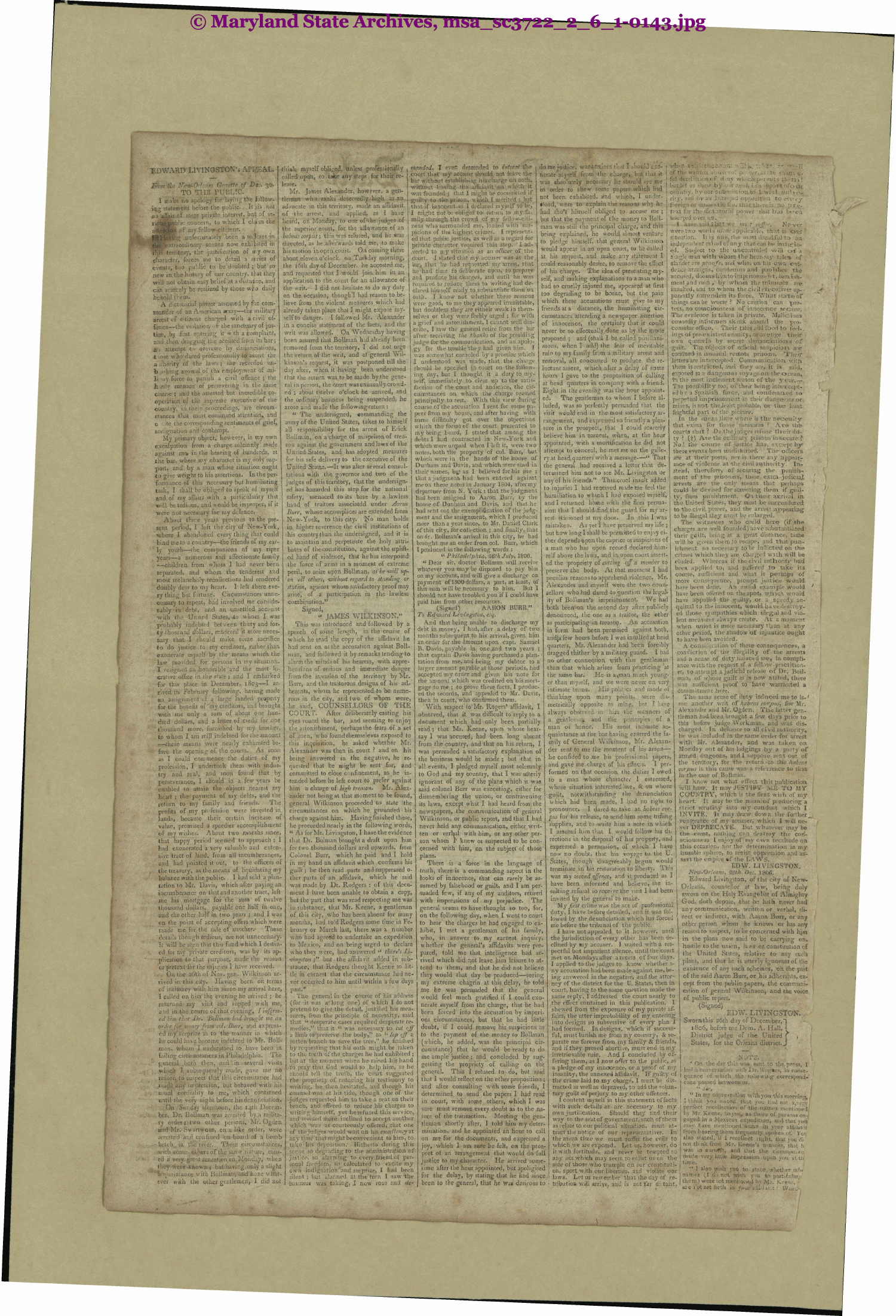
| EDWARD LIVINGSTONE APICAL. Fr^n il- Weiil-Orkahs Gnzette of D%c. 30. TO THE PUBLIC. I Br.aWno apology for laying the follow- in',.; st«rt«f»«nt before the public. It pis not private interest, but; of s»- rjJ^Btiblk: concern, to which I cht'-m the on of ray fellow-citizens. J^Hpng .unfortunately been a sulLrer ordinary scenes now exhibited in ;•;, the justification of my own character, 'forces roe to detail a t< ries of eventii, too public to be doubted ; but so new in the history of our country, that they will not obtain easy belief at a distance, and can scarcely be realized by those wfo daily behold them. A dictatorial power assumed by tie com- raartdsr of an American army—the military arrest of citizens charged with a civil of- fence—the violation of the sanctuary of jus- tice, by first entering it w tb a complaint, and then dragging the accused from its bar-; a 1 attempt to qverawe by dcrkmciations, t lose who dared professionally to assert the a .ihority of the laws; the recorded un- b ashing avowal of ths employment of .mi- lt iy force to punish a civil offence ; the hardy menace of persevering in the same course ; and the asserted but incredible co- operation ot die supreme executive of the country, in these proceedings, are circum- stances that must command attention, and c ite the corresponding sentiments of grief, mi riti contempt. My primary object, however, is my own exculpation from a charge solemnly made against me» in the hearing of hundreds, at the bar. where my character is my only sup- port, and. by a man whose situation ought to give weight to his assertions. In the per- formance of this necessary but humiliating task, I shall be obliged to speak of myself and of my affairs with a particularity that will be tedious, and « ould be improper, if it ¦were not necessary for my defence. About three years previous to the pre- sent period, I left the city of New-York, where 1 abandoned every thing that could bind me to a country—the friends of my ear- ly youth—the companions of my riper years—a numerous and affectionate family —children from whom 1 had never been separated, and whom the tenderest and most melancholy recollections had rendered doubly dear to my heart. I left there eve- ry thing but fortune1. Circumstances unne- cessary to repeat, had involved me conside- rably in debt, and an unsettled account ¦with tin: United States, 4.0 whom I was probably indebted between thirty and for- ty thousand dollar.,, rendered it more neces- sary that 1 should make some sacrifice to do justice to my creditors, rather than exonerate myself by the means which the law provided for persons in my situation. 1 resigned an honorable'and the most lu- crative office in the state ; and I embarked for this place in December, 1803—I ar- rived in February following, having made an as landed property for the benefit of my creditors, and brought with mi only a sum of about one hun- dred dollars, and a letter of c thousand more, furnished by to whom I am still indebted for the amount —these means were nearly exhausted be- fore the opening of the courts. As soon as I could commence the duties of my profession, I undertook them with indus- try and zeal, and soon found that by I should in a few years ;. ranee, be enabled to attain the objects nearest my heart ; the payment of my debts, and the return to my family and friends. The profits of my profession were invested in lands, because their certain increase of value, promised a speedier accomplishment of my wishes. About two months since, that happy period seemed to approach ; I bad exonerated a very valuable and exten- sive tract of land, from all mcumberances, and had pointed it out, to the officers of the treasury, as the means of liquidating my balance with the public. I had sold a plan- tation to Mr, Davis, which after paying an incumberancc on that and another tract, left me his mortgage for the sum of twelve thousand dollars, payable one half in one, and the other half in two years ; and I was on the point of accepting oifers which were made me for the sale of another.- These fietails though tedious, are not unnecessary. It will be sepn that this fund which 1 destin- ed for my private creditors, was by its ap- plication to that purpose, made the reason cr pretext for the injuries I have received. On the 26th of Nov. gen. Wilkinson ar- rived in this city. Having been on terms of intimacy with him since my arrival here, I called on him the evening he arrived j he returned my visit and supped with me, and in the course of that evening, / inform- ed him that Dr. Bcihnan ixul brought me an order , from col. Burr, and axpress- rd my surprize as to the manner in which lie couhl have b.come indebted to Mr. Boll- whoin I understood to have been in failing circumstances in Philadelphia. The ten, and in several -visits which 1 subsequently made, gave me no reason.to suspect that this circumstance had impression, but behaved with his usual cordiality to me, which continued until the very night before his denunciation. On Sunday afternoon, the 14th Decem- ber, Dr. Bollman was arrested by a milita- . ry order: two other persons, Mr. Ogden and Mr. Swartwout, on a like order, were arrested and confined on board of a bomb ketch in the iiver. These circumstances, with sen:", others of the sarr.e nature, caus- ed a v md .y, when they -were Known $ but haying only a slight lecjuaintance with Boll ever with the other gentlemen, I did not th.ittk myself oblige,!, unless professionally called upon, to take any steps for their re- lease. Mr. James Alexander, however, a gen- tleman wh> ranks deservedly ..high as an advocate in this territory, mads an affidavit, of the arrest, and applied), as I have heard, on Monday, to one of'the judges of the superior court, for the allowance of an tabids corpus; this was refused, and he was directed, as he afterwards told me, .to make his motion in open court. On coming there about eleven o'clock, on Tuc*day morning, the 16th day of December, he accosted me, and requested that I would join him in all application to the court for an allowance of the writ. I did not hesitate to do my duty on the occasion, though! had reason to.be- lieve from, the violent measures which had already taken place that I might expose my- self to danger. I followed Mr. Alexander in a concise statement of the facts, and the writ was allowed. On Wednesday having been assured that Boilman had already been removed from the territory, I did not urge the return of the writ, and at general Wil- kinson's request, it was postponed till the day after, when it having been understood that the return was,to be made by the gene- ral in person, the court wasunusually crowd- ed ; about twelve . o'clock he arrived, and the ordinary business being suspended, he arose and made the following return : " The undersigned, «ommanding the army of the United States, takes to himself all responsibility for the arrest of Erick Bahrain, on a charge of misprison of trea- siinst the government and laws of the United States, and has adopted measures for his safe delivery to the executive of the United States.—It was after several consul- tations with the governor and two of the judges of this territory, that the undersign- ed has hazarded this step for the national safety, menaced to its base by a lawless band of traitors associatdd under Aaron Burr, whose accomplices are extended from New-York, to this city. No man holds in higher reverence the civil institutions of his country than the undersigned, and it is to maintain and perpetuate the holy attri- butes of the constitution, against the uplift- ed hand of violence, that he has interposed the force of arms in a moment of extreme peril, to seize upon Bollman, as'he -will up- on all others, -without regard to standing or station, against whom satisfactory proof may arise, of a participation in the lawless combination." . Signed, " JAMES WILKINSON." This was introduced and followed by a speech of some length, in the course of which he read the copy of the affidavit he had sent on as the accusation against Boll- man, and followed it by remarks tending to alarm the minds of his hearers, with appre- hensions of serious and immediate danger from the invasion of the territory by Mr. Burr, and the traitorous designs of his ad- herents, whom he represented to be nume- rous in the city, and two of whom were, he said, COUNSELLORS OF THE COURT. After deliberately casting his eyes round the bar, and seeming to enjoy the astonishment, perhaps the fears of a t»et of wen, who found thernseleves exposed to this inquisition, he asked whether Mr. Alexander was then in court ? and on bis being answered in the negative, he re- quested that he might be sent for, and committed to close confinement, as he in- tended before he left court to prefer against him a charge of high treason. Mr. Alex- ander not being at that moment to be found, general Wilkinson proceeded to state the mcmd:d, 1 even descended to tntreat iho i.&awt wislice,i waflAfistious that I should esd- .court that my accuser should not leave the j derate myself from the charge, but that it was absolutely necessary he should see' me bar without, establishing his charge on oath, without leading thy -affidavit on which it wa- founded ; that I might be committed if guilty to the prison, which I merited ; but thatif innocent as I declared myself to be, I might not be obliged to return to my fa- mily through the crowd of my fell iw-dti- ze'ns who. surrounded me, loaded wit1' picions of the highest crimes. I represent- ed that public justice, as well as a regard for private character required this step. "I aol- .verted to my Situation as an officer of the court. I stated that my accuser was at the bar, that he had requested my arrest, treat he had time to deliberate upon, to prepare and produce his charges, and until he was 1 required.to reduce them to writing had de- clared himself ready to .substantiate them on oath. I know not whether these reasons were good, to me they appeared irresistable, but doubtless they are eitheir weak in them- selves or they were feebly urged ; for with a grief and astonishment, I cannot well des- cribe, I saw the general retire from the bar after receiving the thanks of the presiding judge for the communication, and an apolo- gy for the trouble they had given him. I was somewhat consoled by a promise which I understood was made, that the charge sin old be specified in court on the follow- ing day, but I thought it a duty to my- self, immediately to clear up to the satis- faction of the court and audience, the cir- cumstances on which the charge seamed principally to rest. With this view during course of the accusation I sent for some pa- pers from my house, and after having with some difficulty got over the objections which the forms of the court presented to my being heard, I stated that among the debts I had contracted in New-York, and which were unpaid when I left it, were two notes, both the property of col. Burr, but which were in the hands of the house of Dunham and Davis, and which were sued in their names, bu.v as I believed for his use 5 that a judgment, had been entered against me on these notes in January 1804, after my departure from N. York : that the judgment had been assigned to Aaron Burr, by the house of Dunham and Davis, and that he had sent out the exemplification of the judg-, ment and the assignment, which I produced more than a year since, to Mr. Daniel Clark of this city, ibr collection ; and finally, that on dr. EoUman's arrival in this city, he had brought me an order from col. Burr, which I produced in the following words : " Philadelphia, %Sth July, 1806. " Dear sir, doctor Bollman will receive whatever yon may be disposed to pay bim on my account, and will give a discharge on payment of 1500 dollars, a part, at least, of this sum'will be necessary to him. But I should not have troubled you if I could have paid him from other resources. (Signed) AARON BURR." To Edward Livingston, esq. And that being unable to discharge my debt in money, I had, after a delay of two months subsequent to his arrival, given him an order for the amount upon capt. Samuel B. Davis, payable in one and two years ; that captain Davis having purchased a plan- tation from me, and being my dsbtor to a larger amount payable at those periods, had accepted my order and given his note tor rhe amount which was credited on his mort- gage to me ; to prove these facts, I produc- ed the records, and appealed to Mr. Davis, then in court, who confirmed them. With respect to Mr. Rogers' affidavit, I observed, that it was difficult to reply to a document which had only been partially read ; that Mr. Keene, upon whose hear- say I was accused, had been long absent from the country, and that on his return, I was persuaded a satisfactory explanation of the business would be made ; but that in all events, I pledged myself most solemnly to God and my country, that I was utterly ignorant of any of the plans which it was said colonel Burr was executing, either for dismembering the union, or contravening its laws, except what I had heard from the circumstances on which he grounded his I newspapers, the communication of genera charge against him. Having finished these, he proceeded nearly in the following words, " As for Mr. Livingston, I have the evidence that Dr. Bolman brought a draft upon him for two thousand dollars and upwards, from Colonel Burr, which he paid and I hold in my hand an affidavit which confirms his guilt ; he then read parts and suppressed o- ther parts of an affidavit, which he said was made by Dr. Rodgers : of this docu- ment I have been unable to obtain a copy, but the part that was read respecting me was in substance, that Mr. Keene, a gentleman of this city, who has been absent for many months, had to'd Rodgers some time in Fe- bruary or March last, there was a number who had agreed to undertake an expedition to Mexico, and on being urged to declare who they were, had answered '' there's li- •v&tigttm ;" hut ¦ the affidavit added in sub- stance, that Rodgers thought Keene so lit- tle in earnest that the circumstance had ne- ver occurred to him until within a few days oast.* The general in the course of his address (for it was a long one) of which I do not pretend to give the detail, justified his mea- sures, from the principle cf necessity, said that " desperate cases required desperate re- medies," that it " was necessary to cut off a limb to preserve the body," to " Up off a rotten branch to save the tree," he finished by requesting that his oath might be taken to the truth of the charges he had exhibited ; but at the moment when he raised his hand to pray that God would so help him, as he should tell the truth, the court suggested ipriety of reducing his testimony to writing, he then hesitated, and though his cvans.lwas at hi? side, though one of the judges requested him to take a seat on their bench, and offered to reduce his charges to nself, yet herefused this service, more inclined to accept another which was as courteously offered, that one of the judges would wait on his excellency at an'ytim ;htbecorrveihent to him, to ion. Hitherto during this ing to the administration of ¦ so alarming to every friend of per- sonal freedom, so calculated to excite my own indignation and surprise, I had been silent; but alarmed at the turn I saw the business was taking, J now rose and dc- Wilkinson, or public report, and that I had never held any communication, either writ- ten or verbal with him, or any other per- son whom r knew or suspected to be con- cerned with him, on the subject of those plans. There is a force in the language of truth, there is a commanding aspect in the looks of innocence, that can rarely be as- sumed by falsehood or guilt, and I am per- suaded few, if any of my auditors, retired with impressions of my prejudice. The general seems to have thought so too, for, on the following day, when I went to court to hear, the charges he had engaged to ex- hibit, I met a gentleman of his family, who, in answer to my earnest inquiry, whether the general's affidavits were pre- pared, told me that intelligence had ar- rived which did not leave him leisure to at- tend to them, and that he did not believe they would that day be produced—seeing my extreme chagrin at this delay, he told me he was persuaded that the general would feel much gratified if I could exo- nerate myself from the charge, that he. had been forced into the accusation by imperi- ous circumstances, but that he had little doubt, if I could remove his suspicions as to the payment of the money to Bollman (which, be added, was the principal cir- cumstance) that he would be ready to do me ample justice ; and concluded by sug- gesting the propriety of calling on the general. This I reiused to do, but said that I would reflect on the other proposition ; and after consulting with some friends, I determined to send the papers I had read in court, with some others, which I was sure must remove every doubt as to the na- ture of the transaction. Meeting the gen- tleman shortly after, I told him my deter- mination, and he appointed an hour to call on me for the documents, and expressed a joy, which I am sure he felt, on the pros- pect of an arrangement that would do full justice to my character. He arrived some- time after the hour appointed, but apoligised for the delay, by stating that he had since been to the general, that he Wjs desirous to in order to shew some papers which had not been exhibited, and which, I under- ?tood, were to explain the reasons why he had tho't himself obliged to accuse me ; but that the payment of the money to Boll- man was still the principal charge, and this being explained, he would almost venture to pledge himself, that general Wilkinson would appear in an open court, to be called at his request, and make any statement I could reasonably desire, to remove the e'fect of his charge. The idea of presenting my- self, and making explanations to a man who had so cruelly injured me, appeared at first too degrading to be borne, but the pain which these accusations must give to my friends at a distance, the humiliating cir- cumstances attending a newspaper assertion of innocence, the certainty that it could never be so effectually done as by the inode proposed ; and (shall I be called pusillani- mous, when I add) the fear of inevitable ruin to my family from a military arrest and removal, all concurred to produce the re- luctant assent, which after a delay of some hours I gave to the proposition of calling at head quarters in company with a friend. Eight in the evening was the hour appoint- ed. The gentleman to whom I before al- luded, was so perfectly persuaded that the visit would end in the most satisfactory ar- rangement, and expressed so friendly a plea- sure in the prospect, that I could scarcely believe him in earnest, when, at the hour appointed, with a mortification he did not attempt to conceal, he met me on the galle- ry at head quarters with a message—" That the general had received a letter that de- termined him not to see Mr. Livingston or any of his friends." This.cruel insult added to injuries I had received made me feel the humiliation to which I had exposed myself, and I returned home with the firm persua- sion that I should find, the guard for my ar- rest stationed at my door. In this 1 was mistaken. As yet'I have preserved my life ; but how long I shall be permitted to enp.y ci- ther depends upon the caprice or suspicions of a man who has upon record declared him- self above the laws, and in ot>en court assert- ed the propriety of cutting off a member to preserve the body. At that moment I had pecnliat reasons to apprehend .violence. Mr. Alexander and myself were the two coun- sellors who had dared toouestion the legal- ity of Bollman's imprisonment. We had both been on the second day after publicly denounced, the one as a traitor, the ether as participating in treason. An accusation in form had been promised against both, audjafew hours before I was insulted at head quarters, Mr. Alexander had been forcibly dragged thither by a military guard. I had no other connection with this gentleman than that which arises from practicing at the same bar. He is avman much young- er than myself, and we were never on very intimate terms. His politics and mode oi thinking upon many points, were dia- metrically opposite to mine, but always obse••¦• aim the manners of a gehtler i& and the principles of a man of honor. . His most intimate ac- quaintance at the bar having entered the fa- mily of General "Wilkinson, Mr. Alexan- der sent to me the moment of his arrest— he confided to me his professional papers, and gave me charge of his effects. I per- formed on tbat occasion the duties I owed to a man whose character I esteemed, whose situation interested me, & on whose guilt, notwithstanding the denunciation which had been made, I had no right to pronounce. I dared to take an habeas cor- pus for his release, to send him some trifling supplies, and to write him a note in which I assured him that I would'foilow his di- rections in the disposal of his property, and expressed a persuasion, of which I have now no doubt, that his voyage to the U. States, though disagreeably begun would terminate in his restoration to liberty. This was my second offence, and it produ:ed as I have been informed and believe, the in- sulting refusal io receive the visit I had been invited by the general to make. illy'first crime was the act of professional duty, I have before detailed, and it was fol- lowed by the denunciation which has forced me before the tribunal of the public. I have not appealed to it however, until the jurisdiction of every other has been de- clined by my accuser. I waited with a res- pectful but impatient silence, until the court met on Monday, after a recess of four days. I applied to the judges to know whether a- ny accusation had been made against me, be- ing answered in the negative, and the attor-. ney of the district for the II. States, then in court, having to the same question made the same reply, I addressed the court nearly to the effect contained in this publication. I shewed from the exposure of my private af- wh<-rs a shirt ace . t "": ;. • " ; • of the ¦ > .h«.' shan ful'dt'rehctiort.of d ny winch] r.i' but let us ihew bj 1, in support ofi hy our . rity, and by an intrepid opposition to evsVry ' re. text Iftv the. dictatorial power that has b< eh usurped over as. I t) 1 at we mi Never were two words niore applicable, that is our situation. Il is one, the most dreadful to an inde..rodent mi nil of any that, can b*- ima^iu. ed. Suoject to the uncontroled will of a single man with whom the hear-say tale* of islander are proofs, and who, on his own evi- dence arraigns, condemns and punishes the accused, dooms himto imprisonment, bartish- ment and ruin , by whom the tribunals are insulted, and to whom the civil efcecuttvt; ap- parently surrenders its force. What state of things can be worse ? No caution can pro- tect, no consciousness of innocence sepure; The evidence is taken in private. Malicious cowardly informers skulk around the pro- consular office. Their tales add food to feel- ings of pre-existent enmity, or avenge tlieii- own quarrels by secret denunciations of guilt. The objects of official suspicion, are conimed in unusual remote prisons. Then- letters are intercepted. Comnuinic'rion. with them is restricted, ami they are, it is said, exposed to a dangerous \oyage on the ocean, • most, inclement season of the year.— The possibility too, of then being intercept- ed: by a Spanish force, and condemned to> perpetual imprisonment in their dungeons or mines, is not the least probable, or the I frightful part of the picture. In the mean time where is the necessity? that exists for tho s ? .Vre thp courts shut ? Do.th efuse their du- ty ? {]} Are the pxdi us insecure ? No ! the course of justice has, exct-pt by these events been undistutbed. The officers are at their posts, n^r is there any appear- ance of violence at. the civil authority. In- stead, therefore, of securing the punish- ment of the prisoners, thsse extra -judicial arrests are the only means that perhaps could be devised for screening; them, if guil- ty, from punishment. On their avrival in. the United States, they mast be surrendered to the civil power, and the arrest appearing to be illegal they must be enlarged. The witnesses who could, here (if the charges are well founded) have substantiated their guilt, being at a great distafice, time will be given them to escape, and that pun- ishment so necessary to be inflicted on the crimes which they are charged with will be eluded. Whereas if the-civil authority 'iad been, applied to, and suffered to take its course, sufficient and what is perhaps of move consequence, prompt justice would have been done. .\n awful example would have been offered on the spot, which would have appalled the guilty, or a speedy ac- quittal to the innocent, would have destroy- ' ed those sympathies which illegal and vio- lent measures always create. At a moment when union is more necessary than at any other period, the .shadow of injustice ought to ha'/e been avoided. A < 1 ion of these consequences, a conviction ol the illegality of the arrests and a sense of duty induced me, In compli- ance with the request sf a fell >w-practition- er, to attempt a judicial release of Dr. Boll- man, of whose guilt as is now stated, there was sufficient proof to have -warranted a commitment here. The same sense of duty induced me to is- < sue another writ of habeas corpus, for Mr. Alexander and Mr. Ogden. The latter gen- tleman had been brought a few days prior to this before judge Workman, and was clis- ;:d. In defiance to all civil authority, he was included in the same order for arrest with Mr. Alexander, and was taken on Monday out of his lodgings by a party of armed dragoons, and I suppose sent out of ' the territory, for the return to tWe habeas (orjiits in this cause was a referrence to that in the case of Bolhnan. I know not what elTect this publication will have. It may JUSTIFY MB TO MY COUNTRY, which is the first wish of my heart. It may be the mean of producing a strict scrutiny into my conduct which I INVITE. It may draw down the further„ ve.geance of mv accuser, which I will ne- ver DKl'ItECATK. But whatever may be the event, nothing c: n destroy the con- sciousness I enjoy of my own rectitude on this occasion, nor the deteuninatipn in my humble sphere, to resist oppression and as- sert the empire, »f the t'AWS. EDW. LIVINGSTON. Neia-Orieans, 26th Dec. 1806. Edward Livingston, of the city of New- Orleans, counsellor at law, being duly sworn on the Holy Evangelist of Almighty God, doth depose, .that he hath never had any communication, written or verbal, di- rect or indirect, with Aaron Burr, or any other person whom he knows or has arty reason to suspect, to be concerned with hjm in the plans now said to be carrying on, hostile to the union, raws or constitution cf the United States, relative to any such plans, and that he is utterly ignorant of I existence ol any such schemes, on the pait of the said Aaron Burr, or his adherants. ex- cept from the public papers, the communi- crtion ot general Wilkinson, and the voice of public report. (Signed) EDW. LIVINGSTON. fairs, the utter improbability of my entering into designs so subversive of every plan I | bworntars 26th day ot December,-) had formed. In designs, which it' success- ful, must banish me from my country, & se- parate me forever from my family & friends, and if they proved abortive, must end in my irretrievable ruin. And I concluded by of- fering them, as I now offer to the public, as a pledge of my innocence, or a proof of my insanity, the annexed affidavit. If guilty of the crime laid to my charge, I must be dis- tracted as well as dtqiraved, to add the volun- tary guilt of perjury to my other offences. 1 content myself in this statement of facts with such details as are necessary to my own justification. Should they rind their way to the seatof government, snch of thcrri as relate to our political situation, must at- tract the notice of our representatives. In the mean time we must suffer the evils to which we are exposed. Let us, however, do it with fortitude, and never be tempted to any act which may seem to enlist us on the side of those who trample on our constituti- on, sport with cur liberties, and violate our laws. Let us remember that die day of re- tribution will arriye. and is cot far di tant, iHc6, before me Doni. A. Hall, ' District judge of the United f ( States, for the Orleans district. J NO' * On the do he. press, I '.- »rs, in consa- 1 quence of which lb,: toltywjiig correspond. ence passed between " In rny oonvesvalon with yew this mo I think yo.. recollection of the mimes mentioned by Mr. Keene, to you, as trios-; of persons en- gaged in a Mexican expedition, and thai ion we mention :n your afftditvit from hearing them frequently spoken of. Yov also suited., if I recollect right, tluit you di not think from Mr. Keftne's manner, that h was in euvnWt, and that toe ciiciiysLRo iie.de very Lure. inrpi'«ssipn upon von' ut th tune. " I also wish you to state, whether oth- names CI d> not wish you to partie them) were not mentioned by ?/J-,. |C.e( we lot set forth in y»u.r*affid;iv.t - W. |