 |
|
|
 |
|
 |
|
|||
|
||||
|
||||
|
Federal Gazette & Baltimore Daily Advertiser 1807/01-1807/06 msa_sc3722_2_6_1-0187 Enlarge and print image (4M) |
|
|
|
|
|
|
|
|||
|
||||
|
||||
|
Federal Gazette & Baltimore Daily Advertiser 1807/01-1807/06 msa_sc3722_2_6_1-0187 Enlarge and print image (4M) |
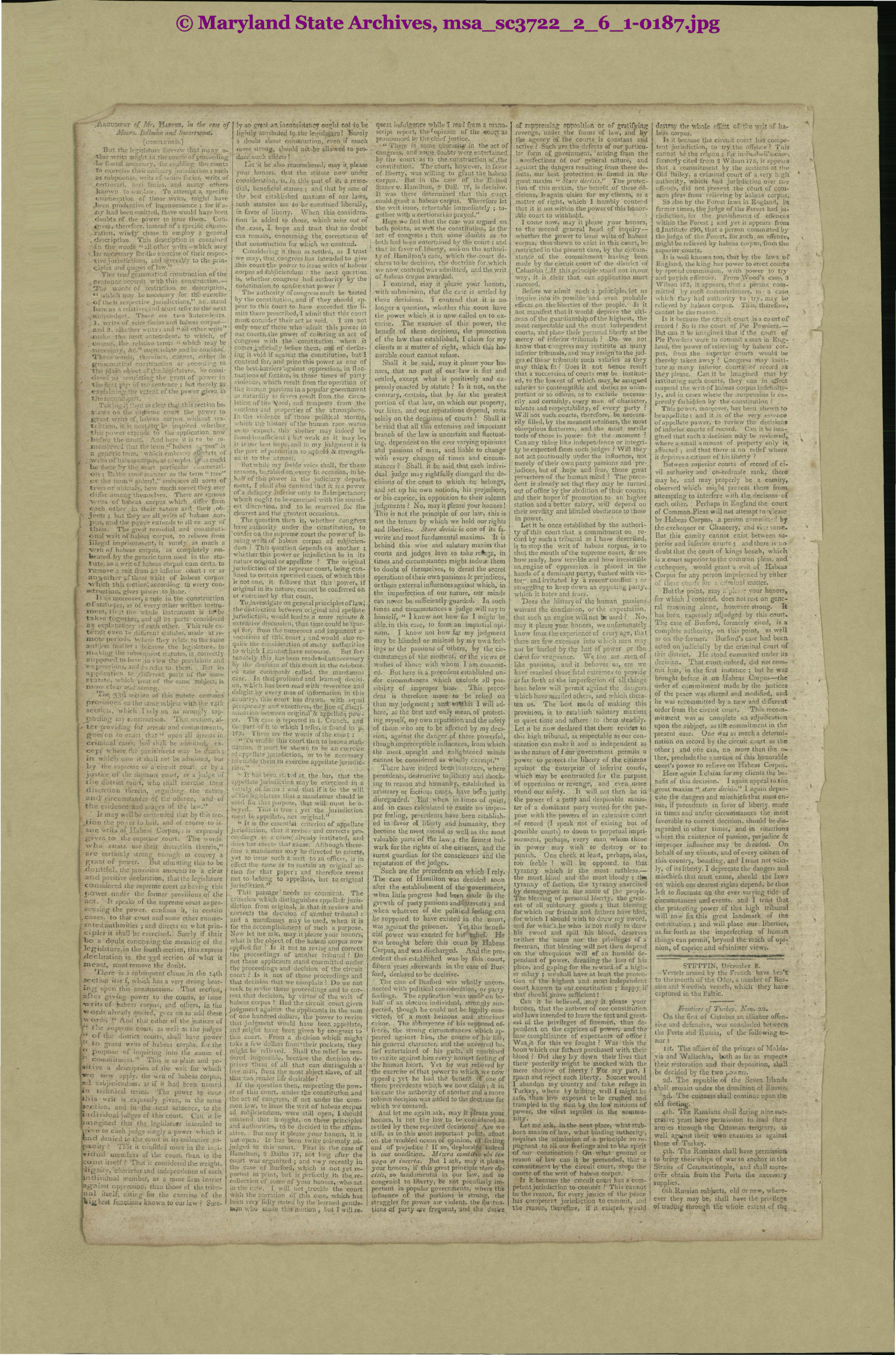
| •' Mr, Harper, In tit east of Messrs. Bolivian and Sioarttoout'. ICM3 DED'i] But the legislature foresaw that many o- ther writs might i;i the coir ding tic fi.iind necessary, for.enahfing the courts to exercise their oi'dinary jurisdiction ; such as subpoena?, writs of venire "facias, writs, of certiorari, fieri facias, and many others known to our lav,'. To attempt a specific enumeration of tiiose writs, might have ^been productive of inconvenience ; for if a- ny had been omitted, there would have been doubts of,the power to issue the lip. (Kori- • "' ¦ fore, instead ora specific ehume- tion, wisely chose to employ a general icription. This description is contained the words " all other writs—which may fog necessary for the exercise of their re bly to the .prin- ciples and usages of law." Tiie true grammatical construction of the senten with this construction.— ords of restriction or description, *' which may be necessary for the exercise of. jurisdictions," &c.stand here as a relative^ and must, refer to the next two antecedents. i. writs of s ' I hah < orpuS and 2. all ether writs : and "ail otherw .-¦¦¦, to which, of the relative ten itch may be y, &c.:' must ;elate and be Th • cannot, either in y. traction or according, to the atufe, be consi- ]y so ffft:A an inconsistency onglit not to Tie ' qwest mdwigence while I read from a manu- f attributed to the let'd.dajure! Surely script report, the' opinion of the eon re as i doubt about construction, 'even if much pronounced by the chief justice, more strong, should not be allowed to pro- duce -Mich effects ! Let it be also remembered, may it please your honors, that the statute now under consideration, is, in this part of it, a reme- dial, beneficial statute ; and that by one of the best established maxims of our laws, such statutes sic to be construed liberally, in favor of liberty. When this considera- tion is added to those, which arise out of the case, I hope and trust that no doubt can remain, concerning the correctness of that construction for which we contend. Considering it then, as settled, as I trust we may, that congress has intended to give .this court the power to issue writs of habeas corpus ad subjiciendum : the next question is, whether congress had authority by the constitution to confer-that power ? Tile authority of congress must be "tested by the constitution, and if they should ap- pear to this court to have exceeded the li- mits there prescribed, I admit that this court in.ist consider their act as void. I am not only one of those who admit this power in our courts,-the power of colfctingj an act of ss with the constitution when it ¦ " 'i'here is spi irity in the act of congress, and sot.ee doubts were entertained by the court as to the construction of .the constitution. The court, however, in favor of liberty, was willing to grant the habeas corpus. But in the case of the United States •&. Hamilton,-8 Dal'. VI, is decisive. 'It was there determined that this court could, grant a habeas corpus. Therefore let the writ issue, returnable immediately ; to- gether with a certiorari as prayed." Here we find that the case was argued on both points, aswetl the constitution, as the act of congress ; that some .doubts as to both had been entertained by the court ; and that ill favor of liberty, and. on the authori- ty of Hamilton's case, which the.coijrt de- clares to be decisive, the doctrine for .which we now contend was admitted, and the writ, of habeas corpus awarded. I contend, may it please your honors,, with submission, that the case is settled by these decisions. I contend that it is no longer a question, whether this court have the power which it is now called on to cx- erci e. The exercise of this power, the benefit of these decisions, the protection of the law thus established, I claim for my comes Jbdiciafcly before them, and of declar- j clients as a matter of right, which this ho- ing it void if against the constitution, but I norable court cannot refuse. the fir: mtence ; but merely ss ; of the power 8JI' . is section be. : r"ii;t the power to grant writs of habeas corpus withou X ) the application now re it is to be re- fnemb"ercd that the term '<").. i pus" is which em',:. : ¦•¦'¦' tuts of ¦,, i could '¦. particular > ..umerati- tnanner as the term " tree" term " ghhrral,*' embraces all sorts of trees or animals, how much soever they may differ among themselves. There are various v/rits of habeas corpus which differ from each other in their nature and their ob-' fjects ; but they are all .writs of habeas cor-. pus, and the power extends to all or any of them. The great remedial and constituti- onal writ of habeas corpus, to relieve from illegal imprisonment, is Surely as mu ¦writ of habeas corpus, as completely em- braced by the generic term used in the sta- tute, as a writ of habeas corpus cum certa to remove a suit from an inferior court : or as SlnjErOtber jf those writs of habeas corpus v. Inch this section, according to ever}' con- «truetioii, gives power to issue. It .:s moreover, a rule in the construe'ion Of-sta of every other written instru- ment,: lh-at the whole instrument is tc*be taken together, and all its parts con ftj explanatory of each other. This rule ex- ;-,!: statutes, made at re- they relate to tile same ruse, the 1. g th* subsejqueivt statutes, is c< Supposed to l:."e m view the provisions and to them. But its of the same Statute, which ,.,.,, f.f the same subject, is «H «"< ng. The 33<5 section of this statute co provision ... on the same/subject with tl sc-ctie,,, which I rely on as strongh, snp- i • ter providing to/ arresfc and commitments! that " upon all ini. *'.i'- i il shall be admitted} ex- cept where the punishroqht i Icath; in. which case it shall n< mitted, but by the supreme or a circuit court cr by a justice o ireme cmnt, or a *!'.e district court, who shall exercise retion therein, regarding the a: and; circumstances of the offence, and of ..ad usages of the law." h may well be i that by this sec- tion the po ur to bail, and of course to is- sue writs of .. .a[us, is expressly g'vca to. the supreme court. The ^ords, who shall use their discretion therein," lire certainly strong i to convey a grant of power. But admitting this to be doubtful, the piov-ision amounts to a clear and positive declaration, that the legislature considered the supreme court as having this J.ower under the former provisions of the It speaks of the supreme court as pos- sessing the power, confines it, in certain cases, to that cunt and some other enume- rated authorities ; and directs on what prin- ciples it shall be exercised. Surely if their 'be a doubt concerning the meaning of the legislature, in the fourth section, this express declaration in the 33d section of what it mean!, must remove the doubt. There is a subsequent clause in the 14th .Section itse f, which has a very strong bear- in.''- upon this construction.- That section, after giving- power to the courts, to issue •writs of hat" . and others, in the words already quoted, gees on to add these ¦words " And that either of the justices of :t ' '•' court, as weil- as the judges ' of the district courts, shall have power to grant writs of habeas corpus, for the [uiring into the /cause of commitment." This is as plain and po- sitive a m of the writ for which pwe now apply, the writ of habeas corpus, ad subjiciendum, as if it had been 1; in technical terms. The power to issue this writ is expiessly given, in the »Ciction, and in .the next sentence, to the of this court. Can it be triagined that the legislature intended to ie 10 each judge singly a power which it i-acl denied to the court in its collective |>sicity ? That it confided more in (lit- i • iduill members of the court, than in the court itself ? That it considered the weight, digmiy, character; and in< noeofeach individual member", as a pore firm barrier against oppression, than those of the tribu- nal itself, sitting for the exercise of the fci&hest function* known to oui law J Sure- coutend for, and prize this power as one of the besl against oppression, in fluc- tuations of faction, in those times of part}' cet which result from the operation of the human passions in a popular government fevers result from the circu- of the V.ood, and tempests from the motions and properties of the atmosphere. In the violence of those political storms, which the history of the human race warns us to expect, this shelter may indeed be found i . , ; but weak as it may be, it is our best hope, and in my judgment it is the part of patriotism to uphold & Strength- en it, to the utmost. But while my feeble voice shall, for these reasons, be .raised on every fit occasion, inbe- Iv.lf of this power in the judiciary depart- ment, I shall also contend that it is a power of a deli ; rior only to its importance; which ought to be exercised with the sound- est discretion, and to be reserved for the clearest and the greatest occasions. The question then is, whether congress have authority under the constitution, to confer oa the supreme court the power of is- suing writs of habeas corpus ad subjicien- dum ? This question depends on another ; whether this power or jurisdiction be in its nature original or appellate ? The original jurisdiction of the supreme court, being.con- fined to certain specifed cases, of which this is not one, it follows that this power, if original in its nature, cannot be conferred on or exercised by that court. To .investigate on general principles of law," the distinction between original and apellate jurisdiction, would lead to a more minute & extensive discussion, than time could be spar- ed for, from the numerous and important a- vocations of this court ; and would also re- quire the consideration of many authorities- ,:h I cae.r.ot have recourse. But for- ly this, has been rendeV-d unnecessary by the decision of this court in the celebrat- ed case commonly called the, mandamus case. In that-protbund and learned decisi- on, which has been read with reverence and delight by every man of information in this couirry, this court has drawn, with equal exactness, the line of discri- 1 original'& appellate) pow- er. The c.i se is reported in 1. Crane!;, and I of it to which I refer, is found in p. I hese are the words of the com t : " To enabk this court then to issue a man- lus, it mus't be shewn to be anexevei.se dsdiction, or to be necessary them to exercise appellate jurisdic- tion." '*• If has been st. t.dat the bar, that the FisdictioA may be exercised in a :..,.- • a id that if it be the will that a mandamus should be used for that purpose, that will must be o- Tiiis is true ; yet the jurisdiction must be appellate, net "original." lv It is the essential criterion of appellate jurisdiction, thai il revises and corrects pro- gS ill a cause already instituted, and ot.cri . that cause. Although theue- fore a mandamus may be directed to courts, yet to issue such a writ to an officer, is in effect the same as to sustain an original ac- tion for that paper ; and therefore seems not to belong to appellate, but to original jurisdiction." This passage ' needs no comment. The criterion which distinguishes appellate juris- diction from original, is that i't revises and corrects the decision of another tribunal : and a mandamus may be used, when it is for the accomplishment of such a purpose. Now let me ask, may it please your honors, the object of the habeas corpus now applied for ? Is it not to revise and correct the proceedings of another tribunal ? Do not these applicants stand committed under the proceedings and decision of the circuit court ? Is it not of those proceedings and that decision that we complain ? Do we not seek to revise those proceedings and to cor- rect that decision, by virtue of the writ of habeas corpus ? Had'the circuit court given judgment against, the applicants in the sum of one hundred dollars, the power to revise . ut would have been appellate, and might have been given by congress to .this court. From a decision which' might take a few dollars from*their pockets, they might be relieved. Shall the relief be ren- dered impossible, because the decision de- priv.es them,of all that can distinguish a! in, fiom the most abject slave, of all that can reader life desirable ? If the question then, respecting the pow- er of this court, under the constitution and of congress, if not under the com- mon law, to issue the writ of habeas corpus ad subjiciendum, were still open, I should contend that it ought, on these principles and authorities, to be decided in the affirm- ative. But may it please your honors, it is not open. It has been twice solemnly ad- in this court. First in the case of Hamilton, 3 Dallas 17, not long after the court was organized j and vn y recently in the case of Burford, which is not yet re- ported in print, but is perfectly in the re- collection of some of your honors, who sat in-the case, I will not trouble the court with the narration of this case, which has RiJJy stated by the learned gentle- man who made this motion \ but I will re- Shall it be said, may it please your ho- nors, that no part of our law is fixt and settled, except what is positively and ex- pressly enacted by statute ? Is it not, on the contrary, certain, that by far the greatest portion of that law, on which our property, our lives, and our reputations depend, rests solely on the" decisions of courts ? Shall it be said that all tins extensive and important branch of the law is uncertain and fluctuat- ing, dependent on the ever varying opinions and passions of men, and liable to change with every change of times and circum- stances ? Shall it be said that each indivi- dual judge may rightfully disregard the de- cisions of the court to which he belongs, and set up his own notions, his prejudices, or'his caprice, in opposition to their solemn judgments ? No, may. it please your honors! This is not the principle of our law, this is not the tenure by which we hold our rights and liberties. Stare deems is one of its fa- vorite and most fundamental maxims. It is behind this wise and salutary maxim that courts and judges love to take refogc> 'n times and circumstances might indnex.- them to doubt of themselves, to dread the secret operations of their own passions & prejudices, or those external influences agaiast which, in the imperfection of our nature, our minds can newer be sufficiently guarded. In such times and circumstances a judge will say to himself, " I know not how far I might be, able, in this.case, to form an impartial opi- nion. I know not how far my judgment may be blinded or mislead by my own feel- ings or the passions of others, by the cir- cumstances of the moment, or the views or wishes of those with whom I am connect- ed. But here is a precedent established un- der circumstances which exclude all pos- sibility of improper bias. This prece- dent is therefore more to be relied on than my judgment ; and" to^this I will ad- here, as the best and only mean, of protect- ing myself, my own reputation and the safety of those who are to be affected by my deci- sion, against the danger pf those powerful, though imperceptible influences, from which the most upright and enlightened minds cannot be considered as wholly exempt." There have indeed been instances, where precedents, destructive to,liberty and shock- ing to reason arid humanity, established in arbitrary or factious times, have been justly disregarded, liut when in times of ciniet, and in cases calculated to excite no impro- per feeling, precedents have been establish- ed in favor of liberty and humanity, they become the most sacred as well as the most valuable parts of the law ; the firmest bul- wark for the rights of the citigens, and the surest guardian for the consciences and the reputation of the. judges. Such are the prepedents on which I rely. The case of Hamilton was decided soon after the establishment of the government, when little progress had been made in the growth of party passions and interests ; and when whatever of the political feeling c?.n be supposed to have existed in the court, gainst the prisoner. Yet this benefi- cial power was exerted for hi,; relief. He was brought before this court by Habeas Corpus, and was discharged. And the pre- cedent thus established was by this court, fifteen years afterwards in the case of Bur- ford, declared to be decisive. ' The case of Burford was wholly uncon- nected witii political consideration, or party feelings. The application was made on be- half of an obscure individual, strongly sus- pected, though he could not be legally con- victed, of a most heinous and atrocious crime. The abhorrence of his supposed of- fence, the strong circumstances which ap- peared against him, the course of his life, his general character, and the universal be- lief entertained of his guilt, all combined to excite against him every hone.Kt feeling of the human heart. Yet he was relieved by the exercise of that power to which we now appeal ; yet he had the benefit of one of those precedents which we now claim ; & in' his case the authority of another and a more solemn decision was added to the doctrine for which we contend. And let me again ask, may it please your honors, is not the law to be considered as settled by these repeated decisions ' Are we still, as to this most important point, afloat on the troubled ocean of opinion, of feeling and of prejudice- ? If so, deploralJt" indeed is our condition. Misera conditio ubi iex vaga et inctria. But I ask, may it'please your honors, if this great principle "stare de- cisis, so fundamental in our law, and so congenial to liberty, be not peculiarly im- portant in popular governments, where the influence of the passions is strong, the struggles for power are violent, the flu- tua- |ions of party a/e frequent, and the desjfe of suppressing opposition or of gratifying revenge, under the forms of law, and by the agency of the courts is constant and active ? Such are the defects of our particu- lar -form of government, arising from the i i»,'infections of our general nature, and against the dangers resulting from these de- fects, our best protection is found in the great maxim " Stare decisis." The protec- tion of this maxim, the benefit of these de- cisions, It again claim for my clients, as a matter of right, which I humbly contend that it is not within the,power of this honor- able court to withhold. I come now, may it please your honors, to the second- general head of inquiry— whether the power to issue writs of habeas eorpus, thus shewn to exist in this csurt, be restricted in the present case, by the circum- stance of the commitment having been made by the circuit court of the district of Columbia I ..If this principle stand not inour way, it is clear that our application must succeed. Before we admit such a principle, let us inquire into its possible and even probable effects on the liberties of the people. Is it not manifest that it would deprive the citi- zens of the guardianship of the highest, the most respectable and the most independent courts, and place their personal liberty at the mercy of inferior -tribunals ? Do we not know that congress may institute as many inferior tribunals, and may assign to the jud- ges of these tribunals such salaries as they may think fit. :' Does it not hence result that a succession of courts may be institut- ed, to the lowest of which may be assigned salaries so contemptible and duties so unim- portant or so odious, as to exclude necessa- rily and certainly, every man of character, talents.and respectability, of every party ? Will not such courts, therefore, be necessa- rily filled, by the meanest retainers, the most obsequious flatterers, and the most servile tools of those in power for the moment ? Can any thing like independence or integri- ty be expected from such judges ? Will they not act continually under the influence, not merely of their own party passions and pre- judices, but of hope and fear, those great perverters of the human mind ? The prece- dent is already set tha,t they mayr be turned out of office by the abolition of their courts; and their hopes of promotion to an higher station and a better salary, will depend 011 their servility and blinded obedience to those in power. Let it be once established by the authori- ty of this court that a commitment on re- cord by such a tribunal as I have described, is to stop the writ of habeas corpus, is to shut the mouth of the supreme court, &' see how reaely, how terrible and how irresistible an engine of oppression is placed in the hands of a dominant party, Slushed with vic- tor"; and irritated by ~a recent" conflict ; or struggling to keep clown an opposing party, which it hates and fears. TJoes the history of the human passions warrant the conclusion, or the expectation, that such an engine will not be used ? No, may it please your honors, we unfortunately know from the experience of every age, that there are few excesses into which men may not be hurled by.the lust of power or the thirst for vengeance. We too are men, of like passions, and it behoves us, ere we have reached those fatal extremes to provide as far forth as the imperfection cf alt things here below will permit against the dangers which have assailed others, and which threa- ten us. The best mede of making this provision, is to establish salutary maxims in quiet time and adhere tc them steadily. Let it be now declared that there resides in this high tribunal, as respectable as our con- stitution can make it and as independent as as the nature of four government permits a power to protect the liberty of the citizens against the enterprize of inferior courts, which may be contsructed ft>r the purpose of oppression or revenge, and even more round our safety. It will net then be ia the power of a petty and despicable minis- ter of a dominant party vested for the pur- pose with the powers of an extensive court of record (I speak not of exising but of .possible courts) to doom to perpetual impri- sonment, perhaps, every man whom those in power may wdsh to destroy or to punish. One check at least, perhaps, alas, too feeble ! will be opposed to that tyranny which is the most ruthless,— the most blind and the most bloody ; tl» tyranny of faction, the tyranny ..exercised by demagogues in the name of the people. The blessing of personal liberty, the great- est of all sublunary goods ; that blessing for which our friend* and. fathers have bled, for which I should wish to draw my sword, and for whic'.ihe who is not ready to draw his sword and spill his blood, deserves neither the name nor the privileges of a freeman, that blessing will not then depend on the obsequious will «f an humble de- pendant of power, dreading the loss of his place, and gaping for the reward of a high- er salary ; we shall have at least the protec- tion of the highest and most Independent court known to our constitution ; happy if that should prove sufficient! Can it be believed, may it please your honors, that the authors of our constitution and laws intended to leave the tirst and great- est cf the privileges of freemen, thus de- pendent on the caprices of power, and the base complaisance of expectants of office 1 Was it for this we fought ? Was this the boon which our fathers purchased with their blood ? Did they lay down their lives that their posterity might be mocked with the mere shadow of liberty ? For my part, I spurn and reject such liberty. Sooner would I abandon my country and take refuge in Turkey, where by bribing well I might be safe, than live exposed to he crushed and trampled in the. dust by the low minions of power, the vilest reptiles in the commu- nity. Let me ask, in the next place, what stub- born maxim of law, what binding authority, requires the admission of a principle so re- pugnant to all our feelings and to the spirit of our constitution ? On what ground or reason of law can it be pretended, that a commitment by the circuit court, stops the course of the writ of habeas corpus. Is it because the circuit court has a com- petent jurisdiction to commit ? Tiiis cannot be the reason, for every justice of the peace has competent jurisdiction to commit, and the reason, therefore, if jt existed, would destroy the whole rfT-":t cf the writ of ha- beas corpus. Is it because the circuit court has compe- tent jurisdiction, to try the offence ? This cannot be the reason ; "for in-Bushell' formerly cited from 3 Wilson 173, it . that a commitment by the sessions at the Old Bailey, a criminal court of a ver> authority, which had jurisdiction over tie; offence, did not prevent the court of com- mon pleas from relieving by habeas corpus. So also by the Forest laws in England, in former times, the. judge of the Forest had ju- risdiction, for the punishment of offences within the Forest .: and yet it appears from 9..Institute £90, that a person committed by the judge of the Forest, for such an offence, might be relieved by habeas corpns, from the superior courts. It is well known too, that by the laws of England, the king has power to erect courts by special commission, with power to try and punish offences. From Wood's case, ;? Wilson. 173, it appears, that a person com- mitted by such commissioners, ma case which they had authority to try, may be» relieved by habeas corpus. This, therefore, cannot be the reason. Is it because the circuit court is a co urt of record ? So is the court of Pie Powders.— Hut can it be wm'aglned that if the court of Pie Powders were to commit a man in Eng- land, the power of lelieviug by habeas cor- pus, from the superior courts would be thereby taken away'? Congress may insti- tute as many interior courts* of record as they please. Can it be imagined that by instituting such courts, they can in effect suspend the writ of habeas corpus indefinite- ly, and in cases whef.e the suspension is ex- pressly forbidden by the constitution ? This power, moreover, has been shewn to ba appellate : and it is of the very essence of appellate power, to review the decisions of inferior courts of record. Can it. be ima- gined that such a'decision may be reviewed, where a small amount of property only is, affected ; and that there is no relief where it deprives a citizen of hislibSrt^ ? Between superior courts of record of ci- vil authority mid co-ordinate rank, there may be, and may properly be a comity, observed which might prevent them from attempting to interfere with the ciecisons of each other. Perhaps in England the court of Common Pleas will not attempt to rt .case by Habeas Corpus, a person comrrittti a by the exchequer or Chancery, and vi e verse. But this comity cannot exist between su- perior and inferior courts ; and there is no doubt that the court of kings bench, which is a court superior to the common pleas, and exchequer, would grant a writ of Habeas Corpus for any person imprisoned by either riminal matter. But the point, may .. pli ;f ,:our honors, for which I contend, does not rent on gene- ral reasoning alone, ho-wever strong. It has been expressly adjudged by this court. The case of Burford, formerly cited, is a complete authority, on this point, as well as on the former. Burford's case had been acted on judicially by the criminal court of this district. He stood commited under its decision. That court indeed, did not com- mit him, in the first instance ; but he was brought before it on Habeas Corpus—the order of commitment made by the justices of the peace was altered and modified, and he was recommitted by a new and different order from the circuit court. This recom- mitment was as complete an adjudication upon the subject, as the commitment in the present case. One was as much a determi- nation on record by the circuit court as the other 5 and one can, no more than the o- ther, preclude the exercise of this honorable court's power to relieve on Habeas Corpus. Here ao-ain I claim for my clients the bo- nefit of this decision. I again appeal to tne great maxim " stare decisis." I again depre- cate the dangers and mischiefs that must en- sue, if precedents in favor of liberty, made in times and under circumstances tne most favorable to correct decision, should be dis- regarded in other times, and in situations where the existence of passion, prejudice & improper influence may be dreaded. On behalf of my clients, and of every citizen of this country, boasting, and I trust not vain- ly, of its liberty, I deprecate the dangers and mischiefs that must ensue, should the laws on which ouv dearest rights depend, be thus left to fluctuate on the ever varying tide- of circumstances and events, and I trust that the protecting power of this high tribunal will now fix this great landmark of the constitution ; and will place our liberties, as far forth as the imperfection of human things can permit, beyond the reach of opi- nion, of caprice and of'sinister views. STETTIN, December 8. Vessels armed by the French have bro't to the mouth of the Oder, a number of Rus- sian and Swedish vessels, which they have captured in the 1-altic. Frontiers of Turkey, Nm. 22. On the first of October an alliance offen- sive and defensive, was concluded between the Forte and Russia, of the following te- nor : 1st. The affairs of the princes of Molda- via and Wallachia, both as far as respects their restoration and their deposition, shall be decided by the two powers. 2d. The republic of the Seven Islands shall remain under the dominion of Russia. 3d. The customs shall continue up eld footing. 4th. The Russians shall during nine suc- cessive years have permission to lead their armies through the Ottoman territory, as well agajnst their own enemies as against those of Turkey. 5th. The Russians shall have permission to bring their ships of war to anchor in the Straits of Constantinople, and shall more- over obtain from the Porte the nectssay supplies. 6th.Russian subjects, old or new, where- ever they may be, shall have the privilege of trading through the whole extent |