 |
|
|
 |
|
 |
|
|||
|
||||
|
||||
|
Federal Gazette & Baltimore Daily Advertiser 1807/01-1807/06 msa_sc3722_2_6_1-0203 Enlarge and print image (4M) |
|
|
|
|
|
|
|
|||
|
||||
|
||||
|
Federal Gazette & Baltimore Daily Advertiser 1807/01-1807/06 msa_sc3722_2_6_1-0203 Enlarge and print image (4M) |
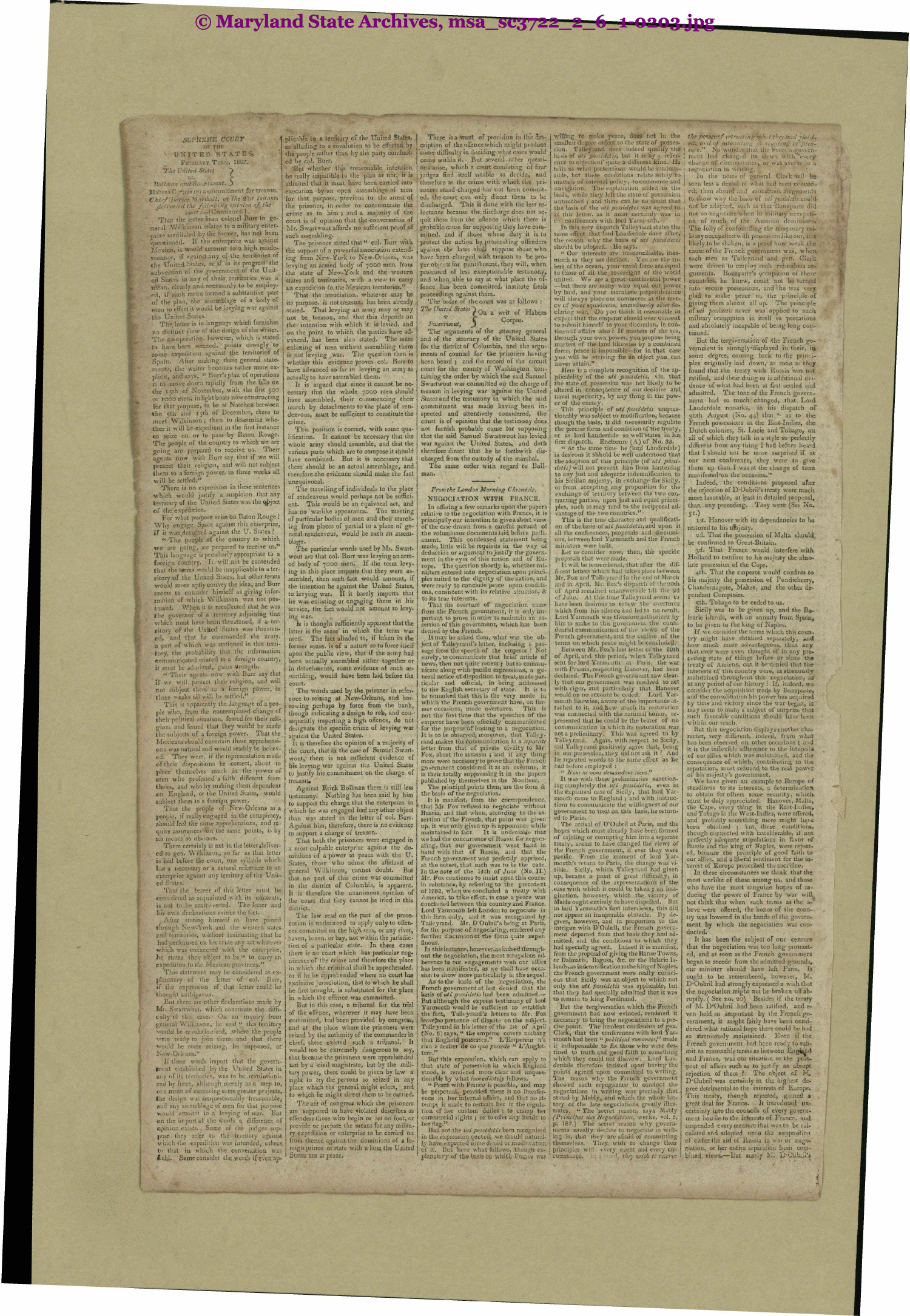
| SUPREME COURT OF THE UNITED STATES, FeT-rtjaky. Trim.;, 1807. The United ,$.'. 1 ' Bollman ahct&jsjttrtvjout.. J Habeas Cofgyw cjl a commitment for treason. Chi.-/ justice Marshall, on the 21rf instant) delivered the following opinion of the court:—- [Continued.! That the letter frwn colonel Burr to ge- neral Wilkinson relates to a military enter, ize meditated by the former, has not been Questioned. If this enterprise was against Mexico, it would amount to'-a high misde- Siieajrior, if against *ny of the territories of the United States, or if in its progress the subversion of the government of the Unit- ed States in any of their territories was a nfean. clearly and necessarily to he employ- ed, if such mean formed a substantive part of'the plan, the assemblage of a body of men to effect it would be levying war against .. the United States. The letter is in language which furnishes no distinct view of the design of the writer. The co-operation, however, which is stated to have been secured, points strongly to some expedition against the territories of Spain. After nuking these general state- ments, the writer becomes rather more ex- plicit, and says, " Burr's plan of operations is to move down rapidly from the tails on the 15th of November, with the first 500 or 1000 men, in light boats now constructing for that purpose, to be at Natchez between the 5th and 15th of December, there to meet Wilkinson; then to determine whe- ther it will be expedient in the fust instance to seize on or to pass by Baton Rouge. The people of the country to which we are going are prepared to receive us. Their agents now with Burr say that if we will protect their religion, and will not subject them to a foreign power, in three weeks all will be settled.'" There is 110 expression in these sentences which would justify a suspicion that any territory of the United States was the qbject of the expedition. For what purpose seize on Baton Rouge 2 Why engage: Spain against this ehterprize, if it was designed against the U. States ? " The people of the country to which we are going, are prepared to receive us." This language is peculiarly appropriate to a foreign Country. It will not be contended that the terms wcrcud be inapplicable to a ter- ritory,-of the United States, but other terms would more aptly convey the idea, and Burr seems to consider himself as giving infor- mation of which Wilkinson was not pos- sessed. When it is recollected that he was the governor ol a territory adjoining that which must have been threatened, if a ter- ritory of the Untied States was threaten- ed, and that he commanded the army, a part of which was stationed in thai terri- tory, the probability that the information communicated related to a foreign country, it must be admitted,'gains strength. " Their agents now .with Burr say that if we will protect their religion, and will not subject them to a foreign power, in three weeks, all will.be settle. 1." This is apparently the language of a peo- ple who, frqm the contemplated change of their political situation, feared for their reli- gion, and feared that they would be made the subjects of a foreign power. That the Mexicans should entertain these apprehensi- ons was natural and would readily be believ- ed. They were, if the representation made of their dispositions be .correct, about to place themselves much in the power of men who professed a faith difierent from theirs, and who by making them dependent on England, ortheUnitedStat.es, would subject them to a foreign power. That the people of New-Orleans as a people, if really engaged in the conspiracy, should feel the same apprehensions, and re- quire assurances on the same points, is by sio means so obvious. There certainly is not in the letter deliver- ed to gen. Wilkinson, so far as that letter is laid before the court, one syllable which has a necessary or a natural reference to an enterprise against any territory of the Unit- ed States. That the bearer of this letter must be considered as acquainted with its contents, is not to be controverted. The letter and liis own declarations evince the fact. After stating himself to have passed through New-York and the western states and territories, without insinuating that he had performed en his rrute any act whatever which was connected with the enterprise, he states their object to be " to carry an expedition to the Mexican provinces." This statement may be considered as ex- planatory of the letter of col. Burr, if the expression of that letter could he thought ambiguous. But there are other declarations made by Mr. Swartwout, which constitute the diffi- culty ol this case; On an inquiry from general Wilkinson, he said" this territory would be revolutionized, where the people were ready to join them, and that there Would be some seizing, he supposed, at New-Orleans." If these words import that the govern- ment established by the United States in any of its territories, was to bo .revolutioni- sed by force, although merely as a step to, cr a mean of executing seme greater projects, the design wis unquestionably treasonable, and any assemblage of men for that purpose would amount to a levying of war. But on the import of the words a difference of opinion exists. Some ol the judges sup- pose they refer to the territory against vhichthe expedition was intended, others to that in which the conversation was tela. Same consider the,words if even, ap- plicable to & territory o* the United States. as alluding to a rovolution to be effected by the people rather than by the party conduct- ed by col. Burr. 'But whether this treasonable intention be really imputihle to the plan or not, it is admited that it must have been carried into execution by an open assemblage of men for that purpose, previous to the arrest of the prisoner, in order to consummate tire crime as to him ; and a majority of the court is of opinion that the conversation of Mr. Swartwout affords no sufficient proof.of such assembling. The prisoner stated that" col. Burr with the support of a powerful association extend- ing from New-York to New-Orleans, was levying an armed body of 7000 men from the state of New-York and the western states and territories, with a vie>v to carry an expedition to the Mexican territories." That the association, whatever may be its purpose, is not treason, has been already stated. That levying an army may or may not be treason, and that this depends on the intention with which it is levied, and on the point to which the parties have ad- vanced, has been also stated. The mere enlisting of men without assembling them is not levying war. The question then is whether this evidence proves col. Burr to have advanced so far in levying an army as actually to have assembled them. It is argued that since it cannot be ne- cessary that the whole 7000 men should have assembled, their Commencing their march by detachments to the place of ren- dezvous, must be sufficient to constitute the crime. This position is correct, with some qua- lification. It cannot be necessary that the whole army should assemble, and that the various parts which are to compose it should have combined. But it is necessary that there should be an actual assemblage, and therefore the evidence should make the fact unequivocal. The travelling of individuals to the place of rendezvous would perhaps not be suffici- ent. This would be an equivocal act, and has no warlike appearance. The meeting of particular bodies ot men and their march- ing from places of partial to a place of ge- neral rendezvous, would be such an assem- blage. The particular words used by Mr. Swart- wout are that col. Burr was le trying an arm- ed body of 7000 men. If the term levy- ing in this place imports that they were as- sembled, then such fact would amount, if the intention be against the United States, to levying war. If it barely imports that he was enlisting or engaging them in his service, the fact would not amount to levy- ing war. It is thought sufficiently apparent that the latter is the sense in which the term was used. The fact alluded to, if taken in the former sense, is of a nature so to force itself upon the public view, that if the aimy had been actually assembled either together or in detachments, some evidence of such as- sembling, would have been laid before the court. The words used by the prisoner in refer- ence to seising at New-Orleans, and bor- rowing perhaps by force from the bank, though indicating a design to rob, and con- sequently importing a high offence, do not designate the specific crime of levying war against the United States. It is therefore the opinion of a m-jority of the court, that in the case of Samuel Swart- wout, there is not sufficient evidence of his levying war against the United States to justify his commitment on the charge of treason* Against Eriek Bollman there is still less testimony. Nothing has been said by him to support the charge that the enterpnze in which he was engaged had any other object than was stated in the letter of col. Burr. Against him, therefore, there is no evidence to support a charge of treason. That both the prisoners were engaged in a most culpable enterprize against the do- minions of a power at peace with the U. States, those who admit the affidavit of general Wilkinson, cannot doubt. But that no part of this crime was committed in the district of Columbia, is apparent. It is therefore the unanimous opinion of the court that they cannot be tried in this district. The law read on the part of the prose- cution is understood to apply only to offen- ces commited on the high seas, or any river, haven, bason, or bay, not within the jurisdic- tion of a particular state. In these cases there is no court which has particular cog- nizance of the crime and therefore the place in which the criminal shall be apprehended, or if he be apprehended where no court has exclusive jurisdiction, that to which he shall be first brought, is substituted for the place in which the offence was committed. But in this case, a tribunal for the trial of the offence, wherever it may have been committed, had been provided by congress, and at the place where the prisoners were seized by the authority of the commander in chief, there existed such a tribunal. It would too be extremely dangerous to say, that because the prisoners were apprehended not Ly a civil magistrate, but by the mili- tary power, there could be given by law a right lo try the persons so seized in any place which ths general might sjt-lect, and to which he might direct them to be carried. The act of congress which the prisoners are supposed to have violated describes as offenders those who begin or set on foot, or provide or prepare the means for any milita- ry expedition or enterprise to be carried On from thence against the dominions of a fo- reign prince or state with whom the United States are at peace. There is a want of precision in the raes* cription of the offence which might produce some difficulty in. deciding what cases would come within it. But several other questi- ons arise, which a court consisting of four judges find itself unable to decide, and therefore as the crime with which the pri- soners stand charged-has not been commit- ed, the court can only direct them to be discharged. This is done with the less re- luctance because the discharge does not ac- quit them from the offence which there is probable.cause for supposing they have com- mitted, and if those whose duty it is to protect the nation by prosecuting offenders against the laws shall suppose those who have been charged with treason to be pro- per objects for punishracnt, they will, when possessed of less exceptionable testimony, and when able to say at what place the of- fence has been committed, institute fresh proceedings against them. The order of the court was as follows : The United States^ a wrh of Habeas Sviarttoout, J ' " The arguments of the attorney general and of the attorney of the United States for the district of Columbia, and the argu- ments of counsel for the prisoners having been heard ; and the record of the circuit court for the county of Washington con- taining the order by which the said Samuel Swartwout was committed on the charge of treason in levying war against the United States and the testimony in which the said commitment was made having been in- spected and attentively considered, the court is of opinion that the testimony does not furnish probable cause tor supposing that the said Samuel Swartwout has levied war against the United States, and doth therefore direct that he be forthwith dis- charged from the custody of the marshal. The same order with regard to Boll- man. From the London Morning Chianicle. NEGOCIATION WITH FRANCE. In offering a few remarks upon the papers relative to the negociation with France, it is principally our intention to give a short view of the case drawn from a careful perusal of the voluminous documents laid before parli. ament. This condensed statement being made, little will be requisite in the way of deduction or argument to justify the govern- ment in the eyes of this nation and of Eu- rope. The question shortly is, whether mi- nisters entered into negociation upon princi- ples suited to the dignity of the nation, and were ready to conclude peace upon conditi- ons, consistent with its relative situation, & to its true interests. That the overture of negociation came from the French government, it is only im- portant to prove In order? to maintain an as- sertion of this government, which has been denied by the French. , It may be asked then, what was the ob- ject of Talleyrand's letter, inclosing- a pas- sage from the speech of the emperor ? Not surely, to communicate ttiat brief article of news, then not quite recent; but to commu- nicate along with pacific expressions, a ge- neral notice of disposition to treat, made par- ticular and official, in being addressed to the English secretary of state. It is to be remarked that this is the very mode in which the French government have, on for- mer occasions, made overtures. This is not the first time that the speeches of the emperor have been officially communicated for the purpose of leading to a negociation. It is to be observed, moreover, that Talley- rand makes the communication in a separate letter from that of private civility to Mr. Fox, about the assassin ; and if any thing more were necessary to prove that the French government considered it as an overture, it is their totally suppressing it in the papers published by themselves in the Moniteur. The principal points then, are the form & the basis of the negociation. It is manifest, from the correspondence, that Mr. Fox refused to negociate without Hussia, and that when, according to the as- sertion of the French, that point was given up, it was only given up in appearance while maintained in fact. It is undeniable that we had the concurrence of Russia for negoci- ating, that our government went hand in hand with that of Hussia, and that the French government was perfectly apprized, at the outset, that such was to be the case. In the note of the 14th of June (No. II.) Mr. Fox continues to insist upon this course in substance, by referring-to the precedent of 1782, wheriwe concluded a treaty with America, to take effect, incase a peace was concluded between this country and France. Lord Yarmouth left London to negociate in this form only, and it was recognized by Talleyrand. Mr. D'Oubril's being at Paris, for the purpose of negociating, rendered any further discussion of the form quite super- fluous. In this instance, however,as indeed through- out the negociation, the most scrupulous ad- herence to our engagements with our allies has been manifested, as we shall have occa- sion to show more particularly in the sequel. As to the basis of the negociation, the French government at last denied that the basis of utipossidetis had been admitted.— But although the express testimony of lord Yarmouth would be sufficient to establish the fact, Talleyrand's letters to Mr. Fox leavejno pretence of dispute on the subject. Talleyrand in his letter of the 1st of April (No. 6) says, " the emperor covets nothing that England possesses." L'Empereur n'a rien a desirer de co que possede " L'Anglet- tere." But this expression, which can apply to that state of possession in which England stood, is rendered more clear and unques- tionable by what immediately follows. " Peace with France is possible, and may be perpetual, provided there is no interfer- ence in her internal affairs, and that no at- tempt is made to restrain her in the regula- tion of her custom duties ; to cramp her commercial rights ; or to offer any insult to her flag." Had not the tisi possidetis been recognised in the expression quoted, we should natural- ly have .expected some denial or modification of it. But here what follows, though ex- planatory of the basis on which Stance w«s willing to make peace, does not in the smallest degree object to the state of posses- sion. Talleyrand does indeed qualify the basis of uti possidetis, but it is by a refer- ence to objects of quite a different kind. He tells us what pretensions would be inadmis- sible, but thrse conditions relate solely to matters of internal policy, to commerce and navigation. Tire explanation added to the basis, while they left the state of possession untouched ; and there can be no doubt that the bssis of the uti possidetis was agreed to in this letter, as it most certainly was in t. -conferences with lord Yarmouth. In this very dispatch Talleyrand states the same effect that lord Lauderdale does after, the reason why the basis of uti possidetis should be adopted. He says, " Oar interests are irreconciliable, inas- much as they are distinct. Yon are the ru- lers of the ocean, your naval force are equal to those of all the sovereigns of the world united. We are a great continental power — but there are many who equal our power by land, and your uiaratime preponderance will always place our commerce at the hot- cv of your squadrons, immediately after de- claring war. Do you think it reasonable to expect that the emperor should ever consent to submit himself to your discretion, in con- tinental affairs also i If masters of the sea, through your own power, you propose being masters of the land likewise by a combined force, peace is impossible—for ill that case you will be striving for an object you can never attain." Here is a complete recognition of the ap- plicability of the uti possidetis, viz. that the state of possession was not likely to be altered in consequence of our decisive and naval superiority, by any thing ill the pow- er of the enemy. This principle of uti possidetis unques- tionably was subject to modification, because though the basis, it did necessarily regulate the precise form and condition of the treaty, or as lord Lauderdale so well "states in his first dispatch. Enclosure (A) of No. 35. " At the same time he (lord Lauderdale) is desirous it shhuld be well understood that the adoption of this principle (of uti pdssi- detis) will not prevent him from hastening to any just and adequate indemnification to his Sicilian majesty, in exchange for Sicily, or from accepting any proposition for the exchange of territory between the two con- tracting parties, upon just and equal princi- ples, such as may tend to the reciprocal ad- vantage of the two countries." This is the true character and qualificati- on of the basis of uti possidetis, and upon it all the conferences, proposals and discussi- ons, between lord Yarmouth and the French ministers were built. Let us consider now, then, the specific proposals that were made. It will be remembered, that after the dif- ferent letters which had taken place between Mr. Fox and Talleyrand in the end ot March and in April, Mr. Fox's dispatch of 1 he20th of April remained unanswerable till the yd of June. At this time Talleyrand seem;; to have been desirous to renew the overtures which from his silence had led to 110 result. Lord Yarmouth was therefore authorized by him to make to this government the confi- dential communication of tin- vk-ws of the French government, and the* outline of the terms on which peace might be concluded. Between Mr. Fox's hist letter 01 the 2Uth of April, and this period, when Talleyrand sent for lord Yaniii utli at Paris, the war with prunaia, respecting Hanover, had been declared. The French government saw clear- ly that our government was resolved to act with vigor, and particularly that Hanover would on no account be ceded. Lord Yar- mouth likewise, aware of the importance at- tached to it, and how much its restoration was connected with the national honor, re- presented that he could be the bearer of no communication in which its restoration was not a preliminary. This was agreed to by Talleyrand. Again, with respect to Sicily, did Talleyrand positively agree that, being in our possession, they did not ask it ? And lie repeated words to the same effect as he had before employed : " Naus ne vous demandons siens," It was with these preliminaries sanction- ing completely the uti possidetis, even in the explained case of Sicily, that lord Yar- mouth came to England ; and with instruc- tions to communicate the willingness of our government to treat on this basis, he return- ed to Paris. The arrival of D'Oubril at Paris, and the hopes which must already have been formed of cajoling or corrupting him into a separate treaty, seems to have changed the views of the French government, if ever they were pacific. From the moment of lord Yar- mouth's return to Paris, the change was vi- sible. Sicily, which Talleyrand had given up, became a point of great difficulty, in consequence of the representations of the .ease with which it could be taken ; an ima- gination, however, which the victory of Maida ought entirely to have dispelled. But in lord Yarmouth's first interviews, this did not appear an insuperable obstacle. By de- grees, however, and in proportion to the intrigue with D'Oubril, the French govern- ment departed from that basis they had ad- mitted, and the conditions to which they had specially agreed. Indeed it is manifest, from the proposal of giving- the Hanse Towns, or Dalmatia, Ragusa, &c. or the Balaric Is- lands, as indemnification to the kingof Naples, the French government were really consci- ous that Sicily was an object to which not only the irfi possidetis was applicable, but that they had specially admitted that it was to remain to king Ferdinand. Hut the tergiversation which the French government had now evinced, rendered it necessary to bring the negociations to a pre- cise point. The insolent confession of gen. Clark, that the conferences with lord Yar- mouth had been " political romances" made it indispensable to fix those who were des- tined to truth and good faith to something which they could not disavow. Lord Lau- derdale therefore insisted upon having the points agreed upon committed to writing. The reason why the French government showed such repugnance to conduct the negociations in writing was-precisely that stated by Mably, and which the whole his- tory of the late negociations greatly illus- trates. " The 'secret reason, says Mably (Principes des Negociations, werks, vol. 5, p. 187.) The secret reason why govern- ments usually decline to negociate in writ- ing is, that they are afraid of committing themselves. They wish to change their principles wi. every event and every cir- cuinstan^a, ¦' i'uy >ivish tc t\;crvc the pciUfrvf retracting ivh, I they h,;u yi«i.l. ed, nv.d of advancing of needing.at pica- sure." No wonder; that the French govern-, riient had c&anged its v^ews with ever? change of circumstance, or was averse in a negociation in writing. ' In the notes of general Claik wil1 be seen less a denial of what had been conced- ed, than absurd and monstrous a'rrgttoients to show why the basis of uti possidetis could not be adopted, such as that Uonaparte did not so negociate when in military occu] on of much of the Austrian dominions. The folly of confounding the temporary mi- litary occupation with possession like our, n.t likely to be shaken, is a proof how weak the cause of the French covernment was, when, such men as Talleyrand and gen. Clark were driven to employ such ridiculous ar- guments. Bonaparte's occupation of these countries, he knew, could not be turnjed into secure possessions, and he was very glad to make peace o:, the principle ol giving them almost all up. The principle; of uti possidetis never was applied to such. military occupption in itself so precarious and absolutely incapable of being long con- tinued. But the tergiversation of the French go- vernment is stronglydisplayed in their, in some degree, coming back to the princi- ples originally laid down, as soon as they found that the treaty with Hussia was not ratified, and their doing so is additional evi- dence of what had been at first settled and admitted. The tone of the French govern- ment had so much changed, that Loid Lauderdale remarks, in his dispatch of 30th August (No. 44) that (i as to the French possessions in the East-Indies, the Dutch colonies, St. Lucie and Tobago, on. all of which they taik in a style so perfectly different from any thing I had before heard that 1 should not be more surprised if, at our next conference, they were to give them up than I was at the chance of tone manifestsd'on the occasion." Indeed, the conditions proposed after the rejection of D'Oubril's treaty were much more favorable, at least in detailed proposal, than any preceding. They were (See No. 5*0 1st. Hanover with its dependencies to be restored to his nfcjesty. 2d. That the possession of Malta should be confirmed to Great-Britain. 3d. That France would interfere with Holland to confirm to his majesty the abso- lute possession of the Cape. 4th. That the emperor would confirm to his majesty the possession of Pondicherry, Chandernagore, Mahee, and the other de- pendant Comptoirs. 5th. Tobago to be ceded to us. Sicily was to be given up, and the Ba- learic islands, with an annuity from Spain, to be given to the king of Naples. If we consider the terms which this ccun- try might have obtained separately, «.nd how much more advantageous, than any that ever were even thought of in any pre- ceding state of things before or since th* treaty of Amiens, can it be denied that tiie> interests of this country were, as strenously maintained throughout this negociation, as at any period of our history : If, indeed, ws consider the acquisition made by Bonaparte, and the consolidation his power has acquired by time and victory since the war began, it may seem to many a subject of surprize that such favorable conditions should have been within our reach. But this negociation displays another cha- racter, very different, indeed, from what has been observed on other occasions ; a > I it is the inflexible adherence to the interests of our allies which was maintained, and tha consequence of which, contributing to the reputation, must redound to the real power of his majesty's government. We have given an example to Europe of steadiness to its interests, a determination to obtain for ofhers some security, which must be duly appreciated. Hanover, Malta, the Cape, every thing in the Bast-Indies, and Tobago in the West-Indies, were offered, and probably something more might have keen obtained ; Lut> these conditions, though connected with considerable, if not perfectly adequate stipulations in favor of Russia and the king of Naples, were reject- ed, because the principle of good faith to our allies, and a liberal sentiment for the in- terest of Europe prescribed the sacrifice. In these circumstanees we think that the most warlike of those among us, and those who have the most sanguine hopes of re- ducing the power of France by war will not think that when such terms as the a- bove were offered, the honor of the coun- try was lowered in the hands of the govern- ment by which the negociation. was con- ducted. It has been the subject of our censure that the negociation was too long protract- ed, and as soon as the French government began to recede from the admitted grounds, our minister should have left Paris. Is ought to be remembered, however, M. D'Oubril had strongly expressed a wish that the negociation might not be broken off ab- ruptly. ( See no. 20) Besides if the treaty of M. D'Oubril had been ratified, and e- ven held so important by the French go- vernment, it might fairly have been consi- dered what rational hope there could be had so strenuously maintained. Even ii the. French government had been ready to sub- mit to reasonable terms as between Engijmd and France, was our situation or the pros- pect of affairs such as to justify an abrupt rejection of them ? The object of M, D'Oubril was certainly in the highest de- gree detrimental to the interests of Europe. This treaty, theugb rejected, gained a great deal for France. It introduced un- certainty into the councils of every govern- ment hostile to the interests of France, and suspended every measure that was to be cal- culated and adopted upou the supposition of either the aid of Russia in war or nego- ciation, or her entire separation bom com- bined, views.—But surely M. i>0i\b;_u'* |