 |
|
|
 |
|
 |
|
|||
|
||||
|
||||
|
Federal Gazette & Baltimore Daily Advertiser 1807/01-1807/06 msa_sc3722_2_6_1-0211 Enlarge and print image (4M) |
|
|
|
|
|
|
|
|||
|
||||
|
||||
|
Federal Gazette & Baltimore Daily Advertiser 1807/01-1807/06 msa_sc3722_2_6_1-0211 Enlarge and print image (4M) |
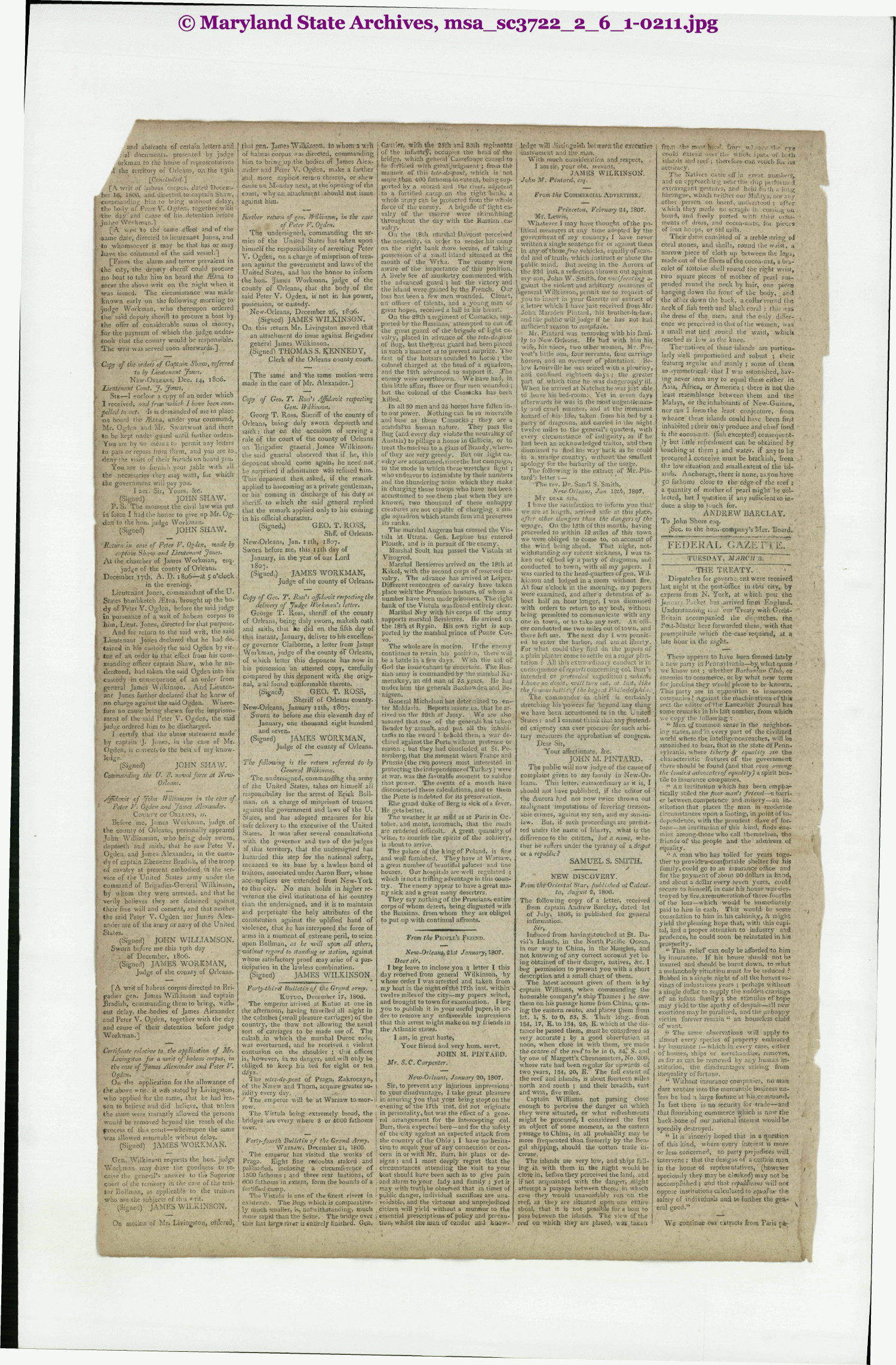
| and abstfaats of certain letters and\ ;ial documents, presented by judge orkman to the house of representatives ,f the territory of Orleans, on, the 13th I [Cpnctuded."] [A writ of habeas corpus, dated ©eteav ber 36, 1800, and directed to captain Shaw, commanding him to bring without delay, the body of Peter V. Orden, together with 'the day ' and cause of his detention before judire Workman.! j~A writ to the same effect and of the ¦same date, directed to lieutenant Jones, and to whomsoever it may be that has or may have the command of the said vessel.] [Trorn the alarm and terror prevalent in the city, the deputy sheriff could procure .no boat to take him on board the iEtna to serve the above writ on the night when it was issued. The circumstance was made •known early on the following morning to judge Workman, who thereupon ordered the said deputy sheriff to procure a boat by the offer of considerable sums ot money, for the payment of which the judge under- took that the county would be responsible. The writ was served soon-afterwards.] Copy of the orders of Captain Shaw, referred ¦to by Lieutenant Jones. New-Orleans, Dec. 14, 1806. Utettlenant Comt. J. Jones. Sir—I enclose a copy of an order which I received, and frost which I have been com- pelled to act. It is demanded of me to place on bo.ifd the iEtna, under your command, Mr. Ogden and Mr. Swartwout and there to be kept under guard until further orders. You are by no means to permit any letters to pass or repass from them, and you are to, deny the visits of their friends on board you. You are to {urnis 1 your Jable with all the necassaries they may want, for which the government will pay you. I am, Sir, Yours, &c. (Signed) JOHN SHAW. P. S. The moment the civil law was put in force I had the honor to give up Mr. Og- den to the hon. judge Workman. (Signed) ' JOHN SHAW. Return in case of Peter V. Ogden, made by capfd'm Sh.Tiv and Lieutenant Jones. At the chamber of James Workman, esq. judi^e of the county of Orleans. December 17th, A. D. 1806—at 5 o'clock in the evening. Lieutenant Jones, commandant of the U. States bombketch /Etna, brought up the bo- dy of Peter V. Ogdcn, before the said judge in pursuance of a writ of habeas corpus to him, Lieut. Jones, directed for that purpose. And for return to the said writ, the said Lieutenant Jones declared that he had de- tained in his custody the said Ogden by vir- tue of an order to that effect from his com- manding officer captain Shaw, who he un- derstood, had taken the said Ogden into his custody in consequence of an order from general James Wilkinson. And Lieuten- ant Jones further declared that he knew of no charge against the said Ogden. Where- fore no cause being shewn for the imprison- ment of the said Peter V. Ogden, the said judge ordered him to be discharged. I certify that the above statement made by captain'J. Jones, iu the case of Mr. Ogden, is correct) to the best of my know- ledge. (Signed) JOHN SHAW. Commanding the V. 8. naval force at New- Orleans. Affidavit- of John WtlHamsm in the case of Peter V- Ogden and James Alexander. County of Orleans, ss. Before me, James Workman, judge,of the county of Orleans, personally appeared John Williamson, who being duly sworn, deposeth and saith, that he saw Peter V. Ogden and James Alexander, in the custo- dy of captain Ebenezer Bradish, of the troop of cavalry at present embodied in the ser- vice of the United States army under the command of Brigadier-General Wilkinson, by whom they were arrested, and that he verily believes they are detained against their free will and consent, and that neither the said Peter V. Ogden nor James Alex- ander are of the army or navy of the United States. (Signed) JOHN WILLIAMSON. Sworn before me this Tgth day of December, 1806. (Signed) JAMES WORKMAN, Judge of the county, of Orleans. £A writ of habeas corpus directed to Bri- gadier gen. James Wilkinson and captain Bradish, commanding them to bring, with- out delay, the .bodies of James Alexander :nd Peter V. Ogdcn, together with the day and cause of their detention before judge Workman.] Certificate relative to the application of Mr. Livingston for a 'writ of habeas corpus, in the case of James Alexander and Peter V. Ogdcn. On the application for the allowance of the above writ, it was stated by Livingston, who applied for the same, that he had rea- son to believe and did believe, that unless the same were instantly allowed the persons would be removed beyond the reach of the fprocess of this court—whereupon the same was allowed returnable without delay. (Signed) JAMES WORKMAN. Gen, Wilkinson requests the hon. judge Workman may >have the goodness to re- ceive tin: general's answer to the Superior comt of 1 lie territory in the case of the trai- tor Bellman, as applicable to the traitors who are the subjects of this *> rit. (Signed) JAMES WILKINSON. On motion of Mr. Lkingaton, chirred, thai ^;cn. James Wilkinson, to whonva-writ of habeas corpus was directed, commanding him to bring up the bodies of James Alex- ander and Pater 'V. Ogden, make a further and more explicit return thereto, or shew cause on Monday next, at the opening of the court, why an attachment should not issue against him. Further return of gen. fl'ilkinson, in the case of Peter V. Ogden. • . The undersigned, commanding the ar- mies of the United States has taken upon himself the responsibility of arresting Peter V. Ogden, on a charge of misprison of trea- son against the government and laws of the United States, and has the honor to inform the hon. 'James Workman, judge of the county of Orleans, that the body of the said Peter V. Ogden, is not in his power, possession, or custody. Ne*'-Orleans, December 26, i?o6. (Signed) JAMES WILKINSON. On this return Mr. Livingston moved that an attachment do issue against Brigadier general James Wilkinson. (Signed^ THOMAS S. KENNEDY, Clerk of the Orleans county court. [The same and 'the same motion were made in the case of Mr. Alexander.] Copy of Geo. T. Ross's Affidavit respecting Gen. Wilkinson. , Georg T. Ross, Slreriff of the county of Orleans, being duly sworn deposeth and saith: that or. the occasion of serving a rule of the court of the county of Orleans on Brigadier general James Wilkinson, the said general observed that if he, this deponent should come again, he need not be surprised if admittance was refused him. This deponent then asked, if the remark applied to hiscoming as a private gentleman, or his coming in discharge of his duty as sheriff, to which the said general replied that the remark applied only to his coming in his official character. (Signed,) GEO. T. ROSS, Stiff, of Orleans. New-Orleans, Jan. tith, 1807. Sworn before me, this nth day of January, in the year of our Lord 1807. (Signed,) JAMES WORKMAN, Judge of the county of Orleans. Copy of Geo. T. Ross's affidavit respecting the delivery of Judge Workman's letter. George T. Ross, sheriff of the county of Orleans, being duly sworn, maketh oath and saith, that ke did on the fifth day of this instant, January, deliver to his excellen- cy governor Claiborne, a letter from JaniGS Workman, judge of the county Of Orleans, of which letter this deponent has now in his possession an attested copy, carefully compared by this deponent with the origi- nal, and found conformable thereto. (Signed) GEO. T. ROSS, Sheriff of Orleans county. New-Orleans, January nth, 1807. Sworn to before me this eleventh day of January, one thousand eight hundred and seven. (Signed) JAMES WORKMAN, Judge of the county of Orleans. The following is the return referred £0 by General Wilkinson. The undersigned, commanding the army of the United States, takes on himself all responsibility for the arrest of Erick Boll- man, on a charge of misprison of treason against the government and laws of the U. Stales, and has adopted measures for his safe delivery to the executive of the United States. It was after several consultations with the governor and two of the judges af this territory, that the undersigned has hazarded this step for the national safety, menaced to its base by a lawless band ot traitors, associated under Aaron Burr, whose accomplices are extended from New-York to this citv. No man holds in higher re- verence the civil institutions of his country than the undersigned, and it is to maintain and perpetuate the holy attributes of the constitution against the uplifted hand of violence, .that he has interposed the force of arms in a moment of extreme peril, to seize upon Bollman, as he 'will upon all others, •without regard to standing or station, against whom satisfactory proof may arise of a par- ticipation in the lawless combination. (Signed) JAMES WILKINSON Forty-third Bulletin 0/ the Grand army. KuTUO, December 17, 180(3. The emperor arrived at Kutuo at one in th.e afternoon, having travelled all night in the calashes (small pleasure carriages) of the country, the thaw not allowing the usual sort of carriages to be made use of. The calash in which the marshal Duroc rode, was overturned, and he received a violent contusion on the shoulder ; this officer is, however, in no danger, and will only be obliged to keep his bed for eight or ten days. The tetes-de-pont of Praga, Zakroczyn, of the Nau-w and Thorn, acquire greater so- lidity every day. Tne emperor will be at Warsaw to mor- row. The Vistula being extremely broad, the bridges are every where 3 or 4C00 fathoms over. Forty-fourth Bulletin of the Grand Army. Warsaw, December 21, 1806. The empsror has visited the works of Praga. Eight fine redoubts staked and pallisaded, inclosing a circumference of 1500 fathoms ; and three rear bastions, of 600 fathoms in extent, form the bounds of a fortified camp. The Vistula is one of the finest rivers in existence. The Bug, which is comparative- ly much smaller, is, notwithstanding, much mote rnpkl than the Seine. The bridge over this last large riv« is entirely finished. Ge,n. Gautier, with the '25'fh and 83fh regiments of the infantry1, occupies the head of the bridge, which general'Casseloupe caused to be fortified wrthgre&tijtidguierit ; from the manner of this tete-dc-pont, which is ' not mqre than 400 fathoms in extent, being sup- ported by a morjjss and the river, adjacent to a fortified camp, on the right bank, a whole arrny can be protected from the whole force of the enemy. A brigade of light ca- valry of tin' reserve were skirmishing throughout the day with the Russian ca- valry. On the 18th marshal Davoust perceived the necessity, in order to render his camp on the right bank more secure,. of taking possession of a small island situated at the mouth of the Wrka. The enemy were aware of the importance of this position. A lively fire of musketry commenced with the advanced guard ; but the victory and the island were gained by the French. Our loss has been a few men wounded. Clouet, an officer of talents, and a young man of great hopes, received a ball in his breast. On the 29th a regiment of Cossacks, sup- ported by the Russians, attempted to cut off the great guard of the brigade of light ca- valry, placed in advance of the iete-de-.pont of Bug, but the>£reat guard had been piaccd in such a manner as to prevent surprize. The first of the hussars sounded to horse ; the colonel charged at the head of a squadron, and the 13th advanced to support it. The enemy were overthrown. We have had, in this little affair, three or four men wounded ; but the colonel of the Cossacks has been killed. In all 30 men and 23 horses have fallen in- to our power. Nothing can be so miserable and base as these Cossacks ; they are a scandatto human nature. They pass the Bug (and every day violate the neutrality of Austria) to pillage a house in Gallicia, or to treat themselves to a glass of Brandy, where- of they are very greedy. But our light ca- valry are accustomed,sincethe last campaign, to the mode in which these wretch/.'s fight ; who endeavor to intimidate by their numbers and the thundering noise which they make in charging those troops who have not been' accustomed to see them ; but when they are known, two thousand of these unhappy creatines are not capable of charging a sin- gle squadron which stands firm and preserves its ranks. The marshal Augerau has crossed the Vis- tula at Utrata. Gen. Lepisse has entered Plousk, and is in pursuit, of the enemy. Marshal Soult has passed the Vistula at Vizogrod. Marshal Bessierres arrived on the 18th at Kikol, with the second corps of reserved ca- valry. The advance has arrived at Leipez. Different rencontres of cavalry have taken place wkh the Prussian hussars, of whom a number have been made prisoners. The right bank of the Vistula was found entirely clear. Marshal Ney with his corps of the army supports marshal Bessierres. He arrived on the 18th at Rypin. His own right is sup ported by the marshal prince of Ponte Cor- vo. The whole are in motion. If the enemy continues to retain his position, there will be a battle in a few days. With the aid of God the issue cannot be uncertain. The Rus- sian army is commanded by the marshal Sa- menskoy, an old man of 73. years, lie has under him the generals Buxhowdenand Be- nigEen. General Michelsonhas determined to en- ter Moldavia. Reports assure us, that he ar- rived on the 29th at Jassy. We are also assured that one of the generals has taken Bender by assault, and put all the inhabi- tants to the sword ! behold then, a war de- clared against the Porte without pretence or reason ; but they had concluded at St. Pe- tersburg, that the moment when Fiance and Prussia (the two powers most interested in protecting theind?pendenceof Turkey) were at war, was the favorable moment to subdue that power. The events of a month have disconcerted these calculations, and to them the Porte is indebted for its preservation._ Ehe grand duke of Berg is sick of a fever. He gets better. The weather is as mild as at Paris in Oc- tober, and moist, insomuch, that the roads are rendered difficult. A great quantity of wine, to nourish the spirits of the soldiery, is about to arrive. The palace of the king of Poland, is fine and well furnished. They have at Warsaw, a great number of beautiful palaces and tine houses. Our hospitals are well regulated ; which is not a trifling advantage in this coun- try. The enemy appear to have a great ma- ny sick and a great many deserters. They say .nothing of the Prussians, entire corps of whom desert, being disgusted with the Russians, from whom they are obliged to put up with continual affronts. From the People's Frientj. New-Orleant, 21j£ January, 1807. Dear sir., I beg leave to inclose you a letter I this day received from general Wilkinson, by whose order I was arrested and taken from my boat in the night Of the 17th inst. within twelve miles of the city—my papers seized, and brought to town for examination. I beg you to publish it in your useful paper, in or- der to remove any unfavorable impressions that this arrest might make on my friends in the Atlantic states. I am, in great haste, Your friend and very hum. servt. JOHN M. PINTARD. Mr. S.C. Carpenter. New-Orleans, January 20, 1807. Sir, to prevent any injurious impressions to your disadvantage, I take great pleasure in assuring you that your being stopt on the evening of the 17th inst. did not originate in personality, but was the effect of a gene- ral arrangement for the intercepting col. Burr, then expected here—and for the safety of the city against an expected attack from the country of the Ohio ; I have no hesita- tion to acquit you of any connection or con- cern in or with Mr. Burr, his plans or de- signs : and I most deeply regret that the circumstances attending the visit to your boat should have been such as to give pain and alarm to your lady and family ; yet it may with truth be observed that in times of public danger, individual sacrifices are una- voidable, and the virtuous and unprejudiced citizen will yield without a murmur to the essential prescriptions of policy and precau- tion, whilst the ma.:i of candor and know- ledge will distinguish between the executive instrument and the man. With much consideration and respect, I am sir. your obt. servant, JAMES WILKINSON. John M. Pintard, esq. From the Commercial Advertiser. , Princeton, February 2-1, 1807. Mr. Lewis, Whatever I may have thought of the po- litical measures at any time adopted by the government of my country, I have never written a single sentence for or against them in any of those/ret; vehicles, equally of scan- dal and of truth, which instruct or abuse the public mind. But seeing in the Aurora of the 23d inst. a reflection, thrown out against my son, John W. Smith, fot vociferating a- . gainst the violent and arbitrary measures of '-general Wilkinson, permit meto request of you to insert in your Gazette an extract of a letter which I have just received from Mr. John Marsden Pintard, his brother-in-law, and the public will judge if he has not had Sufficient reason to complain. ¦ Mr. Pintard was removing with his fami- ly to New-Orleans. He had with him his wife, his niece, two other women, Mr. Pre- vost's little son, four servants, four carriage horses, and an overseer of plantation. Be- low Louisville he was seized with a pleurisy, and confined eighteen days ,• the greater part of which time he was dangerously ill. When he arrived at Natchez he was just able to leave his bed-room. Yet in seven day? afterwards he was in the most ungentleman- ly and cruel manner, and at the imminent hazard of his life, taken from his bed by a .party of dragoons, and carried in the night twelve miles to the general's quarters, with every circumstance of indignity, as if he had been an acknowledged traitor, and then dismissed to find his way back as he could in a strange country, without'the smallest apology for the barbarity of the usage. The following is the extract of Mr. Pin- tard 's letter : — The rev. Dr. Sam'l S. Smith, New-Orleans, Jan. 13tk, 1807. My de'vU sir, I have the satisfaction to inform you that we are at length, arrived safe at this place, after other dangers than the dangers of the voyage. On the 15th of this month, having proceeded to within 12 miles of this town we were obliged to come to, on account of the wind being ahead. That night, not- withstanding my recent sickness, I was ta- ken out of bed by a party of dragoons, and conducted to town, with all my papers. I was carried to the head-quarters of gen. Wil- kinson and lodged in a room without fire. At four o'clock in the morning, my papers were examined, and after a detention of a- bout half an hour longer, I was dismissed with orders to return to my boat, without being permitted to communicate with any one in town, or to take any rest. An offi- cer conducted me two miles out of town, and there left me. The next day 1 was permit- ed to enter the harbor, and am at liberty. For what could they find an the papers of a plain planter come to settle on a sugar plan- tation ? All this extraordinary conduct is in consequence ofreports concerning col. Burr's intended or pretended expedition ; 'which, I have no doubt, will turn out, at last, like the ft- ;iwus bultte'cf the kegs at Phi'ndc/.p/iia. ( The commander in chief is certainly stretching his powers far beyond any thing we have been accustomed to in the United ' States : and I cannot think that any pretend- ed exigency can ever procure fcr such arbi- tary measures the approbation of congress. Dear Sir, Your affectionate, &c. JOHN M. PINTARD. The public will now judge of the cause of complaint given to my family in New-Or- leans. This letter, extraordinary as it is, I should not have published, if the editor of the Aurora had not now twice thrown out malignant imputations of favoring treason- able crimes, against my son, and my son-in- law. But, if such proceedings are permit- ted undei the name of liberty, what is the difference to the citizen, but a name, whe- ther he suffers under the tyranny of a despot or a republic-? SAMUEL S. SMITH. ______s NEW DISCOVERY. From ihe'Oriental Star, published at Calcut- ta, August 2, 1806. The following copy of a letter, received from captain Andrew Barclay, dated 1st of July, 1806, is published for general information. Sir, Induced from having touched at St. Da- vid's Islands, in the North Pacific Ocean, in our way to China, in the Mangles, and not knowing of any correct account yet be- ing obtained of their danger, natives, &c. I beg permission to present you with a short description and a small chart of them. The latest account given of them is by captain Williams, when commanding the honorable company's ship Thames ; he saw them on his passage home from China, earn- ing the eastern route, and places them from lat. 1, S. toO, 55, S. Their long, from 134, 17, E. to 134, 25, E. which at the dis- tance he passed them, must be considered as very accurate ; by a good observation at noon, when close in with them, we made the centre of the reef to be in 0, 54, S. and by one of Margett's Chronometers, No. 209, whose rate had been regular for upwards of two years, 134, 20, E. The full extent of the reef and islands, is about fourteen miles north and south ; and their breadth, east and wtvt, five miles. Captain Williams not passing close enough to perceive the danger on which they were situated, or what refreshments might be procured, I considered the first an object of some moment, as the eastern passage to China, in all probability may be more frequented than formerly by the Ben- gal shipping, should the cotton trade in- crease. The islands are very low, and ships fall- ing in with them in the night would be close in, before, they perceived the land, and if not acquainted with the danger, might attempt a passage between them, in which case they would unavoidably run on the reef, as they are situated upon one entire shoal, that it is not possible for a boat to pass between the islands. The view of the reef on which they are placed, was tafcii fro." the m.y;?T5sead. flop v, 1 .-n.-r• the" eye could <-.Ki.. >vei the whole ipate of both islands aiidreef; therefor* caft vovich Rn its accuracy, The Natives came off in ...reat tun and en approaching near the sfiip perform) d extravagant gestures, and held Forth a long h'arangtje, which neither our Malays, r»oi . other person on board, understood ; after which they made no scruple in cpmii>g on board, and freely parted with their orna- ments cf dress, and cocoa-nuts, for pieces of iron hoops, or old nails. , Their dress consisted of a treble string of coral stones, and shells, round the waist, a narrow piece of cloth up between the legs, made out of the fibres of the cocoa-nut, a bra- celet of tortoise shell round the right wrist, two square pieces of mother of pearl sus- pended round the neck by hair, one piece hanging down the front of the body, and the other down the back, a collar round the neck of fish teeth and black coral : this was the dress of the men, and the only differ- ence we perceived in that of the women, was a small mat tied round the waist, which reached as low as the knee. The'natives of these islands are particu- larly well proportioned and robust ; their feature^ regular and manly ; some of them, so symmetrical, that I was astonished, hav- ing never seen any to equal them either in Asia, Africa, or America ; there is not the least resemblance between them and the Malays, or the inhabitants of New-Guinea, nor can I form the least conjecture, from whence these islands could have been first inhabited ; their only produce and chief food is the oocoa-nut. (fish excepted) consequent- ly but little refreshment can be obtained by touching at them ; and water, if any to be procured I conceive must be brackish, from. the low situation and smallexteiu of the isl- ands. Anchorage, there is none, as you have 50 fathoms close to the edge of the reef ; a quantity of mother of pearl might be col- lected, but I question if any sufficient to in- duce a ship to touch for. ANDREW BARCLAY. To John Shore esq. uSec. to the hon. company's Mar. Board. ¦¦ FEDERAL GAZETTE, TUESDAY, ItfAltC'irs. THE TREATY. . Dispatches for govern:vent were received last night at the post-office in this city, by express from N. York, at which port the j. :ket has arrived from England. Understanding <-..., our Treaty with Great- Britain accompanied the dispatches, the I'ot,t-Master here forwarded their., with that promptitude which the case required, at a late hour in the night. There appears to have been formed lately a new party in Pennsylvania—by what name we know not ; whether Barbarian Ctub, or enemies to commerce, or by what new term for jacobins they would please to be known. This party are in opposition to insurance companies ! Against the machinations of this sect the editor of the Lancaster Journal has some remarks in his last number, from which we copy the following : " Men yf. common sense in the neighbor- ing suites, and in every part of the civilized world where the intelligence-reaches, will be astonished to hear, that in the state rjf Penn- sylvania, where liberty #' equality are the characteristic features of the government there should l>e found (and that even among the loudest advocates of equality) a spirit hos- tile to insurance companies. " An institution which has been empha- tically stiled the floor man's friend—-a barri- er between competence and misery—an in- stitution that places the man in moderate circumstances upon a footing, in point of in- dependence, with the proudest slave of for- tune—an institution of this kind, finds ene- mies among those who call themselves, the friends of the people and the admirers of equality. '* A man who has toiled for years toge- ther to provide a-comfortable shelter for his family, could go to an insurance office and for the payment of about 20 dollars in hand, and about a dollar every seven years, could secure to himself, in case his house was des- troyed by fire,aremunerationof three-fourths of the loss—which would be immediately paid to him in cash. This would be some consolation to him in his calamity, tk might yield the pleasing hope that, with this capi- tal, and a proper attention to industry and prudence, he could soon be reinstated in his prosperity. " This relief can only he afforded to him by insurance. If his house should not b« insured and should be burnt down, to what a melancholy situation must lie be reduced ? Robbed in a single night of all the honest sa- vings of industrious years ; perhaps without a single dollar to supply the sudden cravings of an infant family ; the stimulus of hope may yield to the apathy of despair—all new exertions may be paralized, and the .unhappy victim forever remain " an houseless child of want. " The same observations will apply to almost every species of property embraced by insurance :— -which in every case, either of houses, ships or merchandize, removes, as far as can be removed by any human in- stitution, the disadvantages arising from inequality of fortune. " Without insurance companies, no man dare venture into the mercantile business un- less he had a large fortune at his command. In fact there is no security for trade—and that flourishing commerce wjiich is now the back-bone of our national interest would be speedily destroyed. " It is sincerly hoped that in a question of this kind, where every interest is more or less, concerned, no party prejudices will intervene ; that the designs of a certain man in the house of representatives,' (however speciously they may be cloaked) may not be accomplished; and that republicans will not oppose institutions calculated to equalise the safety of individuals and to further the gen- eral good." We continue our extracts from Taris ta- \ |