 |
|
|
 |
|
 |
|
|||
|
||||
|
||||
|
Federal Gazette & Baltimore Daily Advertiser 1807/01-1807/06 msa_sc3722_2_6_1-0231 Enlarge and print image (4M) |
|
|
|
|
|
|
|
|||
|
||||
|
||||
|
Federal Gazette & Baltimore Daily Advertiser 1807/01-1807/06 msa_sc3722_2_6_1-0231 Enlarge and print image (4M) |
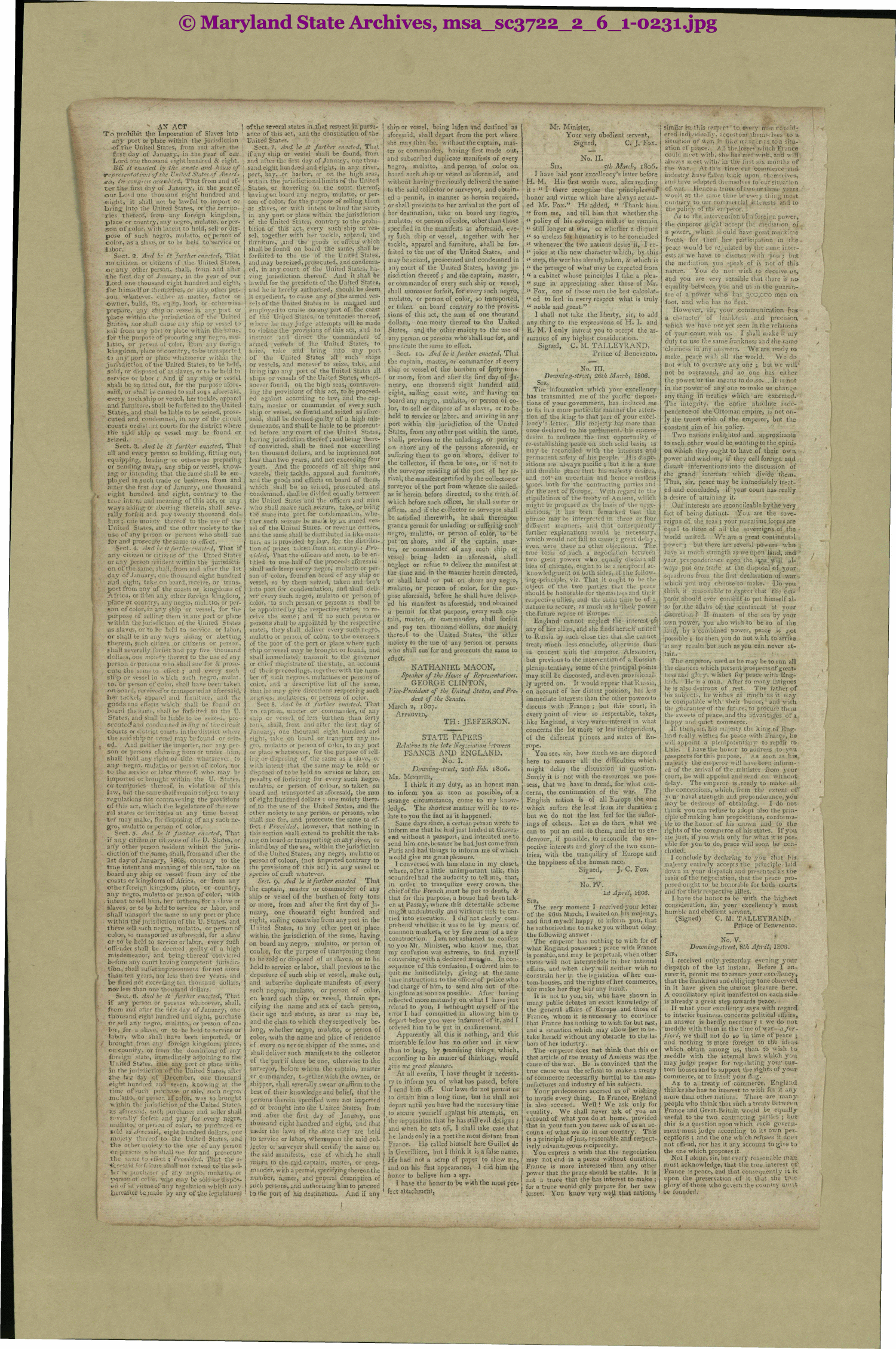
| . " AN ACT J To prohibit the Importation of Slaves into ' any port or place within the jurisdiction of the-United States, from and after the j first day of January, in the year of our Lord one thousand eighthundred & eight. | B/i it enacted by the senate and house of \ representatives of the Untied States of Ameri- j &a, rn congiess assembled'} That from and af- | tei' the first day of January, in the year of , our L-prd one thousand eight hundred and j eight, it shall not. be lawful to import or bring into the United States, or the territo- ries thereof, from any foreign kingdom, place or country, any negro, mulatto, or per- son of color, with intent to hold, seli or dis- pose of such negro, mulatto, or person of color, as a slave, or to be held to -service or labor. Sect. 2. And be it further enacted, That no citizen or citizens of the United States, or any other person, shall, from and after the first day of January, iu the year of our iLord one thousand eight hundred and eight, for himself or themselves, or any other per- son whatever, either as master, factor or owner, build, lit, equip, load, or otherwise prepare, any ship or vessel in any port or place within the jurisdiction of the United States, nor shall cause any ship or vessel to sail from any port or place within the same, for the purpose of procuring any negro, mu- latto, or person of color, from any foreign kingdom, place or country, to he transported to any port or place whatsoever within the jurisdiction of the United States, to he held, sold, or disposed of as slaves, or to be held to service or labor : And if any ship or vessel shall be so fitted out, for the purpose afore- said, or shall be caused to sail sovs aforesaid, every such ship or vessel, her tackle, apparel and furniture, shall be forfeited to the^United States, and shall be liable to be seized, prose- cuted and condemned, in any of the circuit courts or disi. ict courts for the district where the said ship or. vessel may be found or seized. Sect. 3. And be it further enacted, That all and every person so building, fitting out, equipping, loading or otherwise preparing or sending away, any ship or vessel, know- ing or intending that the same shall be em- ployed in such trade or business, from and arter the first day of January, one thousand eight hundred and eight, contrary to the true int.:>iu and meaning of this act, or any ways aiding or abetting therein, shall seve- rally forfeit and pay twenty thousand dol- lars ;¦ one moiety thereof to the use of the United States, and the other moiety to the tise of any person or persons who shall sue for and prosecute the same to effect. Sect. 4. And I e it further enacted, That if any citizen or citizens of the Unted States or any person resident within the jurisdicti- on of the same, shall, from and after the 1st day of January, one thousand eight hundred mid eight, take on board, receive, or trans- port from any'of the coasts or kingdoms of Africa, or from any other foreign kingdom, place or country, any negro, mulatto, or per- son of color, in any ship or vessel, for foe purpose of selling them in any port or place within the jurisdiction of the United States as slaves, or to be held to service or labor, or shall be in any ways aiding or abetting therein, such, citizen or citizens or person, shall severally forfeit and pay five thousand dohais, one moiety thereof to the use of any person or persons who shad see for & prose- cute the same to effect ; and every such ship or vessel in which such negro, mulat. to, or person of color, shall have been taken on board, received or transported as aforesaid, her tackel, apparel and furniture, and the goods and effects which shall be found oil hoard the same, shall be forfeited to the U. States, and shall be liable to be seized, pro- secutetfand condemned in any of the circuit courts or district courts in thexiistrict where the said ship cr vessel may be-found or seiz- ed. And neither the importer, nor any per- son or persons claiming from1 or under him, shall hold any right or title 'whatsoever to any negro, mula.UD, or person of color, nor . to the service oi labor thereof, who may be imported or brought within the U. States, or territories thereof, in violation of law, but the same shall remain subject to shy regulations not contravening the provisions of this act- which the legislature of the seve ral states or territories at any time hereaf tef may make, for disposing of any such ne- gro, mulatto or person of color. Sect. 5. And be it further enacted, That if any citizen or citizens of the U. States, or any other person resident within the juris- diction of the same, shall, from and after the 1st day of January, 1808, contrary to the true intent and meaning of this act, take on board any ship or vessel from any of the coasts or kingdoms of Africa, or from any other foreign kingdom, place, or country, any negro, mulatto or person of color, with , intent to sell him, her orthem, for a slave or slaves, or to be held to service or labor, and shall transport the same to any port or place •within the jurisdiction Cf the U. States, and there sell such negro, mulatto, or person of color, so transported as aforesaid, for a slave or to be held to service or labor, every such offender shall be deemed guilty of a high misdemeanor, and being thereof convicted before any court having competent jurisdic- tion, shrill svrffef imprisonment for not more tSrAn. ten years, nor less than live years, and be fined not exceeding fen thousand dollars, nor less than one thousand dollars. Sect. 6. And be it further enacted, That if any person or persons whenever, shall, from and after the first day of January, one thou.-.Hid eighl hundred and eight, purchase or sell any negro, mulatto,! or person of co- lor, for a slave, or to be held to service or labor, who shall have been imported, or brought from any foreign kingdom, place, or country, or from the dominions of any foreign state, immediately adjoining to the United States, into any port or place with- in the jurisdiction nf the United States, after the la-it day of December, one thousand eight hundred and seven, knowing at the time of such purchase or sale, such negro, mulatto, or person af color, was so brought within, the jurisdiction of the United States, as aforesaid, such purchaser and Seller shall Severally forfeit and pay for every negro, mulatto, or person of color, so purchased or •old as aforesaid, eight hundred dollars, one moiety thereof to the United States, and the other moiety to the use of any person or persons who shall sue for and prosecute the same to effect ; Provided, That the a- fcressid forft dure shall not extend to' the sel- ler "'oc purchaser of any negro, mulatto, or yxtrsoo of col u, wi;o may be sold or dispos- ed of iu viitueof any regulation which jbpreafu* Unmade by any of \hc legislatures of the several states in.that respect in pursu- ance of this act, and the constitution of the United States. Sect. 7. And be it further enacted, That if any ship or vessel shall be found, from and after the first day of January, one thou- sand eight hundred and eight, in any river, port, bay, or harbor, or on the high seas, within the jurisdictionaUimitsof the United States, or hovering on the coast thereof, having on board any negro, mulatto, or per- son of color, for the purpose of selling them as slaves, or with intent to land the same, in any port or place within the jurisdiction of the United States, contrary to the prohi- bition of this act, every such ship or ves- sel, together with her tackle, apparel, and furniture, ^and the goods or effects which shall be found on board the same, shall be forfeited to the use of the United States, and may be seized, prosecuted, and condemn- ed, in any court of the United States, ha- ving jurisdiction thereof. And it shall be lawful for the president of the United States, and he is hereby authorised, should he deem it expedient, to cause any of the armed ves- sels of the United States to be inarmed and employed to cruise on any part of the coast of the United States, or territories thereof, where he may judge attempts will be made to violate the provisions of this act, and to instruct and direct the commanders of armed vessels of" Hie United States, to seize, take and bring into any port of the United States all such ships or vessels, and morever" to seize, take, and bring into any port of the United States all ship's or vessels of the United States, where- soever found, on the high seas, contraven- ing the provisions of this act, to be proceed- ed against according to law, and the cap- tain, master or commander of every such ship or vessel, so found and seized as afore- said, shall be deemed guilty of a high mis- demeanor, and shall be liable to be prosecut- ed before any court of the United States, having jurisdiction thereof; and being there- of convicted, shall be fined not exceeding ten thousand dollars, and be imprisoned not less than two years, and not exceeding four years. And the proceeds of all ships and vsssels, their tackle, apparel aud furniture, and the goods and effects on board of them, which shall be so seized, prosecuted and condemned, shall he divided equally between the United States and the officers and men who shall make such seizure, take, or bring the same into port for condemnation, whe- ther.such seizure be made by an aimed ves- sel of the United States, or revenue cutters, and the same shall be distributed in like man- ner, as is provided by law, for the distribu-, tion of prizes t.-.ken from an. enemy : Pro- vided, That the officers and men, to be en- titled to one-half of the proceeds aforesaid shall safe keep every negro, mulatto or per- son of color, found on board of any ship or vessel, so by them seized, taken and bro't into port for condemnation, and shall deli- ver every such negro, mulatto or person of color, -to such person or persons as shall be be appointed by the respective states3 to re- ceive the same; and if no such person or persons shall be appointed by the respective states, tiiey shall deliver every such negro, mulatto or person of color, to the overseers of the poor of the port or place where such ship or vessel may be brought or found, and shad immediately transmit to the governor or chief magistrate of the state, an account of their proceedings, together with the num- ber of such negroes, mulattoes or persons of color,' and a descriptive list of the same, that he may give directions respecting such negroes, mulattoes, or persons of color. Sect 8. And bg it further enacted, That no captain, master or commander, of any ship or vessel, of less burthen than forty tons, shall, from and after the first day of iry, one thousand eight hundred and eight, take on board or transport any ne- gro, mulatto or person of color, to any port or place whatsoever, for the purpose of sell- ing or disposing of the same as a slave, or with intent that the same may be sold or disposed of to be held to service or labor, on penalty of forfeiting for every such negro, mulatto, cr person of colour, so taken on board and transported as aforesaid, the sum of eight hundred dollars ; one moiety there- of to the use of the United States, and the ether moiety to any person, or persons, who shall sue for, and prosecute the same to ef- fect : Provided, however, that nothing in this section shall extend to prohibit the tak- ing on board or transporting on any river, or inland bay of the sea, within the jurisdiction of the United States, any negro, mulatto or person of colour, (not imported contrary to the provisions of this act) in any vessel or species of craft whatever. Sect. 9, And be it further enacted That the captain, master or commander of any ship or vessel of the burthen of forty tons or more, from and aftsr the first day of Ja- nuary, one thousand eight hundred and eight, sailing coastwise from any port in the United States, to any other port or place within the jurisdiction of the same, having on board any negro, mulalto, or person of coulor, for the purpose of transporting them to be sold or disposed of as slaves, or to be held to service or labor, shall ptevious to the departure of such ship or vessel, make out, and subscribe duplicate manifests of every such negro, mulatto, or person of color, on board such ship, or vessel, therein spe- cifying the name and sex of each person, their age and stature, as near as may be, and the class to which they respectively be- long, whether negro, mulatto, or person of color, with the name and place of residence of every owner or shipper of the same, and shall deliver such manifests to the collector of the port if there be one, otherwise to the surveyor, before whom the captain, master or cr.mmander, t.-gether with the owner, or shipper, shall severally swear or affirm to the best of their knowledge and belief, that the persons therein specified were not imported ed or brought into the United States, from and after the first day of January, one thousand eight hundred and eight, and that uRder the !s,ws of the' .state they are held to sprvice or labon, whereupon the said col- lector cr surveyor shall certifiy the same on the said manifests, cne cf whish he shall return to the caid captain, master, or com- mander, with a permit, specifying thereon the number, names, and general description of such persons, and authorising him to proceed to the port of his destination. And if any ship or vessel, being laden and destined as aforesaid, shall, depart from the port where she may then be, without the captain, mas- ter or commander, having first made out, and subscribed duplicate manifests of every negro, mulatto, and person of color on board such ship or vessel as aforesaid, and without having previously deliverd the same to the said collector or surveyor, and obtain- ed a permit, in manner as herein required, or shall previous to her arrival at the port of her destination, take on board any negro, mulatto, or person of color, otherthantho.se specified in the manifests as aforesaid, eve- ry such ship or vessel, together with her tackle, apparel and furniture, shall be for- feited to the use of the United States, and may be seized, prosecuted and condemned in any court of the United States, having ju- risdiction thereof ; and the captain, master, or commander of every such ship or vessel, shall moreover forfeit, for every such negro, mulatto, or person of color, so transported, or taken on board contrary to the provisi- sions of this act, the sum of one thousand dollars, one moity thereof to the United States, and the other moiety to the use of any person or persons who shall sue for, and prosecute the same to effect. Sect. io. And be it further enacted, That the captain, master, or commander of every ship or vessel of the burthen of forty tons or more, from and after the first day of Ja- nuary, one thousand eight hundred and eight, sailing coast wise, and having on board any negro, mulatto, or person of co- lor, to sell or dispose of as slaves, or to be held to service or labor, and arriving in any port within the jurisdiction of the United States, from any other port within the same, shall, previous to the unlading, or putting on. shore any of the persons aforesaid, or suffering them to go on shore, deliver to the collector, if there be one, or if not to the surveyor residing at the port of her ar- rival, the manifest certified by the collector or surveyor of the port from whence she sailed, as is herein before directed, to the truth of which before such officer, he shall swear or affirm, and if the collector or surveyor shall be satisfied therewith, he shall thereupon grant a permit for unlading or suffering such negro, mulatto, or person of color, to be put on shore, and if the captain, mas- ter, or commander of any such ship or vessel being laden as aforesaid, shall neglect or refuse to deliver the manifest at the time and in the manner herein directed, or shall land or put on shore any negro, mulatto, or person of color, for the pur. pose aforesaid, before he shall have deliver- ed his manifest as aforesaid, and obtained a permit for that purpose, every such cap- tain, master, or commander, shall forfeit and pay ten thousand dollars, one moiety thereof to the United States, the other moiety to the use ot any person or persons who shall sue for and prosecute the same to effect. NATHANIEL MACON, Speaker of the House of Representatives. GEORGE CLINTON, I'ice-President of the United States, andPre- dent of the Senate. March 2, 1807. Approved, TH: JEFFERSON. STATE PAPERS Relative to the late Ne^cciation 'etivcen FSANCE AMD ENGLAND. No. I. Dotvning-strect, loth Feb. 1806. Mr. Minister, I think it my duty, as an honest man to inform you as soon as possible, of a strange circumstance, come to my know- ledge. The shortest manner will be to re- late to you the fact as it happened. Some days since, a certain person wrote to inform me that he had just landed at Graves- end without a passport, and intreated me to send him one, because lit had just come from Paris and had things to inform me of which would give me great pleasure. I conversed with him alone in my closet, where, after a little unimportant talk, this scoundrel had the audacity to tell me, that, in order to tranquilize every crown, the chief of the French must be put to death, & that for this purpose, a house had been tak- en at Passay, where this detestable scheme might undoubtedly and without risk be car- ried into execution. I did not clearly com- prehend whether it was to be by means of common muskets, or by lire arms of a new construction. I am not ashamed to confess to you Mr. Minister, who know me, that my confusion was extreme, to find myself conversing with a declared assa«in. In con- sequence of this confusion, I ordered him to quit me immediately, giving at the same time instructions to the officer of police who had charge of him, to send him out of the kingdom as soon as possible. After having reflected more maturely on what I have just related to you, I bethought myself of the error I had committed in allowing him to depart before you were informed of it, and I ordered him to be put in confinement. Apparently all this is nothing, and this miserable fellow has no other end in view than to brag, by promising things which, according to his maner of thinking, would gvve ~r,e great pleasure. At all events, I have thought it necessa- ry to inform you of what has passed, before I send him off. Our laws do not permit us to detain him a long time, but he shall not depart until yon have had the necessary time to secure yourself against his attempts, on the supposition that he has still evil designs ; and when he sets off, I shall take care that he lands only in a port the most distant from France. He called himself here Guillot dc la Gevrilliere, but I think it is a false name. He had not a scrap of paper to shew me, and on his first appearance, I did him the honor to believe him a spy. 1 have the honor to be with the most per- fs ;t atta.5hra.et1t, Mr. Minister, Your very ohedient servent, Signed, C. J. Fox. No. II. Sir, $th March, 1806. I have laid your excellency's letter before H. M. His first words were, after reading it : "I there recognize the, principles ¦ of honor and virtue which have always actuat- ed Mr. Fox." He added, " Thank him " from me, and tell him that whether the " policy of his sovereign makas us remain « still longer at war, or whether a dispute " so useless for humanity is to be concluded " whenever the two nations desire it, I re- " joice at the new character which, by this " step, the war has already taken, & which is " the presage of what may be expected from " a cabinet whose principles I take a plea- " sure in appreciating after those of Mr. " Fox, one of those men the best calculate " ed to feel in every respect what is truly " noble and great." I shall not take the liberty, sir, to add any thing to the expressions of H. I. and R. M. I only intrcat you to accept the as- surance of my highest consideration. Signed, C. M. TALLEYRAND, Prince of Benevento. 1 No. III. Downing-strcet, 26th March, 1806. Sir, Tile information which your excellency has transmitted me of the pacrffc, disposi- tions of your government, has induced me to fix in a more particular manner the atten- tion of the king to that part of your excel- lency's letter. His majesty has more than once declared to his parliament, his sincere desire to embrace the first opportunity of re-establishing peace on such solid basis, as may be reconciled with the interests and permanent safety of his people. His dispo- sitions are always pacific ; but it is a sure and durable peace that his majesty desires, and not' an uncertain and hence a restless ttuce, both for the contracting parties and for the rest of Europe. With regard to the stipulations of the treaty of Amiens, which might be proposed as the basis of the ciations, it has been remarked that the phrase may be interpreted in three or four different manners, and that consequently" further explanations would be necessary, which would not fail to cause a great delay, even were there no other objections. The. true basis of such a negotiation between two great powers wko equally disdain ail idea of chicane, ought to be a reciprocal ac- knowledgment on both sides, of the follow- ing principle, viz. That it ought to be the object of the two parlies that the peace should be honorable for themselves and their respective allies, aud the same time be of a nature to secure, as much as in their power the future repose of Europe. England cannot neglect the interest pf" any of her allies, and she finds herself united to Russia by such close ties that she cannot treat, much less conclude, otherwise than in conCsrt with the emperor Alexander, but previous to the intervention of a Russian plenipotentiary, some of the principal points may still be discussed, and even provisional- ly agreed on. It would appear that Russia, on account of her distant position, has less immediate interests than the other powers to discuss with France ; but this court, in every point of view so respectable, takes, like England, a very warm interest in what concerns the lot more or less independent, of the different princes and states of Eu- rope. You see, sir, how much we are disposed here to remove all the difficulties which might delay the discussion in question. Surely it is not with the resources we pos- sess, that we have to dread, for what con- cerns, the continuation of the war. The English nation is of all Europe the one which suffers the least from its duration ; but we do not the less feel for the suffer- ings of others. Let us do then what we can to put an end to them, and let us en- deavour, if possible, to reconcile the res- pective interests ai-.d glory cf the two coun- tries, with the tranquility of Europe and the happiness of the human race. Signed, J. C Fox. No. rV. Sir, 1st April, HJC6. The very moment I received your letter of the 26th March, I waited on his majesty, and find myself happy to inform you, that he authorised me to make you without delay the following answer: The emperor has nothing to wish for of what England possesses ; peace with France is possible, and may be perpetual, when other states will not intermeddle in hei internal affairs, and when they will neither wish to constrain her in the legislation of her cus- tom-bouses, and the rights of her commerce, nor make her flag bear any insult. It is not to you, sir, who have shown in many public debates an exact knowledge of the general affairs of Europe and those of France, whom it is necessary to convince that France has nothing to wish for but rust, and a situation which may allow her to be- take herself without any obstacle to the la- bors of hen industry. The emperor does not think that this or that article of the treaty of Amiens was the cause of the war. He is convinced that the true cause was the refusal to make a treaty of commerce necessarily hurtful to the ma- nufactures and industry of his subjects. Yonr predecessors accused us of wishing to invade every thing. In France, England is also accused. Well! We ask only for equality. We shall never ask of you an account of what you do at home, provided that in your turn you never ask of us an ac- count of what we do in our country. This is a principle of just, reasonable and respect- ively advantageous reciprocity. You express a wish that the negotiation may not end in a peace without duration. France is more interested than any other power that the peace should be stable. It is not a truce that she has interest to make ; for a truce would only prepare for her new Jesses. You know very weM that nations.. similar in.this respect to every mar consid- ered individually, accustom themsi Ives to a situation of war, in tjke manter as tea situ- ation of peace. All the losses which France could meet with, she has met with, and will always meet with, in the first six months of the war. At this time our comrnerce aud industry have fallen back upon th.m: elves, and have adapted themselves to our situation of war. Hence a truce of two or three j ears would at the same time be euery thil g most contrary toqur eornruerci .,- and to the policy of the emperor. As to the intervention of a foreign power, the emperor might accept the mediation of . a power, ¦ which should have great maiitir.-s forces, for then her participation in the peace would be regulated by the same inter- ests as! we have to discus with you; but the mediation you speak of is not of this* nature. You do not wish to deceive us, and you are very sensible that there is no- equality between you and us in the guaran- tee of a pdwer who has. 300,000 men on foot, and who has no fleet. However, sir, your communication has a character of frankness and precision which we have not yet seen in the relations of your court with us. I shall make it my duty to use the same frankness and the same clearness in my answers. We are ready to make, pea.e with all the world. We do not wish to overawe any one ; but we wilt' not be overawed, and no one has either the power or the means to do so. , It is not in the power of any one to make us change: any thing in treaties which arc executed. The integrity, the entire absolute inde- pendence of the Ottoman empire, is not oi- ly the truest wish of the emperor, but the constant aim of his policy. Two nations enlighted and approximate to each other would be wanting to the opini- on which they ought to have of their own power ahd wisdom, if they call foreign and distant interventions into the discussion of the grand interests Which divide them. Thus, sir, peace may be immediately treat- ed and concluded, if your court has really a desire of attaining it. Our interests are reconcileableby-the very fact of being distinct. You are the sove- reigns of the seas ; your niaralime forces are equal to those of all the sovereigns of the • [world united. We are a great continental power ; but there are several po*e.rs wha have as much strength as we upon land, and your preponderance upon the tjas will al- " ways put our trade at the disposal of your irons from the first declaration of war which you may choose to moke. Do you think it reasonable to exptct that the em- peror should ever consent to put himself al- so for the affairs of the continent at your discretion ? If masters of the sea by your own power, you also wish to be so of the land, by a combined power, peace is not possible ; for then you do not w ish to arrive at any results but such as you can never at- tain. The emperor, used as he may be to run all the chances which present prospects of great- aSld glory, wishes fur peace with ling- land. He is a man. After so many ialigues he is also desirous of rest. The father of his subjects, he wishes as much as it may be compatible with their honor, and with the guarantee of the future, to procure them the sweets of peace, and the advantages of a happy and quiet commerce. If then, s^r, his majesty the king of Eng- land really wishi s for peace with France, he will appoint a plenipotentiary to repair to Lisle. I have the honor to address to you passports for this purpose. As soon as hi* majesty the emperor will have been inform- ed of the arrival of the minister from your court, he will appoint and send on without delay. The emperor is .ready to make ail the concessions, which, from the extent of" yc u'' naval strength and preponderance, you may be desirous of obtaining. I do not think you can refuse to adopt also the prin- ciple of'making him propositions, conforma- ble to the honor of his crown and to the rights of the eommt rce of his states. If you ate just, if you wish only for what it is pos- sible for you to do, peace will soon be con- cluded. I conclude by declaring to you that his majesty entirely accepts the principle laid down in your dispatch and presented as the basis of the negociation, that the peace pro- posed ought to be honorable for both courts: and for their respective allies. I have the honor to be with the highest consideration, sir, your excellency's most humble and obedient servant, (Signed) C. M. TALLEYRAND, Prince of Henevento. Sm, No. V. Doivni?ig-street, 8th April, 1803. I received only yesterday evening your dispatch of the 1st instant. Before I an- swer it, permit me to assure your excellency, that the frankness and obliging tone observed in it have given the utmost pleasure here. A conciliatory spirit manifested on each side is already a great step towards peace. If what your excellency says with regard to interior business, concerns political affairs, an answer is hardly necessary : we do not meddle with them in the time of war—a for- tiori, we shall not do so in time of peace ; and nothing is more foreign to the ideas which obtain among us, than to wish to. meddle with the internal laws which you may judge proper for regulating your cus- tom houses and to support the rights of your commerce, or to insult your flag. As to a treaty of commerce, England thinks she has no interest to wish for it ..ny more than other nations. There are many people who think that such a treaty between France and Great-Britain would be equally useful to the two contracting parties ; but this1 is a question upon which each govern- ment must judge according to its own per- ceptions ; and the one which refuses it does not offend, nor has it any account to give to the one which proposes it. Not I alone, sir, bstevery reasonable man must acknowledge, that the true interest of Fiance is peace, and that consequently it is; upon the preservation of it that the true glory of those who govern the country m'u ,•» be founded. |