 |
|
|
 |
|
 |
|
|||
|
||||
|
||||
|
Federal Gazette & Baltimore Daily Advertiser 1807/01-1807/06 msa_sc3722_2_6_1-0235 Enlarge and print image (3M) |
|
|
|
|
|
|
|
|||
|
||||
|
||||
|
Federal Gazette & Baltimore Daily Advertiser 1807/01-1807/06 msa_sc3722_2_6_1-0235 Enlarge and print image (3M) |
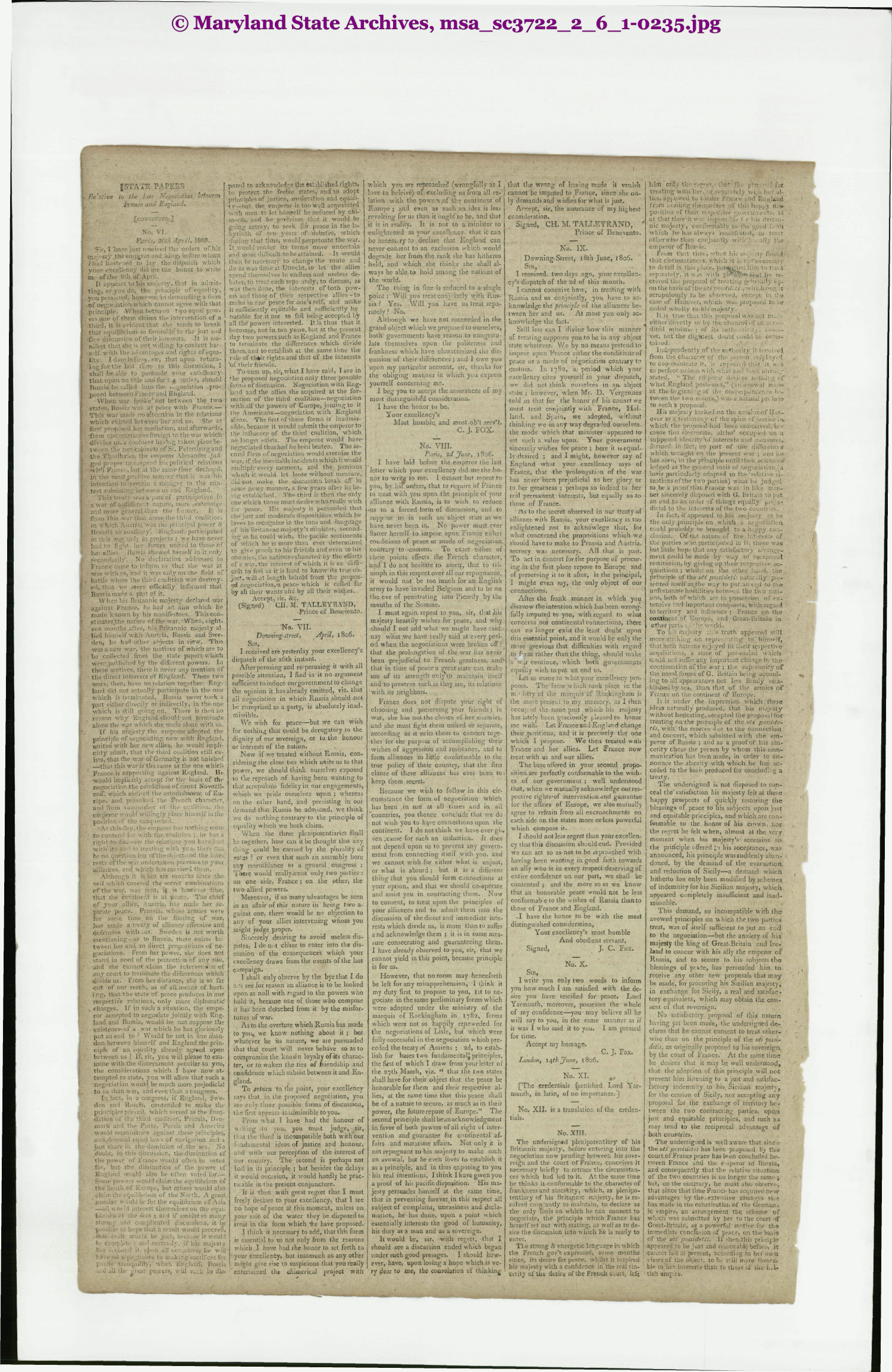
| I STATE PAPERS Relative to the late Negociation between hrancc and Engl, mtiuED.] No. VI. Pfirifi, HiitA 'April, '•' Sir, Votive just received the orders of his :;,- the emperor and king, before whom hastened to lay the dispatch which your excellency did me the .honor to write m ¦ of the 8th of April. It appears to his majesty, that in admit* ting, as.you dw, the principle of'equality, jroa persisted, however, in demanding of negociation which cannot agree with that principle. When between two eqtia claims the intervention of a it is evident that she tends to break that equilibrium so favorable1 to the'just and ;sion of their interests. .It is ma- nifest that she is not willing to content har- self with the advanta ights of equa- lity. 1 dare bi lie-.-t, sir, that upon retum- slng.for the last ttirre. to this discussion, 1 shall be able to persuade your excellency that upon no title and for nj eotive, should Russia.-be-called into the liegociation .pro- posed between France and England. When wa out between the two states, Russia was at peace with France.— This war made no alteration in the relations ¦which existed between her and us. She at first proposed her mediation, and afterwards, from Qjrcurostaiu i to the war which divides us, a coolness' having taken place be- ii is of St. Petersburg and ;| ries, the emperor Alexander jud- ged pi political relations /with Franc ,but at the same time declared, »Y the most positive n rat it was-his intention ¦ i he con- test - ib and England. a; of si tic ....'Lion in 3 Avar of a I ¦ ', more extensive ar.d more general than the former. H is from this war that arose the thitd coalition, in which Antr. . met & i an auxiliary' England participated ojects ; v, e have never ier forces united to those of "ies. Russia shewed herself in it only No declaration addressed to France came to inform us that she was at war with us, and it was only on the field of I battle where the third coalition was destroy- ed, that we were officially informed that Russia made a part of it. When his Britannic majesty declared war against France, he had an aim which he known by his manifestoes. This con- ¦stitutes^the nature of the war. When, eight- een months .after, his Britannic majesty al- lied himself with Austria, Russia and Swe- den, he had other objects in viSW. This was a new war, the motives of which are to . be collected from the slate papers which weri. n,e ii. ¦ ed by the different powers. In these motives, there is never any mention of the direct interests of England. These two Wars, then, have no relation together: Eng- land did not actually participate in the one which is terminated. Russia never took a part either directly or indirectly, in the one which is still going on. There is then no reason why England should not terminate alone the war which she made al me with us. If his majesty the emperor adopted the principle of negociating now with England, united with her new allies, he would impli- citly admit, that the third coalition still ex- ists, that the war of Germany is not finished —that, this war is the same as the one which France is supv- gainst England. He would implicitly accept for the basis of the negociation the conditions of count Novozil- zoff, which eo . d the astonishment of Eu- rope, and ; . the FVench character, and from vanquisher of the coalition, the emfieror would'will inthe position of the vanquish has notbiti ; to contend for with the coalition ; lie has a righi With it ¦ I in treating with yc i. there can he no question but aftheobject sue rests of the war undertaken previous to your alliances, and ->. sprviwd I Although it is but six month veil which covered the secret eotnbinal of the war, was rent, ii is however Hue. that the continent is at p. sc. The chief of your allies, \ustria, has made her se- parate peace. Prussia, whose armies were for some time on the footing of war, has made a treaty of alliance offensive and defensive with us. Sweden is not worth mentioning- as to Russia, there exists be- tween her and us direct propositions of ne- gotiations, From her power, she does not stand in need of the protection of any one, and she Cannot claim the intervention of airy court to terminate the differences which divide us. From her distance, she is so far out of our reach, as of all means of hurt- ing, that the state of peace produces in our respective relations, only more diplomatic charges. If in such a situation, the empe- ror accepted to negotiate jointly with Eng- land and Russia, would he not suppose the existence-of a war which he has gloriously put an end to ' Would he not in fine aban- don between himself and England the prin- ciple of an equality already agreed upon between us ? If, sir, you will please to exa- mine with the discernment peculiar to you, the considerations which I have now at- tempted to state, you will allow that such a negociation would be much more prejudicial to ns than w ar, and even than a congress. In fact, in a congress, if England, Swe- den and ilossia, contended to make the principles prevail, which served as the foun- dation of the third caalition, Prussia, Den- mark and the Pee .. and America would remonstrate against these principles, and,demand iqual laws of navigation and a just share in .the dominion of the sea. No doubt, in this discussion, the diminution of the power of France would often be voted for, but the diminution of the power of England would also be often voted for.— cmld claim the equilibrium of the'South of Europe, but others would also brium of the North. A great the equilibrium of Asia • —all would interest themselves on th a el the seas ; and if amidst s< stormy ani ated discussions, it be' possil hope , proceed, tins lesult wo.do ¦¦ j . ily, if Lis majesty has dt . njion all e he will » sacrifices for pubHfe tranquility, .. land, Russia iu.U all the c,re.at powers, will ?„.!; bg dis- posal to acknowledge the established fights, to protect the feeble states, and to adopt principles of justice, moderation and equali- ty— but the emperor is too well acquainted with men to let him-elf be seduced by chi- , and he perceive* that it would be astray, to seek for peace in the la- byrin'th of ten years of "debates, which during that time, would perpetuate the war. It would render its terms more uncertain and more difficult to be attained. It would then be'necessary to change the route and do as was done at Utrecht, to let the allies j spend themselves in endless, and useless de- bates, to treat each sepa ately, to discuss, as was then done, the interests of both pow- ers arid those of their respective allies-to make in fne peace for one's self, and make it sufficiently equitable and sufficiently ho notable for it not to fail being accepted by all the powers interested. It is thus that it becomes, not in ten years, but at the present day two powers such as England and France to terminate the differences which divide them, and to establish at the same time the rule of tlv*ir rights and that of the interests 'of their friends. To sum up, sir, what I have said, I see in 'he proposed negociation only three possible forms of discussion. Negociation with Eng- land and the allies she acquired at the for- mation of the third coalition—negociation with all the powers of Europe, joining to it the Americans—negociation with England alone. The first of these forms is inadmis- sible, because it would submit the emperor to the influence of the third, coalition, which no langeiexists. The emperor would have dated thushad he been beaten. The se- cond form of negociation would eternise the war, if the inevitable incidents which it would multiply every moment, and the passions which it would let loose without measure, did not make the discussion break Off in noisy manner, a tew years after its be- . lied. The third is then theonly one wdiich those must desire who.really wish I r peace. His majesty is persuaded that t and moderate dispositions which he loves to recognize in the tone and dangtfage of his Britanjiac majesty's minister, second- ing as ha could wish, the pacific sentiments of which he is more than ever determined to give proofs to his friends and even to his onemies, the nations-exhausted' by the efforts of a war, the interest of which it is as cult to feel as it is hard to know its true ob- ject; will at length behold from the propos- ed negociation, a peace which is called For by all their wants and by all their wishes. Accept) sir, &c. (Signed) CII. M. TALLEYRAND, -Prince of Benevento. No. VII. Doivnhig-street, April, 1806. S:r, I received ere yesterday your excellency's dispatch of the 26th instant. After perusing and re:perusing it with all possible attention, I find in it no argument sufficient to induce our government to change the opinion it has already emitted, viz. that all negociation in which Russia should not be comprised as a party, is absolutely inad- missible. We wish for peace—but we can wish for nothing tnat could be derogatory to the dignity of our sovereign, or to the honour or interests of the nation. Now if we treated without Russia, con- sidering the close ties which unite us to that power, we should think ourselves exposed to the reproach of having been wanting to that scrupulous fidelity in our engagements, which we pride ourselves upon ; whereas on the other hand, and presisting in our demand that Russia be admitted, we think we do nothing contrary to the principle of equality which we both claim. When the three plenipotentiaries shall be together, how can it be thought that any thing could be carried by the plurality of vo!-s ? or even that such an assembly bore any resemblance to a general congress : 'i here would really exist only two paities : 011 one side, France ; on the other, the two allied powers. Moreover, if so many advantages be seen in an affair of this nature in being two a- gainst one, there wotild be no objection to any of your allies intervening whom you might judge proper. Sincerely desiring to avoid useless dis- putes, I do not ch'use to enter into the dis- cussion of the consequences which your excellency draws from the events of the last campaign. I shall only observe by the bye that I do II "c see for reason an alliance is to be looked upon as null with regard to the powers who hold it, because one of those who compose it has been detached from it by the misfor- tunes of war. As to the overture which Russia has made to you, we know nothing about it ; but whatever be its nature, we are pursuaded that that court will never behave so as to compromise the known loyalty of its charac- ter, or to waken the .ties of friendship and confidence which subsist between it and En- gland. To j-eturn to the point, your excellency says that in the proposed negotiation, you see only three possible forms of discussion, the Hrst appears inadmissible to you. From what I have had the honour of writing lo you, you must judge, sir, that the third is incompatible both with our fundamental ideas of justice and honour, and with our perception of the interest of our country. The second is perhaps not bad in its principle ; but besides the delays it would occasion, it would hardly be prac- ticable in the present conjuncture. It is then with great regret that I must freely declare to your excellency, that I see no hope of peace at this moment, unless on your side of the water they be disposed to treat in the form which we have proposed. I think it necessary to add, that this form is essential to us not only from the reasons which 1 have bad the honor to set forth to your excellency, but inasmuch as any other might give rise to suspicions that you really entertained the chimerical project with winch yrra are reproached (wrongfully ns I love to beleive) of excluding us from all re- lation with the powers of the continent of Europe ; and even as such an idea is less revolting tor us than it ought.to be, and that it is in reality. It is not to a minister so enlightened as your excellency that it can be necess. ry to declare that England can never consent to an exclusion which would degrade her from the rank she has hitherto held, and which she thinks she shall al- ways be able to hold among the nations of the world. The tiling in fine is reduced to a single point : Will yon treat conjointly with Rus- sia ? Yes. Will you have us treat sepa- rately ? No. Although we have not succeeded in the grand object which we proposed to ourselves, both governments have reason to congratu- late themselves upon the politeness and frankness which have 'characterized the dis- cussion of their differences ; and 1 owe you upon my particular account, sir, thanks for the obliging manner in which you express yourself concerning me. I beg you to accept the assurances of my most distinguished consideration. I have the honor to be, Your excellency's Most humble and most ob't serv't. C. J. FOX. No. VIII. Paris, 'id June, 1R06. I have laid before the emperor the last letter which your excellency did me the ho- nor to write to me. I cannot but repeat to you, by his orders, that to require of France to sseat with you upon the principle of your alliance with Russia, is to wish to reduce •us to a forced form of discussion, and to supp.ise us in such an abject state as we have never been in. No power must ever flatter herself to impose upon France either conditions of peace or mode of negociation contrary to custom. To exact either of these points affects the French character, and I do not hesitate to assert, that to tri- umph in this respect over all our repugnance, it would not be too much for an English army to have invaded Belgium and to be on the eve of penetrating into Picardy by the mouths of the Somme. I must again repeat to you, sir, that Aiis majesty heartily wishes for peace, and why should I not add what we might have said nay what we have really said at every peri- od when the negociations were broken off? that the prolongation of the war has never been prejudicial to French greatness, and' that in time of peace a great state can make use of its strength only to maintain itself and to preserve such.as they are, its relations with its neighbors. France does not dispute your right of choosing and preserving your friends ; in war, she has not the choice of her enemies, and she must fight them united or separate, according as it suits them to concert toge- ther for the purpose of accomplishing their wishes of aggression and resistance, and to form alliances so little conformable to the true policy of their country, that the first clause of these alliances has ever been to keep them secret. Because we wish to follow in this cir- cumstance the form of negociation which has been in use at all times and in all countries, you thence conclude that we do not wish you to have connections upon the continent. I do not think we have ever gi-. ven .cause for such an induction. It does not depend upon ns to prevent any govern- ment from connecting itself with you. and we cannot wish for either what is unjust, or what is absurd ; but it is a different thing that you should form connections at your option, and that we should co-operate and assist you in contracting them. Now to consent, to treat upon the principles of your alliances and to admit them into the discussion of the direct and immediate inte- rests which divide us, is more than to suffer and acknowledge them ; it is in some mea- sure consecrating and guaranteeing them. I have already observed to you, sir, that we cannot yield in this point, because principle is for us. However, that no room may henceforth be left for any misapprehension, I think it my duty first to propose to you, 1st to ne- gociate in the same preliminary forms which were adopted under the ministry of the marquis of Rockingham in 1782, Forms which were not so happily reneweded for the negociations of Lisle, but which were fully successful in the negociation which pre- ceded the treaty ai Amiens ; 2d, to estab- lish for bases two fundamental!principles, the first of which I draw from your letter of the 27th March, viz. " that the two states shall have for their object that the peace be honorable for them and their respective al- lies, at the same time that this peace shall be of a nature to secure, as much as in their power, the future repose of Europe." The [ second principle shallbeanacknowledgment in favor of both powers of all right of inter- vention and guarantee for continental af- fairs and mai'atime affairs. Not only it is not repugnant to his majesty to make such an avowal, but he even loves to establish it as a principle, and in thus exposing to you - his real intentions, I think I have given you a proof of his pacific disposition. His ma- jesty persuades himself at the same time, that in preventing forever, in this respect all subject of complaint, uneasiness and decla- mation, he has done, upon a point which essentially interests the good of humanity, his duty as a man and as a sovereign. It would be, sir, with regret, that I should see a discussion ended Which began under such good presages. I should how- ever, have, upon losing a hope which is ve- ry dear to me, the coasolation of thinking that the wrong of having made it vanish cannot be imputed to Fiance, since she on- ly demands and wishes for what is just. Accept, sir, the assurance of my highest consideration. Signed, CH. M. TALLEYRAND, ' Prince of Benevento. No. IX. Downing-Street, 18th June, 1806. Snt, I received, two days ago, your excellen- cy's dispatch of the 2d of this month. I cannot conceive how, in treating with Russia and us conjointly, you have to ac- knowledge the principle of the alliances be- tween her and us. At most you only ac- kno'vledge the fact. Still less san I divine how this manner of treating supposes you to be in any abject state whatever. We by no means pretend to impose upon France either the conditions of peace or a mode of negociation contrary to custom. In 1782, a period which your excellency cites yourself in your dispatch, we did not think ourselves in an abject state ; however, when Mr. D. Vergennes told us that for the honor of his counrt we must treat conjointly with France, Hol- land, and Spain, we adopted, without thinking we in any way degraded ourselves- the mode which that minister appeared to set such a value upon.. Your government sincerely wishes for peace ; here it is equal- ly desired ; and I might, however say of England what your excellency says of France, that the prolongation of the war has neverbecn prejudicial to her glory or to her greatness ; perhaps so indeed to her real permanent interests, but equally so to those of France. As to the secret observed in our treaty of alliance with Russia, your excellency is too enlightened not to acknowlege that, for what concerned the propositions which we should have to make to Prussia and Austria, secrecy was necessary. All that is past. To act in concert for the purpose of procur- ing.in the first place repose to Europe and of preserving it to it after, is the principal, I might even say, the only object of our connections. After the frank manner in which you disavow the intention which has been wrong- fully imputed to you, with regard to what concerns our continental connections, there can no longer exist the least doubt upon this essential point, and it would be only the more grevious that difficulties with regard to f rm rather than the thing, should make a'wur continue, which both governments equriiiy wish to put art end to. Let us come to what your excellency pro- poses. The form which took place inthe mi istry of the marquis of Rockingham is the more present to my memory, as I then occup- ed (he same post which his majesty has lately been graciously pleased to honor me with'. Let France and England change their .positions, and it is precisely the one which 1 propose. We then treated with France and her allies. Let France now treat with us and our allies. The base offered in your second propo- sition are perfectly conformable to the wish- es of our government ; well understood that, when *e mutually acknowledge ourres- pective rights'of intervention and guarantee for the affairs of Europe, we also mutually agree to refrain from all encroachments on each side on the states more orless powerful which compose it. I should not less regret than your excellen- cy that this discussion should end. Provided we can act so as not to be reproached with having been wanting in good faith towards an ally who is in every respect deserving of entire confidence on our part, we shall be contented ; and the more so as we know that an honorable peace would not be less conformab e to the wishes of Russia than to those of France and England. .1 have the honor to be with the most distinguished consideration, Your excellency's most humble And obedient servant, Signed, J. C. Fox. No. X. Sir, I write you only two words to inform you how much I am satisfied with the de- sire you have testified for peace. Lord Yarmouth, moreover, possesses the whole of my confidence—you may believe all he will say to you, in the same manner as if it was I who said it to you. I am pressed for time. Accept my homage. C. J. Fox. London, 14th June, 1806. No. XI. ^ [The credentials furnished Lord Yar- mouth, in latin, of no importance.] No. XII. is a translation of the creden- tials. No. XIII. The undersigned plenipotentiary of his Britannic majesty, before entering into the negociation now pending between his sove- reign and the court of France, conceives it necessary briefly to retrace the circumstan- ces which had led to it. At the same time be thinks it conformable to the character of frankness and sinceiity, which, as plenipo- tentiary of his Britannic majesty, he is re- solved constantly to maintain, to declare as the only Basis on which he can consent to negociate, the principle wdiich France has herself set out with stating, as well as to de- sire the discussion into which he is ready to enter. The strong & energetic language in which the French gov't expressed, some months since, its desire for peace, whilst it inspired his majesty with a confidence in the real sin- cerity of the desire of the French Cvurt, left him md. . far treating with hi tely with hei al- lies, appeared to-hinder Fi ¦ I -'..nd from availing themselves of this happ) n,-;- position of their n as at that time it was impossible f r his nic majesty, conformably to the good faith which he has always manifestl-d, to ti otherwise than conjuirtly wi ' ' em peror of Russia. From that time, when his m that circumstances, which it is ret luces , , to detail in this place, pei-wjjted him to tieat separately, it was with ] : be re- ceived the proposal of treating geVy r'ailjj iio- on the basis of the uHjpouM ti;, which ouglit scrupulously to be observed, except in ' B case of Hanover, which was proposed to be ceded wholly to his majesty, It is true.that this.proposal was nol rri either directly or by the channel •¦;'. ¦ dite'd minister ; of its authenticity, howe- ver, not the slightest doubt could be enter- tained. Iudependently,oftheat!*horitj - I from the Character, of the person 1'niployed toco911nunicate.it, it ap] iiit.it wes in perfeo 1 i :i whai ha aha stated. ¦• The nofliihg of what England possesses,'" (ar e.vowai made at the b'eginnh g if tb i coi e be- tween the two courts,) was a natural pn. hide to such a propo: His majesty looked on the cessionof Han- over as a testimony of the spiiit of justice ii". which the proposal had been conceived, be- cause this electorate, ah ho' occupied on u supposed identity of int'eresis and ..es.sures, formed in fact, no part of the 'ii.:'. ; -ne'. s which brought en the present war ; and he has see n, in ihe principle until then ai kt owJ ledged as the general basis of I - 111 (a basis particularly adapted to tie- relative si- tuations of the two parties) what he judged to be a proof that France was in like man- ner sincerely disposed with G. Britain to put an end to an order of tilings equally pn dicial to the ii,te;ests of the two counl In fact, it appeared to his majesty to be the only principle on which a negotiation could probably iie brought to a happy con- clusion. Of the nature of th( -of the parties who participated in it, there was but little hope that any satisfactory arrange- ment could be made by way of feci pi cal restitution, by giving up their n .-ac- quisitions ; whilst, on the otd :iie principle of the uti possidetis naturally pre- sented itself as.the way to put an end to the unfortunate hostilities between the two nati- ons, both of which are in possession of ex- tensive and important conquests, with regard to territory and influence; France on the continent of Europe, and Great-Britain ia other parti he world. To his majesty - is truth appeared still, more'.-striking on reprt iting to himself, that both nations enjoyed in their respective acquisitions, a state of possession which c-iiid not suffer any important change by the continuation of the war ; the superiority of the naval forces of G. Britain being accord- ing to all appearances not less firmly esta- blished by sea, than that of the armies of France on the continent of Europe. It is under the impression which these ideas naturally produced, that his majesty without hesitating, accepted the proposal for treating on'the principle of the uti posside- tis, with the reserve due to the connection and concert, which subsisted with the em- peror of Russia ; and as a proof of his sin- cerity chose the person by whom, this com- munication has been made, in order to an- nounce the alacrity with which he has ac- ceded to the basis produced for concluding a treaty. The undersigned is not disposed to con- ceal the'satisfaction his majesty felt at these happy prospects of quickly restoring the blessings of peace to his subjects upon just and equitable principles, and which are con- formable to the honor of his crown, nor the regret he felt when, almost at the very moment when his majesty's accession 10 the principle offered 'o his acceptance, was announced, his principle was suddenly aban- doned, by the demand of the evacuation and reduction of Sicily—a demand which. hitherto has only been modified by schemes of indemnity for his Sicilian majesty, which appeared completely insufficient and inad- raissable. This demand, so incompatible with the avowed principles on which the two parties treat, was of itself sufficient to put an end to the negociation—but the anxiety of his majesty the king of Great-Britain and Ire- land to concur with his ally the emperor of Russia, and to secure to his subjects the blessings of pe.ie, has persuaded him to receive any other new proposals that may- be made, for procuring his Sicilian majesty, in exchange for Sicily, a real and satisfac- tory equivalent, which may obtain the con- sent of that sovereign. No satisfactory proposal of this nature having yet been made, the undersigned de- clares that he cannot consent to treat other- wise than on the principle of the uti possi- detis, as originally proposed to his sovereign by the court of France. At the same time he desires that it may be well understood, that the adoption of this principle will not prevent him lislening to a just and satisfac- factory indemnity to his, Sicilian majesty, for the cession of Sicily, nor accepting any proposal for the exchange of territory be- tween the two contracting paities, upon just and equitable principles, and such a.-* may tend to the reciprocal advantage of both countries. The undersigned is well aware that sinco the uti pissidciis has been pioposed by tlu court of France peace has bteen concluded be- tween France and the e uperor of Russia, and consequently that the relative situation of the two countries is no longer the sarm- ; but, on the contrary, he must also obtervi that since that time Fiance has acquired new advantages by the extensive changes she has made in the constitution of the German, ic empire, an arrangement the scheme of which was submitted by her 10 the court of Great-Britain, as a powerful motive for the immediate conclusion of peace, on the basis of the uti possidetis. ¦ If then this princple i to be just and reasonable! before, it cannot fail at present, according to her own views of the object, to be still more favora- ble to hei intere»ts than to those of ths Let- tish em; re. |