 |
|
|
 |
|
 |
|
|||
|
||||
|
||||
|
Federal Gazette & Baltimore Daily Advertiser 1807/07-1807/12 msa_sc3722_2_6_2-0047 Enlarge and print image (5M) |
|
|
|
|
|
|
|
|||
|
||||
|
||||
|
Federal Gazette & Baltimore Daily Advertiser 1807/07-1807/12 msa_sc3722_2_6_2-0047 Enlarge and print image (5M) |
|
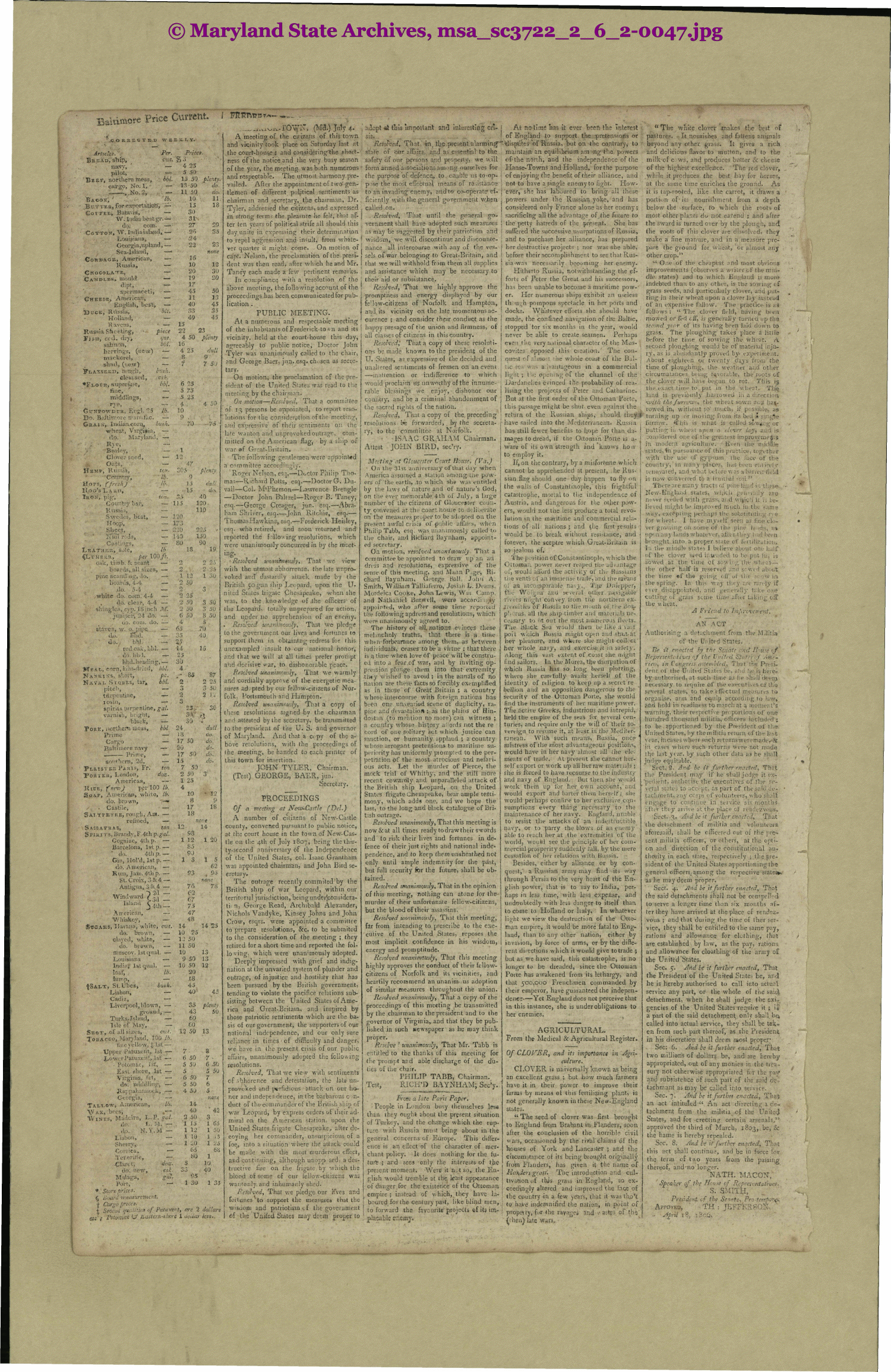
Baltimore Price Current.
,C O K. R E C T E D WEEKLY.
Articles. Per. Prices.
Bread, ship, cwf, IB-
na-Ti, — 4 25
pilot, — 5 50
Beef, northern mess, bbl. 15 50 plenty.
cargo, No. 1, — 13 50 do.
--------,.No.2, — H 50 do.
Bacos, lb- 10 11
, . ^Bu-r^r.iti*, for exportation", — 15 18
Coitee, Batavia, — 30
W. India best gr.— 31
do, com. — 27 29
Cotton, "W". Indiaisland, — 26 35
Louisiana, — 24
Georgia, upland, — 22 23
Sea-Island, —• none
ConBAGB, American, — 16
Russia, — 10 12
CrtOCOLATE, --- 20 30
Candles, mould — 19 20
dipt, r — 17
spermaceti, — 45 50
' Cheese, American, — 11 13
English, best, — 40 45
Duck, Rdssia, bit. .'). > 35
Holland, — 40 45
K avert*, — 15
Russia Sheeting, piece 22 23
Visit, ccd. dvyi >i"t. 4 50 plenty
salfhfJh, bbl. 16
herrings, (uc .v) — 4 25 dull
mackerel, — 8 9
ah ad, (new) — 7 7 50
FlAXSEu:), Sough,
close,.sec1,, tsk
•Flock, superfine, bbl. 6 "5
tine, — 5 75
1 middlings, — 5 25
ri p, — 4 ¦ 4 50
Cunpowdck, Ebgl. '"'5 lb. 10
Do. BiUtivr.oie maitufi.c. — 9 .
Grain', Indian.corn, bush. 70 74
wheat, Virginia, —
[to. Maryland, —
Rye, -
Bavley, — I
Clover need, — 12
Oats, — 47
Hemp, llus&Ut, to*. 305 plenty
' ¦ Country, lb. 9
Hots, (freshJ /'•¦ 15 dull
llou's I. a an, — 15
Iron, pig*, ion. 35 40
Country bar, — 115 120
Russia, — 110
Swedes, beat, —
Hoop, — 173
Sheet, —- I JO 225 t
Nail rods, t 140 150
Cutting's, — SO 90
Lb'Ather, sole, 16 IS 19
$£ctrSi6iit», per WOft.
Oak, tiinb. ft scant — 2 2 25
boards, at! sues, — 2
pine scantling, do. — 1 12 1 30
Boards, 4-4 — 2 50
do. 5-4 — 2
white do. corn. 4-4 — 2 25
do. clear, 4-4 — 2 50 3 50
shingles, cyp.lSjiich M. 2 SO 3 50
. juniner, 24 do. —<¦ (i 50 8 50
in. com. do. ¦— 4 5
staves, v,'. o. pipe. — 65 70
do. iTTid. — 35 40
do.. bbl 2?
red oak, bbl. — 14 16
do. lib.1. — 25
hhd.headirig, — 30
Mfai, corn, kiln-dried, bbl. 4 ¦'
Nankin's, short, pi. .- 85 87
Navai. Siokes, tar, bbl. 2 2 25
pitcli, — o 3 5U
tAypentine, — 2 2 >.
josin, — O
spirits turpentine, gal. ?S. 30
varnish, bi iglit, — sag >x
Mack, — 30
Pokk, northern mess, bbl. 24 dull
Prime — 18 do.
Carp — 17 50 do
Baltimore navy — 20 do.
,-------Prime, — 17 50 do.
southern, 2d, — 15 do.
PtMSTEn Paris, Fr. ton 7 50
Toil i eh, London, doz- 2 50 3
Americas, — 1 2.5
Rice, fnnvj per 100 lb. 4
Soap, American, white, lb. 10 •¦ 12
do. brown, -— 8 9
¦ Castile, — 17 18
Saitpetre, rough, Am. — 18
refined, — none
S A Z$ A T11 A S, ton 12 14
S firits, Brandy,F Aih p. gal. 98
Cogniac, 4th p. — 1 12 1 20
Barcelona, 1st p. — 85
" do. 4th p. — 90
Gin, Hol'd, lstp.— 1 3 1 5
do. American, — 62
Rum, jam. 4th p. — 93 . ?•'>
St. Croix, 3 &4 — none
Antigua, :i & 4 — 76 78
-\ <2i\ ___ 62
Windward / „ i i i „ i >Jo — IsU'"d 54A-- 67 75
American, — 47
7 hiskey, — 48
Sugars, Ha=t r.na, white, put. 14 14 25
do. brown, — 10 25
clayed, white, — do. brewn, — 1 1 50
11 50
muscov. lstqual. — 10 13
Louisiana — 9 50 13
India, lstqual. — 10 50 12
loaf, lb. 20
lump, — 18
tSALT, St.Ubes, busk. 45
Lisbon, — 40 45
Cadiz, —
Liverpool, blown, — S5 plenty
ground, — 43 50
Turks. If.limd, — Isle of May, — 60
CO
Shot, of all sizes, ciii. 12 50 J 3
Tobacco, Maryland, 100 lb.
fine yellow, | 1st ¦
Upper Pajjuxent, 1st — 7 ¦ 8
LowcrPatuxeitf, 1st — 6 50 7 ¦
• Potomac, fsf, — 5 50 6 50
East, shore, 1st —- 5 5 50
Virginia, fat, — 6 50 7
do. Bliddfi"; , — • 5 50 6
Rappahannock^ .—¦ 4 50 5
Georgia, nor.t
Tai.i.o-w, American, lb. H
V; ax., bees, ,— 40 " 42
Wines, Madeira, L.P. gal. 3 50 3
do. L; m. — 1 15 1 65
do. N.Y. .vl — 1 12 1 50
Lisbon, — 1 10 3 15
Sherry, — 1 5j0 1 25
Corsica, — 65 68
Tef.erifle, —• 80 1
Clan t', doz- 5 10
oo. new, tsk. So 40
Malaga, gal. 95
. . Port, — 1 30 1 35
• Starts pWces.
(. Hoard mtamrcincnt.
I?IiUTViy'Br«~ «.__ .
_____^.N^-TO'vyA, (Md.) July 4.
A meeting of the citizens of this town
and vicinity took place on Saturday last at
the court-hou^e ; and consicjering'the short-
ness of the notice and the very busy season
of the year, the meeting, was beth numerous
and respectable. The utmost harmony pre-
vailed. After the appointment of two' gen-
tlemen of different political sentiments as
chairman and secretary, .the chairman, Dr.
Tyler, addressed the citizens, and expressed
in strong term- the pleasure he felt, that af-
ter ten years of political strife all should (his
day unite in expressing their determination,
to.repel aggression and insult, from whate-
ver quarter it might come. On motion of
ca'pt. Nelson, the proclamation of the presi-
dent was then read, after which he and Mr.
Taney each made a few pertinent remarks.
In compliance, with a resolution of the
al>ove meeting, the following account of the
proceedings has been communicated for pub-
lication .
PUBLIC MEETING.
At a numeious and respectable meeting
of the inhabitants of Frederick-tovn and its
vicinity, held at the court-house this day,
agreeably to public notice, Doctor John
Tyler was unanimously called to the chair,
and Geoige Baer, jun. esq. chosen as secre-
tary.
On motion, the proclamation of the pre-
sident of the United States was read to the
meeting by the chairman.
On motion—Resolved, That a committee
of 13 persons be appointed, to report reso-
' lotions for the consideration of the meeting,
iv*8 of' their sentiments on the
late wanton and unprovoked outrage, com-
mitted on the American flag, by a ship of
war of Great-Britain,
The following gentlemen were ar>point*d
a committee accordingly;
Roger Nelson, esq.—Doctor Philip Tho-
mas—Riehmd Potts, esq.—Doctor G. Du-
val]—Col. M'Pherson—Lawrence Brengle
— Doctor John B'altzel—Roger B. Taney,
esq,—George Creager, jun. esq.—Abra-
ham Shiiver, esq.—-John Ritchie, esq.—
Tiiomasilawkins, esq.—Frederick Heisley,
esq, who retired, and soon returned and
reported the following resolutions, which
were unanimously concurred in by the meet-
ing.
¦ Resolved unmfmmah, That we view
with the utmost abhorrense, the late unpro-
voked and dastardly attack made by the
British 50 gun ship Leopard, upon the U-
nited States frigate Chesapeake, when she
was, to the knowledge of .the officers" of
tha Leopard, totally unprepared for action,
and under no apprehension of an enemy.
. Resolved unctti'unously. That we pledge
to the government our bves and fortunes to
support them in obtaining redress for this
unexampled insult to out national honor,
and that we will at all times prefer prompt
and decisive ^ar, to dishonorable peace.
Retained unanimously, That we warmly
and cordially approve of the energetic mea-
sures ad pled by our fellow-citizens of Nor-
folk. I'oitsmouth and Hampton.
Resolved unanimously, That a copy of
these resolutions signed by the chairman
a. ' attested by the secrelsry, be transmitted
to the president of the U. S. and governor
of Maryland. And that a c< py of the a-
bove resolutions, with the proceedings of
¦r Cargo prices*
i StCQiul ¦¦•' litic* qf_ Patux&if, are 2 dollars
:.- ,• "Potomac t»" -%'astern-*hori 1 Jtlim kt*»
the meeting, be handed to each printer of
this town for insertion.
JOHN TYLER, Chairman.
(Test) GEORGE, BAER, jun.
Secretary.
PROCEEDINGS
0/ a ineethrg at Nenv-Castle (Del.)
A number of citizens of New-Castle
county, convened pursuant to public notice,
at the court house in the town of New-Cas-
tle on the 4th of July 1807, being the thir-
ty-second anniversary of the Independence
of the United States, col. Isaac Grantham
was appointed chairman, and John Bird se-
cretary.
The outrage recently commited'by the
British ship of war Leopard, within our
territorial jurisdiction, beingunder]considera-
tf n, George Read, Archibald Alexander,
Nichols Vandyke, Kinsey Johns and John
Crow, esqrs. were appointed a committee
to prepare resolutions, &c. to be submited
to the consideration of the meeting ; they
retired for a short time and reported the fol-
io ring, which were unanimously adopted.
Deeply impressed with grief and indig-
nation at the unvaried system of plunder and
outrage, of injustice and hostility that has
been pursued by the British government,
tending to violate the pacifice relations sub-
sisting between the United States of Ame-
rica and Great-Britain, and inspired by
those patriotic sentiments which are the ba-
sis of our government, the supporters of our
national independence, and our only sure
reliance in tin.es ¦ of difficulty and danger,
we have in the present crisis of our public
affairs, unanimously adopted the following
resolutions.
Resolved, That we view with sentiments
0! ..bhorer.ee and detestation, the late un-
provoked and perfidious attack on our ho-
nor and independence, in the barbarous cn-
duct of the commander of the British ship of
war Leopard, by express orders of their ad-
miral on the American station, upon the
United States frigate Chesapeake, after de-
coying her commander, unsuspicious of a
foe,, into a situation where the attack could
be made with the most murderous effect,
and continuing, although unopp sed, a des-
tructive lire on the frigate by which the
blood of seme of our iel!ow-ckizens was
wantonly, and inhumanly shed.
Resolved, That we pledge our Kves and
fortunes to support the measures that the
wisdom and patriotism cf the government
of the Unifcd States may dcern proper to
j axtapt «t tnis important ant] interesting cri- j
I sis.
Resolved, That in, the/present alarming?'"
state of Our affairs. ar.J as essential to the
safety of our persons and property, we '>vill
' form armed associations nu«.-.rig ourselves for
the purpose of defence,, to ctujWe us to-op-
pose the most effectual means of resistance'
to ah invading enemy, andto co-operate* ef- j
ficiently' with the general government \vhen
¦ called on.
. Resolved, That until the general go-
vernment shall have adopted such measures
as may be suggested by their patriotism and
1 wisdom, we will discontinue and discounte-
, nance all intercourse with any of the ves-
sels of war belonging to Great-Britain, and
! that wc will withhold from them ail supplies
i and assistance which may be necessary to
, their aid or subsistance.
7vr.'o/'£>«/, That we highly approve the
promptness and energy displayed by our
fe'low-citizens of Norfolk and Hampton,
audits vicinity on the late momentousac-
curence ; and consider their conduct as the
happy presage of the union and firmness, of
all classes of citizens in this country.
Resolved' Tiiat a copy of these resoluti-
ons be made known to the president of the
U. States, a; expressive of the decided and
unaltered sentiments of fremen on an event
—inattention or indifference to which
would proclaim us unworthy of the innume-
rable blessings «e enjoy, dishonor our j
country, and be a criminal abandonment of j
the sacred rights of the nation.
Resolved, That a copy of the preceding j
resolutions L«e forwarded, by the secreta-
ry, to the Committee at Norfolk.
ISAAC GRAHAM Chairman.
Attest JOHN BIRD, see'ry.
Meeting'at Gloucester Court House, (Va.)
- On tilt- 31sr anniversary of that day when
America a-su:ne'.l a station among me pow-
ers of the earth, to which sh» was entitled
by the laws of nature and of nature's Cod,
on the ever memorable 4th of July, a large
number of the citizens of Gloucester coun-
ty convened at the court house to delioerate
on the measures proper to be adopted on the
present awful crisis of public artrirs, when
Philip Tabb, esq. was nnanimoqsly called 1.0
the chair, and Hicbard liaynham, appoint-
ed secretary.
On motion, resolved unanimously That a
committee be appointed to draw up an ad
dress and resolutions, expressive of the
sense of this meeting, and Mann Page", Ri-
chard liaynham, George Hall, Joh'i A.
Smith, William Tallial'erro, Josinii L. Deans,
Mordeica Cqoke, John Lewis, Writ ( amp
and Nathaniel iSurwtll, were accordi 1 iy
appointed, who after some time reported
tiie Ibllowin;; apdressand resolutions, which
were unanimously agreed to.
The history of all. nations evinces these
melancholy truths, that there is a time
when-forbearance among them, as between
individuals, ceases to be a virtue ; that there
is a, time when love of peace will be constru-
ed into a fear of war, and by inviting op-
pression plunge them into that extremity
th»y wished to avoid: in the annals of no
nation are these facts so forcibly exemplified
as in those of Great Bsitain ; a country
whose intercourse with foreign nations has
been one utneariod scene of duplicity, ra-
pine and devastation ; as the plains of Hin-
dostan (to mention no more) can witness ;
a country whose history a' ords not the re
cord of one solitary act which justice can
sanction, or humanity applaud ; a country
whose arrogant pretensions to maritime su-
periority has uniformly ptompted to the per-
petration of the most atrocious and nefari-
ous acts. Let the murder of Pierce, the
mock trial of Whitby, and the still more
recent cowardly and unparalleled attack of
the British ship Leopard, on the United
States frigate Chesapeake, boar ample testi-
mony, which adds one, and we hope the
last, to the long and black catalog-tie of Bri-
tish outrage.
Resolved'unanimously, ThzX this meeting is
now&at all times ready to draw their swords
and to risk their lives and fortunes in de-
fence of their just rights and national inde-
pendence, and to keep them unsheathed not
only until ample indemnity for the past,
but full security for the future, shall be ob-
tained. ,
Resolved unanimously. That in the opinion
of this meeting, nothing can atone tpr the
murder of their unfortunate fellcw-citizens,
but the blood of their assassins.
Resolved unanimously, That this meeting,
far from intending to prescribe to the exe-
cutive of the United States, reposes the
most implicit confidence in his wisdom,
energy and promptitude.
Resolved unanimously, That this meeting
highly approves the conduct of their lellow-
citizens of Norfolk and its vicinities, and
heartily recommend an unanimous adoption
of similar measures throughout the union.
Resolved unanimously, That a copy of the
proceedings of this meeting be transmitted
by the chairman to the president and to the
governor of Virginia, and that they be pub-
lished in such newspaper as he may think
proper.
Resolve I unanimously, That Mr. Tabb is
entitled to the thanks of this meeting for
the prompt and able discharge of the du-
ties of the chair.
PHILIP TABB, Chairman.
Test, RICH'D BAYNHAM, Sec'y.
At no time has it ever been trie interest i
of England to support the pretensions or
¦disputes'of Russia, but on the contrary, to
maintain an equilibrium am >ng the powers
oLthe north, and the independence of the
Hanse-TownS and Holland, for the purpose
of enjoying the benefit of their alliance, and
not to have a single enemy to light. How-
ever, she lias laboured to bring all these
powers under the Russian yoke, and has
considered only France alone as her enemy;
sacrificing all the advantage of the future to
the petty hatreds of the present, . She has
suffered the successive usurpations of Russia,
and to purchase her alliance, has prepared
her destructive projects ; nor was she able,
before their accomplishment to see that Rus-
sia >was necessarily becoming her enemy.
Hithsrto Russia, notwithstanding the ef-
forts of Peter the Great and his successors,
has been unable to become a maritime pow-
er. Her numerous ships exhibit an useless
th'ough pompous spectacle in her ports and
docks. Whatever efforts she should have
made, the confined navigation of the Baltic,
stopped tor six months in the year, would
never be able to create seamen. Perhaps
even the very n.eional character of the Mus-
covites opposed this creation.' The con- '¦
qvtsst ' f I ma ie whole coast of the Bal- j
itageous in a commercial j
liiyd ; I ie 0| ,.n;;>g of the channel of the :
Dardanelles evinced the probability of rea-
lising the projects of Peter and Catharine. ,
But at the first order of the Ottoman Porte, :'
this passage might be shut, even against the 1
return of the Russian ships, should they-*'
have sailed into the Mediterranean. Russia
has still fewer benefits to hope for than da-
mages to dread, if the Ottoman Porte is a-
ware of its own strength and knows how
to employ it.
If, on the contrary, by a misfortune which
cannot be apprehended at present, he Rus-
sian.flag should one day happen to fly on
the walls of Constantinople, this frightful
catastrophe, mortal to the independence of
Austria, and dangerous for the other pow-
ers, would not the less produce a total revo-
lution in the maritime and commercial rela-
tions of all nations ; and the first results
would be to break without resistance, and
forever, the sceptre which Great-Britain is
so jealous of.
The position of Constantinople, which the
Ottoman peiwei never reaped pile advantage
of, would afford the activity of the Russians
the vents of an immense trade*, and the means
an incomparable navy. Toe Diriepper,
t\ W igiia and several other navigable
; riright convey from trie northern ex-
its of Kussia to the mouth ol tee dos-
p'. irus, all the ship-timber and materials ne-
icosary to 'it out the most numerous fleets.
The tll.iclc Sea would then be like A vast
poit which Russia might open and shut at
her pleasure, and where she might collect'
her whole navy, and exercise it in safety,
/ilong this vast extent of coast she might
find sailors. In the Morea, tlje Usurpation of
which Russia has so long been plotting,
where she carefully avails herself of the
identity of religion to keep up a secret re
hellion and an opposition dangerous to the
security of the Ottoman Porte, she would
tind the instruments of her maritime power.
The Sctive Greeks, industrious and intrepid,
held the empire of the seas for several cen-
turies, and require only the will of their so-
vereign to resume it, at least in the Mediter-
ranean. With such means, Russia, once '
mistress of the most advantageous positions,
would have in her navy almost all the ele-
ments of trade. At present she cannot her-
self export or work up all her raw materials ;
she is forced to have lecourse to the industry
and navy of England. But then she would
work them up for her own account, and
would export and barter them herself; she
would perhaps confine to her exclusiv
sumptions every thing necessary to the
maintenance of her navy. England, unable
to resist the attacks of an indestructible
navy, or to parry the blows of an enemy
able to reach her at the extremities of the
world, would see the principle of her com-
mercial prosperity suddenly tall, by the mere
cessation of her relations with Russia.
Besides, either by alliance or by con-
quest,' a Russian army may find its way
through Persia to the very heart of the En-
glish power, that is to say to India, per-
haps in less time, with less expense, and
undoubtedly with less danger to itself than
to come to Holland or Italy. In whatever
light we view the destruction of the Otto-
man empire, it would be more fatal to Eng-
land, than to any other nation, either by
invasion, by force of arms, or by the diffe-
rent directions which it would give totrade ;
but as we have said, this catastrophe, is no
longer to be dreaded, since the Ottoman
Porte has awakened from its lethargy, and
that 500,000 Frenchmen commanded by
their emperor, have guaranteed the indepen-
dence—Yet England does not perceive that
in this instance, she is under obligations to
her enemies.
From a late Paris Paper.
People in London busy themselves less
than they ought about the present situation
of Turkey, and the change which the rup-
ture with Russia must bring about in the
general concerns of Europe. This differ-
ence is an eiiect of the character of mer-
chant policy. It does nothing for the fu-
ture ; ard sees only the interests of the
present moment. Were it not so, the En-
glish would tremble at the kast appearance
of danger for the existence of the Ottoman
empire ; instead of which, they have la-
boured for the century past, like blind men,
to forward the favourite projects of its im-
placable enemy.
AGRICULTURAL.
Prom the Medical & Agricultural Register.
Of CLOSER, and its importance hi Agri-
culture.
CLOVER is universally known as being
an excellent grass ; but how much farmers
have it in their power to improve their
farms by means ot this fertilizing plant, is
not generally known in these New-England
states.
"The seed of clover was Erst brought
to lCngland from Brabant in Flanders, soon
after the conclusion of the horrible civil
wars, occasioned by the rival claims of the
nouses of York and Lancaster ; and the
cijcumstance of its being brought originally
from Flanders, has given it the name of
1'la^ders grass. The introduction and cul-
tivation of this grass in England, so ex-
ceedingly altered and improved the taqe'of
the country-in a few years, that it was th,o't
to have indemnified the nation, in point of
property, for the ravages and v- astes. of the'
{;hen) late w«is.
" The white clover makes the best of
pastures. It nourishes and fattens aniinals
beyond any other, grass. It gives a rich
and delicious flavor to mutton, and to the
milk cf c, ws, and produces butter & cheese
of the highest excellence. The red clover,
while it produces the best hay for horses,
at the same time enriches the ground. As
it is tap-rooted, like the carrot, it draws a
portion of its nourishment from a depth
below the surface, to which the roots of
most other plants do not extend ; and after
the sward is turned ever by the plough, and
the roots of this clover are dissolved, they
make a fine manure, and in a measure pre-
pare the ground for wheat, or almost any
other crop."
'" One of the cheapest and most obvious
improvements (observes a writer of the 0
die states) and to which England is mors
indebted than to am ether, is the sowing cf
grass seeds, and particularly clover, and put-
ting in their wheat upon a clover lay instead
of an expensive fallow. The practice is al
follows: "The clover field, having been
mowed of fed off, is generally turned up tha
second year of its having been laid down to
grass. The ploughing takes place a litile
before the time of sowing the wheat. A.
second ploughing would be of mateiial inju-
ry, as is abundantly- proved by- experiment.
About eighteen 01 twenty days from the
time of ploughing, the weather ai.d other
circumatances being favorable, the roots ot"
the clover will have begun to rot. This ijj
exact time to put in the wheat. '.,
land is previously harrowed in a
'ioith the Jurrt'W\, the wheat sown any har-
rowed in, without, so' much, if pi ssibl«, as
turning up or moving from its bed « •
furrow. This is what is called sowing or
putting iu wheat hjkk a diver icy, and is
considered one of the greatest invpi'uve;r.e},3
iu modern agriculture. Even the middle:
states, ft pursuance of this practice, topth.er
with the use of gypsum the foce of the
country,'111 many places, httS been entirely:
.aied, and what before was alwirien Cul.l
is novj cohverfed to i froittul soil "
Tlnre are many tract.-; of pi these,
.New-England suites, wljich genera ¦/ jtr©
never seeded with grass, and wnio'i 1, is be-
lieved might be improved much in the saroa
way, excepting perhaps tK- substitlltitvjj 1
for wheat. I have my»e!f seen as line clo-
ver growing oh some of the pine landa, ¦.
up'.n.an) lands whatever, after they bad bei n
brought into a proper state of tertilfeatiotu
In the middle states I believe a
of the clover svod iiitvended to he put nn, is
sowed at the time Of Sowing the wheat-—-
the other half is .reserve ed about
the time ef the going Off of the s ;vv in
the spring. In. this way tiiry are rarely if
ever disappointed, ana genera!)}' t
cutting of grass seme time aftei taking off
the wheat.
A Friend to Improvement.
AN ACT ,;
Authorising a detachment from the Militia
of the United States. .
Ue it enacted by the S&jate a'tid House if
Represenii Hives of the Vnit< d Stat. • f ,,?«--
tiro, in Congress assembled., That thj Presi-
dent ot the United States be, arid ',- is heie-
by authorised, at such time as be shall |