 |
|
|
 |
|
 |
|
|||
|
||||
|
||||
|
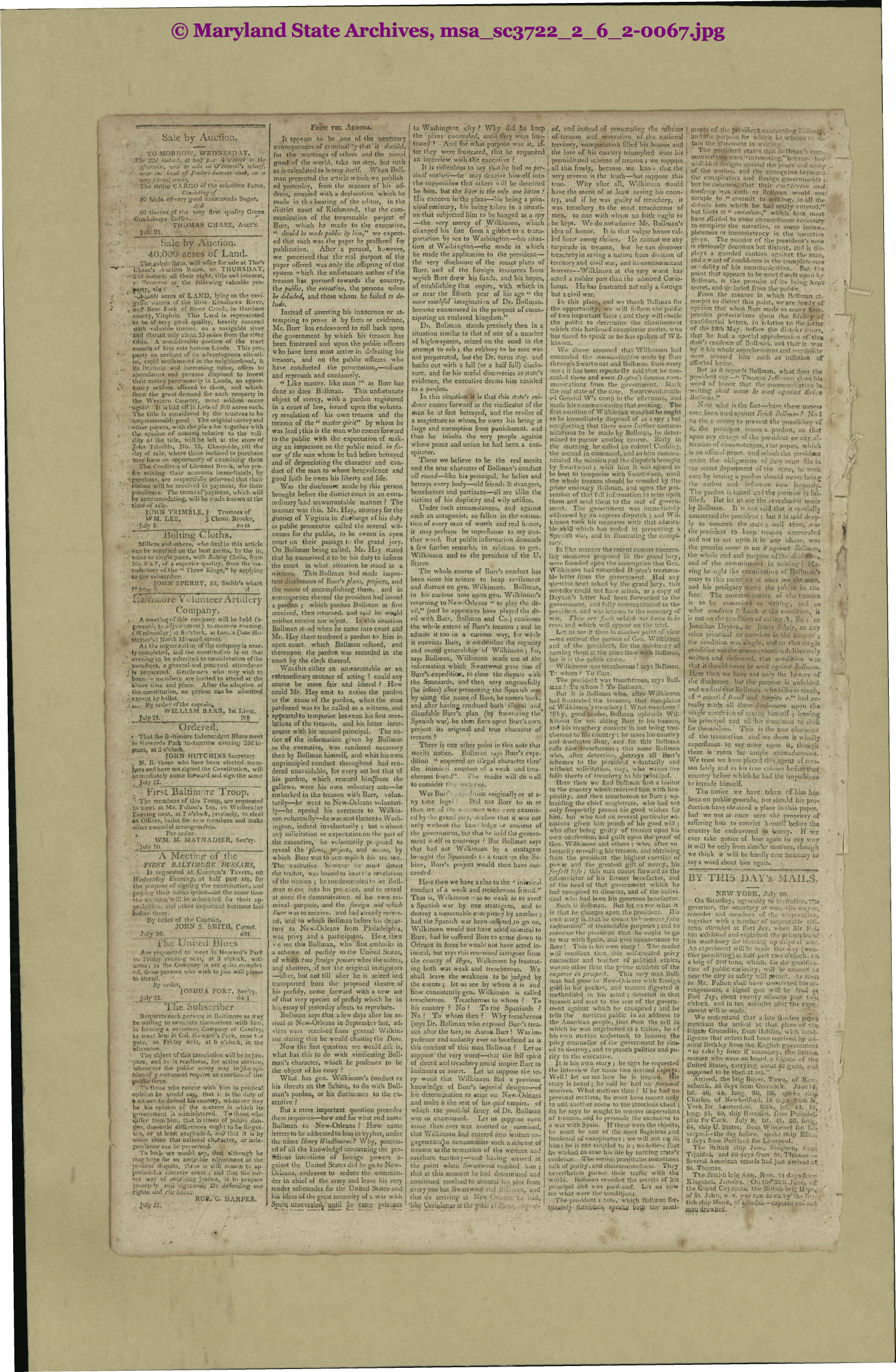
Federal Gazette & Baltimore Daily Advertiser 1807/07-1807/12 msa_sc3722_2_6_2-0067 Enlarge and print image (5M) |
|
|
|
|
|
|
|
|||
|
||||
|
||||
|
Federal Gazette & Baltimore Daily Advertiser 1807/07-1807/12 msa_sc3722_2_6_2-0067 Enlarge and print image (5M) |
|
Sale by Auction.
TO-ftSORRO-W, WEDNESDAY,
The 22d iiistat:}, at half p is 4 o'clock in the
I r.non, will be sola on Q'Danwl't wharf,
near th, hzad c.f Fmleri it-street dock, on a
very h'l-rdl credit.
The entire CARGO of the schoorter Fame,
Consisting of
SO hlids. of very good -Muscovado Sugar,
j ' A(4
GO tierces flf the very first quality Green
Guadeloupe Coffee.
. THOMAS CHASE, Aucfr.
. July 21.________________________
Sale by Auction.
. 40.000 acres of Land.
,Tl(e..5'il'ie: ilje.is will offer for sale at Tho's
'"Chase's Auction Room, op. THURSDAY,
. 8iA instant, all their right, title and interest,
•a Trustees to the following valuable pro-
perty, via r'
1 "^jOjijl/O acres of LAND, lying on the navi-
gsf6;e'waters of the Utile Kenaliawa River,
. anef Bear Fork cf Steer Creek, in Harrison
county, Virginia. This Land is represented
to he Of very good quality, heavily covered
with valuable timber, on a navigable river
and distant only about 35 miles from theritfer
Ohio. A Considerable portion of the tract
consits of first rate bottom Lr.nds This pro-
perty on account of its advantageous situati-
on, rapid settlements" in the neighborhood, &
its intrinsic and increasing value, offers to
speculators and persons disposed to invest
their money permanently in Lands, an oppor-
tunity seldom offered to them, and which
-from -the great demand for such property in
the Western Country, must seldom occur
' again- It is laid ofl'in Lots of 500 acres each.
The title, is considered by the trustees to be
• unquestionably good The original -airvey and
other papers, with the pla s &c. together with
the opinion of counsel relative to the vali-
dity ot the title, will be left at the store of
John Trimble, No. 18, Cheapside, till the
1 lay of sale, where those inclined to purchase
Way have an opportunity of examining them
Tho Creditors of Clement Brook, who pre-
fer settling' their accounts immediately, by
purchase, are respectfully informed that their
claims, will he received in payment, for their
purchases. The terms ofpayment, which will
he accommodating, will be made kuown at the
time of sale.
JOHN TRIMBLE,? Trustees of
VVM. LEE, $ Clemt. Brooke,
July 8-____________________eots
¦. *"¦ Bqiting C loth s.
Millers and others, who deal in this article
, ran be supplied on the best terms, by the in,
voice or single piece, with Bolting Clot/is, from
No. 0 a 7, of a superior quality, from the ma.
nofsi ton of the " Three Kings," by applying
to the subscriber.
JOHN Sl'ERRY, 55, Smith's wharl
,' ?. fav <\ ________ d
liaitiiuore-Volunteer Artillery
Company.
1 A meet'ngof this company will he held (a-
greeabh to adjournment) to-morrow evening,
(Weilm-sulay) at 8 o'clock, at Izeu's (late Ho-
stetler's) North Howard-street-
As the organizati >n of the company is near,
iy completed, and the constitution is on that
evening to be submited to consideration of the
members, a general and punctual attendance
¦ is requested. Gentlemen who may wish to
beco;. e members are invited to attend at the
sibove time and place. After the adoption of
the constitution, no person can be admitted
,'; except by ballot.
: j, By order of the captain,
WILLIAM BARR, 1st Lieut.
July 21.________________________2t|) _
Ordered,
' Thr.t the Baltimore Independent Blues meet
in Howards Park tc-rnorrow evening 2-2d in-
stant, at 3 o'clock.
JOHN HUTCHINS Secretary.
N. B. those, who have been elected mem-
bers and have not signed the Constitution, will
immediately come forward and sign the same
; -?«iy 21.________,____________
First Baltimore Troop.
"' The members of this Troop, are requested
to meet at Mr. Fulton'* Inn, on Wednesday
Evening next, at 7 o'clock, precisely, to elect
an Officer, ballot for.new members and make
other essential arrangements.
, Per order
WM. M. MAYNADIER, Sec'ry.
¦July 20-__________________________¦
A Meeting- of the
FIRST BALTIMORE HUSSARS,
Is requested at Causten's Tavern, on
Wednesday Evening, at half past six, for
ihe purpose cf signing the constitution, and
pacing their subscription—at the same time
The uniform will be submitted for their ap-
probation, and other important business laid
fcefore them.
By order of the Captain,
JOHN S. SMITH, Cornet.
July 20.______________________d3t _
The United Blues
Are. requested to meet in Howard's Park
on Friday evening next, at 5 o'clock, with
arms; as the Company is not quite complet-
ed, those persons who wish to join will please
to attend.
By order,
JOSHUA FORT, Sec'ry.
July 21. __________________d4J._
The Subscriber
Requests such persons in Baltimore as may
be willing to associate themselves with him,
ju forming a vounteei' Company of Cavalry,
to meet him in Col. Howard's Park, near ti.e
gate, on Friday next, at 6 o'clock, in the
afternoon. '
The object of this association will be to pre-
pare, and be. in readiness, for active service,
¦whenever the public sale-ty may in-|the opi-
nion of government require an exertion of the
public force.
To those who concur with him in political
opinion he would say., that i: is the duty of
a citizen to defend his country, whatever may-
be his opinion of the manner in which its
government is administered. Te> those who
BiffeT from him, tiut in times of public dan-
ger, domestic differences ought to he forgot-
ten, or at least suspended, and that it is by
union alone that national character, or inde-
pendence can be preserved.
To both we would s?y, that although he
¦may hope for an amip'ible adjustment of the
present dispute, there is still reason to ap-
prehend.a contrary event ; and that the sur-
est way of ebuining justice, is to prepare
promptly and vigorously i'sr defending our
fights and cur honor.
ROB. G. HARPER.
From the Aurora.
It appears to be one of the necessary
consequences of criminally that it should,
for the warnings of others and the moral
good of the world, take no step, but such
as is calculated to betray itself. When Boll.
man presented the article which we publish
ed yesterday, from the manner of his ad-
dress, coupled with a declaration which he
made in the hearing of the editor, in the
district court of Richmond, that the com-
munication of the treasonable project of
Burr, which he made to the executive,
" should be made public by him," we expect-
ed that such was the paper he proffered for
publication. . After a perusal, however,
we perceived that the real purport of the
paper offered was only the offspring of that
system which the unfortunate author of the
treason has pursued towards the country,
the public, the executive, the persons •whom
he deluded, and those whom he failed to de-
lude.
Instead cf asserting his innocence or at-
tempting to prove it by facts or evidence,
Mr. Burr has endeavored to roll back upon
the government by which his treason has
been frustrated and upon the public officers
who have been most active in defeating his
treason, and on the public officers who
have conducted the prosecution,—odium
and reproach and contumely.
" Like master, like man !" as Burr has
done so does Bollman. This unfortunate
object of mercy, with a pardon registered
in a court of law, issued upon the volunta-
ry revelation of his own treason and the
treason of the " master spirit" by whom he
was lead ; this is the man who comes forward
to the public with the expectation of mak-
ing an impresson on the public mind in fa-
vor of the man whom he had before betrayed
and of depreciating the character and con-
duct of the man to whose benevolence and
good faith he owes his liberty and life.
Was the disclosure made by this person
brought before the district court in an extra-
ordinary ?and unwarrantable manner? The
manner was this, Mr. Hay, attorney for the
district of Virginia in discharge of his duty
as public prosecutor called the several wit-
nesses for the public, to be sworn in open
court .011 their passage to the grand jury.
On Bollman being called, Mr. Hay stated
that he conceived it to be his duty to inform
the court in what situation he stood as a
witness. This Bollman had made impor-
tant disclosures of Burr's plans, projects, and
the means of accomplishing them, and in
consequence thereof the president had issued
a pardon ; which pardon Bollman at first
received, then returned, and said he would
neither receive nor reject. In this situation
Bollman stood when he came into court and
Mr. Hay there tendered a pardon to him in
open court, which Bollman refused, and
thereupon the pardon was recorded in the
court by the clerk thereof.
Was this either an unwarantable or an
extraordinary manner of acting ? could any
course be more fair and liberal ? How
could Mr. Hay omit to notice the pardon
or the cause of the pardon, when the man
pardoned was to be called as a witness, and
appeared to temporise between his first reve-
lations of the treason, and his latter inter-
course with his accused principal. The no-
tice of the information given by Bollman
to the executive, was rendered necessary
then by Bollman himself, and what his own
unprincipled conduct throughout had ren-
dered unavoidable, for every act but that of
his pardon, which rescued him'from the
gallows, were his own voluntary acts—he
embarked in the treason with Burr, volun-
tarily—he went to New-Orleans voluntari-
ly—he opened his overtures to Wilkin-
son voluntarily^-he was sent thenceto Wash-
ington, indeed involuntarily ; but without
any solicitation or expectation on the part of
the executive, he voluntarily pi-.posed to
reveal the plans, projects, and means, by
which Burr was to acc< mplih his tre. son.
The executive howevc be must detest
the traitor, was bound to heart e revelation
of the tieason ; he condescended to iet Boil-
man come into his pre-ence, and to reveal
at once the demonstration of his own cri-
minal purpose, and the foreign aid-which
l'urr was to receive, and had aiready receiv-
ed, and 10 which Bollman before his depar-
taie to New-Orleans from Philadelphia,
was privy and a participator, Heie then
v e sec this Bollman, who first embarks in
a scheme of perfidy to the United Sta^s,
of which t-wo foreign powers whre the aiders,
and abettors, if net tr.e original instigators
—afier, but not till after he is seized and
transported from the proposed theatre of
his perfidy, come forward with a new act
of that very species of perfidy which he in
his essay of yesterday affects to reprobate.
Bollman says that a few days after his ar-
rival at New-Orleans in September last, ad-
vices were received from general Wilkin-
son stating that he would chastise the Dons.
Now the first question we would ask is,
what has this to do with vindicating Boll-
man's character, which he professes to be
the object of his essay ?
What has gen. "Wilkinson's conduct cr
his threats on the Sabine, to do with Boll-
man's pardon, or his disclosures to the ex-
ecutive ?
But a more important question precedes
these inquiries—how and for what end.came
Bollman to New-Orleans ? How came
letters to be addressed to him in cypher, under
the name Henry lUndboume? Why, possess-
ed of all the knowledgd conccrcing the per-
fidious intentions of foreign powers a-
gainst the United States did he go to New-
Orleans, endeavor to seduce the comman-
der in chief of the army and leave his very
tender solicitudes for the United States arid
his ideas of the great necessity of a war with
Spain .ujireveajedj until he camp priseger
to Washington city ? Why did hs keep
the plans - concealed, until .they were frus-
: trated ? And for' what purpose was it, af-
ter they were frustrated, that he requested
an interview with the executive ?
It is ridiculous to say that he had no per-.
sinal viatiws—he may deceive himself into
the supposition that others rtill be deceived
by him, but the biter is the only one bitten !
His concern in the plans—-his being a prin-
cipal emissary, his being taken in a situati-
on that subjected him to be hanged as a spy
—the very mercy of Wilkinson, which
changed his fate from a gibbet to a trans-
portation by sea to Washington—his situa-
tion at Washington—the mode in which
he made the application to the president—
the very disclosure of the seciet plans of
Burr, and of the foreign resources from
wgich Burr drew his funds, and his hopes,
of establishing that empire, with which in
or near the fiftieth year of his age " the
more youthful imagination of Dr. .Bollman.
became enamoured in the prospect of eman-
cipating an enslaved kingdom."
Dr. Boliman stands precisely then in a
situation similar to that of one of a number
of highwaymen, seized on the road in the
attempt to rob ; the robbery to be sure was
not perpetrated, but the Dr. turns stag, and
backs out with a full (or a half full) disclo-
sure, and for his useful discoveries as state's
evidence, the executive deems him entitled
to a pardon.
In this situation it is that this state's evi-
dence comes forward as the vindicator of the
man he at first betrayed, and the reviler of
a magistrate to whom, he owes his being at
large and exemption from punishment, and
thus he insults the very people against
whose peace and union he had been a con-
spirator.
These we believe to be the real merits
and the true character of Bolhnan's conduct
all round—like his principal, be belies and
betrays every body—old friends & strangers,
benefactors and partizans—all are alike the
victims of his duplicity and wily artifice.
Under such circumstances, and against
such an antagonist, so fallen in the estima-
tion of every man of worth and real honor,
it may perhaps be superfluous to say ano-
ther word. But public information demands
a few further remarks, in relation to gen.
Wilkinson and to the president of the U.
States.
The whole course of Burr's conduct has
been since his seizure to heap revilement
and distrust on gen. Wilkinson. Bollman,
in his curious note upon gen. Wilkinson's
returning to New-Orleans " to play the de-
vil," (and he appears to have played the de-
vil with Burr, Bollmin and Co.) confesses
the whofe extent of Burr's treason ; and he
admits it too in a curious way, for while
it convicts Burr, it establishes the sagacity
and sound generalship of Wilkinson ; for,
says Bollman, Wilkinson made use ot the
information which Swartw«ut gave him of
Burr's expedition, to close the dispute vtith
the Spaniards, and then very ungratefully
(he infers) after preventing the Spanish war
by using the name of Burr, he comes b.ick,
and after having.rendered both illegal and
illaudable Burr's plan (by frustrating the
Spsnish war) he then fixes upon Burr's own,
project its original and true character of
treason !'
There is one other point in this note that
merits notice. Bollman s<.y:> Burr's expe-
dition " acquired an illegal character thro'
the inimical covduct of a weak and trea-
cherous frier.-!". Fhe reader will do well
to consider th ei .. ¦ ce.
Was Bur." ;, -.''lion originally or at a-
ny time lei- !)id not Burr to m re
than ten of tK< ¦. isses-wha ; ere examin-
ed by the grand jury,'declare that it was not
only without I he kr.o ledge or consent of
the government, but that he held I lie govern-
ment itself in Contempt ? But Bollman says
that had not Wilkinson by a stratagem
brought fhe Spaniards to a tiuce on the Sa-
bine, Burr's project would then have suc-
ceeded
Heie then we have a clue to the ' inimical
conduct of a weak and treacherous friend."
That is, Wilkinson > as so weak as to avert
a Spanish war by one stratagem, and to
destroy a treasonable conspiracy by another;
had the Spanish war been suffered to go on,
Wilkinson would not have acted inimical to
Burr, had he suffered Burr to come down to
Orleans in force he would not have acted in-
imic il, but says this renowned intriguer from
the county of Hqya, Wilkinson by frustrat-
ing both was weak and treacherous. We
shall leave the weakness to be judged by
the events ; let us see by whom it is and
how consistently gen. Wilkinson is called
treacherous. Treacherous to whom ? To
his country ? No ! To the Spaniards ?
No ! To whom then ? Why treacherous
(says Dr. Bollman who exposed Burr's trea-
son after the fact) to Aaron Burr! Was im-
pudence and audacity ever so barefaced as is
this conduct of this man Bollman ? Let us
suppose the very worst—that the fell spirit
of deceit and treachery could inspire Burr to
insinuate or assert. Let us suppose the ve-
ry worst that Wilkinson had a previous '
knowledge of Burr's imperial designs-r-of
bis determination to seize on New-Orleans
and make it the seat of his quid empire, of
which the youthful fancy of Dr. Bollaian
was so enamoured. Let us suppose Bffiii
more then ever was asserted or surmised,
that Wilkinsou had entered jruo written en-
gagements^ consuriimate such a scheme of
treason as the sevetation of ths western and
southern territory—and ha.ing arrived at
the point when Swartwout reached him ;
that at this moment he had determined and
continued resolved to conceal his plot from
every one but Swariwoti! :i. 0, and
that on arriving at K< v. ( liid,
like Cc-riolauus at the %<
ed, r.fld instead of prosecuting the scheme
of treason and severation of the national
territory, compunction filled his bosom and
' the love of his country triumphed over Ms
premiditated scheme of treason ; we suppose
|. all this freely, because we kno .v that the
I very reverse is the truth—but suppose this
I true. Why after ali, Wilkinson would
j have the merit of at least saving his coun-
j try, and if he was guilty of treachery, it
was treachery to the most treacherous of
men, to one with whom no faith ought to
! be kept. We do not admire Mr. Bollman's
idea of honor. It is that vulgar honor cal-
I led honor among thcives. He cannot see any
i turpitude in treason, but he can discover
f treachreyin saving a nation from division of
territory and civil war, and its concomittant
horrors—Wilkinson at the very worst has
acted a nobler part than the admired Corio-
lanus. He has frustrated not only a foreign
but a civil war.
In this place, and we thank Bollman for
the opportunity, we will inform the public
of two important facts ; and they will enable
the public to determine the chastisement
which this hardened conspirator merits, who
has dared to speak as he has spoken of Wil-
kinson.
We above assumed that Wilkinson had
concealed the communication made by Burr
through Swartwout and Bollman, from every
one ; it has been repeatedly said that he con-
ceahd tiiese and even Dayton?* famous com-
munications from the government. Mark
the real state of the case. Swartwout reach-
ed General W's camp in the afternoon, and
made his communication that evening. The
first emotion of Wilkinson was,that he ought
to be immediately disposed of as a spy ; but
recojlectiug that there were further commu-
nications to be made by Bolhnau, he deter-
mined to pursue another course. Early in
the morning he called on colonel pushing,
the second in command, and to him commu-
nicated the mission and the dispatch brought
by Swartwout ; with him it was agreed to
be bost to temporise with Swartwout, until
the whole treason should be revealed by the
prime emissary' Bollman, and upon the pos-
session of that full information to seize upon
them and send them to the seat of govern-
ment. The government was immediately
addressed by an express dispatch ; and Wil-
kinson took his measures with that admira-
ble skill which has ended iri preventing a
Spanish war, and in frustrating the conspi-
racy.
In like manner the recent rumors concern-
ing measures proposed in the grand jury,
were founded upon the assumption that Gen.
Wilkinson had concealed Uoyton's treasona-
ble letter from the government. Had any
question been asked by the grand jury, this
mistake could not have arisen, as a copy of
Dayton's letter had been forwarded to the
government, and fully communicated to the
president, and was known to the secretary of
war. These are f,iris'which •weknvwtobe
true, and which will appear on the trial.
Let us see it then in another point of view
—we entreat the pardon of Gen. Wilkinson
and of the president, for the indelic.icy of
naming them at the same time with iiollman,
but it is'the public caioe.
Wilkinson was treacherous ! says Bollman.
T:- whom ? To l'urr.
The president was treacherous, says Boll-
man ! To. whom ? To Bollman.
But it is Bollman who, after Wilkinson
had frustrated the treason, that complains
of Wilkinson's treachery ! What treachery ?
Why, good reader, Bolhnau upbraids Wil-
kinson for not aiding Burr in his treason,
and his treachery consists in not being trea-
cherous to his country : he saves his country
and frustrates .Burr, and. for this Bollman
calls him treacherous ; this same Bollman
who, after detect ion, .betrays all Bun's
schemes to the president voluntarily and
without solicitation, nay, who writes iive
folio sheets of treachery to his principal.
Here then we find Bollman first a traitor
to 'he country which received him with hos-
pitality, and then treacherous to Burr ; up-
braiding the chief magistrate, who had not
only frequently proved his good wishes for
him, but who had on several particular »c-
casions given him proofs of his good will ;
who after being guilty of treason upon his
own cor.fession, and guilt upon the proof of
Gen. Wilkinson and others ; who, after vo
hintariiy revealing his treason, and obtaining
from the president the highest exertion of
povtar and the greatest gift of mercy, his
forfeit life ; this man comes forward as the
calumniator of his former benefactor, and
Of the head of that government which he
had conspired to dissever, and of the indivi-
dual who had been his generous benefactor.
Such is Bollman. But let us see what it
is that he charges upon the president. His
own story is, that he meant to "rempve/p/xf
impressions" of treasonable purposes ; and to
convince the president that he ought to go
to war with Spain, and give countenance to
Burr! This is his own story ! The reader
will recollect that this self-created privy
counsellor and teacher of political, ethics,
was no other than the prime minister of the
emperor in prospect. This very man Boil-
man had gone to New-Oi leans with foreign
gold in his' pocket, and treason digested &
methodised in his mind ; detected in that
treason and sent to the teat of the govern-
ment against which he conspired ; and he
tells the merican public in an address to
the American people, that from the cell in
which he was imprisoned as a traitor, he cf
his own motion undertook to become the
privy counsellor of the government he aim-
ed to destroy, and to preach politics and pu-
rity to the executive.
|t is his own story ; he says he requested
the interview for those two decided objects.
Well! let us see how he is treated. His j
story is heard; he said he had no personal
motives. What motives then ? Ifhtihadno
personal motives, he must have meant only
to add another scena to the atrocious cheat;
for he says he sought to remove impressions
of treason, and to persuade the execntiva to
a war with Spain. If these were the objects,
lie must be one of the most flagitious ;md
hardened of conspirators ; yve will not crt-Jit
him; he is not entitled to it ; we believe that
|je wished 60 savje his ihe by turning state's
evidence. The veriest prostitutes sometimes
talk of purity, and disinterestedness. They
nevertheless pursue their traffic with the
world. Bollman revealed the secrets of his
principal and was pardoned". Let us now
see what were the Conditions.
The president's.note, which Bollman for-
tiuwteiy furnipjUts; SPtttkj bath the senti-
mi-uts of the president concc-'n n : ;
and Kie purpose for which he wished to oh
tain the Statement in writih".
The president states tkat'k-ltman's com-
munications were :'interesting-,"becaas»' they
unfolded designs against tho peace and unity
of the natron, and the bdnnncio'n between
the conspirators and foreign gcWernmei
but he assumes, that their Cnmfitcxioh and
tendency was such as Bollman would not-
scruple to « commit to writins;, in alt the
details into which he had orally entered,"
. but hint* at " omissions," which hint must
have alluded to some circumstance necessary
to complete the narration, or some incom-
pleteness or inconsistency in the narrative
given. The manner of the president's not*
is obviously decorous but distant, and h dis-
plays a guarded caution against the man,
and a want of confidence in the completeness
or 1 delity of his communication. 'But the
point that appears to be most dwelt upon by
Bollman, is the promise of its being kejl
secret, and s.e- hided from the public. .
From the manner in which Bollman at-
tempts to distort this point, we are firmly of
opinion that when Burr made so many Sem-
pronian protestations about the fidelity of ¦
confidential letters, in relation to the letter
of th» 13th May, before the distrfct c v.irt,
that he had a special apprehension of'tins
stntfs evidence of 3olln*ar», and that it was
by it his whole apprehensions and '"it-iiiiiitv
were aroused into such an inflation of
affected lienor.
But as it regards Bollman, what does tha
president say—« Thomas Jefferson gives hia
word of honor that the communication in
writing sh-ll never be used against Erie-t
llol'mav." .
Now wllai is the fact—have these -psners
ever been usedagainst Erich Bollman? No I
(>a the c mlrary to prevent the possibility of
it, the president issues a pirdon, so that
upon any change of the president or any al-
teration of circumstances, that paper, which
is an official paper, and which the president
tinder the obligations cf duty must file in
tile secret department of the state, be too:c
care by issuing a pardon should never briar •
the author and infumer into jkopardy-
The pardon is issued „:vl the promise is Fa
filled. But let us sec the levealmerit made
by Bollman. It is not said that it specially
concerned the president ; but it is said deep-
ly to concern the state ; well then., ^ .
the president to keep treason urtrevealed
and not to act upon it in any shape, wa-;
the promise never to use it against IJoUmnn,
the wdtolc end and purpose of the dhchlP.n ,
and of ihe commitment in wiirmfr": Ha-
ying brought the examination of Bollman's
essay to (his point we at once see the man,
and his profigacy stares the public in t.
face. The communication of the treason
is to be commited to writing, and on
•what condition F Look at the condition, it
is not on the condition of saving A. Bu: r or
Jonathan Dayton, or James A lair, or arty
other principal or associate in the
the condition was single, and 0:1 that single
conditionwasthe communicati m deli her ate iy
written and delivered, that condition was
that it should never be used against Bollman.
Here then we have not only the history of
the disclosure, but the purpose is unfolded
and wefind that Bolhnau. wbotalksso much,
of " esse.vtld fraud and turfttu e." had ac-
tually m ide all these disclosures upon the-
single condition of raving himself ; leading
his principal and all hi-s associates to shift
for themselves. This is the true character
of the transaction and we deem it wholly
superfluous to say more upon it, though
there is room for ample animadversion.
We trust we have pliced this agetlt of trea-
son fairly and in his true colours before tkzt
country before which he had the impudence
to intrude himself.
The notice we have taken of him has
been on public grounds, nor should his pro->
duction have obtained a place in this paper,
had we not at once seen the propriety of
suffering him to convict himself before the
country he endeavored to betray. If we
ever take notice of him again in any way
it will be only from simikir motives, though
we think it will be hardly ever necosary to
say a word about him again.
BY THIS DAY'S MALLS.
NEW YORK, July 30.
On Saturday, agreeably t6 invitation, Trie
governor, the secretary at war, tin- mayor,
recorder and members of the c 1 p-.rution,
together with a number of wspectafcle citi-
zens', attended at fort Jay, when IMr..jPu'L<
ton exhibited and explained the principle. (j£
his machinery for blowing up ships of war.
An experiment will be made this arty (wea-
ther permitting) at half-past two o'clock, < r»
a brig of 200 tons, which, for the gratifica-
tion of public curiosity, will be moored ;:sr
near the city as safety will permit. As soon
as Mr. Fulton shall have completed his ar-
rangements, a signal gun wi!| L:
Fort J»y, about twenty m;nut(-;s past
o'clock, and in ten minutes ;ifhj: the t
riment will be made.
We understand that alate {Juebec. pfpi
mentions the arrival at that place of the
fiigaiv Crocodile, from. Halifax, with iutfcl-
ligence that orders had been received by ad-
miral Berkley from the English government
"to take by force if necessary, "the Bmisj| .
seamen who were on board a frigate of the.
United States, carrying about 92 guns, an
supposed to be then at sea." '
Arrived^ the brig Rover, Town, of Ken,
nebuiik, 52 days from Greenock.. Jttuel*,'
lat. 46, 43, long. 30, 39, spoke shhi1
Charles, of Newbedford, 19 days iron
York for Amsterdam. Qpjh, lat. 43, Is,
long. Si, 40, ship Hercules, from Philndel-'
phia for Cork. July 8', lat. 41, 58, Ion,¦-..¦,
04, ship U. States, from Wiscasset for ]'X
verpoel—the day before, " spoke ship Eli. ...
3 days from Portland for Liverpool.
The British ship Jane, Simpson, frotn
Trinidad, and £0 days from St, Thomas. -
Several American ve3J»els had just arrived at
St. -Thomas.
The Britihh brig Ann, Ross, |