 |
|
|
 |
|
 |
|
|||
|
||||
|
||||
|
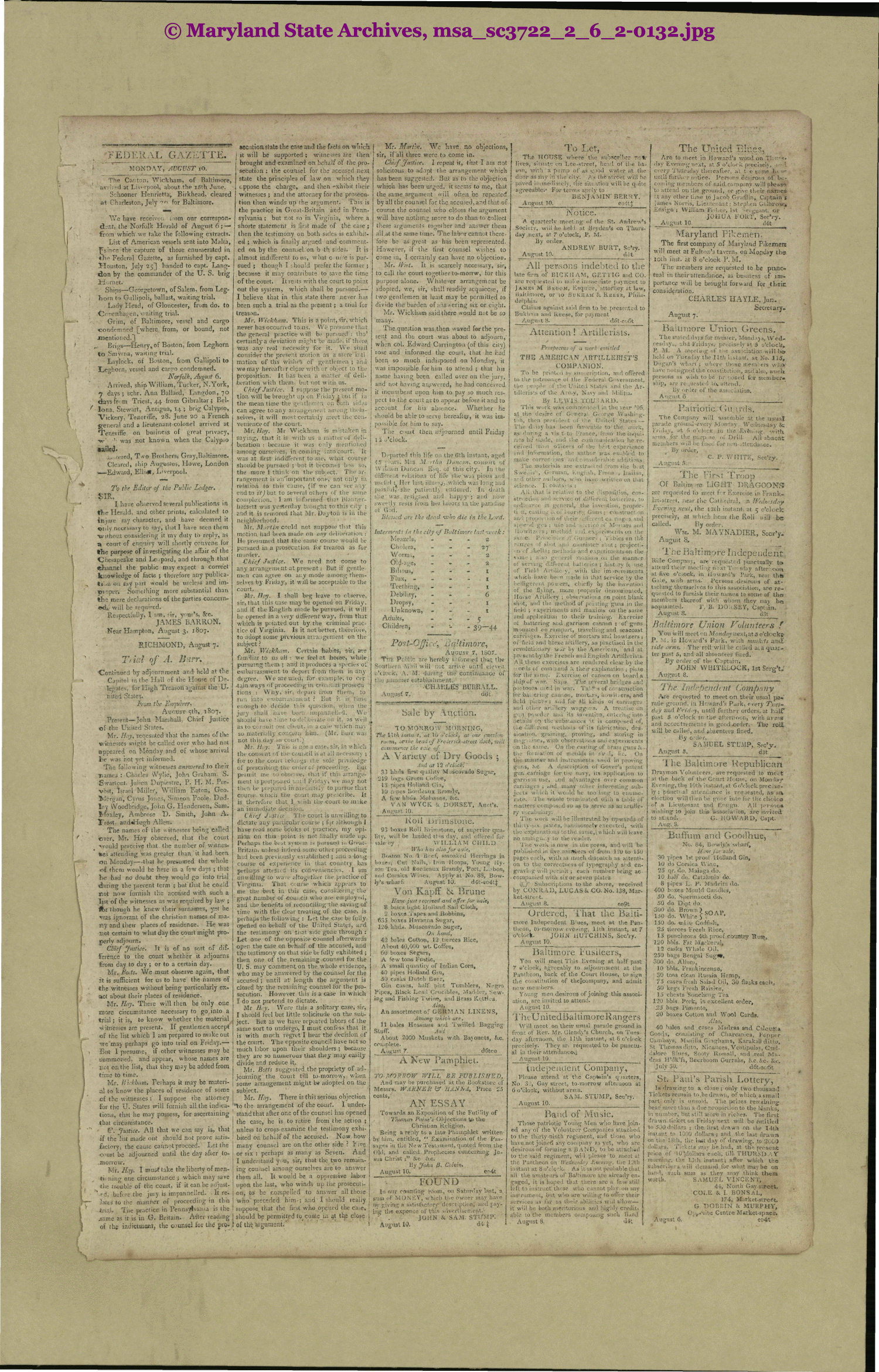
Federal Gazette & Baltimore Daily Advertiser 1807/07-1807/12 msa_sc3722_2_6_2-0132 Enlarge and print image (4M) |
|
|
|
|
|
|
|
|||
|
||||
|
||||
|
Federal Gazette & Baltimore Daily Advertiser 1807/07-1807/12 msa_sc3722_2_6_2-0132 Enlarge and print image (4M) |
|
FEDERAL GAZETTE.
\
/
MONDAY, AUGVSTid.
The Canton, Wickham, of Baltimore,
:n ,ired at Liverpool, about the i5th June.
Schooner Henrietta, Birkhead, cleared
at Charleston, July ?i for Baltimore.
We have received i-om our correspon-
d.-r.t, the Norfolk Herald of August 6; —
from which we take the following extracts.
List of American vessels sent into Malta,
Fsince the capture of those enumerated in
tbr- Federal Gazette, as furnished by capt.
Houston, July 25] handed to capt. Lanrr-
don by the commander of the U. S. brig
Hornet.
Ships—Georgetown, of Salem, from Leg-
horn to Gallipoli, ballast, waiting trial.
Lady Head, of Gloucester, from do. to
Ci-meifhagen, waiting trial.
Grim, of Baltimore, vessel and cargo
condemned [where. from, or bound, not
.mentioned.3
Brigs—Henry, of Boston, from Leghorn
to Smyrna, waiting trial.
Laylock, of Boston, from Gallipoli to
Leghorn, vessel and caro-o condemned.
Norfolk, August 6.
Arrived, ship William, Tucker, N.York,
7 days; schr. Ann Ballard, Langdon, 70
days from Triest, 44 from Gibraltar ; Bel-
lona. Stewart, Antigua, 14 ; brig Calypso,
Vickery, Teneriffe, 28. June 20 a French
general and a lieutenant-colonel arrived at
Tenet iffe. on business of great privacy,
-w-' '¦ was not known when the Calypso
•ailed.
rred, TVo Brothers, Gray,Raltimore.
Cleared, ship Augustus, Howe, London
—Edward, Elliat, Liverpool.
To the Editor of the Public Ledger.
KIR,
I have observed several publications in
the Herald, and other prints, calculated to
ihjtire joy character, and have deemed it
oiilv necessary to say, that I have seen them
"Without considering it my duty to reply, as
a court of enquiry will shortly convene for
the purpose of investigating the affair of the
Chesapeake and Le spard, and through that
channel the public may expect a correct
knowledge of facts ; therefore any publica-
tion on my part would be listless and im-
proper. Something more substantial than
the mere declarations of the parties concern-
ed, will be required.
Respectfully, I am, fir, your'*, Sec.
JAMES BARRON.
Near Hampton, Augusts, 1807.
RICHMOND, August 7.
T, id of A. Burr.
"Continued by adjournment and held at the
Capitol in the Hall of the House of De-
;,>rlligh Treason against the ti-
nned States,.
Eromthe Enquirer,
Auctrsx ctri, 1807.
Present—John Marshall, Chief Justice
of the United States.
Mr. Hay, reqesuted that the names of the
witnesses might be called over who had not
appeared on Monday and 01 whose arrival
Ire was hot yet informed.
The following witnesses anstocred to their
names : Charles vVylie, John Graham. S.
Swartont. Juiicn Dupiestr*, P- H. M. Pre-
V&st, Israel Miller, William Eaton, Geo.
SeJcfgan, Cvrus Jones, Simeon Poole- Dud.
Icy IVo.odbridge, John G. Henderson, Sam.
Moxley, Ambrose D. Smith, John A.
Trost. and«Hugh Allen.
The names of the witnesses being called
ever, Mr. Hay observed, that the court
¦Mould perceive that the number of witnes-
ses attending Was greater than it had been
on Monday—that he presumed the whole
of them would be here in a few days ; that
Tie had no doubt they would go into trial
during the pierent term ; but'that he coald
riot now furnish the accused with such a
list of the witnesses as was required by law ;
¦flbr though he knew their surnames, yet he
"-,\as ignorant of the christian names of ma-
ny and their places of residence. He was
sint certain to what day the court might pro-
perly adjourn.
Chief Justice. It is of no sort of dif-
ference to the court whether it adjourns
from day to day ; or to a certain day.
Mr. Bods. We must observe again, that
it is sufficient for us to have the names of
the witnesses without being particularly ex-
act ahout their places of residsnee.
Mr. Hay. There will then be only one
more circumstance necessary to go into a
trial; it is, to know whether the material
witnesses are present. If gentlemen accept
of the list which I am prepared to make out
¦we may perhaps go into trial on Friday.—
But I presume, if other witnesses may be
summoned, and appear, whose names are
jiot on the list, that they may be added from
time to time.
Mr. HickhanU Ferhaps it may be materi-
al to know the places of residence of some
.cf the witnesses: I suppose the attorney
for the U. States will furnish all the indica-
tion:.:, that he may possess, for ascertaining
that circumstance.
V. Justice. All that we can say is,, that
if the list made out should not prove satis-
factory, the cause cannot proceed.1 Let the
court be adjourned until the day after to-
. morrow.
Mr. Hay. I must take the liberty of men-
tis ning one circumstance ; which may save
the trouble of the court, if it can be adjust-
"" td, before the jury is impannel'ed. It re.
3ates to the manner of proceeding in this
{,..:.!. Toe practice in Pennsylvania is the
.-same as it is in G. Britain. After reading
of the indictment, the counsel for the pro-
sedition stale the cnie and the facts on wlttcB
it will be supported ; witnesses are then
brought and examined on behalf of the pro-
secution : the counsel for the accused next
state the principles of law on which they
eppose the charge, and then exhibit their
witnesses ; and the attorney for the prosecu-
tion then winds up the argument. This is
the practice in Great-Britain and in Penn-
sylvania ; but not so in Virginia, where a
shorte statement is first made of the case ;
then the testimony on both sides is exhibit-
ed ; which is finally argued and comment-
ed on by the counsel on b th sides. It is
almost indifferent to us, what c urse is pur-
sued ; though I should prefer the former;
.because it may contribute to save the time
of the court. It rests with the court to point
out the system, which shall be pursued.—-
I believe that in this state there never has
been such a trial as the present; a trial for
treason.
Mr. Wickham. This is a point, sir, which
never has occurred to as. W6 presume that
the general practice will be pursued : tho'
certainly a deviation might be made, if there
was any real necessity for it. We sum!
consider the present motion as a mere inti
niation of tlis wishes of gentlemen ; and
we may hereafter close with or object to 1 he
proposition. It lias been a matter of deli-
beration with them, but not with us.
Chief Justice. I suppose the present mo-
tion will be brought up on Frida) ; but if in
the mean time the gehtleii . onTOth sides
can agree to any arrangement among them-
selves, it will most certainly meet the con-
venience of the court.
Mr. Hay. Mr Wickham is mistaken in
saying, that it is with us a (natter.of deli-
beration : because it was only mentioned
among ourselves, incoming into court, it
was at first indifferent to me, what course
should be pursued ; but it becomes less so,
the more 1 think on the subject. The ar-
rangement is au'impoitant one, not only hi
relation to this cause, (if we can see any
end to it) but to several others of the same
Complexion. I am informed that Bla
hai'sett was yesterday brought to this city ;
arid it is remored that Mr. Dayton is in the
in ighborlvoodi
Mr. Martin could not suppose that this
motion had been made on any deliberation :
He presumed that the same course would be
pursued in a prosecution for treason as for
murder.
Chief Justice. We need not come to
any arrangement at present : But it' gentle
nn-n can agiee on ai. v mode among them-
selves by Friday, it will be acceptable to the
court.
Mr. Hay. I shall beg leave to rl.serve,
sir, that this case may be opened on Friday,
and if the English m-de be pursued, it will
be opened in a very different way, from that
which is pointed out by the criminal prac-
tice of Virginia. Is it not better, therefore,
to adopt some previous arrangement on the
subject ?
Mr. Wickham. Certain habits, sir, are
familiar to us all : we feel at home, while
pursuing them ; and :t produces a species of.
embarrassment to depart from tlu-in 111 any
degree. Weateusefj; for example, to cer
-tain ways of proceeding in crHiiilial prbsi c'u
tions : Wh_y, sir., depart from them, to
fun into 1 ni \ But it ii
enough to decide this qui io'l en the
jury shall have lied'. We
should bave-,time to-deliberate >ri it as well
as to o< i-uit Ottt .:!>.'iit, in a case widen may
so materially concern him. (Mr. buir was
not this day hi t
Mr. Hay. This is not a case, sir, in which
the const tit of tne cuncil is ai all nece
tor to the court belongs live sole priviledge
of prescribing the order ol i'.ui
peunit ine or obsi e, that if this arrange-
ment is postponed until Friday; we may not
then be prepared in nc- ii ti. to pursue, that
course which the court may prescribe; It
is therefore that 1 wish the court to make
an immediate deci
LhnJ Justia The court is unwilling to
dictate any particular course ; for although I
have read some books of practice, my opi-
nion on this point is not filially made up.
Perhaps the best system is pursued in Great-
Britain, unless indeed some other proceeding-
had been previously established ; ana a long
course ol experience in that country has
perhaps attested its conveniences. .1 am
unwilling 10 ware altogether the practice of
Virginia. That cause which appears to
me the best in this case, consign
great number of Cornell who are employed,
and the benefits of reconciling the saving of
time with the clear treating of the case, is
perhaps the following : Let the case be fully
opened on behalf of the United States, and
the testimony on that side gone through :
Let one of the opposite counsel afterwards
open the case on behalf of the accused, and
the testimony on that side be fully exhibited ;
then one of the remaining counsel for the
U. S. may comment on the whole evidence,
who may be answered by the counsel for the
accused ; until at length the argument is
closed by the remaining counsel for the pro-
secution. However this is a case in which
I do not pretend to dictate.
Mr Hry. Were this a solitary case, sir,
I should feel but little solicitude on the sub-
ject. But as we have repeated labors of the
same sort to undergo, I must confess that it
is with much regret I hear the decision of
the court. The opposite council have not so
much labor upon their shoulders ; because
they are so numerous that they may easily
divide and reduce it,
Mr. Botts suggested.the propriety of ad-
journing the court till to-morrow, when
some arrangement might be adopted on the
subject.
Mr. Hay. There is this serious objection
"to the arrangement of the court. I under-
stand that after one of the counsel has opened
the case, he is to retire from the action ;
unless to cross-examine the testimony exhi-
bited on behalf of the accused. Now how
many counsel are on the other side I Tt ive
or six : perhaps as many as Seven. And
I understand y>>u, sir, that the two remain-
ing counsel among ourselves are to answer
them all. It would be a oppressive labor
upon the last, who winds up the prosecuti-
on, to be compelled to answer all those
who' preceded him-; and I shouTd really
suppose that the first who opened the case, I
should be permitted tc. conic ia at the close j
of the argument.' l
Mr. Mart'pn. We have, no objections,
sir, if all three were to come in.
Chi.f Justice. I repeat it, that I am not
solicitous to adopt the arrangement which
has been suggested. Bflt as to the objection
which has been urged, it seems to me, that
the same argument will often.be repeated
by all the counsel for the accused, and that of
course the counsel who closes the argument
will have nothing more to do than to Collect
these arguments together and answer them
all at the same time. The labor cannot there-
fore be as great as has been represented.
However, if the first counsel wishes to
come in, I certainly can have no objection.
Mr. ii'nt. It is scarcely necessary, sir,
to call the court together to-morrw, for this
purpose alone. Whatever arrangement be
adopted, we, sir, shall readily acquiecse, if
two gentlemen at least may be permitted to
divide the burden of answering six or eight.
Mr. Wickham said there would not be so
many.
The.question was then waved for the pre-
sent and the court was about to adjourn,
when col. Edward Carriugton (of this city)
lose and informed the court, that he had
been so much indisposed on Monday, it
was impossible for him to attend ; that bis
name having been called ever oil the jury,
and not having answered, he had conceived
it incumbent upon him to pay so much res-
pect to the court as to appear before it and to
account for his absence. Whether he
should be able to serve herealt«y> it was im-
possible for him to say.
The court then adjourned until Friday
ii ..'clock.
Departed this life on the (5th instant, aged
43 , aVs, Mrs Martha Duncan, consult of
Wiriiam Duncan Esq. of this city. In the
it relations of life she was pious and
¦ i I : Her last illness which was'kmg and
il" She patiently endured. In death
she was resigned nod happy; and
ts from her labors in the paradise
or 0 id'.
Blessed arc the dead ivho die in the L'ird.
Interments in the city of Baltimore last 0 . ek :
Meazels, 2
Cholera, 27
Worms,, ... 2
Old-age, - ... 2
Bilious, - - - I
Flux, ... - 1
teething, Debility, * „ 1 6
Dropsy, Unknown, Adults, - - 1 1 - 5
Children, - '- - 39—44
Post-QJJi:/. 1 tyltimore*,
August 7, 1S07. .
Trflt PcHio ore hereby infqrnied thut, the
ill flut arrive until eleven
o'tlocK, A. M. daring the continuance of
the siiejo.ier establishment.
¦ CUAV.LES BUfiR.NXL..
All,';OSt 7.
dtit
Sale by Auction.
TO MORROW MORNING,
7Vie %iih intuit, at 16 a'clSch at our attctibn
rovm, Jt'tJie head tf Frcitnck-strtet dock, villi
continence the sale of
A Variety of Dry Goods ;
And at 12 o'clock. '
33 hiids first <|'i.ihtv M.iseovado Sug-ar,
2}9 bugs Green Gofit*,
¦13 pipes Holland t.l'vi,
10 pipes lio'deimx Brandy,
A few blin* i»ir,!:is,-,e-i, e;c.
VAN WYCK. & D0RSEY, Ami's.
Aiiffust 10.________ ¦_______
Koii iirirnstone.
93 boxes Pioil Brimstone, of superior qua-
lity, will be landed this day, and offered tin-
side by WILLIAM CHILD
Who has also for |