 |
|
|
 |
|
 |
|
|||
|
||||
|
||||
|
Federal Gazette & Baltimore Daily Advertiser 1807/07-1807/12 msa_sc3722_2_6_2-0202 Enlarge and print image (5M) |
|
|
|
|
|
|
|
|||
|
||||
|
||||
|
Federal Gazette & Baltimore Daily Advertiser 1807/07-1807/12 msa_sc3722_2_6_2-0202 Enlarge and print image (5M) |
|
.
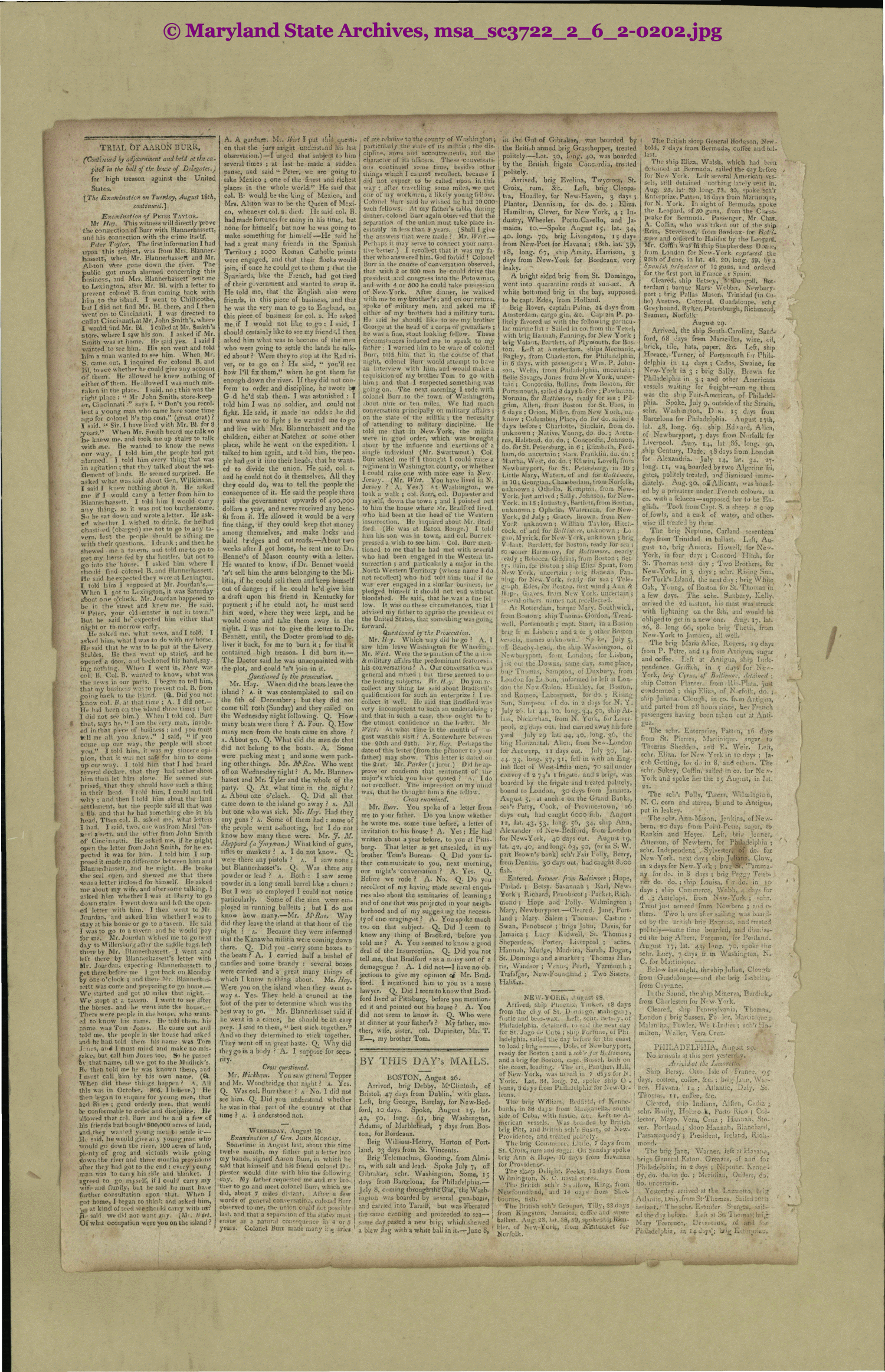
TRIAL OF AARON BURR,
fConthtucd by adjournment and held at the ca-
pltol in the hall of the house of Delegates.)
for high treason, against the United
States.
\The Examination en Tuesday, August lSfA,
continued.'].
Examination of Peter TayIor.
Mr flay. This witness will directly prove
the connection of Burr with Blannerhassett,
and his connection with the crime itself.
Peter Tnytor. The first information I had
upon this subject, was from Mr?. Blanner-
hassett, when Mr. Blannerhassett and Mr.
Abtoti wfere gone down the river. The
public got much alarmed concerning this
business, and Mrs. Blannerhassett sent me
to Lexington, after Mr. Bl. with a letter to
prevent colonel B. from coming back with
liim to the island. I went to Chillicothe,
but I did not find Mr. Bl. there, and I then
went on to Cincinnati. I was directed to
callat Cincinnati,at Mr. John Smith's, where
I would find Mr. Bl. I called at Mr. Smith's
store, where I saw his son. I asked if Mr.
Smith was at home. He said yes. I said I
wanted to see him. His son went and told
Slim a man wanted to see him. When Mr.
S. came out, I inquired for colonel B. and
Bl. to see whether he could give any account
of them. He allowed he knew nothing of
either of them. He allowed I was much mis-
taken in the place. I said, no ; this was the
right place : '' Mr John Smith, store-keep
t-r~, Cincinnati:" says I, " Don't you recol-
lect a young man who came here some time
ago for colonel B's top coat," (great coat) i
I said. " Sir, I have lived with Mr. Bl. for 3
years." When Mr. Smith heard me talk so
he knew me, and took me up stairs to talk
with me. He wanted to know the news
our way. I told him,the people had got
alarmed. I told him every thing that was
in agitation ; that they talked about the set-
tlement of lands. He seemed surprised. He
asked what was said about, Gen. Wilkinson.
I said I knew nothing about, it. He asked
rne if I would carry a letter from him to
Blannerhassett. I told him I would carry
any thing, so it was not too burthensome.
So he sat down and wrote a letter. He ask-
ierl whether I wished to drink, for he had
chastised (charged) me not to go to any ta-
vern, lest the people should be sifting me
with their questions. I drank ; and then he
Shewed me a tavern, and told me-to go to
fret my lwse fed by the hostler, but not to
go into the house. I asked him where I
should find colonel B. and Blannerhassett.
lie said he expected they were at Lexington.
I told him I supposed at Mr. Jourdan's.—
When I got to Lexington, it was Saturday
about one o'clock. Mr. Jourdan happened to
be in the 'street and knew me. He said,
" Peter, your old master is not in town."
But he said he"expected him either that
night or to morrow early.
He asked me, what news, and I told. I
asked him, what I was to do \vith my horse.
He said that he was to be put at the Livery
Staliles. He then went up stairs', and he
opened a door, and beckoned his hand, say -
in,; nothing. When I went in, there was
col. B. Col. B. wanted to know, what was
the news in our parts. I began to tell him,
that my business was to prevent col. B. from
going back to the island, (a. Did you not
know' col. B. at that time ; A. I did not.—
He had been on the island three times : but
I did not see him.) When I told col. Burr
that, says he, " I am the very man, involv-
ed in that piece of business ; and you must
toll me all you know." 1 said, " if you
come up our way, the people will shoot
you." J told him, it was rny sincere opi-
nion, that it was not safe for him to come
up our way. I told him that I had beard
several declare, that they had rather shoot
him than let him alone. He seemed sur-
prised, that they should have such a thing
in their head. 1 told him, I could not tell
why ; and then I told him about the land
settlement, but the people said all that w«as
a fib and that he had something else in his
head. Then co). B. asked me, what letters
I had. I said, two, one was from Mrs) 1?aii-
jjerl a sett, and the other from John Smith
of Cincinnati!. He asked me, if he might
open the letter from John Smith, for he ex-
pected it was for him. 1 told him I sup-
posed it made no difference between him and
Blannerhassett, and he might. He broke
the seal open, and shewed me that there
tuasa letter inclosed for himself. He asked
jne about my wife, and after some talking. I
asked him whether I was at liberty to go
down stairs I went down and left the open-
ed letter with him. I then went to Mr.
Jourdan, and asked him whether I was to
stay at his house or go to a tavern. He said
I was to go to a tavern and he would pay
for me. Mr. Jourdan wished me to go next
day to Willersburg after the saddle bags, left
there by Mr. Blannerhassett. I went and
left there by Blanneihassett's letter with
Mr. Jourdan, expecting Blannerhassett to
get there before me 1 got back on Monday
by one o'clock ; and there Mr. Blannerhus-
settt was come arid preparing to go home__
We started and got iO miles that night.
We slopt at a tavern. I went to see after
the horses, and he went into the house.
There were pet pie in the house, who want-
ed to know liis name. He told them, his
name was Tom Jones. He came out and
told me, the people in the house had asked
and he had told them his name was Tom
J nes, an*l I must mind and make no mis-
take, but call him Jones too. So he passed
iv that name, till we got to the Mudjick's.
He then told me he was known there, and
I mnst call him by his own name, (Q.
When did these things happen? A, All
this was in October, 806, I believe.) He
».hen began to enquire for young men, that
Jiad Ri es ; good orderly men, that would
be conformable to order and discipline. He
allowed that eel. Burr and he and a few of
his friends had bough' 800,000 acres of land,
and they waived young men $o settle if—
Hi' said, he would give any young man who
¦would go down the river, 100 acres of land,
plenty of grog and victuals while going
Sown the river and three months provisions
after they had got to the end : every young
man was to carry his rifle and blanket. I
agreed to go myself, if J could carry my
wife and family, but he said hi.- must have
further consultation upon that. When I
got home, I began to thin?: and asked him,
:„ at kind of seed we should carry with ur?
pe said w* did aot want .any. (M-. Wirt.
Of what occupation were you on the island ?
A. A gardnflr. Mr. Wirt I put tin,' questi-
on that the jury might understand his last
observation.)—I urged that subject to him
several times ; at last he made a sudden
pause, and said " Peter, we are going to
take Mexico ;. one of the finest and richest
places in the whole world." He said that
col. B- would be the king of Mexico, and
Mrs. Alston was to be the Queen of Mexi-
co, whenever col. b. died, lie said col. B.
had made fortunes for many in his time, but
none for himself; but now he was going to
make something for himself—He said he
had a great many friends in the Spanish
Territory ; 2000 Roman Catholic priests
were engaged, and that their flocks would
join, if once he could get to them ; that the
Spaniards, like the French, had got tired
of their government and wanted to swap it.
He told me, that the English also were
friends, in this piece of business, and that
he was the very man to go to England, on
this piece of business for col. u. He asked
me if I would not like to go : I said, I
should certainly like to see my friend 'J then
asked him what was to become of the men
who were going to settle the lands he talk-
ed about ? Were they to stop at the Red ri-
ver, or to go on ? He said, " you'll see
how I'll fix them," when he got them far
enough down the river. If they did not con-
form to order and discipline, he swore bf
G d he'd stab them. I was astonished : I
told him I was no soldier, and could not
fight. He said, it made no odds : he did
not want me to fight ; he wanted me to go
and live with Mrs. Blannerhassett and the
children, either at Natchez or some other
place, while he went on the expedition. I
talked to him again, and told him, the peo-
ple had trot it into their heads, that he want-
ed to divide the union. He said, col. n.
and he could not do it themselves. All they
they could do, was to tell the people the
consequence of it. He said the people there
paid the government upwards of 400,000
dollars a year, and never received any bene-
fit from it. He allowed it would be a very
fine thing, if they could keep that money
among themselves, and make locks and
build lr dges and cut roads.—About two
weeks after I got home, he sent me to Dr.
Bennet's of Mason county with a letter.
He wanted to know, if Dr. Bennet would
'n't sell him the arms belonging to the Mi-
litia, if he could sell them and keep himself
out of danger ; if he could he'd give him
a draft upon his friend in Kentucky for
payment ; if he could not, he must send
him word, where they were kept, and he
would come and take them away in the
night. I was not to give the letter to Dr,
Bennett, until, the Docter promised to de-
liver it back, for me to burn it ; for that it
contained high treason. I did burn it.—
The Doctor said he was unacquainted with
the plot, and could 'n't join in it.
Questioned by the prosecution.
Mr. Hay. When did the boats leave the
island ? a. it was contemplated to sail on
the 6th of December; but they did not
come till 10th (Sunday) and they sailed on
the Wednesday night following. Q. How
many boats were there ? A. Four. Q. How
many men from the boats came on shore ?
a. About 30. Q. What did the men do that
did not belong to the boats. A. Some
were packing meat ; and some were pack-
ing other things. Mr. M'Rae. Who went
off on Wednesday night ? A. Mr. Blanner-
hasset and Mr. Tyler and the whole of the
party. Q. At what time in the night ?
a. About one o'clock. Q^ Did all that
came down to the island go away ? a. All
but one who was sick. Mr. liny. Had they
any guns ? a. Some of them had : some of
the people went a.shooting, but I do not
know how many there were. Mr. J. M.
Sheppard (a Juryman.) What kind of guns,
rifles or muskets ? a. I do not know. Q^
were there any pistols ? a. I saw none ;
but Blannerhasset's. Ch Was there any
powder or lead ? A. Both : I saw some
powder in a long small barrel like a churn :
But I was so employed I could not notice
particularly. Some of the men were em-
ployed in running bulletts ; but I do not
know how many.—Mr. M'Rae. Why
did they leave the island at that hour of the
night ? a. Because they were informed
that the Kanawha militia wcie coming down
there. Q^ Did you -carry some boxes to
the boats ? A. I carried half a bushel of
candles and some brandy : several boxes
were carried and a great many things of
which I know nothing about. Mr. Hay.
Were you on the island when they went a-
way a. Yes. They held a council at the
foot of the pier to determine winch was the
best way to go. Mr. Blannerhasset said if
he went in a canoe, he should be an easy
prey. I said to them, " best stick together."
And so they determined to stick together.
They went off in great haste. CK Why did
they go in a body ? A. I suppose for secu-
rity.
Cross questioned.
Mr. Ifickham. You saw general Topper
and Mr. Woodbridge that night ? a. Yes.
Q^ Was col. Burr those ? a No. I did not
see him. Cb. Did you understand whether
he was in that part of the country at that
time ? A. I understood not.
Wednesday, August 19.
Examination of Gen. John Morgan.
Sometime in August last, about this time
twelve month, my father put a letter into
my hands, signed Aaron Burr, in which he
said that himself and his friend colonel Du-
plester would dine with him tiie following
day. My father requested me and my brfi-
ther to go and meet colonel Burr, which we
did, about 7 miles distant. After a few
words of general conversation, colonel Burr
observed to me, the union could mt possibly
last, and that a separation of the states must
ensue as a natural consequence in 4 or 5
years. Colonel Burr made tunny i:.» .irics
of me relative to the county of Washington;
particularly the state of its militia ; the dis-
cipline, arms and accoutrements, and the
character of its officers. These conversati-
ons continued some time, besides other
things which I cannot recollect, because I
did not expect to be called upon in this
way ; after travelling some miles, we met
one of my workmen, a likely young fellow.
Colonel Burr said he wished he had 10.000
Such fellows. At my father's table, during
dinner, colonel Burr again observed that the
separation of the union must take place in-
evitably in less than 5 years. (Shall I give
the answers that were made ? Mr. IVirt.—
Perhaps it may serve to connect your narra-
tive better.) I recollect that it was my fa-
ther who answered him, God forbid ! Colonel
Burr in the course of conversation observed,
that with 2 or 300 men he could drive the
president and congress into the Potowmac,
and with 4 or 500 he could take possession
of New-York. After dinner, he walked
with me to my brother's ; and on our return,
spoke of military men, and asked me if
either of my brothers had a military turn.
He said he should like to see my brother
George at the head of a corps of grenadiers ;
he was a fine, stout looking fellow. These
circumstances induced me to speak to my
father : I warned him to be ware of colonel
Burr, told him that in the course of that
night, colonel Burr wouid attempt to have
an interview with him, and would make a
requisition of my brother Tom to go with
him ; and that I suspected something was
going on. The next morning I rode with
colonel Burr to the town of Washington,
about nine or ten miles. We had much
conversation principally on military affairs ;
on the state of the militia ; the necessity
of attending to military discipline. He
told me that in New-York, the militia
were in. good order, which was brought
about by the influence and exertions of a
single individual (Mr. Swartwout.) Col.
Burr asked me if I thought I could raise a
regiment in Washington county, or whether
I could raise one with more ease fa New-
Jersey. (Mr. Wirt. You have lived in N.
Jersey ? A. Yes.) At Washington, we
took a walk ; col. Burr-,, col. Dupiester and
myself, down the town ; and I pointed out
to him the house where .vTr. Bradford lived,
who had been at the head of the Western
insurrection. He inquired about Mr. (irad
ford. (He was at Baton Houge.) I told
him his son was in town, and col. Burr ex
pressed a wish to see him. Col. Burr men-
tioned to me that he had met with several
who had been engaged in the Western in-
surrection ; and particularly a major in the
North Western Territory (whose name I do
not recollect) who had told him, that if he
was ever engaged in a similar business, lie
pledged himself it should not end without
bloodshed. He said, that he was a line fel
low. It was on these circumstances, that I
advised my hitherto apprisu the president 01
the United States, that something was going
forward.
Questioned by the Prosecution.
Mr. II y. Which way did he go ? A. I
saw him leave Washington for Wheelinb.
Mr. Wirt. Were the Separation of the u.ii hi
& military affdrs the predominant features i .
his conversations? A. Our conversation vv;..,
general and mixed ; but these seemed to o<-
the leading subjects, Mr. lL,y. Do you re-
collect any thing he said about Bradford's
qualifications for such an enterprize ? I re-
collect it well. He said that Bradford was
very incompetent to such an undertaking ;
and that in such a case, there ought to be
the utmost confidence in the leader. Mr
Wirt. At what time in the month of u-
gust was this visit r A. Somewhere between
tiie 20th and 25th. S^t; Bay. Perhaps the
date of this letter (from the prisoner to your
father) may show. This letter is dated on
the 2ist. Mr.Parker (a juror.) Did heap-
prove or condemn that sentiment of the
major's which you have quoted ? A. I do
not recollect. Tiie impression on my mind
was, that he thought him a fine fellow.
Cross examined.
Mr. Burr. You spoke of a letter from
me to your father. Do you know whether
he wrote me, some tune before, a letter of
invitation to his house ? A. Yes; He had
written about a year belore, to you at Puts-
burg. That letter is yet unsealed, in my
brother Tom's Bureau. Q Did your la-
ther communicate to you, next morning,
our night's conversation ? A. Yes. Q.
Before we rode ? A. No. Q Do you
recollect of my having made several enqui-
ries also about the seminaries of. learning ;
and of one that was projected 111 your neigh-
borhood and of my suggesting the necessi-
ty of eno uraging.it ? A. You spoke much
too on that subject. Q. Did I seem to
know any thing of Bradford, before you
told me ? A. You seemed to know a good
deal of the Insurrection. Q. Did you not
tell me, that Bradford « as a noisy sort of a
demagogue ? A. I did not—I have no ob-
jections to give my opinion 0/ Mr. Brad-
ford. I mentioned him to you as a mere
lawyer. Q^ Did I seem to know that Brad-
ford lived at Pittsburg, before you mention-
ed it and pointed out his house ? A. You
did not seem to know it. Q. Who were
at dinner at your father's ? My father, mo-
ther, wife, sister, col. Dupiester, Mr. T.
E—, my brother Tom.
BY THIS DAY'S MAILS.
BOSTON, August 26.
Arrived, brig Debby, M'Clintosh, of
Bristol, 47 days from Dublin,' with glass.
Left, brig George, Barclay, for New-Bed-
ford, 10 days. Spoke, August 15, lat.
42, 50, long. 61, brig Washington,
Adams, of Marblehead, 7 days from Bos-
ton, for Bordeaux.
Brig William-Henry, Horton of Port-
land, 33 days from St. Vincents.
Brig Telemachus, Gooding, from Almi-
ra, with salt and lead. Spoke July 7, off
Gibraltar, schr. Washington, Some, 15
days from Barcelona, for Philadelphia.—
July 8, coming through-thc'Gut, the Wash-
ington was boarded by several gun-boats,
and carried into Tarailf, but was liberated J
the same evening and proceeded to sea— ,
same day passed a new brig, which shewed
a blew flag with a white ball in it.—June 8, ¦
in the Gut of Gibraltar^, was boarded by
the British armed bri |