|
If
$¦¦
'.
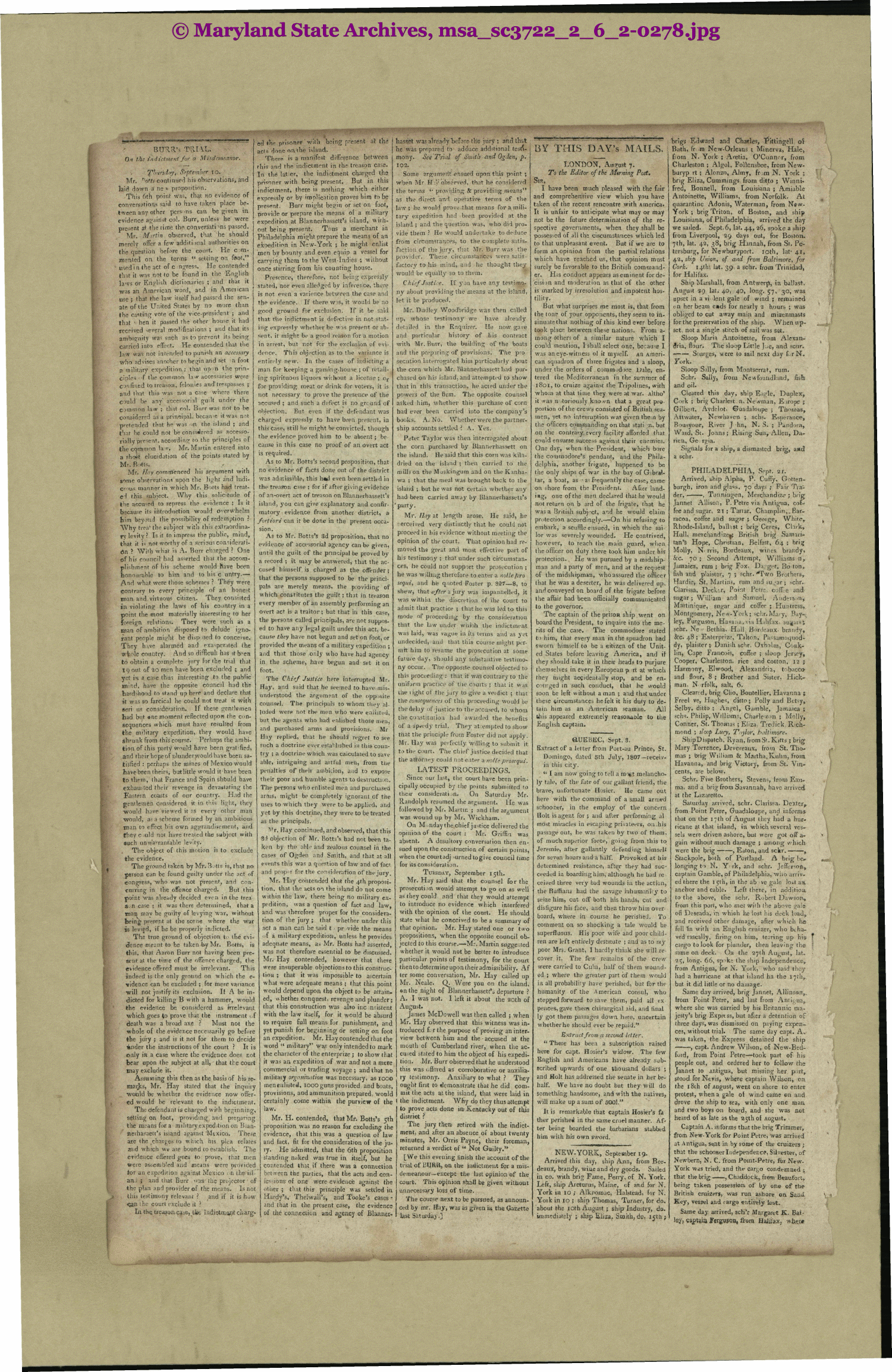
BtfRR's TRIAL.
On the indictment for a Misdemeanor.
'Thursday,. September TO.
Mr. "ofts continued his observations, and
laid down a ne « proposition.
This 6th point was, that mo evidence of
conversations said to have taken place be-
tween any other persons can be given in
evidence against col. Burr, unless he were
present a+ the time the conversati ms passed.
Mr. Mirtin observed, that he should
merely offer a few additional authorities on
the question before the court. He c om-
mented on the terms " setting on foot,"
usedl n the act of c .tigress. He contended
that it wis not to be found in the English
laws or English dictionaries ; and that it
was an American word, and in Amencan
use ; that the law itself had passed the sen-
ate of the United Slates by no more than
the casting vote of the vice-president ; and
that ' hen it passed the other house it had
received several modifications ; and that its
ambiguity was such as to prevent its being
carried into effect. He contended that the
law was not intended to punish an accessary
who advises another to begin and set n foot
a military expedition.; that up n the prin-
ciples df the common law accessaries were
confined to treason, felonies and trespasses ;
and that this was not a case where there
could' be any' accessorial guilt under the
Common law ; that col. Burr was not to be
considered as a principal, because it was not
pretended that he was fin the island ; and
that he could not be considered as accesso-
rial^ present, according to the principles of
the cqmmon la ». Mr. Martin entered into
a shoit elucidation of the points stated by
Mr. Bofts.
Mr. Hoy commenced his argument with
some observations upon the light and ludi-
crous manner in which Mr. Butts had treat-
ed this subject. Why this solicitude of
the accused to repress the evidence ; Is it
because its introduction would overwhelm
him beyond the possibility of redemption ?¦
Why trea'the subject with this extraordina-
ry levity ? Is it to impress the public, mind,
that it is not worthy of a serious considerati-
on ? With what is A. Burr charged ? One
of his council had assorted that the accom-
plishment of his scheme would have been
honourable to him and to his c untry.—
And what were those schemes ? They were
contrary to every principle of an honest
man and virtuous citizen. They consisted
in violating the laws of his country in a
point the most materially interesting to her
foreign relations. They were such as a
man of ambition disposed to delude igno-
rant people mifht be disposed to conceive.
They h ive alarmed and exasperated the
jvfcole country. And so difficult has it b'jen
to obtain a complete jury lorihe trial that
19 out of 20 men have been excluded ; and
yet in a case thus interesting to the public
mind, have the opposite council had the
hardihood to stand up here and declare that
it was so farcical he could not treat it with
seri us consideration. If these gentlemen
had but uld not have treated the subject with
such unwarrantable levity.
The object of this motion is to exclude
the evidence.
The ground taken by Mr. Botts is, that no
psrson can be found guilty under the act of
congress, who was not present, and con-
curring in the offence charged. But this
point was already decided even in the trea
s-.n case ; it was there determined, that a
man tnav be guilty of levying war, without
being-present at the scene where the war
is levied, if he be properly indicted.
The true ground of objection to the evi-
dence meant to be taken by Mr. Botts, is
this, that Aaron Burr not having been pre-
sent at the time of the offence charged, the
evidence offered must be irrelevant. This
indeed is the only ground on which the e-
vidence can be excluded ; for mere variance
¦will not justify its exclusion. It A be in-
dicted for killing B with a hammer, would
the evidence be considered as irrelevant
which goes to prove that the instrument <,f
death was a broad axe ? Must not the
whole of the evidence necessarily go before
the jury ; and is it not for them to decide
Ander the instructions of the court ? It is
only in a case where the evidence does cot
bear upon the subject at all, that the court
may exclude it.
Assuming this then as the basis-of his re-
marks, Mr. Hay stated that the inquiry
would be whether the evidence now offer-
ed would be relevant to the indictment.
The defendant is charged with beginning,
setting on foot, providing and preparing
the means for a military .expedition on Btan-
nei'hasaett's island against Mtxico. These
are the chaij.x.v to which his plea relates
and which we are bound to establish. The
evidence offered goes to prove, that men
were assembled and means were provided
for an. expedition aga-nst Mexico .n the isl
an.i ; and that Burr u'as the projector' of
the plan and provider of the means. Is not
this testimony relevant ? and if it is how
S, it would be no
good ground for exclusion. If it be said
that the indictment is defective in not stat-
ing expres«ly whether he was present or ab-
sent, it might be a good reason for a motion
in arrest, but not for the exclusion of evi-
dence. This objection as to the variance is
entirely new. In the cases of indicting a
man for keeping a gaming-house,; of retail-
ing spirituous liquors without a license ; or
for providing meat or drink for voters, it is
not necessary to prove the presence of the
accused ; and such a defect is no ground of
objection. But even if the defendant was
charged expressly to have been present, in
this case, still lie might be convicted, though
the evidence proved him to be absent; be
cause in this case no proof of an overt act
is required.
As to Mr. Botts's second proposition, that
no evidence of facts done out of the district
was admissible, this h*l even been settled in
the treason ense : for if after giving evidence
of an-overt act of treason on Blannerhassett's
island, you can give explanatory and confir-
matory : evidence from another district, a
fortiori can it be done in the present occa-
sion.
As to Mr. Botts's 3d proposition, that no
evidence of accessorial agency can be given,
until the guilt of the principal be proved by
a record ; it may be answered, that the ac-
cused himself is charged as t,he offender ;
that the persons supposed to be the princi-
pals are merely means, the providing of
which constitutes the guilt; that in treason
every member of an assembly performing an
overt act is a traitor; but that in this case,
the persons called principals, a'e not suppos-
ed to have any legal guilt under this act, be-
cause they have not begun and set on foot, or
provided the means of a military expedition ;
and that those only who have had agency
in the scheme, have begun and set it on
foot.
The Chief Justice here interrupted Mr.
Hay, and said that he seemed to have mis-
understood the argument of the opposite
counsel. The principals to whom they al-
luded were not the men who were enlisted,
but the agents who had enlisbed those men,
and purchased arms and provisions. Mr
Hay replied, that he should regret to see
such a doctrine ever established in this coun-
try ; a doctrine which was calculated to save
able, intriguing and artful men, from tne
penalties of their ambition, and to expose
their poor and humble agents to destruction.
The persons who enlisted men and purchased
arms, might be completely ignorant of the
uses to which they were to be applied, and
yet by this doctrine, they were to be treated
as the principals.
Mr, Hay continued, and observed, that this
3 1 objection of Mr. Botts's had not been ta-
ken by the able and zealous counsel in the
cases of Ogden and Smith, and that at all
events this was a question of law and of fact
and proper for the consideration of the jury.
Mr. Hay contended that the 4th proposi-
tion, that the acts on the island do not come
within the law, there being no military ex-
pedition, was a question of fact and law,
and was therefore proper for the considera-
tion of the jury ; that whether under this
act a man can be said t pr vide the means
of a military expedition, unless he provides
adequate means, as Mr. Botts had asserted,
was not therefore essential to be discussed.
Mr. Hay contended, however that there
were insuperable objections to this construc-
tion ; that it was impossible to ascertain
what were adequate means ; that this point
would depend upon the object to be attain,
ed, whethei conquest, revenge and plunder;
that this construction was also inc insistent
with the law itself, for it would be absurd
to require full means for punishment, and
yet punish for beginning or setting on foot
an expedition. Mr. Hay contended that the
word " military" was only intended to mark
the character of the enterprise ; to show that
it was an expedition of war and not a mere
commercial or trading voyage; and that no
militaty organization was necessary, as 1000
men enlisted, 1000guns provided and boats,
provisions, and ammunition prepared, wonld
certainly come within the purview of the
law.
Mr. H. contended, that Mr. Botts's 5th
proposition was no reason for excluding the
evidence, that this was a question of law
and fact, fit for the consideration of the ju-
ry. He admitted, that the 6th proposition
standing naked was true in itself, but he
contended that if there was a connection
between the parties, that the acts and con-
fessions of one were evidence against the
other ; that this principle was settled in
Hardy's,- Thelwall's, and Tboke's cases •
and that in the present case, the evidence
of the connection and agency of Blanner-
hasset was already before the jury ; and th«t
he was prepared to adduce additional.testi-
mony. See Trial of Smith and Ogden, p.
102.
Some argument ensued upon this point ;
when Mr H :v observed, that he considered
the terms '' providing & providing means"
as the direct and operative terms of the
law ; he would prove that means for a mili-
tary expedition had been provided at the
island ; and the question was, who did pro-
vide them ? He would undertake to deduce
from circumstances, to the complete satis*
faction of the jury, that Mr. Burr was the
provider. These circumstances were satis-
factory to his mind, and he thought they
would be equally so to them.
Chief'Justice. If you have any testimo-
ny about providing the means at the island,
let it be produced.
Mr. Dudley Woodbridge was then called
up, whose testimony we have already
detailed in the Enquirer. He now gave
and particular history of his contract
with Mr. Burr, the building of the boats
and the prepiring of provisions. The pro
sedition interrogated him particularly about
the corn which Mr. Blailnerhassett had pur-
chased on his island, and attempted to show
that in this transaction, he acted under the
powers of the firm. The opposite counsel
asked him, whether this purchase of corn
had ever been carried into the company's
books. A. No. Whether were the partner-
ship accounts settled ? A. Yes.
Peter Taylor was then interrogated about
the corn purchased by Blannerhassett on
the island. He said that this corn was kiln-
dried on the island ; then carried to the
mills on the Muskingum and on the Kanha-
wa ; that the meal was brought back to the
island ; but he was not certain whether any
had been carried away by Blannerhassett's
•party.
Mr. Hay at length arose. He said, he
perceived very distinctly that he could not
proceed in his evidence without meeting the
opinion of the court. That opinion had re-
moved the great and most effective part of
his testimony ; that under such circumstan-
ces, lie could not support the prosecution ;
he was willing therefore to enter a nolle flro
sequi, and he qnoted Foster p. 327—8, to
sheWj that after a jury was impannelled, it
was within the discretion of ihe court to
admit that practice ; that he was led to this
mode of proceeding by the consideration
that the law under whioh the indictment
was laid, was vague in its terms and as yet
undecided, and that this course might per-
mit him to resume the prosecution at some
future day, should any substantive testimo-
ny occur. The opposite counsel objected to
this proceeding : that it was contrary to the
uniform practice of the ourts ; that it was
the light of the jury to give a veidict ; that
the consequences of this proceeding would be
the delay of justice to the accused, to whom
the constitution had awarded the benefits
of a speedy trial. They attempted to show
that the principle from Foster did not apply.
Mr. Hay was perfectly willing to submit it
to tiie court. The chief justice decided that
the attorney could not enter a nolle prosequi.
LATEST PROCEEDINGS.
Since our last, the court have been prin-
cipally occupied by the points submitted 10
their consideration. On Saturday Mr.
Randolph resumed the argument. He was
followed by Mr. Martin ; and the argument
was wound up by Mt. Wickham.
On Monday the chief justice delivered the
opinion of the court : Mr. Griffin was
absent. A desultory conversation then en-
sued upon the construction of certain points,
when the courtadj >urned togive council time
for its consideration.
Tuesday, September 15th.
Mr. Hay said that the counsel for the
prosecution would attempt to go on as well
as they could and that they would attempt
to introduce no evidence which interfered
with the opinion of the court. He should
state what he conceived to be a summary of
that opinion. Mr. Hay stated one or two
propositions, when the opposite council ob-
jected to this course.—Mr. Martin suggested
whether it would not be better to introduce
particular points of testimony, for the court
then to determine upon their admissibility. Af
ter some conversation, Mr. Hay called up
Mr. Neale. Q. Were you on the island,
smthe night of Blannerhassett's, departure ?
A. I was not. I left it about the 20th of
August.
James McDowell was then called ; when
Mr. Hay observed that this witness was in-
troduced f.-rthe purpose of proving an inter-
view between him and the-accused at the
mouth of Cumberland river, when the ac-
cused stated to him the object of his expedi-
tion. Mr. Burr observed that he understood
this was offered as corroborative or auxilia-
ry testimony. Anxiliary to what ? They
ought first to demonstrate that he did com-
mit the acts at the island, that were laid in
the indictment. Why do they thus attempt
to prove acts done in Kentucky out of this
district ?
The jury then setired with the indict-
ment, and after an absence of about twenty
minutes, Mr. Orris Payne, their foreman,
returned a verdict of " Not Guilty."
[We this evening finish the account of the
trial of BURR, on the indictment for a mis-
demeanour—except the last opinion of the
court. This opinion shall be given without
unnecessary loss of time.
The course next to be pursued, as announ-
ced by m-r. Hay, was as given hi the Gazette
last Saturday.]
•¦.u— ,_
fee and sugar, 21 ; Tartar, Champlin,.Bar-
racoa, coffee and sugar ; Geoige, White, fc
Rhode-Island, ballast ; brig Ceres, Clark,
Hull, merchandize*; British brig Samari-
tan's Hope, Christian, Belfast, 64 ; brig
Molly, N- rris, Bordeaux, wines brandy,
&c. 70 ; Second Attempt, Williams n,
Jamaica, rum ; brig Fox, Dagger, Bo ton,
fish and plaister, 7 ; schr. 'Two Brothers,
Hardie, St. Martins, rum and su.;ar; schr. ,
Clarissa, Decktr, Point Petre. coff.-e and
sugar; William and Samuel, AndersoTrj
Martinique, sugar and coffee ; Huntress,
Montgomery, Ne>v-York; schr.Mary, Bay-^
ley, Furguson, Havaoa, via Halifax- sugars)
schr. Ne ¦¦ Bethia. Hall, Bordeaux, brandy,
&c. 48 ; Enterprize, Talton, Passamaipiod-
dy, plaister ; Danish schr. Oxholm, Conk-
lin, Cape Francois, coffee ; sloop Jersey,
Cooper, Charleston, rice and cotton, 12;
Harmony, Elwood, Alexandria, tobacco
and flour, 8 ; Brother and Sister, Hick-
man, N rfolk, salt, 6.
Cleared, brig Clio, Boutellier, Havanna j
Freel ve, Hughes, ditto ; Polly and Betsy,
Selby, ditto ; Angel, Gamble, Jamaica ;
schs. Philip, Williams, Charleston ; Molly,
Conner, St. Thomas ; Eliza, Tredick. Rich-
mond ; sloop Lucy, Taylor, baltimore.
ShipDispatch. Ryan, fromS'.Kitts ; brigt
Mary Torrence, Devereaux, from St. Tho-
mas ; brig William & Martha,Kuhn, from
Havanna, and brig Victory, from St. Vin-
cents, are below.
Schr. Five Brothers, Stevens, from Exu-
ma, and a brig from Savannah, have arrived
at the Lazaretto.
Saturday arrived, schr. Clarissa, Dexter,
from Point Petre, Guadaloupe, and informs
that on the 17th of August they had a hur-
ricane at that island, in which several ves-
sels were driven ashore, but were got off a- -
gain without much damage ; among which
were the brig-------, Eaton, and sckr.-------,
Stackpole, both of Portland. A brig he-- .
longing to N. York, and schr. Jefferson,
captain Gamble, of Philadelphia, who arriv-
ed there the 1 5th, in the ab ve gale lo>t aa
anchor and cable. Left there, in additioa
to the above, the schr. Robert Dawson,
from this port, who met with the above gals
off Deseada, in whieh he lost his deck load,,
and received other damage, after which he ,
fell In with an English cruizer, who beha-
ved rascally, firing on him, tearing up his f <
cargo to look for plunder, then leaving the I
same on deck. On the 27th August, lat.
2?, long. 66, sp 'ke the ship Independence,
from Antigua, for N. York, who said they
had a hurricane at that island hn the 17th,
but it did little or no damage.
Same day arrived, brig Jannet, Allinson,.
from Point Petre, and last from Antigua,
where she was carried by his Britannic ma-
jesty's brig Exprtss, but afier a detention of
three days, was dismissed on paying expen-
ces, without trial. The same day capt. A.„
was taken, the Express detained the ship
-------, capt. Andrew Wilson, of New-Bed-
ford, from Point Petre—took part of his
people out, and ordered her to follow the
Jannet to Antigua, but missing her port,
stood for Ntvis, where captain Wilson, en.
the 18th of August, went onshore to enter
protest, when a gale of wind came on and
drove the ship to sea, with only one man
and two boys on board, and she was not
heard of as late as the 25th of August.
Captain A. informs that the brig Trimmer,
from New-York for Point Petre, was arrived
at Antigua, sqnt in by some of the cruizers j
that the schooaerlndependence, Silvester, of
Newbern, N. C. from Point-Petre, for New-
York was tried, and the car&o condemned ;,
that the brig-------, Chaddock, from Beaufort,
being taken possession, of by one of the
British cruizers, was run ashore on Sand \
Key, vessel and cargo entirely lost.
Same day arrived, sch'r Margaret K. Bai-
ley, caftaia Ferguson, from Halifax, whet*
'
~
|