 |
|
|
 |
|
 |
|
|||
|
||||
|
||||
|
Federal Gazette & Baltimore Daily Advertiser 1807/07-1807/12 msa_sc3722_2_6_2-0282 Enlarge and print image (5M) |
|
|
|
|
|
|
|
|||
|
||||
|
||||
|
Federal Gazette & Baltimore Daily Advertiser 1807/07-1807/12 msa_sc3722_2_6_2-0282 Enlarge and print image (5M) |
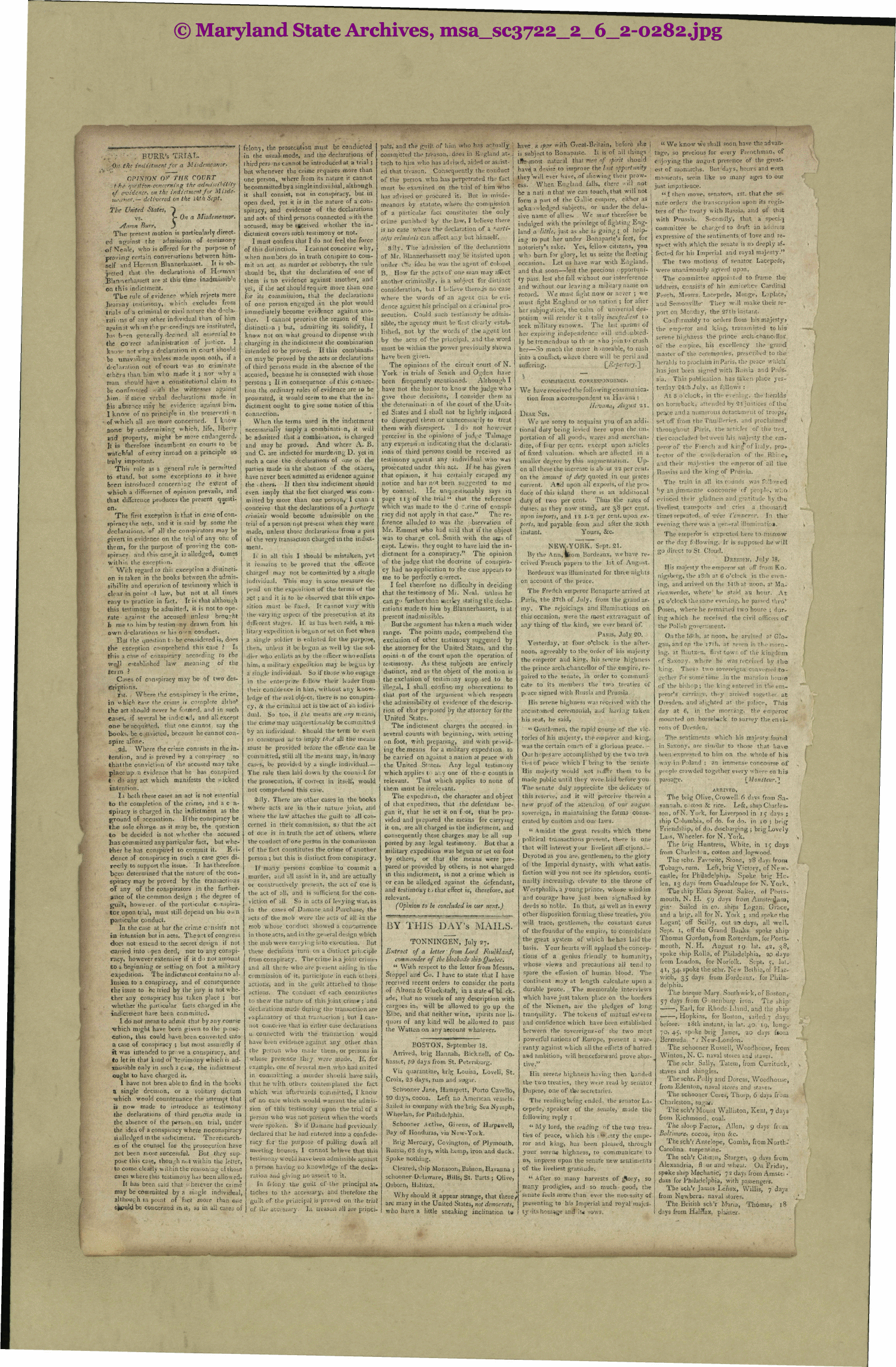
| ... . BURR's TRIAL. Or. the indictment for a Misdemeanor- OPINION Of fHB COURT .the rjuestion concerning the admissibility of evidence, on the indictment for Misde- mr./'/or,— delivered on the Hth Sept. The United States, "} vs. >• On a Misdemeanor. Aaron Burr, J The present motion is particularly direct- ed against the admission of testimony . of Nenle, who is offered for the purpose of proving certain conversations between him- self and Herman Blannerhasset. It is ob- jected that the declarations of Herman Blanoerhassett are at this time inadmissib'e on this indictment. Tbe rule of evidence which rejects mere hearsay testimony, which excludes from (rials of a criminal or civil nature the rl'da- rati >ns of any other individual than of him against whom the proceedings are instituted, has b~en generally deemed all essential to the co rect administration of justice. I know not why a declaration in court should he unavailing unless made upon oath, if a declaration oiit of court was to criminate ethers than, him who made it ; nor why a man should have a constitutional claim to be confronted • ith the witnesses against him- if mere verbal declarations made in :riis afess-ice ma'y be evidence against him. 1 know of no principle in the preservation • cf which all are more concerned. I know none by ¦undermining which, life, liberty and property, might be more endangered. It is therefore incumbent on courts to be watchful of every inroad on a principle so truly important. This rule as a general rule is permitted to stand, but some exceptions to it have been introduced concerning the extent of which a difference of opinion prevails, and that difference produces the present questi- on. The first exception is that in Case of con- spiracy the acts, and it is said by some the declarations, of all the conspirators may be fiven in evidence on the trial of any one of them, for the purpose of proving the con- spiracy and this case^it is-alledged, Comes within the exception. With regard to this exception a distincti- on is taken in the books between the admis- sibility and operation of testimony which is clear in point ot law, but not at all times easy to practice in fact. It is that although this testimony be admitted, it is not to ope- rate against the accused unless brought h me to him by testimony drawn from his own declarations or his o-'-n conduct. But the question to be considered is, does (the exception comprehend this case ? Is this a case of conspiracy according to the ¦wejl established law meaning of the Sei rn ? C.i'-es of conspiracy may be of two des- criptions. 1st. Where the conspiracy is the crime, in which ease the crime is complete altho' the act should never be formed and in such eases, if several be indicted, and all except one be acquitted, that one cannot say the books, be c mvicted, because he cannot con- spire alone. •ad. Where fhecrmve consists in the in- tention, and is proved ny a conspiracy so that the conviction of the accused may take place up n evidence that he has conspired t do any act which manifests the wicked intention. la both these cases an act is not essential to the completion of the crime, and a c n- spiracy is charged in the indictment as the ground of accusation. If the conspiracy be the sole charge as it may be, the question to be decided is not whether the accused lias committed any particular fact, but whe- ther he has conspired to commit it. Evi- dence :>f conspiracy in such a case goes di- rectly to support the issue. It has therefore heen determined that the nature of the con- spiracy may be proved by the transactions of any of the conspirators in the further- ance of the common design ; the degree of guilt, however of the particular conspira- tor, upon trial, must still depend on his o.\ n particular conduct. In the case at bar the crime consists not in intention but in acts. Theat of congress does not extend to the secret design it not carried into .pen deed, nor to any conspi- racy, however extensive if it do not amount to a beginning or setting on foot a military expedition. The indictment contains no al- lusion to a conspiracy, and of consequence the issue to be tried by the jury is not whe- ther any conspiracy has taken place ; but ¦whether the particular facts charged in the indictment have been committed. I do not mean to admit that by any course which might have been given to the prose- cution, this could have been conveited into a case of conspiracy ; but most assuredly if it was intended to pr ve a conspiracy,, and to let in that kind of testimony which is ad- missible only in such a case, the indictment ought to have charged it. I have not been able to find in the books a single decision, or a solitary dictum which would countenance the attempt that is now made to introduce as testimony the declarations of third persons made in the absence ot the person on trial, under the idea of a conspiracy where noconspiracy sialledged mthe indictment. Thcresearch- es of the counsel for the prosecution have not been more successful. But they sup- pose this case, though hot'within the letter, to come clearly within the reasoning ct those cases where this testimony has been allowed. It has been said that wherever the crime may be committed by a single individual, although in point of fact more than one sjjould, be concerned in it, as in all case,; of felony, the prosecution must be conducted in the usual, mode, and the declarations of third persons cannot be introduced at a trial ; but whenever the crime requires more than one person, where from its nature it cannot be committed by a single individual, although it shall consist, not in conspiracy, but in open deed, yet it is in the nature of a con- spiracy, and evidence of the declarations and acts of third persons connected with the accused, may be received whether the in- dictment covers such testimony or not. I must confess that I do not feel the force of this distinction. I cannot conceive why, when numbers do in truth conspire to com- mit an act as murder or robberry, the rule should be, that the declaration of one of them is no evidence against another, and yet, if the act should require more than one for its commission, that the declarations of one person engaged .in the plot would immediately become evidence against ano- ther. I cannot perceive the reason of this distinction ; but, admitting its solidity, I know not on what ground to dispense with charging in the indictment the combination intended to be proved. If this combinati- on may be proved by the acts or declarations of third persons made in the absence of the accused, because he is connected with those persons ; If in consequence of this connec- tion the ordinary rules of evidence are 10 be prostrated, it would seem to me that the in- dictment ought to give some notice of this connection. When the terms used in the indictment necessartally imply a combination, it will be admitted that a combination, is charged and may be proved. And where A. B. and C. are indicted for murdering D. yet in such a case the declarations of one of the parties made in the absence of the others, have never beeri admitted as evidence against the .thers. II then this indictment should even imply that the fact charged was com- mined by more than one person/ I ennn t conceive that the declarations of a particeps criminis would become admissible on the trial of a person not present when they were made, unless those declarations from a part of the very transaction charged in the indict- ment. Ii in all this I should be mistaken, yet it remains to be proved that the offence charged may not be committed by a single individual. This may in some measure de- pend on the exposition of the terms ot the act ; and it is to be observed that this expo- sition must be fxed. It cannot vary with tlie varying aspect of the prosecution at its different stages. It" as has been said, a mi- litary expedition is begun or set on foot when a =in^le soldier is enlisted for the purpose, then, unless it be begun as well by the sol- dier who enlists as by tbe officer w no enlists him, a military expedition may be begun by a single individual. So if those v. ho engage in the enterprise follow their It ader from their confidence in him, without any know- ledge of tbe real object, there is no conspira- cy, or the criminal act is the act of an indivi- dual. So too, if the means are any means, the crime may unquestionably be committed by an individual. Should the term be even so construed as to imply that all the means must be provided before the offence can be committed, still all the means may, in many cases, be provided by a single individual.— The rule then laid down by the conns, 1 for the prosecution, if correct in itself, would not comprehend this case. Bdly, There are other cases in the books where acts are in their nature joint, and where the law attaches the guilt to all con- cerned in their commission, s.> that the act of one is in truth the act of others, where the conduct of one person in the commission of the fact constitutes the crime of another person ; but this is distinct from conspiracy. If many persons combine to commit a murder, and all assist in it, and are actually or constructively present, the act of one is tlie act of all, and is sufficient for the con- viction of all So in acts of levying war, as in the cases of Damane and Purchase) the acts of the mob were the acts of all in the mob whose conduct showed a concurrence in those acts, and in the general design which the mob were carrying into execution. But these decisions turn on a distinct principle from conspiracy. The crime is a joint crime) and all these who are present aiding in the commission of it, participate in each otheri actions, and in the guilt attached to those actions. The conduct of each contributes to shew the nature of this joint crime ; and declarations made during the transaction are explanatory of that transaction ; but I can- not conceive that in either case declarations unconnected with the transaction would have been evidence against any other than the person who made them, or persons in whose presence they were made. If, for example, one of several men who had united in committing a murder should have said, that he with others contemplated tlie fact which was afterwards committed, I know of no case which would warrant the admis- sion of this testimony upon the trial of a person who was not present when the words were spoken. So if Damane had previously declared that he had entered into a confede- racy for the purpose of pulling down a!! meeting houses, I cannot believe that this testimony would have been admissible against a person having no knowledge of the decla- ration and giving no assent to it. In felony the guilt cf the principal at. taches to the accessary, and therefoie the guilt of the principal is proved on the trial of the accessary. In treason all are princi- pals, and the guilt of him who has actually ' have a spar with Great-Britain, before she i committed the treason, does in E igland at- I is subject to Bonaoarte. It is of all things tach to him who has advistd, aided or assist- ! tlte .most natural that rtleft of spirit should ed that treason. Consequently the conduct '. havda .desire to improve the last opportunity of the person who. has perpetrated the fact must be examined on the trial of him who has advised or procured it. But in misde- meanors by statute, where the commission of a particular fact constitutes the only crime punished by the law, I believe there is no case where the declaration of a fiarti- cefis criminis can affect any but himself. 3;l!y. The admission of the declarations of Mr. Blannerhassett may be insisted upon under tSte idea he was the agent of colonel B, How far the acts of one man may affect another criminally, is a subject for distinct consideration, but I believe there, js no case where the words of an agent can be evi- dence agair.st his principal on a criminal pro- secution. Could such testimony be admis- sible, the agency must be first clearly estab- lished, not by the words of tlie agent but by the acts of the principal, and the word must be within the power previously shown have been given. The opinions of the circuit court of N. York in trials of Smith and Ogden have been frequently mentioned. Although I have not the honor to know the judge who gave those decisions, I consider them as the detewninati n of the court of the Unit- ed States and 1 shall not be lightly induced to disregard them or unnecessarily to treat them with disrespect. I do not however perceive in the opinions of judge Talmage any expresai in indicating that the declarat- ions of third persons could be received as testimony against any individual who was prosecuted under this act. If he has given that opinion, it has certainly escaped my notice and has not been suggested to me by counsel. He unquestionably says in page 113 of the trial " that the reference which was made to the d :.rine of conspi- racy did not apply in that case." The re- ference alluded to was the observation of Mr. Emmet who had said that if the object was to charge col. Smith with the aeJs of capt. Lewis, thcyoujjht to have laid the in- dictment for a conspiracy." The opinion of the judge that the doctrine of conspira- cy had no application to the case appears to me to be perfectly correct. I feel therefore no difficulty in deciding that the testimony of Mr. Neal, unless he can go further than merley stating the decla- rations made to him by Blannerhassett, is at present inadmissible. But the argument has taken a much wider range. The points made, comprehend the exclusion of other testimony suggested by the attorney for the United States, and the ooini n of the court upon the operation of testimony. As these subjects are entirely distinct, and as the object of the motion is the exclusion of testimony supp sed to be illegal, I shall confine, my observations to that part of the argument which respects the admissibility ot evidence of the descrip- tion of that proposed by the attorney for the United States. The indictment charges the accused in several counts with beginning, with setting on foot, with preparing, and with provid- ing the means for a military expedition to be carried on against a nation at peace with the United States. Any legal testimony which applies to airy one of the e counts is relevant. Tnat which applies to none of them must be irrelevant. The expedition, the character and object of that expedition, that the defendant be- gan it, that he set it on f ot, that he pro- vided and prepared the means for carrying it on, are all charged in tbe indictment, and consequently these charges may be all sup ported by any legal testimony. But that a military expedition was begun or set on foot by others, or that the means were pre- pared or provided by others, is not eharged in this indictment, is not a crime which is or can be alled^ed against the defendant, and testimony t,1 that effect is, therefoie, not relevant. (Opinion to bt concluded in our next.) BY THIS DAY's MAILS. TONNINGEN, July 27. Extract of a letter ' from Lord Faulhland, commander of the blockade ship Quebec. " With respect to the letter from Messrs. Stopped and Co. I have to state that I have received recent orders to consider the ports of Altona & Glucksladt, in a state ef bl ck- ade, that no vessels of any description with cargoes in, will be allowed to go up the Elbe, and that neither wine, spirits nor li- quors of any kind will be allowed to pass the Watten on any account whatever. BOSTON, September 18. Arrived, brig Hannah, Bicknell, of Co- hasset, Ł9 days from St. Petersburg. Via quarantine, brig Louisa, Loveli, St. Croix, 25 clays, rum and sugar. Schooner Jarre, Hamiyett, Porto Cavello, 30 days, cocoa. Left no American vessels. Sailed in company with the brig Sea Nymph, Wheelan, for Philadelphia. Schooner Active, Givens, of Harpiwell, Bay of Honduras, via New-York. Brig Mercury, Covington, of Plymouth, Bussia, 63 days, with hemp, iron and duck. Spoke nothing. Cleared,ship Monsoon, Babson, Havanna ; schooner Delaware, Hills; St. Barts ; Olive, Osborn, Halifax. Why should it appear strange, that there/ arc many in the United States, not democrats, who have a little sneaking inclination ta they will ever have, .of shewing their prow- ess." When England falls, there -ill not be a nati n that we can touch, that will not ¦ form a part of the Gallic empire, cither as 1 ackno fledged subjects, or under the delu-j sive name of allies. . We must therefore be indulged with the privilege of fighting Eng- land a little, jiibt as she is going ; of help- ing to put her under Bonaparte's feet, for notoriety's sake. Yes, fellow citizens, you wh > burn for glory, let us seize the fleeting occasion. Let us have war with England, and that soon—lest the precious opportuni- ty pass, lest she fall without our interference and without our leaving a military name on record. We must light now or never ; we must fight England or no nation ; for after her subjugation, the calm of universal des- potism will render it t tally inexpedient to seek military renown. The last spasms of her expiring independence will undoubted- ly be tremendous to th se vho join to crush her—So much the more h inorable, to rush into a conflict, where there will be peril and suffering. [Repertory.'] COMMERCIAL CORRESPONDENCE. We have received the following communica- tion from a correspondent in Havana : Havana, August 21. Dear Sir, We are sorry to acquaint you of an addi- tional duty being levied here upon the im- portation of all goods, wares and merchan- dize, of frur per cent, except upon articles of fixed valuation, which are affected in a smaller degree by this augmentation. Up- on all these the increase is ab ut 22 per cent, on the amount of duty quoted in our prices current. Afkl upon all exports, of the pro- duce of this island there is an additional duty of two per cent. Thus the rales of duties, as they now- stand, are 38 per cent. upon imports, and 12 1-3 per cent, upon ex- ports, and payable from and after the 20th instant. Yours, &c. NEW-YORK, Sept. 21. By the Ann,p-om Bordeaux, wehave re- ceived French papers to the 1st of August. Bordeaux was illuminated for three nights on account of the peace. The Frettch emperor Bonaparte arrived at Paris, the 27th of July, from the grand ar- my. The rejoicings and illuminations on this occasion, were the most extravagant of any thing of the kind, we ever heard of. Paris, July 20. Yesterday, at four o'clock in the after- noon, agreeably to the order of his majesty the emperor and king, his serene highness the prince arch-chancellor of the empire, re- pairer) to the senate, in order to comiriuui cate to its members the two treaties of peace signed with Russia and Prussia His serene highness was received with the accustomed ceremonial, and having taken his seat, he said, " Gentlemen, the rapid course of the vic- tories of his majesty, the emperor and king, was the certain omen of a glorious peace. - Ourhepesare accomplished by the two trea ties of peace which I'bring to tbe senate His majesty would not suffer them to be made public until they were laid before you. Tlie senate duly appreciate the delicacy ot this reserve, and it will perceive therein a new proof of the attention of our august sovereign, in maintaining tbe forms conse- crated by custom and our laws. " 4midst the great results which these political transactions present, there is one that will interest your liveliest affections. - Devoted as you are, gentlemen, to the glory of the Imperial dynasty, with what satis- faction will you not see its splendor, conti- nually increasing, elevate to the throne of Westphalia, a young prince, whose wisdom and courage have just been signalised by deeds so noble. In that, as well as in every other disposition forming these treaties, you will trace, gentlemen, the constant cares of the founder of the empire, to consolidate the great system of which he has laid the basis. Your hearts will applaud the concep- tions of a genius friendly to humanity, whose views and precautions all tend to spare the effusion of human blood. The continent may at length calculate upon a durable peace. The memorable interviews which have just taken place on the borders of the Niemen, are the pledges of long tranquility. The tokens of mutual esteem and confidence which have been established between the sovereigns ¦• of the two most powerful nations of Europe, present a war- ranty against which all the efforts of hatred asd ambition, will henceforward prove abor- tive." His serene highness having then banded the two treaties, they were read by senator Dupere, one of the secretaries. The reading being ended, the senator La- cepede, speaker of the senate, made the following reply : " My lord, the reading of the two trea- ties of peace, which bis i Pjesty the empe- ror and king, has been pleased, through your serene highness, to communicate to us, impress upon the senate new sentiments of the liveliest gratitude. " After so many harvests of gtory, so many prodigies, and so much good, the senate feels more than ever the necessity of presenting to his Imperial and royal'majes- ty'its homage and it* vows. " We know we shall soon have the advan- tage, so precious for every Frenchman, of enjoying the august presence of the great- est of tnonurchs. But days, hours and even moments, seem like so many ages to our just impatience. " I then move, senators, 1st. that the se- nate orders the transcription upon its regis- ters of the treaty with Russia, and of that with Prussia. Secondly, that a speci.'i committee be charged to draft an address expressive of the sentiments, of love and re- spect with which the senate is so deeply af- fected for his Imperial and royal majesty." The two motions of senator Lacepede, were unanimously agreed upon. The committee appointed to frame the address, consists of his eminence Cardinal Fesch, Messrs. Lacepede, Monge, Laplace,' and Semonville- They wdl make their re- port on Monday, the 27tb instant. Conf :rmably to orders from his majesty, the emperor and king, transmitted to his serene highness the prince arch-chancellor, of tbe empire, his excellency the grand master of tlie ceremonies, prescribed to the heralds to proclaim in Paris, the peace which has just been signed with Re.ssia and Rus- sia. This publication has taken place yes- terday 24th July, as follows : At 5 o'clock, in the evening, the heralds on horseback, attended by 21 justices of tlie pea/;e and a numerous detachment of troops, set off from the'Tfuiilleries, and proclaimfcd: throughout Paris, tlie articles of the trea. ties concluded between Iris majesty the em- peror of the French and king of Italy, pro- tector of the confederation of the Rhine, and their majesties tbe emperor of ail the Russias and the king of Pnfssia. The train in all its rounds was followed by an'.immense concourse of people, who evinced their gladness and gratitude by the liveliest transports and cries a thousand times repeated- of-vt'w Vemneror. In the evening there was a general illnminatio*. The emperor is expected here to morrow or the day following. It is supposed he will go direct to St Cloud. Dresden, July 18. His majesty tbe emperor sat iff from Ko- nigsberg, the i3th at 6 o'clock in the even- ing, and arrived on the 14th at noon, at Ma- rienwerder, where he staid au hour. At 12 o'clock the same evening, he passed thro' Posen, where he remained two'home ; dur- ing which he received the civil officers of the Polish government. OnthelC'h, at noon, he arrived at G!o- gau, and on 'be i7th, at seven in the morn- ing, at Bautzen, first tow: of the kingdom of Saxony, where he was received by the king;. Tiles- two sovereigns conversed to- gether for some time in the mansion house of the bishop; the king entered in the sm- peror's carriage, th' y arrived together at Dresden, and alighted at the palace, This day at R, in the morning, the emperor mounted on horseback to survey the envi- rons of Dresden. The sentiments which his maiesiy found in Saxony, are similar to those that have heen expressed to him on the whole of his way in Poland ; an immense concourse of people crowded together every where on his passage, • [Moniteur.l ARRIVED, The brig Olive, Crowell 6 days from .Sa- vannah, cotton & rice. Left, ship Charles- ton, ofN. York, for Liverpool in 15 days ; ship C dumbia, of do. fordo, in iO ; brig Friendship, of do. discharging ; brig Lovely Lass, Wheeler, for N. York. The btig Huntress, White, in l<; days from Charleston, cotton and logwood. The schr. Favorite, Stone, 28 days from Tobago, rum. Left, brig Victory, of New- castle, for Philadelphia. Spoke brig He- len, 13 days from Guadaloupe for N. York.. Tbe ship Eliza Sproat Salter, ot Ports- month, N. II. 59 days from Amsterdam, gin- Sailed in co. ships Logan, Grace, and a brig, all for N. York ; and spoke tire Logan', off Scilly, out 20 days, all we 11. Sept. I, off the Grand Banks, spoke ship Thomas Gordon, fiom Rotterdam, for Ports- mouth, N. H. August 19 lit, 42, 38, spoke ship Rolla, of Philadelphia, 20 days from London, for Norfolk. Sept. 5, lat. 41, 34, spoke the schr. New Belhin.of Har- wich, 35 days from Bordeaux, for Phila- delphia. The barque Mary South wirk, of Boston, 57 days from G ttenburg iron. The ship -------, Earl, for Rhode-Island, and the ship .-------, Hopkins, for Boston, sailed 7 days before. 18th instant, in lat. 40.19, long.' 70, 45, spoke brig James, 20 days fsoia Bermuda * r New-London. The schooner Russell, Woodhouse, from Winton, N. C. naval stores and slaves. The schr Sally, Tatem, from Currituck, Staves and shingles. The schr. Polly and Dorcas, Woodhouse, from Edenton, naval stores and staves. The schooner Ceres, Thorp, 6 days from. Charleston, Sugar. The sch'r Mount Walliston, Kent, 7 days from Richmond, coal. The sloop Factor, Allen, 9 days from Baltimore, cocoa, iron &c. The sch'r Antelope, Combs, fiorn North- Carolina turpentine. The sch'r Citin;n, Sturges, 9 davs from Alexandria, fl ur and wheat. On Frida), spake ship Mechanic, 72 days from Amstei • darn for Philadelphia, with passengers. The sch'r James Lenox, Willis, 7 days. from Newberu, naval stores. The British sch'r Maria, Thomas, 18 driys from Halifax, plaieter- ;..»wi ,-.,T. „¦_________, ¦ ...-¦¦¦-.win |