 |
|
|
 |
|
 |
|
|||
|
||||
|
||||
|
Federal Gazette & Baltimore Daily Advertiser 1807/07-1807/12 msa_sc3722_2_6_2-0618 Enlarge and print image (5M) |
|
|
|
|
|
|
|
|||
|
||||
|
||||
|
Federal Gazette & Baltimore Daily Advertiser 1807/07-1807/12 msa_sc3722_2_6_2-0618 Enlarge and print image (5M) |
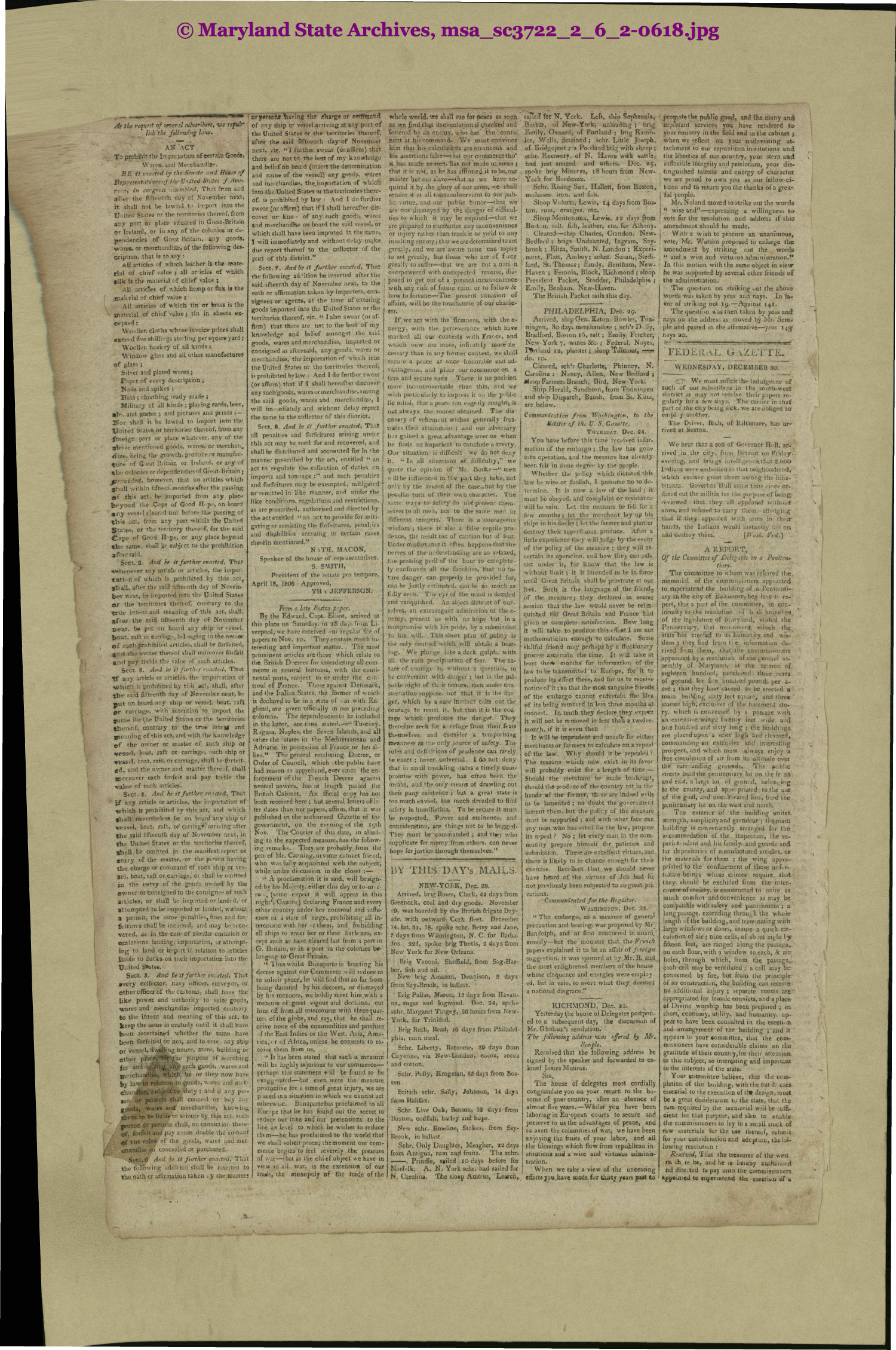
| \ / At the refi'st of several subscribers, tne repib' : lisb the following low. AN ACT To prohibit the Importation of certain Goods, Wares, and Merchandize. BE it enacted by the Senate and House nf Representatives-< of any such goods, wares and merchandise on board the said vessel, or which shall hava been imported in the same, I will immediately and without delay ma.ke due report thereof to the collector of the port of this district." Sect. 1. And be it further enacted, That the following ad ition be inserted after the said lifteenth day of November next, to the oath or affirmation taken by importers, con- signees or agents, at the time of entering goods imported into the United States or the territories thereof, viz. " I also swear (or af- firm) that there are net to the best of my knowledge and belief amongst the said goods, wares and merchandise, imported or consigned as aforesaid, any goods, wares or merchandise, the importation of which into the United States or the territories thereof, is prohibited bylaw : And I do further swear (or affirm) that if I shall hereafter discover any such'goods, wares or merchandise, among the said goods, wares and merchandize, I will immediately and without delay report the same to the collector of this district. Sect. 8. And be it further enacted, That all penalties and forfeitures arising under this act may be sued for and recovered, and shall be distributed and accounted for in *he manner prescribed by the act, entitled " an act to regulate the collection of duties on imports and tonnage :" and such penalties and forfeitures may be exempted, mitigated or remitted in like manner, and under the like conditions, regulations and restrictions, as are prescribed, authorised and directed by the act entitled "an act to provide for miti- gating or remitting the forfeitures, penalties and disabilities accruing in certain cases therein mentioned." N\TH. MACON, Speaker of the house of representatives. , S. SMITH, President of the senate pro tempore. April 18, 1806 Approved, TH : JEFFERSON. From a late Boston p ^pcr. By the Edward, Capt. Eliiot, arrived at this place on Saturday, in 28 days from Li- verpool, we have received ur regular file of papers to Nov. 10. They contain much in- teresting and important matter. The most prominent articles are those which relate to the British D crees for interdicting all com merce in neutral bottoms, with the conti- nental ports, subject to or under the o>n- troul of France. Those against Denmark, and the Italian Slates, fhe former of wnich is declared to be in a mate of v ar with En gland, are given officially in our pieceduijj columns. The dependencies to be included in the latter, are thus stated.—"Tuscany. Ragusa. Naples, the Seven Islands, and all other the states in the Mediterranean and Adriatic, in possession ot France or her al- lies." The general retaliating Decree, or Order of Council, which the public have had reason to apprehend, ever since the en- forcement of the French Decree against neutral powers, has at length passed the British Cabinet. An fficial copy has not been received here ; but several letters of la ter dates than our papers, affirm, that it was published in the authorised Gazette of the government, on the evening of the iijth Nov. The Courier of this date, in allud- ing to the expected measure, has the follow- ing remaiks. They are probably horn the pen of Mr. Carning, orsome cabinet friend, who was fully acquainted with the subject, while under discussion in the closet :— '' A proclamation it is said, will Design- ed by his Majesty, either this day or to-m r- r® , (some expect it will appear in this night'.s Gazette) declaring France and every other country under her controul and influ- ence in a stale of siege, prohibiting all in- tercourse with her < r them, and forbidding all ships to enter her or their harh urs, ex- cept tuch as have cleared last from a port 111 G. Britain, or in a port in the colonies be- longing to Great Britain. " Thus whilst Bonaparte is boasting his decree against our Commerce »ill teduce us to solicit peace, he will find that so far from being daunted by his decrees, or dismayed by his menaces, we boldly meet him with a measure of great vigour and decision, cut him off from all intercourse with threequar- ters of the globe, and say, that he shall re- ceive none of the commodities and produce •f the East-Indies or the West, Asia, Ame- rica, 1 r of Africa, unless he consents to re- ceive them from us. " It has been stated that such a measure will be highly injurious to our commerce— perhaps this statement will be found to be exaggerated—but even were the measure productive lor a time of great injury, we are p ated ma situation in which we cannot act otherwise. Bonapartehas proclaimed to all Europe that he has found out the secret to reduce our tone and our pretensions to the line an level to which he wishes to reduce thtm—he has proclaimed to the world that we shall solicit peace, themoment our com- merce begins to feel severely the pressure of war—that as the chief object we have in view in all war, is the extension of our trails, the monopoly of the trade of the whole world, we snail sne for peace as «oort as we find that its circulation if checked and fettered by ah enemy, who has' the conti- nent at his command. We must convince him that his calculations are erroneous and his assertions false—that our commerce tho* it has made us rich, has not made us mean ; that it is not, as he has affirmed it to be, our master but our s'.ave—that as we have ac- quired it by the glory of our arms, »e shall render it at all times subservient to our pub- lic virtue, and our public honor—that we are- not dismayed by the danger of difficul- ties to which it may be exposed—that we are prepared to encounter any inconvenience or injury rather than truckle or yield to any insulting enemy; that we are determined to act greatly, and we are aware none can aspire to act greatly, but those who are of f-ice greatly to suffer—that we are not a nati n overpowered with unexpected reverse, dis- posed to get out of a present inconvenience with any risk of futuie rain, or to follow & bow to fortune—The present situation of affairs, will be the touchstone of our charac- ter. If we act with the firmness, with the e- nergy, with the perseverance which have marked all our contests with France, and which now are more, infinitely more ne Cessary than in any former contest, we shall secure a peace at once honorable and ad- vantageous, and place our commerce on a firm and secure Oasis There is no position more incontrovertible than this, and we wish particularly to impress it on the public lie mind, that a peace too eagerly sought, is not always tin- sooner obtained. The dis covery of vehement wn>hes generally frus- trates their attainment ; and our adversary tias gained a great advantage over us when he finds us impatient to conclude a treaty. Our situation, is difficult - we do not deny it, " In all situations ef difficulty," we quote the opinion of Mr. Burke—" men v, ill be influenced in the part they take, net only by the reason of the case,, but by the peculiar turn of their own character. Ttie same ways to safety do not present them- selves to all men, nor to the same men in different tempers. There is a courageous wisdom ; there is also a false reptile pru deuce, the result n*t of caution but of fear. Under misfortunes it often happens that the nerves of the understanding are so relaxed, the pressing peril of the hour so complete- ly confounds all the faculties, that no fu- ture danger can properly be provided for, can be justly estimated, can be so mrich as fully seen, T fe eye of the mir.d is dazzled and vanquished. An abject distrust of our. selves, an extravagant admiration ol the e- nemy, present us with no hope but in a compromise with his pride, by a submission to his will. This short pl.,n of policy is the only counsel which will obtain a hear- ing. We plunge into a dark gulph, with all the rash precipitation of fear. The na- ture of courage is, without a question, to be conversant with danger ; but in the pal- pable night of th ir teirors, men under Con sternation suppose, not that it is the dan gtr, which by a sure instinct Calls out the courage to resist it, but that it is the pod rage which produces the danger. They therefore seek for a refuge from their fears themselves, and consider a temporising meanness as the only source of safety. The rules and definitions of prudence can rarely tie exact ; never universal. I do not deny that in small truckling ,tates a timely com- promise with power, has often been the means, aud the only means ot drawling out their puny existence ; but a great state is 'oo much envied, too much dreaded to find safety in humiliation. To be secure it must be respected. Power and eminence, and consideration, are things not to be begged- They must be commanded ; and thry who supplicate for mercy from others, can never hope for justice through themselves." BY THIS DAY'S MAILS. NEW-YORK, Dec. 28. Arrived, brig Rover, Clark, 44 days from Greenock, coal and dry goods. November •9, was boarded by the British frigate Dry- ade, with outward Cork fleet. December 14, lat. 81, 18, spoke schr. Betsy and Jane, 7 days from Wilmington, N. C. for Barba- dos. 22d, spoke brig Thetis, 2 days from New York for New Orleans. Brig Venoni, Sheffield,, from Sag-Har- bor, fish and oil. New brig Amazon, Dennison, 2 days from Say-Brook, in ballast. ' Brig Pallas, Mason, 15 days from Havan- na, sugar and logwood. Dec. 24, spoke schr. Margaret Tingey, 26 hours from New- York, for Trinidad. Brig Ruth, Read, tO days from Philadel- phia, corn meal. Schr. Liberty, Ransome, 3S> days from Cayenne, via New-London, eocoa, rocoa and cotton. Schr. Polly, Krogman, 85 days from Bos- ton British schr. Sally, Johnson, 14 days ftom Halifax. Schr. Live Oak, Benson, 13 days from Boston, codfish, barley and hops. New schr. Emeline, Stokes, from Say- Brook, in ballast. Schr. Only Daughter, Meagher, 22 days from Antigua, rum and fruits. The schr. -------, Prindle, sailed 10 days before for Norfolk. A, N. York schr. had sailed for N. Carolina. The sleep Amtius, Learch, : saT!e3 for N. York. Left, ship Sophron'a, B.irbar, of New-York, unloading ; brig Enlily, Oxnardj of Portland ; brig Ramb- ler, Wells, detaitied ; schr. Little Joseph, of Bridgeport ; a Portland brig with, sheep; schr. Recovery, of N, Haven with eattle, had just arrived and others. Dec. 25, spoke brig Minerva, 18 hours from New- York for Bordeaux. Schr. Rising Sun, Hallett, from Boston, molasses, iron, and fish. Sloop Volutia, Lewis, 14 days from Bos- ton, rum, oranges, etc. Sloop Montezuma, Lewi«, 12 days from Bost n, salt, fish, leather, etc. for Albany. Cleared—ship Charles, Crandon, New- Bedford ; brigs Undaunted, Ingram, Say- brook ; Eliza, Smith, N. London ; Experi- ment, Flatt, Amboy; schrs. Susan,,Stedi- ford, St.Thomas; Emily, Bentham, New- Haven ; Feronia, Block, Richmond ; sloop President Packet, Stodder, Philadelphia ; Emily, Benham, New-Haven. The British Packet sails this day. PHILADELPHIA, Dec. 29. Arrived, ship Gen. Eaton, Bowles, Ton- ningen, 80 days merchandise ; sch'r D lly, Eradford, Bosion 16, salt ; Emily, Fetcher, New-York 7, wines &c.; Federal, Noyes, Portland 12, plaister; sloop Ta'lmout, —ft do. 10. Cleared, sch'r Charlotte, Phinney, N. Carolina : Nancy, Allen, New Bedford ; •loop Farmers Branch, Bird, New York. Ship Herald, Sandborn, from Tohningen and ship Dispatch, Baush, from St. Kitts, are below. Communication from Washington, to the Editor of the V S. Gazette. Thursday, Dec. 24. You have before this time received infor. mation of the embargo ; the law has gone into operation, and the measure has already been felt in some degree by the people. Whether the policy which dictated this law be wise or foolish, I presume no to de- termine. It is now a law of the land ; it must be obeyed, and complaint or resistance will be vain. Let the measure be felt for a few months; let the merchant lay up his ships in his docks : let the farmer and planter destroy their Superfluous produce. After a little experience they will judge by the event of the policy of the measure ; they will as certain its operation, and how they can sub- sist under it, for know that the law is without limit ; it is intended to be in.force until Great Britain shall be prostrate at our feet. Such is the language of the friends of the mesisure; they declared in secret session that the law would never be relin- quished tilt Great Britain and France had given us complete satisfaction. How long it will takis to produce this effiet I am not mathematician enough to calculate. Some skilful friend may perhaps by a fluctionary process ascertain the time. It will take at least thr«% months' for information of the law to be transmitted to Europe, for it to produce its effect there, and for us to receive notice of it; so that the most sanguine friends of the embargo cannot entertain the idea of its being removed in less three months at soonest. In truth they declare they exp.Kt it will not be removed in less than a twelve- month, if it is even then It will be imprudent and unsafe for either merchants or farmers to calculate on a repea1 of the law. Why should it be repealed ? The reasons which now exist in its favor will probably exist for a length of time.— Should the merchant be made bankrupt, should the produce of the country rot in the hands of the farmer, th. se are indeed evils to be lamented ; no doubt the government lament them, but the policy of the measure must be supported ; and with what face can any man who has voted for the law, propose its repeal ? No ; let every man in the com- munity prepare himself for patience and submission. These are excellent virtues, and there is likely to be chance enough for their exercise. Recollect that we should never have heard of the virtues of Job had ht not previously been subjected to so great pri- vations. .' Communicated for the Register. Washington, Dec. 24. " The embargo, as a measure of genera' precaution and bearing, was proposed by Mr Randolph, and at first concurred in unani. Hiously—but the moment that the French papers explained it to be an affair of foreign suggestion, it was spurned at by Mr. R. and the most enlightened members of the house whose eloquence and energies were employ- ed, but in vain, to avert what they deemed a national disgrace." 1 promote I he public good, and the raany ani Ciportant services you have rendered to your country in the field and in the cabinet ; when we reflect on yaur undeviating at- tachment to our republican institutions and the liberties of our country, your stern aad inflexible integrity and patriotism, your dis- , tinguished talents and energy of character j we are proud to own you as our fellow-ci- tizen and to return you the thanks of a grea- j ful people. Mr. Noland moved to strike out the words j " wise and"—expressing a willingness to j vote for the resolution and address if this amendment should be made. With a wish to procure an unanimous, ; vote, Mr; Watson proposed to enlarge the ; amendment by striking out the words 1 " and a wise and virtuous administration." ¦ In this motion with the same object invievr he was supported by several other friends of the administration. The question on striking out the above words wab taken by yeas and nays. In fa- vor of striking out 19.—Against 141. The question was then taken by yeas and nays on the address as moved by Mr. Sera* pie and passed in the aliirmalive—yeas 143? nays 30. 'FEDERAL G vZETTE. RICFIMOND, Dec. 22. Yesterday ^he house ol Delegates postpon- ed to a subsequent day, the discussion of Mr. Gholson'b resolution. The following address >was offered by Mr. Semple. Resolved that the following address be signed by the speaker and forwarded to co- lonel James Munroe. Sir, The house of delegates most cordially congratulate you on your return to the bo- some of your country, after an absence of almost five years.—Whilst you have been laboring in Eiropean courts to secure and preserve to us the advantages of peace, and to avert the calamities of war, we have been enjoying the fruits of your labor, and all the blessings which flow from republican in stitulions and a wise and viitueus adminis- tration. When we take a view of the unceasing efforts you have made for thirty years past to WEDNESDAY, DECEMBER 30. ¦ We must solicit the indulgence of such of our subscribers jn the sonlh-w'est district as may not leceive their p.tpeis re- gularly for a tew days. The carrier in that' part of' the city being sick, we are obliged to' empl, y another. The Driver, Rich, of Baltimore, has ar- rived at Boston. We hear that a son of Governor Hull, ar- rived in the city, from [Jetrojt on Friday- evening, and brings intelligence! that 3 OOO Indians- were embodied in that neighborhood, which excites great alarm among the inha- bitants. Govert-.Or Hull some time since or-. dered out the militia for the purpose of being reviewed that they all appeared without arms, and refused to carry them ¦ all"o'ging that if they appeared with arms in hands, the Indians would instantly fall on and destroy them. [Wash. Fed.] A REPORT, Of the Committee of Delegates on a Peniteiu t'lo.ry. The committee to whom was referred the. memoiial of the commissioners appointed to superintend the building of a Penitenti- ary in the city of Baltimore, beg leve to re- port, that a part of ihe committee, in con- formity to the resolution of both branches, of the legislature of fciaryland, visited the Penitentiary, that monument which the state has eree'ed to its humanity and wis- dom ; they find from t' e information de- rived from them, that the commissioners .appointed by a resolution of the general as- sembly of Maryland, at the scsion of. eighteen bundled, purchased three acres of ground (01 five buo*ti«d pounds per a- cre ; that they have caused to be erected a main budding sixty feet square., and three ' srottes high,exclusive of the basement sto- ry, which is connected by a passage with an extensive wing, t'Aemy feet wide ai d one hund.ed and sixty long ; the buildinas are placed upon a scite high ai-.d elevated, commanding an extensive and interesting prospect, and which must always enjoy a free circulation of air from its altitude over the surr -unding grounds. The public streets bind the penitentiary lot on the fr nt anal ea..t, a large lot tit ground, belonging to the county, and apprr priated to the use of the goal, and uncultivated lots, bind the penitentiary to: on the west and north. The exterior of the building unites strength, simplicity and grsndeur ; tee, mam building is conveniently arranged for the accommodation of the inspectors, the su- periiittndant and his family, and guards and for depositories of manufactured aiticles, or the materials fur them ; the wing appro- priated to the confinement of those unfor- tunate beings whose crimes requite that they should be excluded from the inter- course of society, is constructed to unite as much comfort and convenience as may be. compatible with safety and punishment"; a long passage, extending through the whole length of the building, and terminating with large windows or doors, insure a quick cir- culation of air ; nine cells, of ab ,ut eight I.jb fifteen feet, are ranged along the passaga, on each floor, with a window to each, & air holes, through which, from the passage each cell may be ventilated ; a cell may be consumed by fire, but from the principle of its construction, the building can receive no additional injury ; separate rooms are.: appropriated for temale convicts, and a place of Divine worship has been prepared ; in. short, economy, utility, and humanity, ap- pear to have been consulted in the erecti.>l\ and arrangement of the building ; and it appears to your •btntnittee, that the com- missioners have considerable claims on the gratitude of their countiy,for their attention to this subject, so interesting and itnpoitant to the interests of the state. Your committee believe, that the com- pletion of this building, with the out-h uses essential to the execution of th* design, must be a great desideratum to the state, that the sum required by the memorial will be suffi- cient for tiiat purpose, and also to enable , the commissioners to lay in a small stock of raw materials for the use thereof, submit for your consideration and adoption, thelol- lowing resolution : Resolved, That the treasurer of the west rn sh re be, and he is bereby authored nd directed to pay unto the commissioners »ppohv.ed to tuperintend the ciectiuii ot* a |