 |
|
|
 |
|
 |
|
|||
|
||||
|
||||
|
Maryland State Archives Maryland Colonization Journal Collection MSA SC 4303 msa_sc4303_scm11070-0009 Enlarge and print image (4M) |
|
|
|
|
|
|
|
|||
|
||||
|
||||
|
Maryland State Archives Maryland Colonization Journal Collection MSA SC 4303 msa_sc4303_scm11070-0009 Enlarge and print image (4M) |
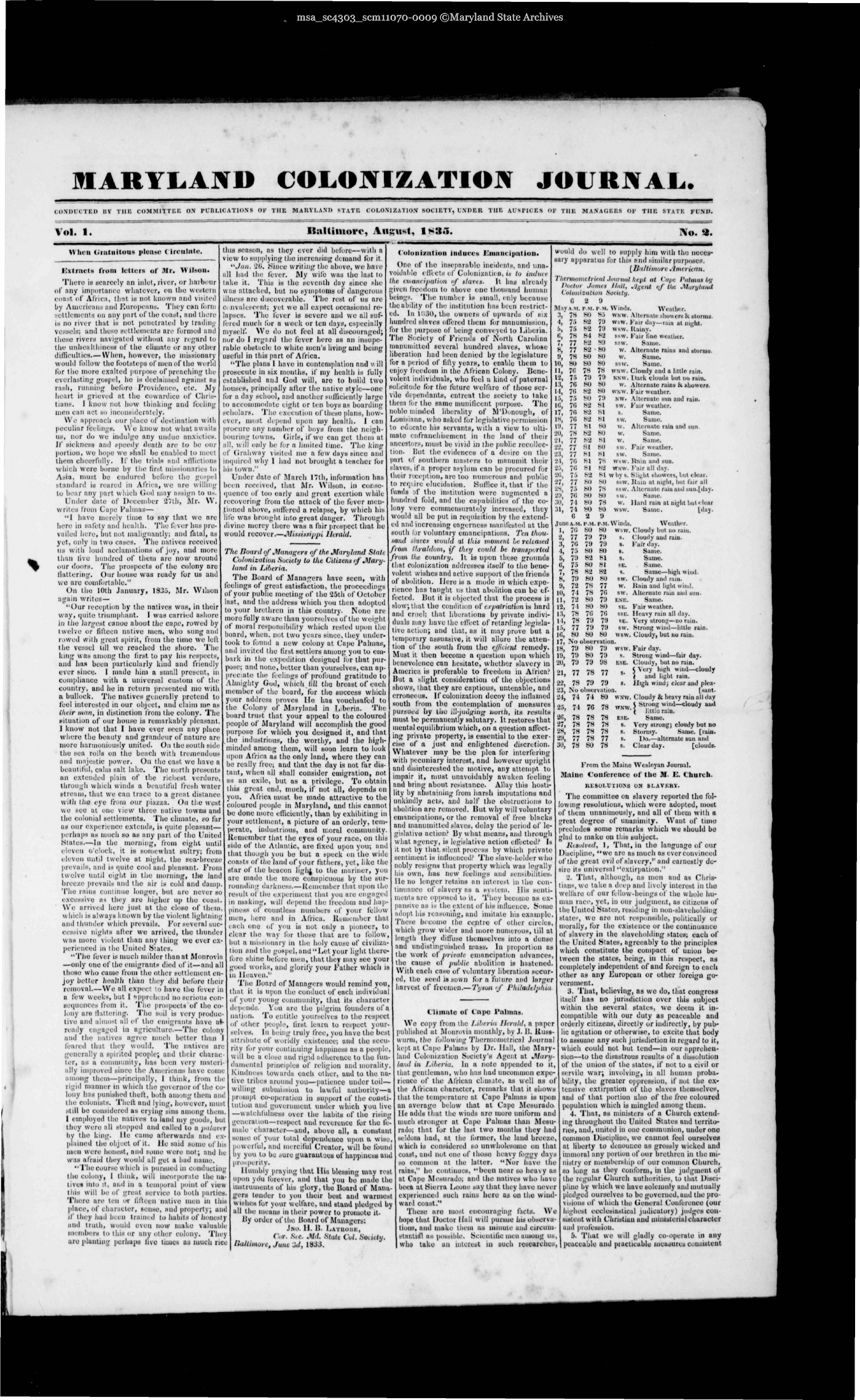
| MARYLAND COLONIZATION JOURNAL. CONDUCTED MY THE COMMITTEE ON PCDI.ICATIONS Of THE MARYLAND STATE COLONISATION SOCIETY, UNDER THE AUSPICES 01 THE MANAGERS OF THE STATE FUND. Vol. 1. Baltimore, August, 1835 No. 3. W hen Ciiitnitous please ( hi'Hlate. ¦extracts from letters of Mr. Wilson. There is scarcely an inlet, river, or harbour of any importance whatever, I'll tlm western coast of Africa, that is not known and visited liy Americans and European*, They can form settlements on any part of the coast, mid there is no river that is not penetrated by trading vessel*; and then settlement* are formed and these rivers navigated without any regard to the unhcalthiness of the climate or any other difficulties___When, however, the missionary would follow the footsteps of men of tbo world for the more exalted purpose of preaching the everlasting gospel, he is declaimed against as rash, running before Providence, etc. My heart is grieved at the cowardice of Chris- tians. I know not how thinking and feeling men can net so ineousidefately. We approach our place of destination with peculiar feelings. We know not what awaits us, nor do we indulge any undue anxieties. If sickness and speedy death are to be our portion, we hope we shall be enabled to meet them cheerfully. If the trials and affliction* which were home hy the first missionaries to Asia, must be endured before the gospel standard is reared in Africa, we are willing to hear any part which God may assign to us. Under date of December 27th, Mr. \V. writes from Cape Palmaa— "1 have merely time to say that we are hero in safety and health. The fever has pre- vailed here, but not malignantly; and fatal, as yet, only in two cases. The natives received us with loud acclamations of joy, and more than live hundred of them are now around our doors. The prospects of the colony are Haltering. Our house was ready for us mid wi are comfortable." On the 10th January, 18J5, Mr. Wilson again writes — "Our reception by the natives was, in their way, quite triumphant. I was carried ashore in the largest canoe about the cape, rowed by twelve or fifteen native men, who sung and rowed with great spirit, from the time we left the vessel till we reached the shore. The king was among the first to pay his respects, and has been particularly kind and friendly ever since. I made him a small present, in compliance with a universal custom of the country, and he in return presented me with a bullock. The natives generally pretend to feel interested in our object, and claim me as their man, in distinction from the colony. The situation of our house is remarkably pleasant. ] know not that I have ever seen any place where the beauty and grandeur of nature are more harmoniously united. On the south side the sea rolls on the bench with tremendous and majestic power. On the east we have a beautiful, calm salt lake. The north presents an extended plain of the richest verdure, through which winds a beautiful fresh water Stream, that we can trace to a great distance with (he eye from our piazza. On the west we see at one view three native towns and the colonial settlements. The climate, so far as our experience extends, is quite pleasant— perhaps as much so as any part of the United iStates.—In the morning, from eight until eleven o'clock, it is somewhat sultry; from eleven until twelve at night, the sea-breeze prevails, and is quite cool and pleasant. From twelve until eight in the morning, the luml breeze prevails and the air is cold and damp. The rains continue longer, but are never so excessive as they are higher up the coast. We arrived here just at the close of them, which is always known by the violent lightning and thunder which prevuils. l'"or several suc- cessive nights after we arrived, the thunder was more violent than any lliing we ever ex- perienced in the United States. "The fever is much milder than at Monrovia this season, as they ever did before—with a view to supplying the increasing demand lor it '•Jan. JO. Since writing the above, we have all had the lever. My wile was the last to take it. This is tile seventh day since she was attacked, hut no symptoms of dangerous illness are discoverable. The rest of us are c. nvalcM'ont; yet we oil expect occasional re- lapses. The fever is severe and we all suf- fered much Ibr a week or ten days, especially myself. We do not feel at oil discouraged; nor do I regi rd the lever hero as an insupe- rable obstacle to white men's living and being useful in this part of Africa. "The plans 1 have in contemplation mid will prosecute in six months, if my health is fully established mid God will, are to build two houses, principally after the native style—one for a day school, and another sufficiently large to accommodate eight or ten boys as hoarding scholars. The execution of these plans, how- ever, must depend upon my health. I can procure any number of boys from the neigh- bouring towns. Qiris, if we can get them at all. wiil only be for a limited time. The king of Grahway visited me a few days since and inquired why 1 had not brought a teacher for his town." Under date of March 17th, information has been received, that Mr. Wilson, in conse- quence of too early mid great exertion while recovering from the attack of the fever men- tioned above, suffered u relapse, by which his lite was brought into great danger. Through divine mercy there was a fair prospect that he would recover.—Misshsijijn lhrald. —only one of the emigrant* died of it—ami all those who came from the other settlement en- joy better health than they did before their removal.—We all expect to have the fever in a few weeks, but I apprehend no serious con- sequences from it. The prospects of the co- lony are Battering. The soil is very produc- tive am! almost all of the emigrants have al- ready engaged in agriculture.—The colony and the natives agree much better than 1 feared that they would. The natives ore generally a spirited people; and their charac- ter, as a community, has been very materi- ally improved since the Americans buve come among them—principally, 1 think, from the rigid manner in which the governor of the co- lony has punished theft, both among them and the colonists. Theft and lying, however, must still be considered as crying sins among them, 1 employed the natives to laud my goods, but they were all stopped and culled to a jialanr by the king. He came afterwords ami ex- plained the object of it. He said some of his men were honest, and some were not; and he was afraid they would all get a bad name. "The course winch is pursued iii conducting the colony, I think, will incorporate the na- tives into it, ond in u temporal point of wow tins will be of great service to both parties. There are ten or fifteen native men in this place, of character, sense, mid property; and if they had been trained to habits of" honesty and truth, would even now make valuable members to tbk or uyotber colony. They are planting porhups live times as much rice The ffnnrrf tt* Jlfnnejn * eftkt Maryland St/iii Colonisation Society to the Citizens ifMary- land in Liberia. The Board of Managers have seen, with feelings of great satisfaction, the proceedings of your public meeting of the 25th of October last, and the address which you then adopted to your brethren in this country. None are more fully aware than yourselves of the weight of moral responsibility which rested upon the hoard, when, not two years since, they under- took to found a new colony at Cape l'almas, and invited the first settlers otiiung you to em- hark in Hie expedition designed lor that pur- pose; and none, better than yourselves, can ap- preciate' the feelings of profound gratitude to Almighty God, which fill the breast of each member of the board, for the success which your address proves lie lias vouchsafed to the Colonv of Maryland in Liberia. The board tru.-t that your appeal to the coloured people of Maryland will accomplish the good purpose for which you designed it, and that the industrious, the worthy, and the high- minded among them, will soon learn to look upon Africa as the only land, where they can be really free; and that the day is not fur dis- tant, when all shall consider emigration, not as an exile, but as a privilege. To obtain this great end, much, if not all, depends on you. Africa must be made attractive to the coloured people in Maryland, and this cannot be done more efficiently, than by exhibiting in your settlement, a picture of an orderly, tem- perate, industrious, and moral community. Remember that the eyes of your race, on this side of the Atlantic, are fixed upon you; mid that thu.igii you be but o speck on the wide coasts of the land uf your fathers, yet, like the star of the beacon liglii, to the mariner, you are made the more conspicuous by the sur- rounding darkness.—Remember that upon the result of the experiment that you are engaged in making, will depend the freedom and hap- piness uf countless numbers of your fellow men, here and in Africa. Remember that inch one of you is not only o pioneer, to clear the way for those that arc to follow, but a missionary in the holy cause of civiliza- tion mid the gospel,SJHt"Let your light tliero- f re shine before men, that they may sec your good works, und glorily your Father which is in Heaven." The Hoard of Managers would remind you, that it is upon the conduct of each individual of your young community, that its character depends. You ure the pilgrim founders of a nation. To entitle yourselves to the respect of other people, first learn to respect your- selves. In being truly free, you have the best attribute of worldly existence; and the secu- rity tbr your continuing happiness os a people, will be a clote and rigid adherence to the fun- damental principles of religion and morality. Kindness towards each other, and to the na- tive tribes around you—patience under toil— willing submission to lawful authority—a prompt eo-operatioa in support of the consti- tution and government under which you live —watchfulness over the habits of the rising general ion—respect and reverence for the fe- male character—and, ubove all, a constant ¦Mae of your total dependence upon a. wise, powerful, and merciful Creator, will be found by you to be sure guarantees of happiness and prosperity. Humbly preying that His blessing may rest upon you forever, and that you be made the instruments of his glory, the Hoard of Mana- gers lender to you their best and warmest wishes for your welfare, and stand pledged by all the means in their power to promote it- liy order of the Hoard of Managers*. Jno. 11. 11. I.ATIIOIIK, (far. .S,e. Mi. State Cut. SoluIij. Bakimon, June Ji. P.M. Winds. Weulher. It, 73 HO S5 wnw. Alternate showers Sksturiiw. I, 75 S2 7!* Wiw. Fair d;ij—rain at night. !>, 75 S2 7!) wsw. Itainy. 0, 78 84 S2 smv. Fair line weather. 7, 77 82 M Mf, Same. H, 77 82 • SO W. Alternate rains and storms 9, 7S SO SO iv. Same. in, so SO 80 ssw. Same. 11, 7li 73 73 wnw. Cloudy anil a little rain. 18, 75 7'J 73 nnw. Hark clouds but no rain. 1.1, 7'! SO SO w. Alternate rains 6* showers. 11, 70 S-J SI) wsw. Fair weather. IS, 75 SO 79 NW. Alternate sun and rain. l(i, 70 S2 SI sw. Fair weather. 17, 70 H SI s. Same, is, 7« 82 SI sw. Same. It, 77 SI SO iv. Alternate rain and sun 10, 7S S2 SI) w. S;mie. 11, 77 H ^1 «'. Same. 22, 77 SI SO IW. Fair weather. 23, 77 SI SI sw. Same. 21, 70 SI 7S wsw. Kaiii and sun. 25, 70 SI S2 wnw. Fair all day. 20, 75 S2 SI whys. Slight showers, hut clcai. 27, 77 so su tsw. Bub at Bight, M fair all 23, 73 SO 73 ssiv. Alternate rum and sun.[day. IB, 70 SO SO sw. Same. ill), 71 SO 73 w. Hard rain at night but elear 31, 71 SO SO wsw. Same. I'^y- 0 2 9 June \.m. t'.M. r.M. Winds. Weather. 1, 70 BO HO wsw. Cloudy but no rain. 2, 77 79 79 s. Cloudy and rain. 3, 70 79 79 8. Fair day. 4, 75 HI) HO 8. Same. 5, 79 82 SI s. Same, (j, 75 SO SI se. Same. 7, 73 82 82 s. Same—high wind. S, 79 SO SO sw. Cloudy and ram. 9, 72 7H 77 w. Raki and light wind. 19, 7-1 78 70 sw. Alternate ram and sun. 11, 72 SO 79 ene. Same. 12, 71 SO SO se. Fair weather. 13, 78 70 70 sse. Heavy rain all day. II, 78 79 79 se. Very strong—no ram. 15, 77 79 79 IW. Strong wind—little rain. It, SO SO HO wsw. Cloudy, but no rain. 17, No observation. IS, 79 SO 79 wsw. Fair day. 19, 79 80 79 s. Strong wind—fair day. 20, 79 79 98 ESE. Cloudy, but no rain. M 77 ;« 57 e 5 Vury lul*u wind—cloudy 21, 77 /a (7 s. J and ||sht ra|n 22, 78 79 79 s. High wind; clear and plea- 23, No observation. [sant. 21, 74 74 SO wnw. Cloudy & heavy rain all clay 25, 74 76 73 mrw Strong wind - cloudy and little rain. 20, 78 78 78 ESE. Same. 27, 73 78 73 s. Very strong; cloudy but no 28, 78 73 73 s. Stormy. Same. [ram. 29, 77 78 77 s. Do.—alternate sun and 30, 73 80 78 s. Clear day. [clouds. |