 |
|
|
 |
|
 |
|
|||
|
||||
|
||||
|
Maryland State Archives Maryland Colonization Journal Collection MSA SC 4303 msa_sc4303_scm11070-0051 Enlarge and print image (5M) |
|
|
|
|
|
|
|
|||
|
||||
|
||||
|
Maryland State Archives Maryland Colonization Journal Collection MSA SC 4303 msa_sc4303_scm11070-0051 Enlarge and print image (5M) |
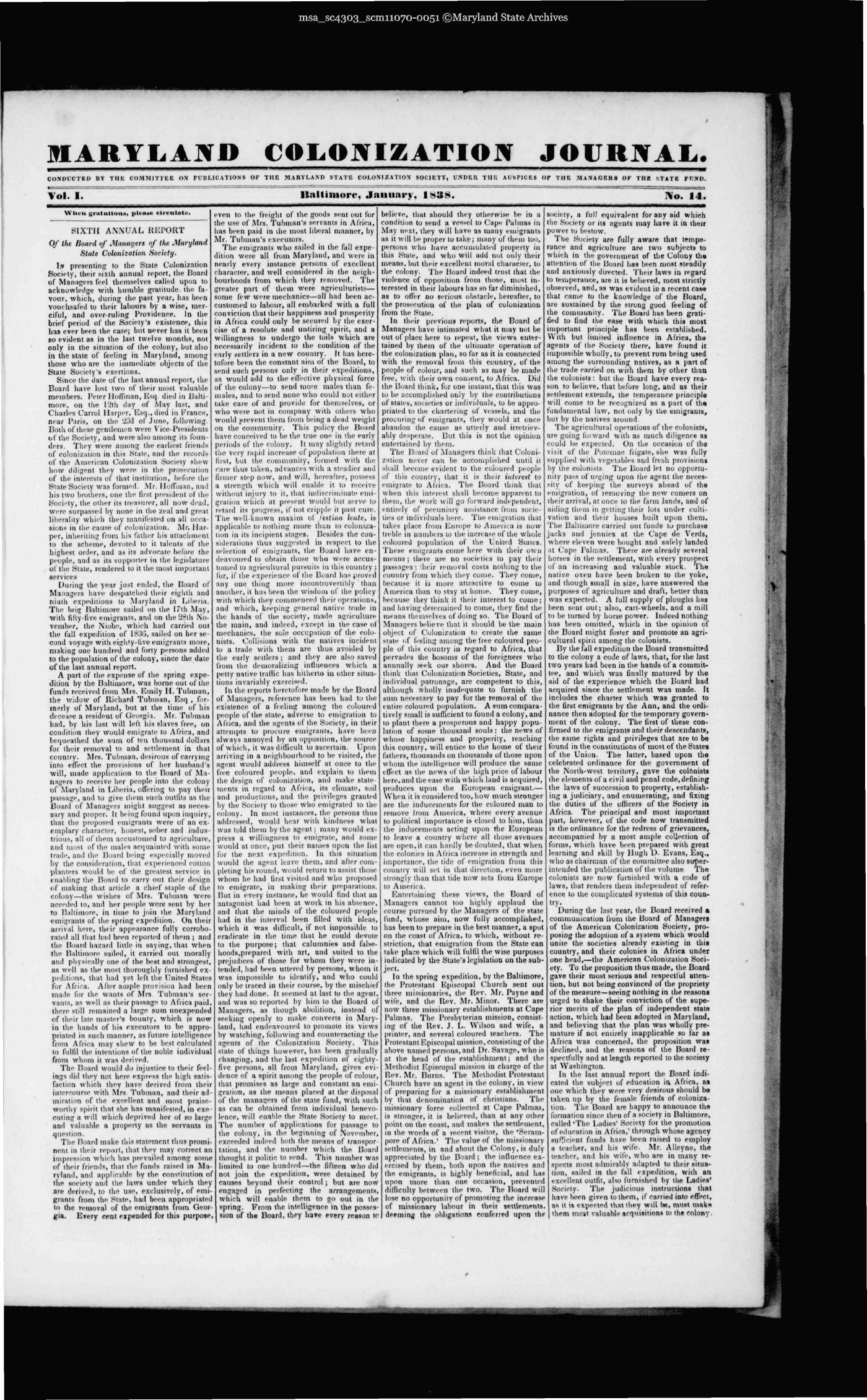
| MARYLAND COLONIZATION JOURNAL. CONDUCTED BY THE COMMITTEE ON PUB LICATIONS OF THE MARYLAND STATE COLONIZATION SOCIETY, UNDER THE AUSPICES OF THE MANAGERS OF THE STATE FUND. Vol. I. Baltimore, January, 1838. No. 14. When gratuitous please circulate. SIXTH ANNUAL REPORT Of the Board of Managers of the Maryland State Colonization Society. In presenting to the State Colonization Society, their sixth annual report, the Hoard of Managers feel themselves called upon to acknowledge with humble gratitude, the fa- vour, which, during the past year, has been vouchsafed to their labours by a wise, mer- ciful, and over-ruling Providence. In the brief period of the Society's existence, this has ever been the case; but never has it been so evident as in the last twelve months, noi only in the situation of the colony, but also in the state of feeling in Maryland, among those who are the immediate objects of the State Society's exertions. Since the date of the last annual report, the Board have lost two of their most valuable members. Peter Hoffman, Esq died in Balti more, on the 12th day of May last, and Charles Carrol Harper, Esq., died in France, Bear Part*, on the 2od of June, following. Coih of these gentlemen were Vice-Presidents of the Society, and were also among its foun- ders. They were among the earliest friends of colonization in this State, and the records of th" American Colonization Society shew how diligent they were in the prosecution of the interests of that institution, before the State Society was formed. Mr. Hoffman, and his two brothers, one the first president of the Society, the other its treasurer, all now dead, were surpassed by none in the zeal and great liberality which they manifested on all occa- sions in the cause of colonization. Mr. Har- per, inheriting from his father his attachment to the scheme, devoted to it talents of the lushest order, and as its advocate before the people, and as its supporter in the legislature of the Stale, rendered to it the must important services During the year just ended, the Board of Managers have despatched their eighth and ninth expeditions to Maryland in Liberia. The brig Baltimore sailed on the 17th May, with lifty-five emigrants, and on the 2^th [No- vember, the Niobe, which had carried out thi' fall expedition of 1886, sailed on her se- cond voyage with eighty-live emigrants more, making one hundred and forty persons added to the population of the colony, since the date of the last annual report. A part of the expense of the spring expe- dition by the Baltimore, was borne out of the funds received from Mrs. Emily H. Tubman, the widow of Richard Tubman, Esq , for- merly of Maryland, but at the time of his decease a resident of Georgia. Mr. Tubman had, by his last will left bis slaves free, on condition they would emigrate to Africa, and bequeathed the sum of ten thousand dollars for their removal to and settlement in that country. Mrs. Tubman, desirous of carrying into effect the provisions of her husband's ¦will, made application to the Board of Ma- nagers to receive her people into the colony of Maryland in Liberia, offering to pay their passage, and to give them such outfits as the Boanl of Managers might suggest as neces- sary and proper. It being found upon inquiry, that the proposed emigrantl were of an ex- emplary character, honest, sober and indus- trious, all of them accustomed to agriculture, and moat of the males acquainted with some trade, and the Board being especially moved by the consideration, that experienced cotton planters would be of the greatest service in maiding the Board to carry out their design of making that article a chief siaple of the colony—the wishes of Mrs. Tubman were acceded 10, and her people were sent by her to Baltimore, in time to join the Maryland emigrant! of the spring expedition. On their arrival here, their appearance fully corrobo- rated all that had been reported of them ; and the Hoard hazard little in saying, that when the Baltimore sailed, it carried out morally and physically one of the best and strongest, as well as the moat thoroughly furnished ex- peditions, that had yet left the United States for Africa. Alter ample provision had been made for the wants of Mrs Tubman'! ser- vants, as well as their passage to Africa paid. there still remained a large sum unexpended of their late master's bounty, which is now in the hands of his executors to be appro- priated in such manner, as future intelligence from Africa may shew to be best calculated to fulfil the intentions of the noble individual from whom it was derived. The Board would do injustice to their feel- ings did they not here express the high satis- faction which they have derived from their iaterconrse with Mrs Tubman, and their ad- miration of the excellent and most praise worthy spirit that she has manifested, in e.\e culing a will which deprived her of so large and valuable a properly as the servants in question. The Board make this statement thus promi- nent in their report, that thev may correct an impression which has prevailed among some of iheir friends, that the funds raised in Ma- ryland, and applicable hy the enns'itution of the society and the laws under which they are derived, to the use, exclusively, of emi- grants from the State, had been appropriated to the removal of the emigrants from Geor- gia. Every cent expended for this purpose, even to the freight of the goods sent out for the use of Mrs. Tubman's servants in Africa, has been paid in die most liberal manner, by Mr. Tubman's executors. The emigrants who sailed in the fall expe- dition were all from Maryland, and were in nearly every instance persons of excellent character, and well considered in the neigh- bourhoods from which they removed. The greater part of them were agriculturists— some few were mechanics—all had been ac- customed to labour, all embarked with a full conviction that their happiness and prosperity in Africa could only be secured by the exer- cise of a resolute and untiring spirit, and a willingness to undergo the toils which are necessarily incident to the condition of the early settler! in a new country. It has here- tofore been the constant aim of the Board, to send such persons only in their expeditions, as would add to the effective physical force of the colony—to send more males than fe- males, and to send none who could not either take care of and provide for themselves, or who were not in company with others who would prevent them from being a dead weight on the community. This policy the Board have conceived to be the true one in the early periods of the colony. It may slightly retard the very rabid increase of population there at (irst, but the community, formed with the care thus taken, advances wilh a steadier and firmer step now, and will, hereafter, possess a strength which will enable it to receive without injury to it, that indiscriminate emi- gration which at present would but serve to retard its progress, if not cripple it past cure. The well known maxim of leslina lentc, is applicable to nothing more than to coloniza- tion in its incipient stages. Besides the con- siderations thus suggested in respect to the selection of emigrants, the Board have en- deavoured to obtain those who were accus- tomed to agricultural pursuits in this country ; for, if the experience of the Board has proved any one thing more incontrovertibly than another, it has been the wisdom of the policy wilh which they commenced their operations, and which, keeping general native trade in the hands of the society, made agriculture ihe main, and indeed, except in the case of mechanics, the sole occupation of the colo- nists. Collisions with the natives incident to a trade with them are thus avoided by the early settlers ; and they are also saved from the demoralizing influences which a petty native traffic has hitherto in other situa- tions invariably exercised. In the reports heretofore made by the Board of Managers, reference has been had to the existence of a ft elmg among the coloured people of the stale, adverse to emigration to Africa, and the agents of the Society, in their attempts to procure emigrants, have been always annoyed by an opposition, the source of which, it was difficult to ascertain. Upon arriving in a neighbourhood to be visited, the agent would address himself at once to the free coloured people, and explain to them the design id' colonization, and make stale nients in regard lo Africa, its climate, soil and productions, and the privileges granted by the Society to those who emigrated to the colony. In most instances, the persons thus addressed, would hear with kindness what was told them hy the agent; many would ex- press a willingness to emigrate, and some would at once, put their names upon the list for the next expedition. In this situation would the agenl leave them, and alter com- pleting his round, would return lo assist those whom he had first visited and who proposed to emigrate, in making their preparations. Hut in every instance, he would find that an antagonist had been at work in his absence, and that the minds of the coloured people had in the interval been filled with ideas, which it was difficult, if not impossible to eradicate in the lime that lie could devote to the purpose; that calumnies and false- hoods.prepared wilh art, and suited lo the prejudices of those for whom they were in- tended, had been uttered by persons, whom it was impossible to identify, and who could only be traced in lheir course, by the mischief they had done. It seemed at last to the agent, and was so reported by him to the Board of Managers, as though abolition, instead of seeking openly to make converts in Mary- land, had endeavoured to promote its views by watching, following and counteracting the agents of the Colonization Society. This slate of things however, has been gradually changing, and the last expedition of eighty- five persons, all from Maryland, gives evi- dence of a spirit among the people of colour, thai promises ns large and constant an emi- gration, as the means placed at the disposal of the managers of the slate fund, with such as can be obtained from individual benevo- lence, will enable the State Society to meet. The number of applications for passage lo the colony, in the beginning of November, exceeded indeed both Ihe means of transpor lilion, and the number which the Board thought it politic to send. This number was limited to one hundred—the fifteen who did not join the expedition, were detained by causes beyond lheir control; but are now engaged in perfecting the arrangements, which will enable them to go out in the spring. From the intelligence in the posses- sion of the Board, they have pvery reason to believe, that should they otherwise be in tl condition to send a vessel to Cape I'almas in May next, ihey will have as many emigrants as it will be proper lo take; many of then too, persons who have accumulated property in this Stale, and who will add not only their means, but their excellent moral character, to the colony. The Hoard indeed trust that the violence of opposition from those, most in- terested in lheir labours has so far diminished, as to oiler no serious obstacle, hereafter, lo the prosecution of ihe plan of colonization from the State. In their previous reports, the Board of Managers have animated what it may not be out of place here lo repeat, the views enter- tained by them of the ultimate operation of the colonization plan, so far as it is connected with the removal from this counlry, of the people of colour, and such as may be made free, with their own consent, to Africa. Did ihe Board think, for one instant, that this was to be accomplished only by the contributions of states, societies or individuals, to be appro- priated to the chartering of vessels, and the procuring of emigrants, they would at once abandon the cause as utterly and irretriev- ably desperate. But this is not the opinion entertained by them. The Heard of Managers think that Coloni- zation never can be accomplished until it shall become evident lo the coloured people of this country, that it is their interest to emigrate to Africa, The Board think that when ibis interest shall become apparent to them, the work will go forward independent, entirely of pecuniary assistance from socie- ties or individuals here. The emigration that takes place from Europe lo America is now treble in numbers lo the increase of ihe whole coloured population of the United Slates. These emigrants come here with their own means ; there are no societies lo pay their passages; their removal costs nothing to the country from which they come. They come, because it h more attractive to come lo America lhan to stay at home. They come, because they think it their interest to come; and having determined to come, they find the means themselves of doing so. The Hoard of Managers believe that it should be the main object of Colonization to create the same stale of feeling among the free coloured peo- ple of ibis country in regard to Africa, that pervades die bosoms of the foreigners who annually seek our shores. And the Board think that Colonization Societies, State, and individual patronage, are competent to this, although wholly inadequate to furnish the sum necessary to pay tor the removal of the entire coloured population. A sum compara- tively small is sufficient to found a colony, and io plant there a prosperous and happy popu- lation of some thousand souls : the ww^ of whose happiness and prosperity, reaching this country, will entice lo the home of their fathers, thousands on thousands of those upon whom the intelligence will produce the same effect as the news of ihe high price of labour here, and the ease with which laud is acquired, produces upon the European emigrant.— When it is considered too, how much stronger are the inducements for the coloured man to remove Irom America, where every avenue to political importance is closed to him, than the inducements acting upon the European to leave a country where all those avenues are open, it can hardly be doubted, that when the colonies ill Africa increase in strength and importance, the tide of emigration from this country will set in that direction, even mora strongly than that tide now sets from Europe to America. Entertaining these views, the Board of Managers cannot too highly applaud the course pursued by ihe Managers of the state fund, whose aim, now fully accomplished, has been to prepare in the best manner, a spot on the coast of Africa, to which, without re- striction, that emigration from the State can take place which will fulfil the wise purposes indicated by the Stale's legislation on the sub- ject. In the spring expedition, by the Baltimore, the Protestant Episcopal Church sent out three missionaries, the Bev. Mr. Payne and wile, and ihe flev. Mr. Minor. There are now three missionary establishments at Cape I'almas. The Presbyterian mission, consist- ing of the Bev. J. L. Wilson and wife, a printer, and several coloured teachers. The Protestant Episcopal mission, consisting of the above named persons, and Dr. Savage, who is at the head of the establishment; and the Methodist Episcopal mission in charge of the Bev. Mr, Bums. The Methodist Protestant Church have an agent in the colony, in view of preparing for a missionary establishment by that denomination of christians. The missionary force collected at Cape I'almas, is stronger, it is believed, lhan at any oilier point on the coast, and makes the settlement, in the words of a recent visitor, the 'Seram- pore of Africa.' The value of thp missionary settlements, in and about the Colony, is duly appreciated hy the Board ; the influence ex- ercised by them, both upon the natives and the emigrants, is highly beneficial, and has upon more than one occasion, prevented difficulty between the two. The Board will lose no opportunity of promoting the increase of missionary labour in their settlements, dpeming 'he obligations conferred upon the society, a full equivalent for any aid which the Society or its agents may have it in lheir power to bestow. The Society are fully aware that tempe- rance and agriculture are two subjects to which in the government of the Colony the, attention of the Board has been most steadily and anxiously directed, 'lheir laws in regard to temperance, are it is believed, most strictly observed, and, as was evident in a recent MM that came to the knowledge of the Board, are sustained by the strong good feeling of the community. The Board has been grati- fied to find the ease with which this most important principle has been established. With but limbed influence in Africa, the agents of the Society there, have found it impossible wholly, to prevent rum being used among the surrounding natives, as a part of the trade carried on wiih them by other than the colonists: but the Board have every rea- son to believe, that before long, and as their settlement extends, the temperance principle will come to be recognized as a part of the fundamental law, not only by the emigrants, but by the natives around The agricultural operations of the colonists, are going forward with as much diligence as euuld be expected. On the occasion of the visit of the Potomac frigate, she %vas fully supplied with vegetables and fresh provision* by the colonists. The Board let no opportu- nity pMS of urging upon the agent the neces- sity of keeping the surveys ahead of the emigration, of removing ihe new comers on their arrival, at once to the farm lands, and of aiding them in getting lheir lots under culti- vation and their houses built upon them. The Baltimore carried out funds to purchase jacks and jennies at the Cape de Verds, where eleven were bought and safely landed at Cape Talmas. There are already several horses in the Settlement, with every prospect of an increasing and valuable slock. The native oven have been broken to the yoke, and though small in size, have answered the purposes of agriculture and draft, better than was expected. A full supply of ploughs has been sent out; also, cart-wheels, and a mill to be turned by horse power. Indeed nothing has been omitted, which in the opinion of the Board might foster and promote an agri- cultural spirit among the colonists. By the fall expedition the Board transmitted to the colony a code of laws, that, for the last two years had been in the hands of a commit- tee, and which was finally matured by the aid of the experience which the Board had acquired since the settlement was made. It includes the charter which was granted to the first emigrants by the Ann, and the ordi- nance then adopted for the temporary govern- ment of the colony. The first of these con- firmed to the emigrants and their descendants, the same rights and privileges that are to be found in the constitutions of most of the States of the Union. The latter, based upon the celebrated ordinance tor the government of the North-west territory, gave the colonists ihe elements of a civil and penal code, defining the laws of succession to property, establish- ing a judiciary, and enumerating, and fixing the duties of the officers of the Society in Africa The principal and most important part, however, of the code now transmitted is the ordinance for the redress of grievances, accompanied by a most ample collection of forms, which have been prepared wilh great learning and skill by Hugh D. Evans, Esq., who as chairman of the committee also super- intended ihe publication of the volume The colonists are now furnished with a code of laws, that renders them independent of refer- ence lo the complicated systems of this coun- try. During the last year, the Board received a communication from the Board of Managers of the American Colonization Society, pro- posing the adoption of a system which would unite the societies already existing in this country, and their colonies in Africa under one head,—the American Colonization Soci- ety. To the proposition thus made, the Board gave their most serious and respectful atten- tion, but not being convinced of the propriety of the measure—seeing nothing in the reasons urged to shake their conviction of the supe- rior merits of the plan of independent state action, which had been adopted in Maryland, and believing that the plan was wholly pre- mature if not entirely inapplicable so far as Africa was concerned, the proposition was declined, and the reasons of ihe Board re- spectfully and at length reported lo the society at VVashington. In the last annual report the Board indi- cated the subject uf education in Africa, as one which they were very desirous should bo taken up by the female friends of coloniza- tion. The Board are happy to announce the formation since then of a society in Baltimore. called 'The Ladies' Society for the promotion of education in Africa," through whose agency sufficient funds have been raised to employ a teacher, and his wife. Mr. Allcyne, the teacher, and his wife, who are in many re- spects most admirably adapted to their situa- tion, sailed in the fall expedition, wiih an excellent outfit, also furnished by the Ladies' Society. The judicious instructions lhat have been given to them, if carried into effect, as it is expected that they wilt be, must niak* them men valuable acquisitions to the colony |