 |
|
|
 |
|
 |
|
|||
|
||||
|
||||
|
Maryland State Archives Maryland Colonization Journal Collection MSA SC 4303 msa_sc4303_scm11070-0058 Enlarge and print image (5M) |
|
|
|
|
|
|
|
|||
|
||||
|
||||
|
Maryland State Archives Maryland Colonization Journal Collection MSA SC 4303 msa_sc4303_scm11070-0058 Enlarge and print image (5M) |
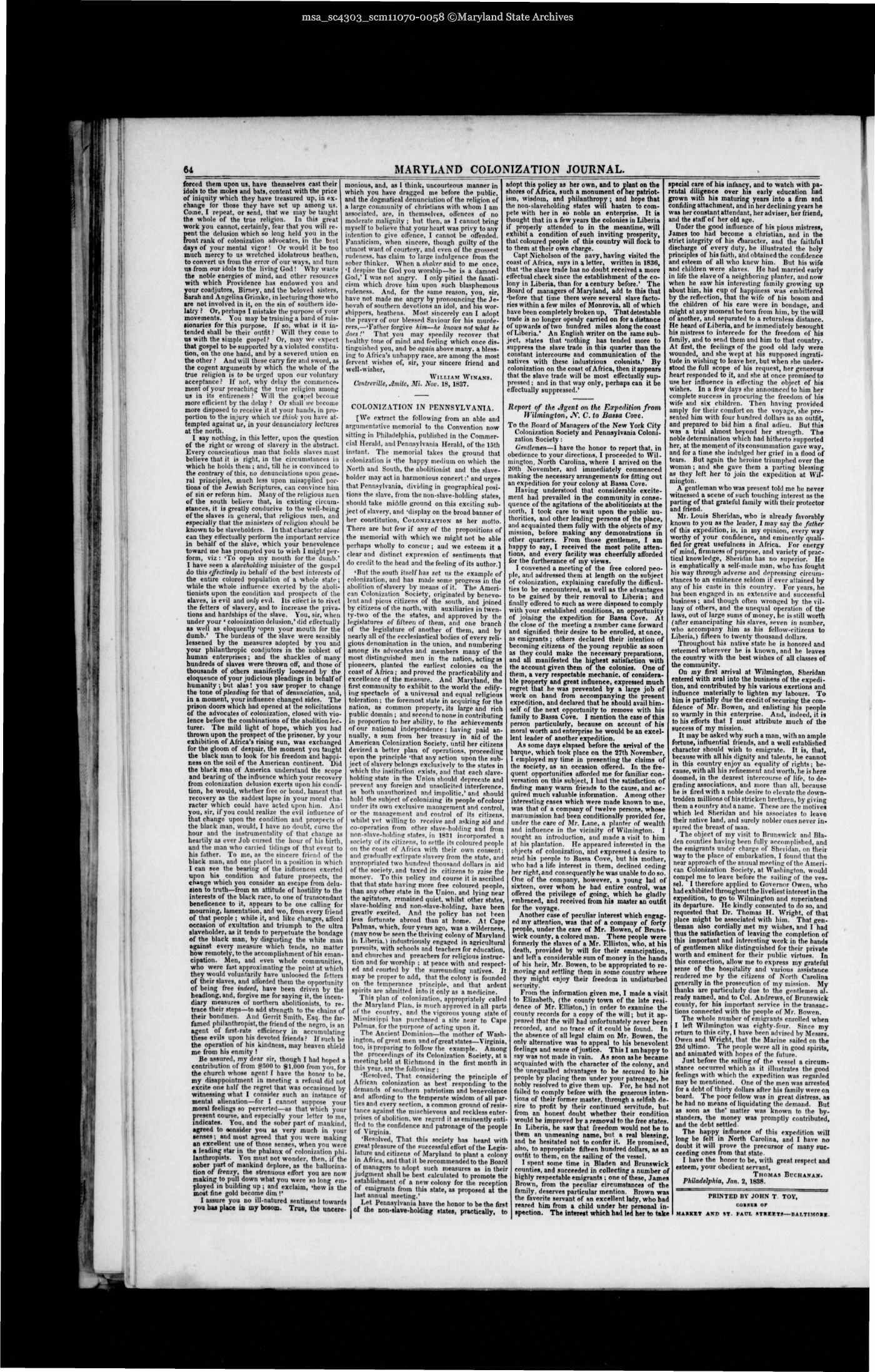
| 64 MARYLAND COLONIZATION JOURNAL. forced them upon us, have themselves cast their idols to the moles and bats, content with the price of iniquity which they have treasured up, in ex- change lor those they have set up among us. Come, I repeat, or send, that we may be taught the whole of the true religion. In this great work you cannot, certainly, fear that you will re- pent the delusion which so long held you in the front rank of colonization advocates, in the best days of your mental vigor! Or would it be too much mercy to us wretched idolatrous heathen, to convert us from the error of our ways, and turn us from our idols to the living God ! Why waste the noble energies of mind, and other resources with which Providence has endowed you and your coadjutors, Birney, and the beloved sisters, Sarah and Angelina Griinke, in lecturing those who are not involved in it, on the sin of southern ido- latry ? Or, perhaps I mistake the purpose of your movements. You may be training a band of mis- sionaries for this purpose. If so, what is it in- tended shall be their outfit ? Will they come to us with the simple gospel? Or, may we expect that gospel to be supported by a violated constitu- tion, on the one hand, and by a severed union on the other ? And will these carry fire and sword, as the cogent arguments by which the whole of the true religion is to be urged upon our voluntary acceptance ? If not, why delay the commence, ment of your preaching the true religion among us in its entireness ? Will the gospel become more efficient by the delay ? Or shall ire become more disposed to receive it at your hands, in pro- portion to the injury which we think you have at- tempted against us, in your denunciatory lectures at the north. I say nothing, in this letter, upon the question of the right or wrong ot slavery in the abstract. Every conscientious man that holds slaves must believe that it is right, in the circumstances in which he holds them; and, till he is convinced to the contrary of this, no denunciations upon gene- ral principles, much less upon misapplied por- tions of the Jewish Scriptures, can convince him of sin or reform him. Many of the religious men of the south believe that, in existing circum- stances, it is greatly conducive to the well-being of the slaves fn general, that religious men, and especially that the ministers of religion should lie known to be slaveholders. In th.it character alone can they effectually perform the important service in behalf of the slave, which your benevolence toward me has prompted you to wish I might per- form, viz : 'To open my mouth for the dumb.' I have seen a sluveholding minister of the gospel do this effectively in behalf of the best interests of the entire colored population of a whole state; while the whole influence exerted by the aboli- tionists upon the condition and prospects of the slaves, is evil and only evil. Its (tract is to rivet the fetters of slavery, and to increase the priva- tions and hardships of the slave. You, sir, when under your ' colonization delusion,'did eliectually as well as eloquently 'open your mouth for the dumb.' The burdens of the slave were sensibly lessened by the measures adopted by you and your philanthropic coadjutors in the noblest of human enterprises; and the shackles of many hundreds of slaves were thrown off, and those of thousands of others manifestly loosened by the eloquence of your judicious pleadings in behalf of humanity ; but alas I you saw proper to change the tone of pleading for that of denunciation, and, in a moment, your influence changed sides. The prison doors which had opened at the solicitations of the advocates of colonization, closed with vio- lence before the combinations of the abolition lec- turer. The mild light of hope, which you had thrown upon the prospect of the prisoner, by your exhibition of Africa's rising sun, was exchanged for the gloom of despair, the moment you taught the black man to look for his freedom and happi- ness on the soil of the American continent. Did the black man of America understand the scope and bearing of the influence which your recovery from colonization delusion exerts upon his condi- tion, he would, whether free or bond, lament that recovery as the saddest lapse in your moral cha- racter which could have acted upon him. And you, sir, if you could realize the evil influence of that change upon the condition and prospects of the black man, would, I have no doubt, curse the hour and the instrumentality of that change as heartily as ever Job cursed the hour of his birth, and the man who carried tidings of that event to his father. To me, as the sincere friend of the black man, and one placed in a position in which I can see the bearing of the influences exerted upon his condition and future prosiects, the ch?nge which you consider an escape from delu- sion to truth?from an attitude of hostility to the interests of the black race, to one of transcendant beneficence to it, appears to be one calling for mourning, lamentation, and wo, from every friend of that people ; while it, and like changes, afford occasion of exultation and triumph to the ultra slaveholder, as it tends to perpetuate the bondage of the black man, by disgusting the white man against every measure which tends, no matter how remotely, to the accomplishment of his eman- cipation. Men, and even whole communities, who were fast approximating the point at which they would voluntarily have unloosed the fetters of their slaves, and afforded them the opportunity of being free indeed, have been driven by the headlong, and, forgive me for saying it, the incen- diary measures of northern abolitionists, to re- trace their steps?to add strength to the chain9 of their bondmen. And Gerrit Smith, Esq. the far- famed philanthropist, the friend of the negro, is an agent of first-rate efficiency in accumulating these evils upon his devoted friends? If such be the operation of his kindness, may heaven shield me from his enmity ! Be assured, my dear sir, though I had hoped a contribution of from ?5(10 to 91,000 from you, for the church whose agent I have the honor to be. my disappointment in meeting a refusal did not excite one half the regret that was occasioned by witnessing what I consider such an instance of mental alienation?for I cannot suppose your moral feelings so perverted?as that which your present course, and especially your letter to me, indicates. You, and the sober part of mankind, agreed to aonsider you as very much in your senses; and most agreed that you were making an excellent use of those senses, when you were ? leading star in the phalanx of colonization phi- lanthropists. You must not wonder, then, if the sober part of mankind deplore, as the hallucina- tion of frenzy, the strenuous effort you are now making to pull down what you were so long em- ployed in building up ; anil exclaim, 'how is the most fine gold become dim !' I assure you no ill-natured sentiment towards you has place in my bosom. True, the uncere- monious, and, as 1 think, uncourteous manner in which you have dragged me before the public, and the dogmatical denunciation of the religion of a large community of christians with whom I am associated, are, in themselves, offences of no moderate malignity; but then, as I cannot bring myself to believe that your heart was privy to any intention to give offence, I cannot be offender). Fanaticism, when sincere, though guilty of the utmost want of courtesy, and even of the grossest rudeness, has claim to large indulgence from the sober thinker. When a shaker said to me once, 'I despise the God you worship?he is a damned God,' I was not angry. I only pitied the fanati- cism which drove him upon such blasphemous rudeness. And, for the same reason, you, sir, have not made me angry by pronouncing the Je- hovah of southern devotions an idol, and his wor- shippers, heathens. Most sincerely can I adopt the prayer of our blessed Saviour for his murde- rers,?'Father forgive him?he knows not what he does." That you may speedily recover that healthy tone of mind and feeling which once dis- tinguished you, and be again above many, a bless- ing to Africa's unhappy race, are among the most fervent wishes of, sir, your sincere friend and well-wisher, WILLIAM WlNANS. Centreville, Amite, Mi. Nov. 18, 1837. adopt this policy as her own, and to plant on the shores of Africa, such a monument of her patriot- ism, wisdom, and philanthropy ; and hope that the non-slaveholding states will hasten to com- pete with her in so noble an enterprise. It is thought that in a few years the colonics in Liberia if properly attended to in the meantime, will exhibit a condition of such inviting prosperity, that coloured people of this country will flock to to them at their own charge. Capt Nicholson of the navy, having visited the coast of Africa, says in a letter, written in 183fi, that 'the slave trade has no doubt received a more effectual check since the establishment of the co- lony in Liberia, than for a century before.' The Board of managers of Maryland, add to this that 'before that time there were several slave facto- ries within a few miles of Monrovia, all of which have been completely broken up, That detestable trade is no longer openly carried on for a distance of upwards of two hundred miles along the coast of Liberia.' An English writer on the same sub- ject, states that 'nothing has tended more to suppress the slave trade in this quarter than the constant intercourse and communication of the natives with these industrious colonists.' By colonization on the coast of Africa, then it appears that the slave trade will be most effectually sup- pressed ; and in that way only, perhaps can it be effectually suppressed.' COLONIZATION IN PENNSYLVANIA. [We extract the following from an able and argumentative memorial to the Convention now sitting in Philadelphia, published in the Commer- cial Herald, and Pennsylvania Herald, of the 15th instant. The memorial takes the ground that colonization is 'the happy medium on which the North and South, the abolitionist and the slave- holder may act in harmonious concert:' and urges that Pennsylvania, dividing in geographical posi- tions the slave, from the non-slave-holding states, should take middle ground on this exciting sub- ject of slavery, and 'display on the broad banner of her constitution, Colonization' as her motto. There are but few if any of the propositions of the memorial with which we might not be able perhaps wholly to concur; aud we esteem it a clear and distinct expression of sentiments that do credit to the head and the feeling of its author.] 'But the south itself has set us the example of colonization, and has made some progress in the abolition of slavery by means of it. The Ameri- can Colonization Society, originated by benevo- lent and pious citizens of the south, and joined by citizens of ihe north, with auxiliaries in twen- ty-two of the the states, and approved by the legislatures of fifteen of them, and one branch of the legislature of another of them, and bv nearly all of the ecclesiastical bodies of every reli- gious denomination in the union, and numbering among its advocates and members many of the most distinguished men in the nation, acting as pioneers, planted the earliest colonies on the coast of Africa; and proved the practicability and excellence of the measure. And Maryland, the first community to exhibit to the world the edify- itig spectacle of a universal and equal religious toleration; the foremost state in acquiring for the nation, as common property, its large and rich public domain ; and second to none in contributing in proportion to her ability, to the achievements of our national independence ; having paid an- nually, a sum from her treasury in aid of the American Colonization Society, until her citizens devised a better plan of operations, proceeding upon the principle 'that any action upon the sub- ject of slavery belongs exclusively to the states in which the institution exists, and'that each slave- holding state in the Union should deprecate and prevent any foreign and unsolicited interference, as both unauthorized and impolitic,' and should hold the subject of colonizing its people of colour under its own exclusive management and control, or the management and control of its citizens, whilst yet willing to receive and asking aid and co-operation from other slave-holding and from non-slave-holding states, in 1831 incorporated a society of its citizens, to settle its coloured people on the coast of Africa with their own consent; and gradually extirpate slavery from the state, and anpropriated two hundred thousand dollars in aid of the society, and taxed its citizens to raise the money. To this policy and course it is ascribed that that state having more free coloured people, than any other state in the Union, and lying near the agitators, remained quiet, whilst other states, slave-holding and non-slave-holding, have been greatly excited. And the policy has not been less fortunate abroad than at home. At Cape Palmas, which, four years ago, was a wilderness, (may now be seen the thriving colony of Maryland in Liberia.) industriously engaged in agricultural pursuits, with schools and teachers for education, and churches and preachers for religious instruc- tion and for worship : at peace with and respect- ed and courted by the surrounding natives. It may he proper to add, that the colony is founded on the temperance principle, and that ardent spirits are admitted into it only as a medicine. This plan of colonization, appropriately called the Maryland Plan, is much approved in all parts of the country, and the vigorous young state of Mississippi has purchased a site near to Cape Palmas for the purpose of acting upon it. The Ancient Dominion?the mother of Wash- ington, of great men and of great states?Virginia, too, isprepnring to follow the example. Among the proceedings of its Colonization Society, at a meetingheld at Richmond in the first month in thi? year, are the following: 'Resolved. That considering the principle of African colonization as best responding to the demands of southern patriotism and benevolence and affording to the temperate wisdom of all par- ties and every section, a common ground of resis- tance against the mischievous and reckless enter- prises of abolition, we regard it as eminently enti- tled to the confidence and patronage of the people of Virginia. 'Resnlved, That this society has heard with great pleasure of the successful effort of the Legis- lature and citizens of Maryland to plant a colony in Africa, and that it be recommended to the Board of managers to adopt such measures as in their judgment shall be best calculated to promote the establishment of a new colony for the reception of emigrants from this state, as proposed at the last annual meeting.' Let Pennsylvania have the honor to be the first of the non-slave-holding states, practically, to Report of the Agent on the Expedition from Wilmington, N. C.. to Bassa Cove. To the Board of Managers of the New York City Colonization Society and Pennsylvania Coloni- zation Society: Gentlemen?1 have the honor to report that, in obedience to your directions, I proceeded to Wil- mington, North Carolina, where I arrived on the 20th November, and immediately commenced making the necessary arrangements for fitting out an expedition for your colony at Bassa Cove. Having understood that considerable excite- ment had prevailed in the community in conse- quence of the agitations of the abolitionists at the north, I took care to wait upon the public au- thorities, and other leading persons of the place, and acquainted them fully with the objects of my mission, belbre making any demonstrations in other quarters. From those gentlemen, I am happy to say, I received the most polite atten- tions, and every facility was cheerfully afforded for the furtherance of my views. I convened a meeting of the free colored peo- ple, and addressed them at length on the subject of colonization, explaining carefully the difficul- ties to be encountered, as well as the advantages to be gained by their removal to Liberia; and finally offered to such as were disposed to comply with your established conditions, an opportunity of joining the expedition for Bassa Cove. At the close of the meeting a number came forward and signified their desire to be enrolled, at once, as emigrants ; others declared their intention of becoming citizens of the young republic as soon as they could make the necessary preparations, and all manifested the highest satisfaction with the account given them of the colonies. One of them, a very respectable mechanic, of considera- ble property and great influence, expressed much regret that he was prevented by a large job of work on hand from accompanying the present expedition, and declared that he should avail him- self of the next opportunity to remove with his family to Bassa Cove. I mention the case of this person particularly, because on account of his moral worth and enterprise he would be an excel- lent leader of another expedition. As some days elapsed before the arrival of the barque, which took place on the 27th November, I employed my time in presenting the claims of the society, as an occasion offered. In the fre- quent opportunities afforded me for familiar con- versation on this subject, I had the satisfaction of finding many warm friends to the cause, and ac- quired much valuable information. Among other interesting cases which were made known to me, was that of a company of twelve persons, whose manumission had been conditionally provided for, under the care of Mr. Lane, a planter of wealth and influence in the vicinity of Wilmington. I sought an introduction, and made a visit to him at his plantation. He appeared interested in the objects of colonization, and expressed a desire to send his people to Bassa Cove, but his mother, who had a life interest in them, declined ceding her right, and consequently he was unable to do so. One of the company, however, a young lad of sixteen, over whom he had entire control, was offered the privilege of going, which he gladly embraced, and received from his master an outfit for the voyage. Another case of peculiar interest which engag- ed mv attention, was that of a company of forty people, under the care of Mr. Bowen, of Bruns- wick county, a colored man. These people were formerly the slaves of a Mr. Elliston, who, at his death, provided by will for their emancipation, and left a considerable sum of money in the hands of his heir, Mr. Bowen, to be appropriated to re- moving and settling them in some country where they might enjoy their freedom in undisturbed security. From the information given me, I made a visit to Elizabeth, (the county town of the late resi- dence of Mr. Elliston,) in order to examine the county records for a copy of the will; but it ap- peared that the will had unfortunately never been recorded, and no trace of it could be found. In the absence of all legal claim on Mr. Bowen, the only alternative was to appeal to his benevolent feelings and sense of justice. This I am happy to say was not made in vain. As soon as he became acquainted with the character of the colony, and the unequalled advantages to be secured to his people by placing them under your patronage, he nobly resolved to give them up. For, he hail not failed to comply before with the generous inten- tions of their former master, through a selfish de- sire to profit by their continued servitude, but from an honest doubt whether their condition would he improved by a removal to the free states. In Liberia, he saw that freedom would not be to them an unmeaning name, but a real blessing, and he hesitated not to confer it. He promised, also, to appropriate fifteen hundred dollars, as an outfit to them, on the sailing of the vessel. I spent some time in Bladen and Brunswick counties, and succeeded in collecting a number of highly respectable emigrants ; one of these, James Brown, from the peculiar circumstances of the family, deserves particular mention. Brown was the favorite servant of an excellent lady, who had reared him from a child under her personal in- spection. The interest which had led her to take special care of his infancy, and to watch with pa- rental diligence over his early education had grown with his maturing years into a firm and confiding attachment, and in her declining years he was her constant attendant, her adviser, her friend, and the staff of her old age. Under the good influence of his pious mistress, James too had become a christian, and in the strict integrity of his character, and the faithful discharge of every duty, he illustrated the holy principles of his faith, and obtained the confidence and esteem of all who knew him. But his wife and children were slaves. He had married early in life the slave of a neighboring planter, and now when he saw his interesting family growing up about him, his cup of happiness was embittered by the reflection, that the wife of his bosom and the children of his care were in bondage, and might at any moment be torn from him, by the will of another, and separated to a returnless distance. He heard of Liberia, and he immediately besought his mistress to intercede for the freedom of his family, and to send them and him to that country. At first, the feelings of the good old lady were wounded, and she wept at his supposed ingrati- tude in wishing to leave her, but when she under- stood the full scope of his request, her generous heart responded to it, and she at once promised to use her influence in effecting the object of his wishes. In a few days she announced to him her complete success in procuring the freedom of his wife and six children. Then having provided amply for their comfort on the voyage, she pre- sented him with four hundred dollars as an outfit, and prepared to bid him a final adieu. But this was a trial almost beyond her strength. The noble determination which had hitherto supported her, at the moment of its consummation gave way, and for a time she indulged her grief in a flood of tears. But again the heroine triumphed over the woman ; and she gave them a parting blessing as they left her to join the expedition at Wil- mington. A gentleman who was present told me he never witnessed a scene of such touching interest as the parting of that grateful family with their protector and friend. Mr. Louis Sheridan, who is already favorably known to you as the leader, I may say the father of this expedition, is, in my opinion, every way worthy of your confidence, and eminently quali- fied for great usefulness in Africa. For energy of mind, firmness of purpose, and variety of prac- tical knowledge, Sheridan has no superior. He is emphatically a self-made man, who has fought his way through adverse and depressing circum- stances to an eminence seldom if ever attained by any of his caste in this country. For years, he has been engaged in an extensive anil successful business ; and though often wronged by the vil- lany of others, and the unequal operation of the laws, out of large sums of money, tie is still worth (after emancipating his slaves, seven in number, who accompany him as his fellow-citizens to Liberia,) fifteen to twenty thousand dollars. Throughout his native state he is honored and esteemed wherever he is known, and he leaves the country with the best wishes of all classes of the community. On my first arrival at Wilmington, Sheridan entered with zeal into the business of the expedi- tion, and contributed by his various exertions and influence materially to lighten my labours. To him is partially due the credit of securing the con- fidence of Mr. Bowen, and enlisting his people so warmly in this enterprise. And, indeed, it is to his efforts that I must attribute much of the success of my mission. It may be asked why such a man, with an ample fortune, influential friends, and a well established character should wish to emigrate. It is, that, because with all his dignity ami talents, he cannot in this country enjoy an equality of rights ; be- cause, with all his refinement and worth, he is here doomed, in the dearest intercourse of life, to de- grading associations, and more than all. because he is fired with a nohle desire to elevate the down- trodden millions of his stricken brethren, by giving them a country and a name. These are the motives which led Sheridan and his associates to leave their native land, and surely nobler ones never in- spired the breast of man. The object of my visit to Brunswick and Bla- den counties having been fully accomplished, and the emigrants under charge of Sheridan, on their way to the place of embarkation, I found that the near approach of the annual meeting of the Ameri- can Colonization Society, at Washington, would compel me to leave before the sailing of the ves- sel. I therefore applied to Governor Owen, who had exhibited throughout the liveliest interest in the expedition, to go to Wilmington and superintend its departure. He kindly consented to do so, and requested that Dr. Thomas H. Wright, of that place might be associated with him. That gen- tleman also cordially met my wi.dies, and I had thus the satisfaction of leaving the completion of this important and interesting work in the hands of gentlemen alike distinguished for their private worth and eminent for their public virtues. In this connection, allow me to express my grateful sense of the hospitality and various assistance rendered me by the citizens of North Carolina generally in the prosecution of my mission. My thanks are particularly due to the gentlemen af. ready named, and to Col. Andrews, of Brunswick county, for his important service in the transac- tions connected with the people of Mr. Bowen. The whole number of emigrants enrolled when I left Wilmington was eighty-four. Since my return to this city, I have been advised by Messrs. Owen and Wright, that the Marine sailed on the 23d ultimo. The people were all in good spirits, and animated with hopes of the future. Just before the sailing of the vessel a circum- stance occurred which as it illustrates the good feelings with which the expedition was regarded may be mentioned. One of the men was arrested for a debt of thirty dollars after his family were on board. The poor fellow was in great distress, as he had no means of liquidating the demand. But as soon as the' matter was known to the by- standers, the money was promptly contributed, and the debt settled The happy influence of this expedition will long be felt in North Carolina, and I have no doubt it will prove the precursor of many suc- ceeding ones from that state I have the honor to be, w ith great respect and esteem, your obedient servant, Thomas Buchanan. Philadelphia, Jan. 2, 1838. PRINTED BY JOHN T TOY, CORNER OF MARKET AND ST- PAUL STRRETS ? BALTIMORE |