 |
|
|
 |
|
 |
|
|||
|
||||
|
||||
|
Maryland State Archives Maryland Colonization Journal Collection MSA SC 4303 msa_sc4303_scm11070-0063 Enlarge and print image (4M) |
|
|
|
|
|
|
|
|||
|
||||
|
||||
|
Maryland State Archives Maryland Colonization Journal Collection MSA SC 4303 msa_sc4303_scm11070-0063 Enlarge and print image (4M) |
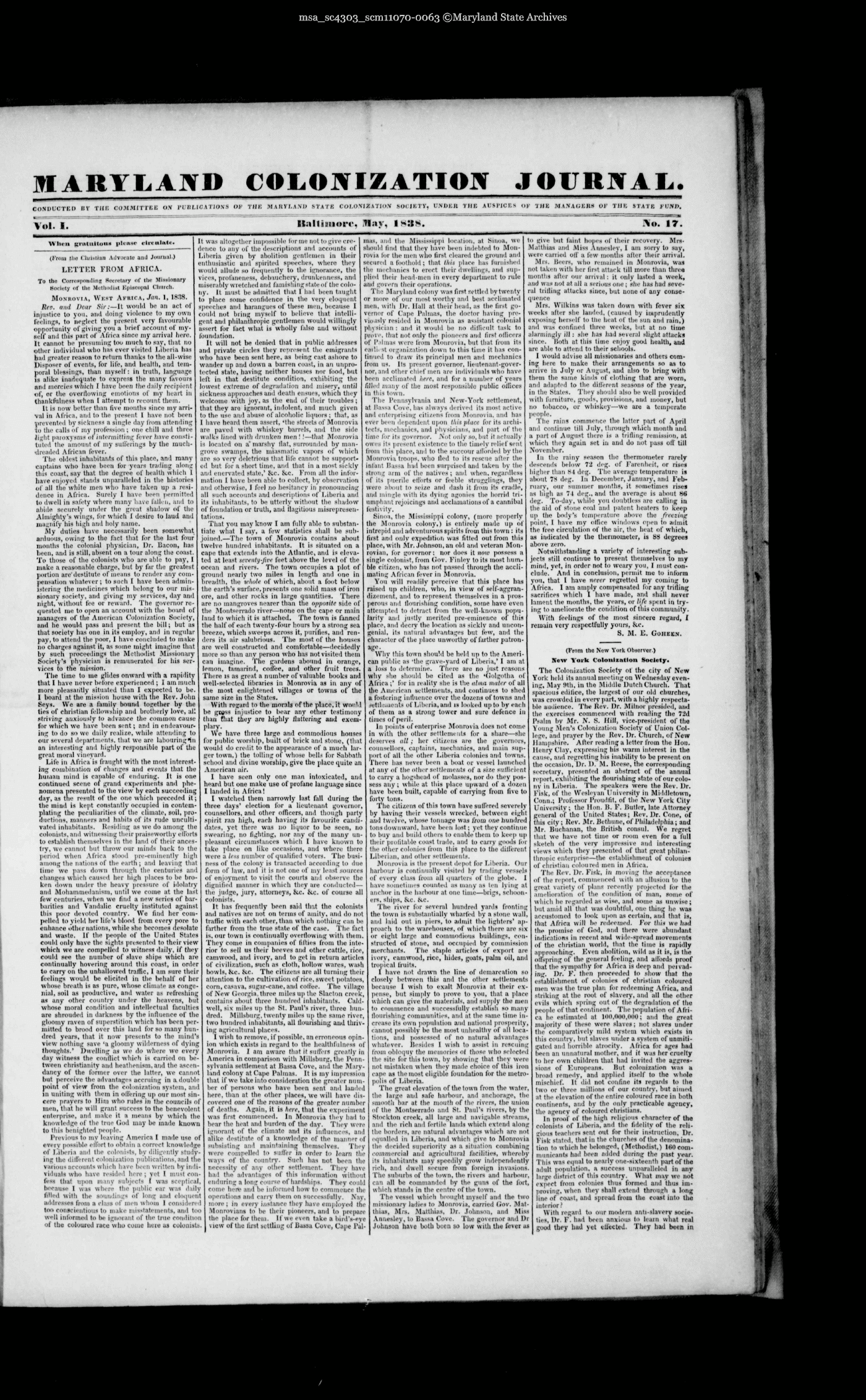
| MARYLAND COLONIZATION JOURNAL. CONDUCTED BY THE COMMITTEE ON PUBLICATIONS OF THE MARYLAND STATE COLONIZATION SOCIETY, UNDER THE AUSPICES OF THE MANAGERS OF THE STATE FIUND. Vol. I. Baltimore, May, 1838, No. 17. When gratuitous please circulate. (From the Christian Advocate and Journal.) LETTER FROM AFRICA. To the Corrospondence Secretary Of the Missionary Society of the Methodist Episcopal Church. Monrovia, West Africa, Jan. 1, 1838. Rev. and Dear Sir:— It would be an act of injustice to you. and doing violence to my own feeling*, to neglect tin- present very favourable opportunity of giving you a brief account of my- self an.I this part of Africa, since my arrival here. It cannot be presuming too milch to say, that no other individual who has ever visited Liberia has had greater reason to return thanks to the all-wise Disposer of events, for life, and health, and tem- poral tllenlngli than myself: in truth, language is alike inadequate to express the many favours and mercies which I have been the daily recipient of, or the overflowing emotions of my heart in thankfulness when I attempt to recount them. It is now bettor than five mouths since my arri- val in Africa, and to the presold 1 have not been prevented by sickness a tingle day from attending to the calls of my profession; one chill and three light paroxysms ot intermitting fever bar* consti- tuted the amount of my sufferings by the mucli- ilreaded African fever. The oldest inhabitants of this place, and many captains who have been for years trading along this coast, say that the degree of health which 1 have enjoyed stands unparalleled in the histories of all tiie white men who have taken up a resi- dence in Africa. Surely I have been permitted to dwell in safety where many have fallen, and to abide securely under the gnat shadow of the Almighty*! wings, for which I desire to laud and magnify nil high and holy name. My duties have necessarily been somewhat arduous, owing to the fact that for the last four months the colonial physician, Dr. Bacon, has been, and is still, absent on a tour along the coast. To those of the colonists who are abb' to pay, I make a reasonable charge, but by far the greatest portion are'destitute of means to render any com- pensation whatever; to such I have been admin- istering the medicines which belong to our mis- sionary society, and giving my services, day and night, without fee or reward. The governor re- quested me to 0|>*n an account with the board of managers of the American Colonization Society, and he would pass and present the bill; but as that society has one in its employ, and in regular pay, to attend the poor, I have concluded to make no charges against it, as some might imagine that by such proceeding! the Methodist Missionary Society's physician is remunerated for his ser- vices to the mission. The time to me glides onward with a rapidity that I have never before experienced ; I am much more pleasantly situated than I expected to be. 1 board at the mission house with the Rev. John Seys. We are a family bound together by the ties of christian fellowship and brotherly love, all striving anxiously to advance the common cause for which we have been sent; and in endeavour- ing to do so we daily realize, while attending to our several departments, that we are labouring •in an Interesting and highly responsible part of the great moral vineyard. Life in Africa is fraught with the most interest- ing combination of changes and events that the human mind is capable of enduring. It is one continued scene of grand experiments and phe- nomena presented to the view bv each succeeding day, as the result of the one which preceded it; the mind is kept constantly occupied in contem- plating the peculiarities of the climate, soil, pro- ductions, manners and habits of its rude unculti- vated inhabitants. Residing as we do among the colonists, and witnessing their praiseworthy eli'orts to establish themselves m the land of their ances- try, we cannot but throw our minds back to the period when Africa stood pre-eminently high among the nations id' the earth; and leaving that time we pass down through the centuries and changes which caused her high places to be bro- ken down under the heavy pressure of idolatry and Mohammedanism, until we come at the last few centuries, when we lad a new series of bar- barities and Vandalic cruelty instituted against this poor devoted country. We find her com- pelled to yi'ld her life's blood from every pore to enhance other nations, while she becomes desolate and waste. If the people of the United States could only have the siglds presented to their view which we are compelled to witness daily, if they could see the number of slave ships which are continually hovering around this coast, in order to carry on the unhallowed traffic, 1 am sure their feelings would be elicited in the behalf of her whoso breath is as pure, whose climate as conge- nial, soil as productive, and water as refreshing as any other country under the heavens, but whose moral condition ami Intellectual faculties are shrouded in darkness by the influence of the gloomy raven of superstition which has been per- mitted to brood over this land for so many hun- dred years, that it now presents to the mind's view nothing save 'a gloomy wilderness of dying thoughts.' Dwelling ai we do where we every day witness the contlict which is carried on be- tween Christianity and heathenism, and the ascen- dancy of the former 0V«r the latter, we cannot but perceive the advantages accruing in a double point of view from the colonization system, and in uniting with them in offering up our most sin- cere prayers to Mini who rules in the councils of men, that he will grant success to the benevolent enterprise, and make it a means by which the knowledge of the true Cod may be made known to this benighted people. Previous to mv leaving America I made use of every possible effort to obtain a correct knowledge of Liberia and the colonists, by diligently striv- ing the different colonization publications, ami the various accounts which h IVe Man written by Indi- viduals who have resided lure; yet I patut con- toss that Boon many subject! I was sceptical, because 1 wis whore the public ear was d tilv filled with the soundings of long and eloquent addresses from a class of men whom 1 considered too conscientious to make misstatement*, and too well informed to be Ignorant of the true condition of the coloured race who come heie as colonist-,. It was altogether impossible lor me DOttoglve cro- dence to any of the descriptions and accounts of Liberia given by abolition gentlemen in their enthusiastic and spirited speeches, where they would allude so frequently to the ignorance, the vices, profaneness, debauchery, drunkenness, and miserably wretched and famishing state of the colo- ny. It must be admitted that I had been taught to place some confidence in the very eloquent speech** and harangues of these men, because I could not bring myself to believe that intelli- gent and philanthropic gentlemen would willingly assert for fact what is wholly false and without foundation. It will not be denied that in public addresses and private circles they represen the emigrants who have been sent here, as being cast ashore to wander up and down a barren coast, in an unpro- tected state, having neither houses nor food, but left in that destitute condition, exhibiting the lowest extreme of degradation and misery, until sickness approach*! and death ensues, which they welcome with joy. as the end of their troubles ; that they are ignorant, indolent, and much given to the use and abuse of alcoholic liquor* : that, as 1 have heard them assert, 'the streets of Monrovia are paved with whiskey barrels, and the side walks lined with drunken men I I—that Monrovia is located on a' marshy Mat, surrounded by man- grove swamps, the miasmatic vapors of which an so very deletrious that life cannot be support- ed but for a short time, and that ill a most sickly and enervated state,' iic. Ike. From all the infor- mation 1 have been able to collect, by observation and otherwise, I feel no beaitancy in pronouncing all such accounts and descriptions of Liberia and its inhabitants, to be utterly without the shadow of foundation or truth, and ilagitious misrepresen- tations. That you may know I am fully able to substan- tiate what I say, a few statistics shall be sub- joined.—The town of Monrovia contains about twelve hundred inhabitants. It is situated on a cape that extends into the Atlantic, and is eleva- ted at least scvenlij-Jirr feet above the level of the ocean and rivers. The town occupies a plot of ground nearly two miles in length and one in breadth, the whole of which, about a foot below the earth's surface, presents one solid mass of iron ore, and other rocks in large quantities. There are no mangroves nearer than the opposite side of the Montsorrailo river—none on the cape or main laud to which it is attached. The town is fanned the half of each twenty-four hours by a strong sea breeze, which sweeps across it, purifies, and ren- ders its air salubrious. The most of the houses are well constructed and comfortable—decidedly more so than any person who has not visited them can imagine. The gardens abound in orange, lemon, tamarind, coffee, and other fruit trees. There is as great a number of valuable books and well-selected libraries in Monrovia as in any of the most enlightened villages or towns of the same size in the States. With regard to the morals of the place, it woe.td be gross injustice to bear any other testimony than that tiiey are highly flattering and exem- plary. We have three large and commodious houses for public worship, built of brick and stone, (that would do credit to the appearance of a much lar- ger town,) the tolling of whose bells for Sabbath school and divine worship, give the place Quit* an American air. I have seen only one man intoxicated, and heard but one make use of profane language since I landed in Africa! I watched them narrowly last fall during the three days' election for a lieutenant governor, counsellors, and other officers, and though party spirit ran high, each having its favourite candi- dates, yet there was no liquor to be seen, no swearing, no lighting, nor any of the many un- pleasant circumstances which I have known to take place on like occasions, and where there were a In* number of qualified voters. The busi- ness of the colony is transacted according to due form of law, and it is not one of uiy least .sources of enjoyment to visit the courts and observe the dignified manner in which they are conducted— the judge, jury, attorneys, &c. kc. of course all colonists. It has frequently been said that the colonists and natives are not on terms of auiitv. and do not trallic with each other, than which nothing can be farther from the true state of the case. The fact is, our town is continually overflowing with them. They come in companies of fifties from the inte- rior to sell us their beeves and other cattle, rice, camwood, and ivory, and to get in return articles of civilization, such as cloth, hollow wares, wash bowls, Ik. Ike. The citizens are all turning their attention to the cultivation of rice, sweet potatoes, eorn.casava, sugar-cane, and rollee. The village of New Georgia, three miles up the Slactou creek, contains about three hundred inhabitants. Cald- well, siv miles up the St. Paul's river, three hun- dred. Millsburg. twenty miles up the same river, two hundred inhabitants, all nourishing and thriv- ing agricultural places. I wish to remove, if possible, an erroneous opin- ion which exists in regard to the health fulness of Monrovia. I am aware that it sutlers greatly in America in comparison with Millsburg, the Penn- sylvania settlement at Bassa Cove, and the Mary- land colony at Cape Palmas. It is my impression that if we take into consideration the greater num- ber of persons who have been sent and tended here, than at the other places, we will have dis- covered one of the reasons of the greater number of deaths. Again, it is here, that the experiment xvI* fust commenced. In Monrovia they had to bear the heat and burden of the day. They were Ignorant of the climate and its influences, and alike destitute of a knowledge of the manner of subsisting and maintaining themselves. They wore compelled to sutler in order to learn the ways of the country. Such has not been the necei ilty of any other settlement. They have had the advantages of this information without enduring a long course of hardships. Tho\ could come belt and bo Informed how to commence the operations and cany them on successfully, Nay, more; in every instance they have employed the Monrovians to be their pioneers, and to prepare the place for them. If we even take a bird's-eye view of the fiat settling of Bassa Cove, Cape Pal- mas, and the Mississippi location, at Sinoa, we should find that they have been indebted to Mon- rovia lor the men who first cleared the ground and Secured a foothold ; that (Ml place has furnished the mechanic* to erect their dwellings, and sup- plied their head-men in every department to rule and govern their operations. The Maryland colony was first settled by twenty or more of our most worthy and best acclimated men, with Dr. Hall at their bead, as the first go- vernor of Cape Palmas, the doctor having pre- vioasly resided in Monrovia as Mlittant colonial physician: and it would be no difficult teak to prove, that not only tic pioneer* and first officers of Palma* were from Monrovia, but that from its earlii st organization down to this time it has con- tinued to draw its principal men and mechanic* from us. Its present governor, lieutenant-gover- nor, and other chief men are individuals who have been acclimated here, and for a number of years filled many of the most responsible public otfices in this town. The Pennsylvania and New-York settlement, at Bassa Cove, has always derived its most active and enterprising citizens from Monrovia, and has ever been dependent upon this place for its archi- tects, mechanic*, and physicians, and part of the time for its governor. Not only so, but it actually owes its present existence to the timely relief Cent from this place, and to the succour afforded by the Monrovia troops, who fled to its rescue after the inlaid llassa had been surprised and taken by the strong arm of the natives ; and when, regardless of is puerile eli'orts or feeble struggling*, they were about to seize ami dash it from its cradle, and mingle with its dying agonies the horrid tri- umphant rejoicings and acclamations of a cannibal festivity. Sinoa, the Mississippi colony, (more properly the Monrovia colony,) is entirely made up of intrepid and adventurous spirits from this town : its first and only expedition was fitted out from this place, with Mr. Johnson, an old and veteran Muti- rovian, for governor; nor does it MM possess | single colonist, from Gov. Finley to its most hum- ble citizen, who has not passed through the accli- mating African fever in Monrovia. You will readily perceive that this place has raised up children, wdio, in view of self-aggran- dizement, and to represent themselves in a pros- perous and flourishing condition, some have even attempted to detract from the well-known popu- larity and justly merited pre-eminence of this place, and decry the location as sickly and uncon- genial, its natural advantages but few, and the character of the place unworthy of farther patron- age. Why this town should be held up to the Ameri- can public as 'the grave-yard of Liberia,' I am at a loss to determine, Then are no just reasons why she should he cited as the ¦Golgotha of Africa ;' for in reality she is the atOM muter of all the American settlements, and continues to shed a fostering influence over the dozens of towns and settl uoenu of Liberia,and u looked up to by each of them as a strong tower and sure defence in times of peril. In point* of enterprise Monrovia does not come in with the other settlements for a share—she deserves all ; her citizens are the governors, counsellors, captains, mechanics, and main sup- port of all the other Liberia colonies and towns. There has never been a boat or vessel launched at any of the other settlements of a size sufficient to carry a hogshead of molasses, nor do they pos- sess any; while at this place upward of a dozen have been built, capable of carrying from live to forty tons. The citizens of this town have suffered severely by having their vessels wrecked, between tight and twelve, whose tonnage was from one hundred tons downward, have been lost; yet they continue to buy and build others to enable them to keep up their piotitahle coast trade, and to carry goods for the outer colonic* from this place to the different Liberian, and other settlements. Monrovia is the present depot for Liberia. Our harbour is continually visited by trading vessels of every class from all quarters of tin1 globe. 1 have sometimes counted as many as ten lying at anchor in the harbour at one time—brigs, schoon- ers, ships, tec. ti.c. The river for several hundred yards fronting the town is substantially wharfod by a stone wall, and laid out in piers, to admit the lighters' ap- proach to the warehouses, of which there are six or eight large and commodious buildings, con- structed of stone, and occupied by commission merchants. The staple articles of export are ivory, camwood, rice, hides, goats, palm oil, and tropical fruits. I have not drawn the line of demarcation so closely between this and the other settlements because' I wish to exalt Monrovia at their es- pouse, but simply to prove to you, that a place which can give the material*, and supply the men to commence and successfully establish so many flourishing communities, and at the same time in- crease its own population and national prosperity, cannot possibly be the most unhealthy of all loca- tions, and possessed of no natural advantages whatever. Besides I wish to assist in rescuing from obloquy the memories ,,( those who selected the site for this town, by showing that they were led mistaken when they made choice of this iron cape as the most eligible foundation for the metro- polis of Liberia. The great elevation of the town from the water, the large and safe harbour, and anchorage, the smooth bar at the mouth of the rivers, the union of the Montserrado and St. Paul's rivers, by the Stockton creek, all large and navigable streams, and the rich and fertile lands which extend along the borders, are natural advantages which are not .quailed in Liberia, and which give to Monrovia Hi.' decided superiority as a situation combining commercial and agricultural facilities, whereby its inhabitants may speedily grow independently rich, and dwell secure from foreign invasions. The suburbs of the town, the rivers and harbour, can all be commanded by the guns of the fort, which stands in the centre of the town. The vessel which brought myself and the two missionary ladies to Monrovia, carried Gov. Mat- thias, Mrs. Matthias, Dr. Johnson, and Miss Annesley, to Bassa Cove. The governor and Dr Johnson have both been so low with the fever as to give but faint hope* of their recovery. Mrs. Matthias and Miss Annesley, I am sorry to say, were carried off a few months alter their arrival. Mrs. Beers, who remained in Monrovia, was not talon with her first attack till more than three months after our arrival: it only lasted a week, and was not at all a serious one; 'she has had seve- ral trilling attacks since, but none of any conse- quence Mrs. Wilkins was taken down with fever six weeks after she landed, (caused by imprudently exposing herself to the heat of the sun and rain,) and was confined three weeks, but at no time alarmingly ill : she has had several slight attacks since. Both at this time enjoy good health, and are able to attend to their schools. I would advise all missionaries and others com- ing: here to make their arrangements so as to arrive in July or August, and also to bring with them the same kinds of clothing that are worn, and adapted to the different seasons of the year, in the States. They should also be well provided with furniture, goods, provisions, and money, but no tobacco, or whiskey—we are a temperate people. The rains commence the latter part of April and continue till July, through which month and a part of August there is a trifling remission, at which they again set in and do not pass oil till November. In the rainy season the thermometer rarely descends below 72 deg. of Farenheit, or rises higher than 84 deg. The average temperature is about 78 deg. In December, January, and Feb- ruary, our summer months, it sometimes rises as high as 74 deg., and the average is about 86 deg. To-day, while you doubtless are calling in the aid of stone coal and patent heaters to keep up the body's temperature above the freezing point, I have my olfice windows open to admit the free circulation of the air, the heat of which, as indicated by the thermometer, is 88 degrees above zero. Notwithstanding a variety of interesting sub- jects still continue to present themselves to my mind, yet, in order not to weary you, I must con- clude. And in conclusion, permit me to inter** you, that I have ncrcr regretted my coming to Africa. I am amply compensated for any trifling sacrifices which I have made, and shall never lament the months, the years, or life spent in try- ing to ameliorate the condition of this community. With feelings of the most sincere regard, I remain very respectfully yours, &c. S. M. E. Goheen. (From the New York Observer.) New York Colonization Society. The Colonization Society of the city of New York held its annual meeting on Wednesday even- ing. May !ltb, in the Middle Dutch Church. That spacious edifice, the largest of our old churches, was crowded in every part, with a highly respecta- ble audience. The Rev. Dr. Milnor presided, ami the exercises commenced with reading the 72d Psalm by Mr. N. S. Hill, vice-president of the Young Men's Colonization Society of Union Col- lege, and prayer by the Rev. Dr. Church, of New Hampshire. Alter reading a letter from the Hon. Henry Clay, expressing bis warm interest in the cause, and regretting his inability to be present on the occasion, Dr. D. M. Reese, the corresponding secretary, presented an abstract of the annual report, exhibiting the flourishing state of our colo- ny in Liberia. The speakers were the liev. Dr. Fisk, of the Wesleyaii University in Middletown, Conn.; Professor Proudfil, of the New York City University; the Hon. B. F. Batter, late Attorney general of the United States; Rev. Dr. Cone, of this city; Rev. Mr. Uethune, of Philadelphia; and Mr. Buchanan, the British consul. We regret that we have not time or room even for a full sketch of the very impressive and interesting views which they presented of that great philan- thropic enterprise—the establishment of colonies of enristian coloured men in Africa. The Rev. Dr. Fisk, in moving the acceptance of the report, commenced with an allusion to the great variety of plans recently projected lor the amelioration of the condition of man, some of which he regarded M wise, and some as unwise; but amid all that was doubtful, one thing h.' was accustomed to look upon as certain, and that is, that Africa will be redeemed. For this we had the promise of Cod, and there wan abundant indications in recent and wide-spread movements of the christian world, that the time is rapidly approaching. Kven abolition, wild as it is, is the offspring of the general folding, and all'ords proof that the sympathy for Africa is deep and lieivad- ing. Dr. F. then proceeded to show that tho establishment of colonies of christian coloured men was the true plan for redeeming Africa, and striking at the root of slavery, and all the other evils which spring out of the degradation of the people of that continent. The population of Afri- ca he estimated at 100,000,000; and the great majority of these were slaves; not slaves under the comparatively mild system which exists in this country, but slaves under a system of unmiti- gated and horrible atrocity. Africa for ages had been an unnatural mother, and it was her cruelty to her own children that had invited the aggres- sion of Europeans. But colonization was a broad remedy, and applied itself to the whole mischief. It did not confine its regards to the two or three millions of our country, but aimed at the elevation of the entire coloured rare in both continents, and by the only practicable agency, the agency of coloured christians. In proof of the high religious character of the colonists of Liberia, and the fidelity of the reli- gious teachers sent out for their instruction. Dr. Fisk stated, that in the churches of the denomina- tion to which he belonged, (Methodist,) 160 com- municants had been added during the past year. This was rqual to nearly one-sixteenth part of the adult population, a success unparalleled in any large district of this country. What may we not expect from colonies thus formed and thus im- proving, when they shall extend through a long line of coast, and spread from the coast into the interior1 With regard to our modfrn anti-slavery socie- ties. Dr. F. had been anxious to learn what real good they had yet effected. They had been in |