 |
|
|
 |
|
 |
|
|||
|
||||
|
||||
|
Maryland State Archives Maryland Colonization Journal Collection MSA SC 4303 msa_sc4303_scm11070-0074 Enlarge and print image (4M) |
|
|
|
|
|
|
|
|||
|
||||
|
||||
|
Maryland State Archives Maryland Colonization Journal Collection MSA SC 4303 msa_sc4303_scm11070-0074 Enlarge and print image (4M) |
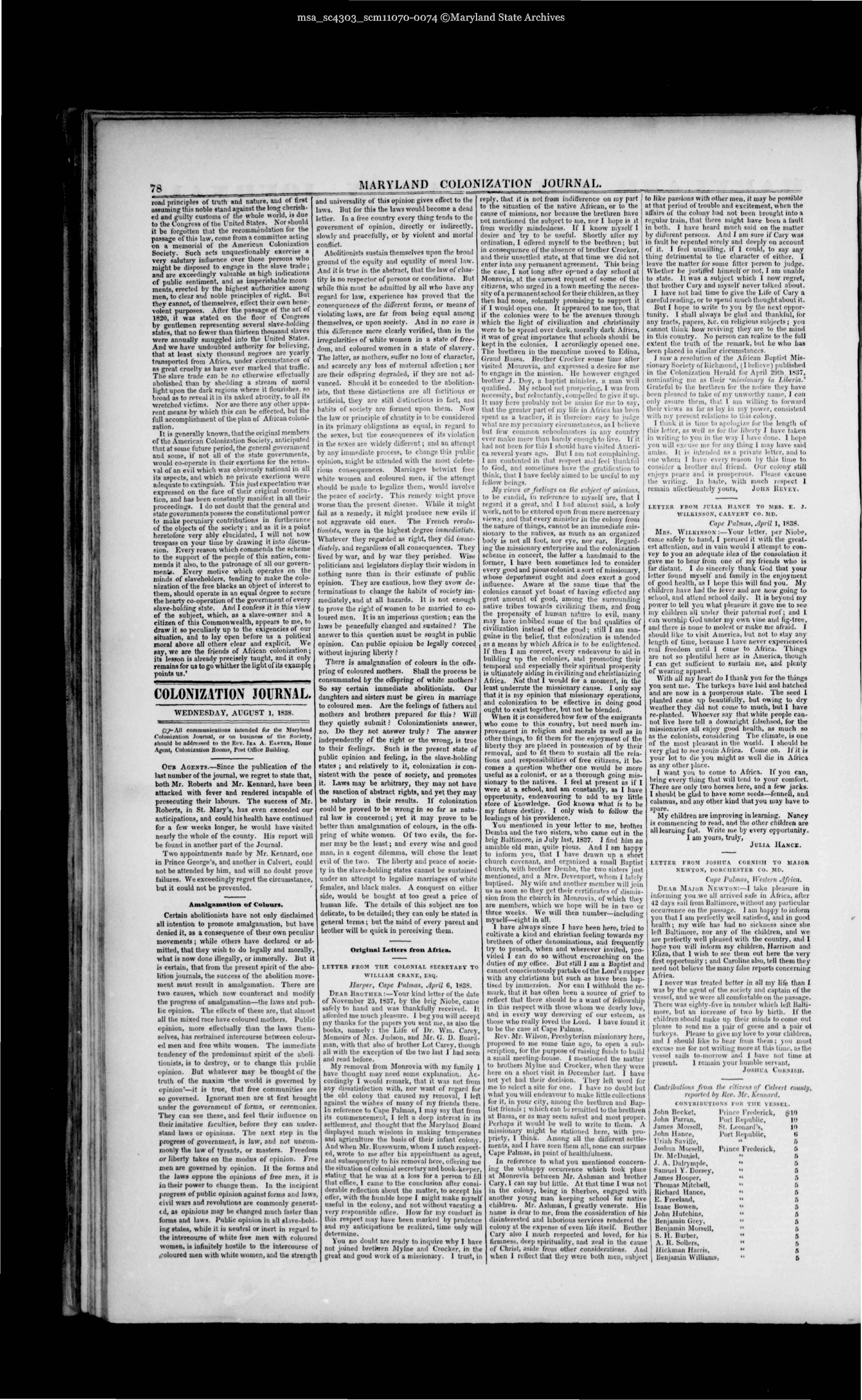
| 78 road principles of truth and nature, and of first assuming this noble stand against the long cherish- ed and guilty customs of the whole world, is due to the Congress of the United States. Nor should it be forgotten that the recommendation for the passage of this law, come from a committee acting on a memorial of the American Colonization Society. Such acts unquestionably exercise a very salutary influence over those persons who might be disposed to engage in the shue trade; and are exceedingly valuable as high indications of public sentiment, and as imperishable monu raents, erected by the highest authorities among men, to clear and noble principles of right. But they cannot, of themselves, effect their own bene- volent purposes. After the passage of the act of 1820, it was stated on the floor of Congress by gentlemen representing several slave-holding states, that no fewer than thirteen thousand slaves were annually smuggled into the United States. And we have undoubted authority for believing, that at least sixty thousand negroes are yearly transported from Africa, under circumstance of as great cruelty as have ever marked that tratlic. The slave trade can be no otherwise effectually abolished than by shedding a stream of moral light upon the dark regions where it nourishes, so broad as to reveal it in its naked atrocity, to all its wretched victims. Nor are there any other appa- rent means bv which this can be effected, but the full accomplishment of the plan of African coloni- zation. It is generally known,thatthe original members of the American Colonization Society, anticipated that at some future period, the general government and some, if not all of the state governments, would co-operate in their exertions for tlio remo- val of an evil which was obviously national in all its aspects, and which no private exertions were adequate to extinguish. This just expectation was expressed on the face of their original eonstitu- tion, and has been constantly manifest in all their proceedings. I do not doubt that the general and state governments possess the constitutional power to make pecuniary contributions in furtherance of the objects of the society ; and as it is a point heretofore very ably elucidated, I will not now trespass on your time by drawing it into discus- sion. Every reason which commends the scheme to the support of the people of this nation, com- mends it also, to the patronage of all our govern- ments. Every motive which operates on the minds of slaveholders, tending to make the colo- nization of the free blacks an object of interest to them, should operate in an equai degree to secure the heartv co-operation of the government of every slave-holding state. And I confess it is this view of the subject, which, as a slave-owner and a citizen of this Commonwealth, appears to me, to draw it so peculiarly up to the exigencies of our situation, and to lay open before us a political moral above all others clear and explicit. We say, we are the friends of African colonization; its lesson is already precisely taught, and it only remains for us to go whither the light of its example points us.' MARYLAND COLONIZATION JOURNAL. COLONIZATION JOURNAL, WEDNESDAY, AUGUST 1, 1838. All communications intended for the Maryland Colonization Journal, or on business of the Society, should be addressed to the Rev. Ira A. Easter, Home Agent, Colonization Rooms, Post Office Building. Our Agents.—Since the publication of the last number of the journal, we regret to state that, both Mr. Roberts and Mr. Kennard, have been attacked with fever and rendered incapable of prosecuting their labours. The success of Mr. Roberts, in St. Mary's, has even exceeded our anticipations, and could his health have continued for a few weeks longer, he would have visited nearly the whole of the county. His report will be found in another part of the Journal. Two appointments made by Mr. Kennard, one in Prince George's, and another in Calvert, could not be attended by him, and will no doubt prove failures. We exceedingly regret the circumstance, but it could not be prevented. Amalgamation of Colours, Certain abolitionists have not only disclaimed all intention to promote amalgamation, but have denied it, as a consequence of their own peculiar movements ; while others have declared or ad- mitted, that they wish to do legally and morally, what is now done illegally, or immorally. Rut it is certain, that from the present spirit of the abo- lition journals, the success of the abolition move- ment must result in amalgamation. There are two causes, which now counteract and modify the progress of amalgamation—the laws and pub- lic opinion. The ellects of these are, that almost all the mixed race have coloured mothers. Public opinion, more effectually than the laws them- selves, has restrained intercourse between colour- ed men and free white women. The imtmditto tendency of the predominant spirit of the aboli- tionists, is to destroy, or to change this public opinion. But whatever may be thought of the truth of the maxim 'the world is governed by opinion'—it is true, that free communities are eo governed. Ignorant men are at first brought under the government of forms, or ceremonies. They can see these, and feel their influence on their imitative faculties, before they can under- stand laws or opinions. The next step in the progress of government, is law, and not uncom- monly the law of tyrants, or masters. Freedom or liberty takes on the modus of opinion. Free men are governed by opinion. It the forms and the laws oppose the opinions of free men, it is in their power to change them. In the incipient progress of public opinion against forms and laws, civil wars aud revolutions are commonly generat- ed, as opinions may be changed much taster than forms and laws. Public opinion in all alive-hold- ing states, while it is neutral or inert in regard to the intercourse of white free men with coloured women, is infinitely hostile to the intercourse of ,-objured men with white women,and the strength and universality of this opinion gives effect to the law s. But for this the laws would become a dead letter. In a free country every thing tends to the government of opinion, directly or indirectly, slowly and peacefully, or by violent and mortal conflict. Abolitionists sustain themselves upon the broad ground of the equity and equality of moral law. And it is true in the abstract, that the law of chas- tity is no rccpeetof of persons or conditions. But while this must be admitted by all who have any regard for law, experience has proved that the consequences of the different forms, or meaii3 of violating laws, are far from being equal among themselves, or upon society. And in no case is this difference more clearly verified, than in the irregularities of white women in a stale of free- dom, and coloured women in a state of slavery. The hitler, as mothers, suffer no loss of character, aud scarcely any loss of maternal affection ; nor are their offspring; degraded, if they are not ad- vanced. Should it be conceded to the abolition- ists, that these distinctions are all factitious or artificial, they are still distinctions in fact, and habits of society are formed upon thorn. Now the law or principle of chastity is to be considered in its primary obligations as equal, in regard to the sexes, but the consequences of its violation in the sexes are widely different; and an attempt by any immediate process, to change this public opinion, might be attended with the most delete- rious consequences. Marriage! betwixt free white women and coloured men, if the attempt should be made to legalize them, would involve the peace of society. This remedy might prove worse than the present disease. While it might fail as a remedy, it might produce new evils if not aggravate old ones. The French revolu- tionsts, were in the highest degree immediatists. Whatever they regarded as right, they did imme- diately, and regardless of all consequences. They lived by war, and by war they perished. Wise politicians and legislators display their wisdom in nothing more than in their estimate of public opinion. They are cautious, how they avow de- terminations to change the habits of society im- mediately, and at all hazards. It is not enough to prove the right of women to be married to co- loured men. It is an imperious question; can the laws be peacefully changed and sustained .' The answer to this question must be sought in public opinion. Can public opinion be legally coerced without injuring liberty.' There is amalgamation of colours in the offs- pring of coloured mothers. Shall the process be consummated by the offspring of white mothers I So say certain immediate abolitionists. Our daughters and sisters must be given in marriage to coloured men. Are the feelings of fathers aud mothers and brothers prepared for this ? Will they quietly submit '. Colouizationists answer, no. Do they not answer truly.' The answer independently of the right or the wrong, is true to their feelings. Such is the present state of public opinion and feeling, in the slave-holding states ; and relatively to it, colonization is con- sistent with the peace of society, and promotes it. Laws may be arbitrary, they may not have the sanction of abstract rights, and yet they may be salutary in their results. If colonization could be proved to be wrong in so far as natu- ral law is concerned ; yet it may prove to be better than amalgamation of colours, in the offs- pring of white women. Of two evils, the for- mer may be the least; and every wise and good man, in a cogent dilemma, will chose the least evil of the two. The liberty and peace of socie- ty in the slave-holding states cannot be sustained under an attempt to legalize marriages of white females, ami black males. A conquest on cither side, would be bought at too great a price of human life. The details of this subject are too delicate, to be detailed; they can only be stated in general terms ; but the mind of every parent and brother will be quick in perceiving them. Original Letters iron Africa. LETTER FROM THE COLONIAL SECRETARY TO WILLIAM CRANE, ESQ. Harper, Cape Palmas, April 6, 1838. Dear Brother:—Your kind letter of the date of November 23, 1837, by the brig Niohe, came safely to hand and was thankfully received. It afforded ine much pleasure. 1 begyou will accept my thanks fur the papers you sent me. as also the books, namely: the Life of Dr. Win. Carey, Memoirs of .Mrs. Judsou, and Mr. G. D. Board- man, with that also of brother Lot Carey, though all with the exception of the two last 1 had seen and read before. My removal from Monrovia with my family 1 have tin.ught may need some explanation. Ac- cordingly 1 would remark, that it was not from any dissatisfaction with, nor want of regard (or the old colony that caused my removal, I left again-t the wishes of many of my friends there. In reference to Cape Palmas, 1 may say that from its commencement, 1 lelt a deep interest in its settlement, and thought that the Maryland Board displayed much wisdom in making temperance ami agriculture tin- bseisof llieir infant colony. And when Mr. Russwurm, whom I much rcspec't- ed, wrote to me after bis appointment as agent, and subsequently to his removal here, offering Be the situation of colonial secretary ami book-keeper, stating that lie was at a loss for a person to (ill that office, 1 came to the conclusion after consi- derable reflection about the matter, to accept his oiler, with the humble hope 1 might make myself useful in the colony, and not without vacating a very responsible office. How far my conduct in this respect may have been marked by prudence and my anticipations be realized, time only will determine. You no doubt are ready to inquire why I have not joined brethren Mylne and Crocker, in the great and good work of a missionary. 1 trust, in reply, that it is not from indifference on my part to the situation of the native African, or to the cause of missions, nor because the brethren have not mentioned the subject to me, nor I hope is it from worldly mindedness. If I know myself I desire and try to be useful. Shortly after my ordination, I offered myself to the brethren; but in consequence of the absence of brother Crocker, and their unsettled state, at that time we did not enter into any permanent agreement. This being (lie ease, I not long alter op"ned a day school at Monrovia, at the earnest rctpicst of some of the citizens, who urged in a town meeting the neces- sity of a permanent school for their children, as they then had none, solemnly promising to support it if I would open one. It appeared to me too, that if the colonies were to be the avenues through which the light of civilization and Christianity were to be spread over dark, morally dark Africa, it was of great importance that schools should be kept in the colonies. I accordingly opened one. The brethren in the meantime moved to i'.iliua, Grand Bassa. Brother Crocker some time after visited Monrovia, and expressed a desire for me to engage in the mission, lie however engaged brother J. Doy, a baptist minister, a man Wt II qualified. My school not prospering, I was from in n mtty, but reluctantly, compelled to give it up. 1* may here probably not be amiss for me to say, that the greater part of my life in Africa has been spent as a teacher, it is therefore easy to judge what are my pecuniary circumsl mees, as I believe but lew common schoolmasters in any country ever make more than bin ly enough to live. If it had not been lor lids i should have visited Ai.n-ri- Ba sni ml years ago. JSut I am not complaining. I am contented in that respect and feel thankful to God, ami sometimes have the gratification to think, that 1 have feebly aimed to be useful to my fellow beings, My views or feelings on the subject of missions, to be candid, in reference to myself are, that I regard it a great, and 1 bad almost said, a holy work, not to be entered upon from mere mercenary iie»s; and that every minister in the colony from the nature of things, cannot be an immediate mis- sionary to the natives, as much as an organized body is not all foot, nor eye, nor ear, Regard- ing the missionary enterprise and the colonization scheme in concert, the latter a handmaid to the former, 1 have been sometimes led to consider every good and pious colonist a.sort of missionary, whose deportment ought and does exert a good influence. Aware at the same time that the colonies cannot yet boast of having effected any- great amount of good, among the surrounding native tribes towards civilizing them, and from the propensity of human nature lo evil, many may have imbibed some of the bad qualities of civilization instead of the good; still I am san- guine in the belief, that colonization is intended as a means by which Africa is to he enlightened. If then I am correct, every endeavour to aid in building up the colonies, and promoting their temporal aud especially their spiritual prosperity is ultimately aiding in civilizing ami christianizing Africa. Not that 1 would for a moment, in the least underrate the missionary cause. I only say that it is my opinion that missionary operations, and colonization to be effective in doing good ought to exist together, but not be blended. When it is considered how few of the emigrants who come to this country, but need much im- provement in religion anil morals as well as in other things, to fit them for the enjoyment of the liberty they are placed ill possession of by their removal, and to fit (hem to sustain all the rela- tions and responsibilities of free citizens, it be- comes a question whether one would be more- useful as a colonist, or as a thorough going mis- sionary to the natives. I feel at present as if I were at a school, and am constantly, as I have opportunity, endeavouring to add to my little store of knowledge. God knows what is to be my future destiny. I only wish to follow the leadings of his providence. You mentioned in your letter to me, brothet Detnba and the two sisters, who came out in the brig Baltimore, in July last, 1837. I find him an amiable old man, quite pious. And I am happy to inlbrm you, that I have drawn up a short church covenant, and organized a small Baptist church, with brother Demba, the two sisters just mentioned, and a Mrs. Devenport, whom 1 lately baptised. My wife and another member w ill join us as soon so they get their certificates of dismis- sion from the church in Monrovia, of which they are members, which we hope will be in two of three weeks. We will then number—including myself—eight in all. 1 have always since I have been here, tried to cultivate a kind and christian feeling towards my brethren of other denominations, and frequently try to preach, when and wherever invited, pro- vided I can do so without encroaching on the duties of my offset. Rut still I am a Baptist and cannot conscieiitously partake of the Lord's supper with any christians but such as have been iiaii- tised by ilium i-ion. Nor can 1 withhold the re- mark, that it has often been a source of grief to reflect that there should be a want of fellowship in this respect with those whom we dearly love, and in eveiy way deserving of our esteem, as those who really loved the Lord. 1 have found it to be the case at Cape Palmas. Rev. Mr. Wilson, Presbyterian missionary here, proposed to me some time ago, to open a sub- scription, for the purpose of raising funds to build a small meeting-house. 1 mentioned the matter to brothers M)lue and Crocker, when they were here on a short wsil in December last. 1 have- not yet had their decision. They left word for tin- lo select a site for one. I have no doubt but what you will endeavour to make little collections for it, in your city, among the brethren and Bap- tist friends; Which Can be remitted to the brethren at Bam, or as may seem safest aud most proper. Perhaps it would be well to write to them. A missionary might be stationed here, with pro- priety, 1 think. Among all the different settle- ments, and I have seen them all, none can surpass Cape Palmas, in point of healthluliicss. in reference to what you mentioned concern- ing the unhappy occurrence which took place at Monrovia between Mr, Ashman and brother Gary, 1 can say but little. At that time 1 was not in the colony, being in Sherbro, engaged with another young man keeping school lor native children. Mr. Ashman, I greatly venerate. His name is dear to me, from the consideration of his disinterested and laborious services rendered (he colony at the BXpeass of even life itself. Brother Gary also I much respected and loved, for his Irmness, deep spirituality, and zeal in tire cause of Christ, aside from other considerations. And when 1 reflect that they weic both men, subject to like passions with other men, it may be possible at that period of trouble and excitement, when the affairs of the colony bad not been brought into a regular train, that there might have been a fault in both. I have heard much said on the matter by different persons. And I am sure if Gary was in fault he repented sorely and deeply on account of it. 1 feci unwilling, if I could, to say any thing detrimental to the character of either. I leave the matter for some fitter person to judge. Whether lie justified himself or not, 1 am unable to state. It was a subject which 1 now regret, that brother Gary and myself never talked about. I have not had time to give the Idle of Gary a Careful reading, or to spend much thought about it. But I hope lo write to you by the next oppor- tunity. I shall always be glad and thankful, for any tracts, papers, Ccc. on religious subjects; you cannot think how reviving they are to the mind in this country. No person can realize to the full extent the truth of tlie remark, but he who has been placed in similar circumstances. 1 saw a resolution of the African Baptist Mis- sionary Society of Richmond, (1 believe) published in the Colonization Herald for April 29th 1837, nominating me as their 'missionary in Liberia.' Grateful to the brethren for the notice they have been pleased io take of my unworthy nam'-, I can only assure them, (hat I am willing to forward tlnir vi-ws as far as lay in my power, consistent with my present n lations to this colony. I think it is time to apologize for the length of this tetter, as well as for the liberty 1 have taken in writing to yon in the way 1 have done. I hope you will excuse me lor any thing 1 may have said amiss. It i- intended as a private letter, and to ine whom I bare ever) reason by this time to consider a brother and friend. Our colony still enjoys peace and is prosperous. Please excuse tin- writing. In haste, with much respect 1 remain affectionately yours, John Revey. LETTER FROM JULIA HANCE TO MRS. E. J. WILKINSON, CALVERT CO. MD. Cape Palmas, April 1, 1838. Mrs. Wilkinson:—Your letter, per Niobe, came safely to hand, I perused it with the great- est attention, and in vain would I attempt to con- vey to you an adequate idea of the consolation it gave me to hear from one of my friends wdio is far distant. I do sincerely thank God that jour letter found myself and family in the enjoyment of good health, as I hope this will find you. My children have had the lever and arc now going to school, and attend school daily. It is beyond my power to tell you what pleasure it gave me to see my children all under their paternal roof; and 1 can worship God under my own vine and fig-tree, and there is none to molest or make me afraid. 1 should like to visit America, but not to stay any length of time, because 1 have never experienced real freedom until I came to Africa. Things are not so plentiful here as in America, though I can get sufficient to sustain me, and plenty of wearing apparel. Willi all my heart do I thank you for the things you sent me. The turkeys have laid and hatched and are now in a prosperous state. The seed 1 planted came u)i beautifully, but owing to dry weather they did not come to much, but 1 have re-planted. Whoever say that white people can- not live here tell a downright f.dsebsod, for the missionaries all enjoy good health, as much so as the colonists, considering The climate, is one of the most pleasant in the world. 1 should be very glad to see youiii Africa. Come on. if it is your lot to die you might as well die in Africa as any other place. I want you to come to Africa. If you can, bring every thing that will tend to your comfort. There are only two horses here, and a lew jacks. I should be glad to have some seeds—fennell, and calamus, and any other kind that you may have to spare. My children are improving in learning. Nancy is commencing to read, and the other children are allleeming fast. Write me by every opportunity. I am yours, truly, JULIA Hance. LETTER FROM JOSHUA CORNISH TO MAIOR NEWTON, DORCHESTER CO. MD. Cape Palmes, Western Africa. Dear Major Newton:—1 take pleasure in informing you .We all arrived safe ill Africa, after 42 days sail from Baltimore, without any particular occurrence on the passage 1 am happy to inform you that 1 am perfectly well satisfied, and in good health; my wife has had no sickness since she lelt Baltimore, nor any of the children, and we are perfectly well pleased with the country, and I hope you will inform my children, Harrison ami F.hza, that 1 wish to see them out here the very first Opportunity! and Caroline also, tell them they need not believe the many false reports Concerning Africa. 1 never was treated better in all my lira than I was by the agent of tin- soc iety and captain of the vessel, and we were all comfortable on the passage. 'II.i re was I ighly-live in number which lelt Balti- more, but an increase of two by birth. If the children should make up their Bunds to come out pleSSS to send me a pair of geese and a pair ol turkeys. Please to give my love to your children, and 1 should like to hear trees them; \<>u must excuse nn- lor not writing more at this lime, as the vessel sails to-morrow and 1 have not lime at present. 1 remain your bumble servant, Joshua Cornish Contributions from the citizens of Calvert county, reported by Rev. Mr. Kennard. CONTRIBUTIONS FOR THE VESSEL. John Becket, Prince Frederick, Port Republic, St. Leonard's, Port Republic, " Prince Frederick, $10 John Parran. 10 James Morsell, 10 John Hance, 6 Uriah Saville, 5 Joshua Morsell, 5 Dr. McDaniel, " 5. J. A. Dalrymple, " 5 Samuel Y. Dorsey, " 5 James Hooper, " 5 Thomas Mitchell, " 5 Richard Hance, " 5 E. Freeland, " 5 Isaac Bowen, " 5 John Hutchins, " 5 Benjamin Grey. " 5 Benjamin Morsell, " 5 S. H. Barber, " 5 A. R. Sollers, " 5 Hickman Harris. " 5 Benjamin Williams, " 5 |