 |
|
|
 |
|
 |
|
|||
|
||||
|
||||
|
Maryland State Archives Maryland Colonization Journal Collection MSA SC 4303 msa_sc4303_scm11070-0078 Enlarge and print image (5M) |
|
|
|
|
|
|
|
|||
|
||||
|
||||
|
Maryland State Archives Maryland Colonization Journal Collection MSA SC 4303 msa_sc4303_scm11070-0078 Enlarge and print image (5M) |
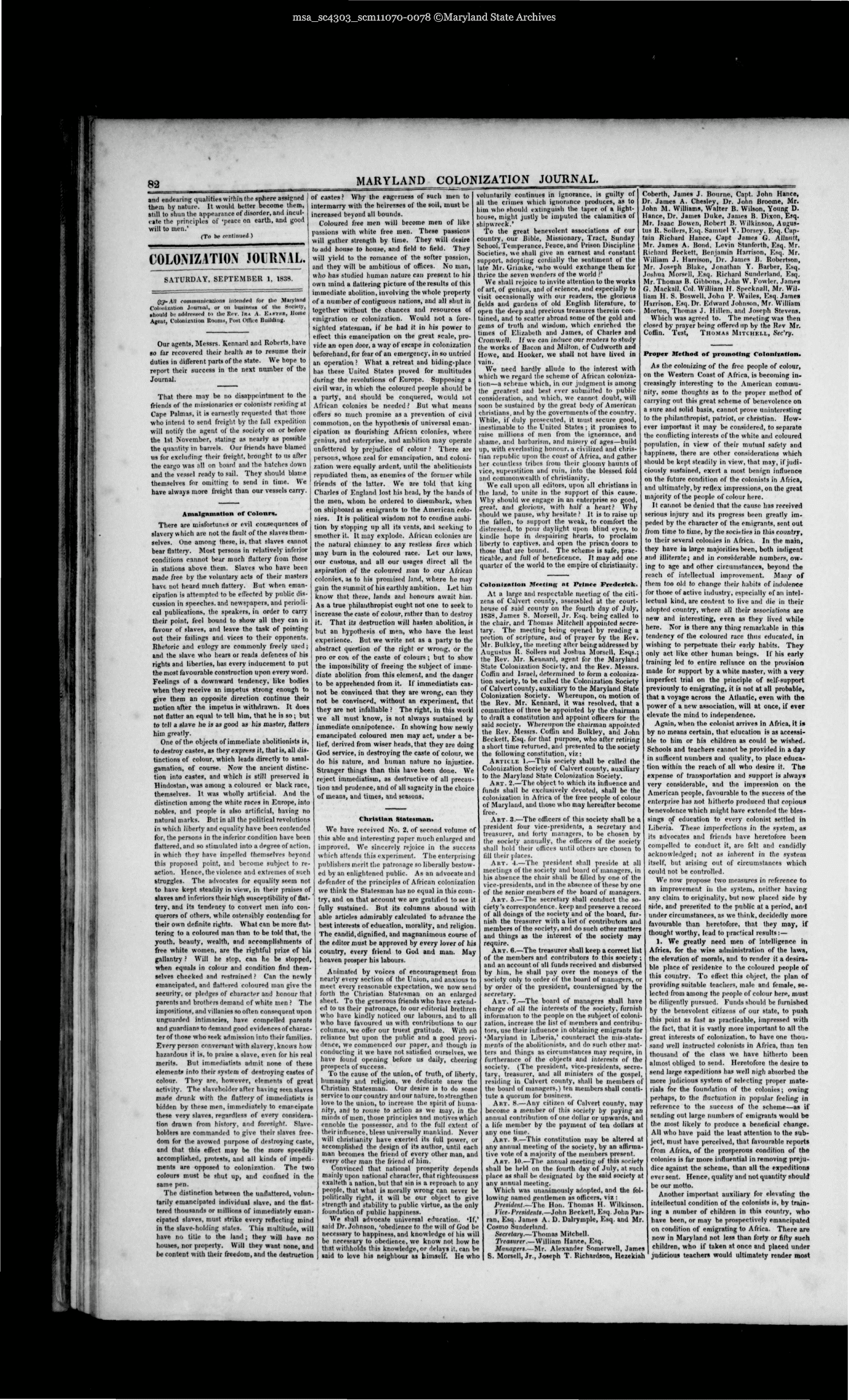
| and endearing qualities within the sphere assigned them by nature. It would better become them, still to shun the appearance of disorder, and incul- cate the principles of 'peace on earth, and good will to men.' (To be continued. ) COLONIZATION JOURNAL. SATURDAY, SEPTEMBER 1, 1838. MARYLAND COLONIZATION JOURNAL. All communications intended for the Maryland Colonization Journal, or on business of the Society, should be addressed to the Rev. Ira A. EASTER, Home Agent, Colonization Rooms, Post Office Building. Our agents, Messrs. Kennard and Roberts, have so far recovered their health as to resume their duties in different parts of the state. We hope to report their success in the next number of the Journal. That there may be no disappointment to the friends of the missionaries or colonists residing at Cape Palmas, it is earnestly requested that those who intend to send freight by the fall expedition will notify the agent of the society on or before the 1st November, stating as nearly as possible the quantity in harrels. Our friends have blamed us for excluding their freight, brought to us after the cargo was all on board ami the hatches down and the vessel ready to sail. They should blame themselves for omitting to send in time. We have always more freight than our vessels carry. Amalgamation of Colours. There are misfortunes or evil consequences of slavery which are not the fault of the slaves them- selves. One among these, is, that slaves cannot bear flattery. Most persons in relatively inferior conditions cannot bear much flattery fiom those in stations above them. Slaves who have been made free by the voluntary acts of their masters have not heard much flattery. But when eman- cipation is attempted to be etl'ected by public dis- cussion in speeches, and newspapers, and periodi- cal publications, the speakers, in order to carry their point, feel bound to show all they can in favour of slaves, and leave the task of pointing out their failings and vices to their opponents. Rhetoric and eulogy are commonly freely used; and the slave who hears or reads defences of his rights and liberties, has every inducement to put the most favourable construction upon every word. Feelings of a downward tendency, like bodies when they receive an impetus strong enough to give them an opposite direction continue their motion after the impetus is withdrawn. It does not flatter an equal to tell him, that he is so; but to tell a slave he is as good as his master, flatters him greatly. One of the objects of immediate abolitionists is, to destroy castes, as they express it, that is, all dis- tinctions of colour, which leads directly to amal- gamation, of course. Now the ancient distinc- tion into castes, and which is still preserved in Hindostan, was among a coloured or black race, themselves. It was wholly artificial. And the distinction among the white races in Europe, into nobles, and people is also artificial, having no natural marks. But in all the political revolutions in which liberty and equality have been contended for, the persons in the inferior condition have been flattered, and so stimulated into a degree of action, in which they have impelled themselves beyond this proposed point, and become subject to re- action. Hence, the violence and extremes of such itruggles. The advocates for equality seem not to have kept steadily in view, in their praises of slaves and inferiors their high susceptibility of flat- tery, and its tendency to convert men into con- querors of others, while ostensibly contending for their own definite rights. What can be more flat- tering to a coloured man than to be told that, the youth, beauty, wealth, and accomplishments of free white women, are the rightful prize of his gallantry ? Will he stop, can he be stopped, when equals in colour and condition find them- selves checked and restrained? Can the newly emancipated, and flattered coloured man give the lecurity, or pledges of character and honour that parents and brothers demand of white men ? The impositions, and villanies so often consequent upon unguarded intimacies, have compelled parents and guardians to demand good evidences of charac- ter of those who seek admission into their families. Every person conversant with slavery, knows how hazardous it is, to praise a slave, even for his real merits. But immediatists admit none of these elements into their system of destroying castes of colour. They are, however, elements of great activity. The slaveholder after having seen slaves made drunk with the flattery of immediatists is bidden by these men, immediately to emancipate these very slaves, regardless of every considera- tion drawn from history, ami foresight. Slave- holders are commanded to give their slaves free- dom for the avowed purpose of destroying caste, and that this effect may be the more speedily accomplished, protests, and all kinds of impedi ments are opposed to colonization. The two colours must be shut up, and confined in the same pen. The distinction between the unflattered, volun- tarily emancipated individual slave, and the flat- tered thousands or millions of immediately eman- cipated slaves, must strike every reflecting mind in the slave-holding states. This multitude, will have no title to the land; they will have no houses, nor property. Will they want none, and he content with their freedom, and the destruction of castes? Why the eagerness of such men to intermarry with the heiresses of the soil, must be increased beyond all bounds. Coloured free men will become men of like passions with white free men. These passions will gather strength by time. They will desire to add house to house, and field to field. They will yield to the romance of the softer passion, and they will be ambitious of offices. No man, who has studied human nature can present to his own mind a flattering picture of the results of this immediate abolition, involving the whole property of a number of contiguous nations, and all shut in together without the chances and resources of emigration or colonization. Would not a fore- sightcd statesman, If he had it in his power to effect this emancipation on the great scale, pro- vide an open door, a way of escape in colonization beforehand, for fear of an emergency, in so untried an operation? What a retreat and hiding-place has these United States proved for multitudes during the revolutions of Europe. Supposing a civil war, in which the coloured people should be a party, and should be conquered, wculd not African colonies be needed ! But what means oilers so much promise as a prevention of civil commotion, on the hypothesis of universal eman- cipation as flourishing African colonies, where genius, and enterprise, and ambition may operate unfettered by prejudice of colour I There are persons, whose zeal for emancipation, and coloni- zation were equally ardent, until the abolitionists repudiated them, as enemies of the former while friends of the latter. We are told that king Charles of England lost his head, by the hands of the men, whom he ordered to disembark, when on shipboard as emigrants to the American colo- nies. It is political wisdom not to confine ambi- tion by stopping up all its vents, and seeking to smother it. It may explode. African colonies are the natural chimney to any restless fires which may burn in the coloured race. Let our laws, our customs, and all our usages direct all the aspiration of the coloured man to our African colonies, as to his promised land, where he may gain the summit of his earthly ambition. Let him know that there, lands and honours await him. As a true philanthropist ought not one to seek to increase the caste of colour, rather than to destroy it. That its destruction will hasten abolition, is hut an hypothesis of men, who have the least experience. But we write not as a party to the abstract question of the right or wrong, or the pro or con of the caste of colours ; but to show the impossibility of freeing the subject of imme- diate abolition from this element, and the danger to be apprehended from it. If immediatists can- not be convinced that they are wrong, can they not be convinced, without an experiment, th.t they are not infallable ? The right, in this world we all must know, is not always sustained by immediate omnipotence. In showing how newly emancipated coloured men may act, under a be- lief, derived from wiser heads, that they are doing God service, in destroying the caste of colour, we do his nature, and human nature no injustice. Stranger things than this have been done. We reject immediatisin, as destructive of all precau- tion and prudence, and of all sagacity in the choice of means, and times, and seasons, voluntarily continues in ignorance, is guilty of all the dimes which ignorance produces, as to him who should extinguish the taper of a light- house, might justly be imputed the calamities of shipwreck.' To the great benevolent associations of our country, our Bible, Missionary, Tract, Sunday School. Temperance, Peace, and Prison Discipline Societies, we shall give an earnest and constant support, adopting cordially the sentiment of the late Mr. Griuike, 'who would exchange them fur thrice the seven wonders of the world ?' We shall rejoice to invite attention to the works of art, of genius, and of science, and especially to visit occasionally with our readers, the glorious fields and gardens of old English literature, to open the deep and precious treasures therein con- tained, and to scatter abroad some of the gold and gems of truth and wisdom, which enriched the times of Elizabeth and James, of Charles and Cromwell. If we con induce our readers to study the works of Bacon and Milton, of Cudworth and Howe, and Hooker, we shall not have lived in vain. We need hardly allude to the interest with which we regard the scheme of African coloniza- tion?a scheme which, in our judgment is among the greatest and best ever submitted to public consideration, and which, we cannot doubt, will soon be sustained by the great body of American christians, and by the governments of the country. While, if duly prosecuted, it must secure good, inestimable to the United States ; it promises to raise millions of men from the ignorance, and shame, and barbarism, and misery of ages?build up, with everlasting honour, a civilized and chris- tian republic upon the coast of Africa, and gather her countless tribes from their gloomv haunts of vice, superstition and ruin, into the blessed fold and commonwealth of Christianity. We call upon all editors, upon all christians in the land, to unite in the support of this cause. Why should we engage in an enterprise fo good, great, anil glorious, with half a heart? Why should we pause, why hesitate ? It is to raise up the fallen, to support the weak, to comfort the distressed, to pour daylight upon blind eyes, to kindle hope in despairing hearts, to proclaim liberty to captives, and open the prison doors to those that are bound. The scheme is safe, prac- ticable, and full of beneficence. It may add one quarter of the world to the empire of Christianity. Coberth, James J. Bourne, Capt. John Hance, Dr. James A. Chesley, Dr. John Broome, Mr. John M. Williams, Walter B. Wilson, Young D. Hance, Dr. James Duke, James B. Dixon, Efq. Mr. Isaac Bowen, Robert B. Wilkinson, Augus- tus R. Sollers, Esq. Samuel Y. Dorsey, Esq. Cap- tain Richard Hance, Capt James G. Allnutt, Mr. James A. Bond. Levin Stanfnrth, Esq. Mr. Richard Beckett, Benjamin Harrison, Esq. Mr. William J. Harrison, Dr. James B. Robertson, Mr. Joseph Blake, Jonathan Y. Barber, Esq. Joshua Morsell, Esq. Richard Sunderland, Esq. Mr. Thomas B. Gibbons, John W. Kovvler, James G. Mackall. Col. William H. Specknall, Mr. Wil. liam H. S. Boswell, John P. Wailes, Esq. James Harrison. Esq. Dr. Edward Johnson, Mr. William Morton, Thomas J. Hillen. and Joseph Stevens. Which was agreed to. The meeting was then closed by prayer being offered up by the Rev Mr. Coffin. Test, Thomas Mitchell, Sec'ry. Christian Statesman. We have received No. 2, of second volume of this able and interesting paper much enlarged and improved. We sincerely rejoice in the success which attends (his experiment. The enterprising publishers merit the patronage so liberally bestow- ed by an enlightened public. As an advocate and defender of the principles of African colonization we think the Statesman has no equal in this coun- try, and on that account we are gratified to see it fully sustained. But its columns abound with able articles admirably calculated to advance the best interests of education, morality, and religion. The candid, dignified, and magnanimous course of the editor must be approved by every lover of his country, every friend to God and man. May heaven prosper his labours. Animated by voices of encouragement from nearly every section of the Union, and anxious to meet every reasonable expectation, we now send forth the Christian Statesman on an enlarged sheet. To the generous friends who have extend- ed to us their patronage, to our editorial brethren who have kindly noticed our labours, and to all who have favoured us with contributions to our columns, we offer our truest gratitude. With no reliance but upon the public and a good provi- dence, we commenced our paper, and though in conducting it we have not satisfied ourselves, we have (bund opening be/ore us daily, cheering prospects of success. To the cause of the union, of truth, of liberty, humanity and religion, we dedicate anew the Christian Statesman. Our desire is to do some service to our country and our nature, to strengthen love to the union, to increase the spirit of huma- nity, and to rouse to action as we may, in the minds of men, those principles and motives which ennoble the possessor, and to the full extent of their influence, bless universally mankind. Never will Christianity have exerted its full power, or accomplished the design of its author, until each man becomes the friend of every other man, and every other man the friend of him. Convinced that national prosperity depends mainly upon national character, that righteousness exalteth a nation, but that sin is a reproach to any people, that what is morally wrong can never be politically right, it will be our object to give strength and stability to public virtue, as the only foundation of public happiness. We shall advocate universal education. 'If,' said Dr. Johnson, 'obedience to the will of (Jod be necessary to happiness, and knowledge of his will be necessary to obedience, we know not how he that withholds this knowledge, or delays it, can be ?aid to love his neighbour as himself. He who Colonization Meeting at Prince Frederick. At a large and respectable meeting of the citi- zens of Calvert county, assembled at the court- house of said county on the fourth day of July, 1838, James S. Morsell, Jr. Esq. being called to the chair, and Thomas Mitchell appointed secre- tary. The meeting being opened by reading a portion of scripture, and of prayer by the Rev. Mr. Bulkley, the meeting after being addressed by Augustus R. Sellers and Joshua Morsell, Esqs.; the Rev. Mr. Kennard, agent for the Maryland State Colonization Society, and the Rev. Messrs. Coffin and Israel, determined to form a coloniza- tion society, to be called the Colonization Society of Calvert county, auxiliary to the Maryland State Colonization Society. Whereupon, on motion of the Rev. Mr. Kennard, it was resolved, that a committee of three be appointed by the chairman to draft a constitution and appoint officers for the said society. Whereupon the chairman appointed the Rev. Messrs. Coffin and Bulkley, and John Beckett, Esq. for that purpose, who after retiring a short time returned, and presented to the society the following constitution, viz: Article 1.?This society shall be called the Colonization Society of Calvert county, auxiliary to the Maryland State Colonization Society. Art. 2.?The object to which its influence and funds shall be exclusively devoted, shall be the colonization in Africa of the free people of colour of Maryland, and those who may hereafter become free. Art. 3.?The officers of this society shall be a president four vice-presidents, a secretary and treasurer, and forty managers, to be chosen by the society annually, the otlicers of the society shall hold their oltices until others are chosen to till their places. Art. 4.?The president shall preside at all meetings of the society and board of managers, in his absence the chair shall be tilled by one of the vice-presidents, and in the absence of these by one of the senior members of the board of managers. Art. 5.?The secretary shall conduct the so- ciety's correspondence, keep and preserve a record of all doings of the society and of the board, fur- nish the treasurer with a list of contributors and members of the society, and do such other matters and things as the interest of the society may require. Art. 6.?The treasurer shall keep a correct list of the members and contributors to this society ; and an account of all funds received and disbursed by him, be shall pay over the moneys of the society only to order of the board of managers, or by order of the president, countersigned by the secretary. Art. 7.?The board of managers shall have charge of all the interests of the society, furnish information to the people on the subject of coloni- zation, increase the list of members and contribu- tors, use their influence in obtaining emigrants for 'Maryland in Liberia,' counteract the mis-state- ments of the abolitionists, and do such other mat- ters and things as circumstances may require, in furtherance of the objects and interests of the society. (The president, vice-presidents, secre- tary, treasurer, and all ministers of the gospel, residing in Caivert county, shall be members of the board of managers,) ten members shall consti- tute a quorum lor business. Art. 8.?Any citizen of Calvert county, may become a member of this society by paying an annual contribution of one dollar or upwards, and a life member by the payment of ten dollars at any one time. Art. 9.?This constitution may be altered at any annual meeting of the society, by an affirma- tive vote of a majority of the members present. Art. 10.?The annual meeting of this society shall be held on the fourth day of July, at such place as shall be designateil by the said society at any annual meeting. Which was unanimously adopted, and the fol- lowing named gentlemen as officers, viz : President.?The Hon. Thomas H. Wilkinson. Vice-Presidents.?John Beckett, Esq John Par- ran, Esq. James A. D. Dalrymple, Esq, and Mr. Cosmo Sunderland. Secretary.?Thomas Mitchell. Treasurer.?William Hance, Esq. Managers.?Mr. Alexander Somerwell, James S. Morsell, Jr., Joseph T. Richardson, Hezekiah Proper Method of promoting Colonization. As the colonizing of the free people of colour, on the Western Coast of Africa, is becoming in- creasingly interesting to the American commu- nity, some thoughts as to the proper method of carrying out this great scheme of benevolence on a sure and solid basis, cannot prove uninteresting to the philanthropist, patriot, or christian. How- ever important it may be considered, to separate the conflicting interests of the white and coloured population, in view of their mutual safety and happiness, there are other considerations which should be kept steadily in view, that may, il judi- ciously sustained, exert a most benign influence on the future condition of the colonists in Africa, and ultimately, by reflex impressions, on the great majority of the people of colour here. It cannot be denied that the cause has received serious injury and its progress been greatly im- peded by the character of the emigrants, sent out from time to time, by the societies in this country, to their several colonies in Africa. In the main, they have in large majorities been, both indigent and illiterate; and in considerable numbers, ow- ing to age and other circumstances, beyond the reach of intellectual improvement. Many of them too old to change their habits of indolence tor those of active industry, especially of an intel- lectual kind, are content to live and die in their adopted country, where all their associations are new and interesting, even as they lived while here. Nor is there any thing remarkable in this tendency of the coloured race thus educated, in wishing to perpetuate their early habits. They only act like other human beings. If his early training led to entire reliance on the provision made for support by a white master, with a very imperfect trial on the principle of self-support previously to emigrating, it is not at all probable, that a voyage across the Atlantic, even with the power of a new association, will at once, if ever elevate the mind to independence. Again, when the colonist arrives in Africa, it is by no means certain, that education is as accessi- ble to him or his children as could be wished. Schools and teachers cannot be provided in a day in sufikent numbers and quality, to place educa- tion within the reach of all who desire it. The expense of transportation and support is always very considerable, and the impression on the American people, favourable to the success of the enterprise has not hitherto produced that copious benevolence which might have extended the bles- sings of education to every colonist settled in Liberia. These imperfections in the system, as its advocates and friends have heretofore been compelled to conduct it, are felt and candidly acknowledged; not as inherent in the system itself, but arising out of circumstances which could not be controlled. We now propose two measures in reference to an improvement in the system, neither having any claim to originality, but now placed side by side, and presented to the public at a period, and under circumstances, as we think, decidedly more favourable than heretofore, that they may, if thought worthy, lead to practical results:? 1. We greatly need men of intelligence in Africa, for the wise administration of the laws, the elevation of morals, and to render it a desira- ble place of residence to the coloured people of this country. To effect this object, the plan of providing suitable teachers, male and female, se- lected from among the people of colour here, must be diligently pursued. Funds should be furnished by the benevolent citizens of our state, to push this point as fast as practicable, impressed with the fact, that it is vastly more important to all the great interests of colonization, to have one thou- sand well instructed colonists in Africa, than ten thousand of the class we have hitherto been almost obliged to send. Heretofore the desire to send large expeditions has well nigh absorbed the more judicious system of selecting proper mate- rials for the foundation of the colonies; owing perhaps, to the fluctuation in popular feeling in reference to the success of the scheme?as if sending out large numbers of emigrants would be the most likely to produce a beneficial change. All who have paid the least attention to the sub- ject, must have perceived, that favourable reports from Africa, of the prosperous condition of the colonies is far more influential in removing preju- dice against the scheme, than all the expeditions ever sent. Hence, quality and not quantity should be our motto. Another important auxiliary for elevating the intellectual condition of the colonists is, by train- ing a number of children in this country, who have been, or may be prospectively emancipated on condition of emigrating to Africa. There are now in Maryland not less than forty or fifty such children, who if taken at once and placed under judicious teachers would ultimatety render most 82 |