 |
|
|
 |
|
 |
|
|||
|
||||
|
||||
|
Maryland State Archives Maryland Colonization Journal Collection MSA SC 4303 msa_sc4303_scm11070-0113 Enlarge and print image (5M) |
|
|
|
|
|
|
|
|||
|
||||
|
||||
|
Maryland State Archives Maryland Colonization Journal Collection MSA SC 4303 msa_sc4303_scm11070-0113 Enlarge and print image (5M) |
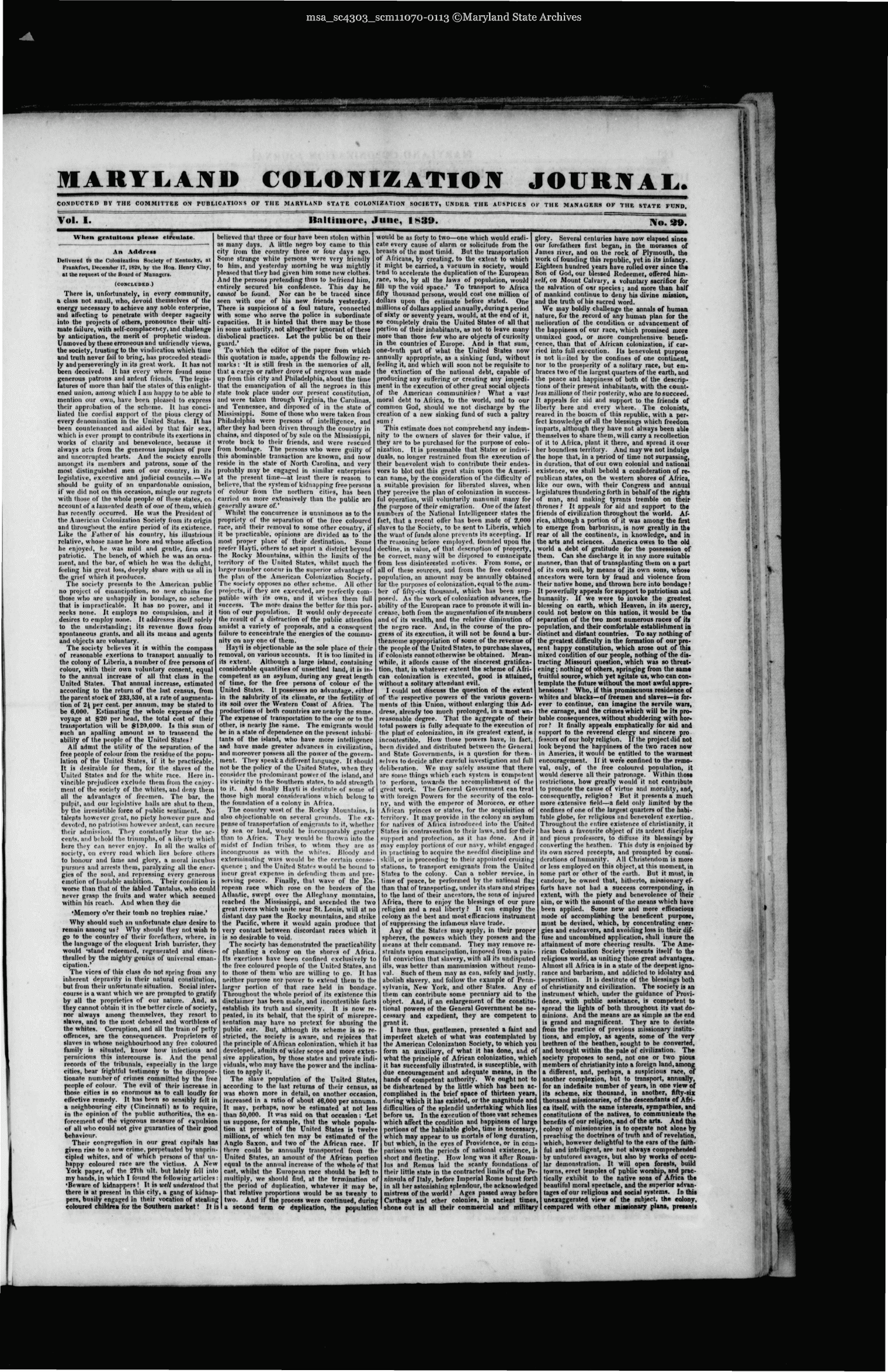
| MARYLAND COLONIZATION JOURNAL. CONDUCTED BY THE COMMITTEE ON PUBLICATIONS OF THE MARYLAND STATE COLONIZATION SOCIETY, UNDER THE AUSPICES OK THE MANAGERS OF THE STATE FUND Vol. I. Baltimore, June, 1839. No. 29. When gratuitous please circulate. An Address Delivered to the Colonization Society of Kentucky, at Frankfort, December 17, 1829, by the Hon Henry Clay, at the request of the Board of Managers. (CONCLUDED.) There is, unfortunately, in every community, a class not small, who, devoid themselves of the energy necessary to achieve any noble enterprise, and affecting to penetrate with deeper sagacity into the projects of others, pronounce their ulti- mate failure, with self-complacency,and challenge by anticipation, the merit of prophetic wisdom. Unmoved by these erroneous and unfriendly views, the society, trusting to the vindication which time and truth never fail to bring, has proceeded steadi- ly and perseveringly in its great work. It has not been deceived. It has every where found some generous patrons and ardent friends. The legis- latures of more than half the states of this enlight- ened union, among which I am happy to be able to mention our own, have been pleased to express their approbation of the scheme. It has conci- liated the cordial support of the pious clergy of every denomination in the United States. It has been countenanced and aided by that fair sex, which is ever prompt to contribute its exertions in works of charity and benevolence, because it always acts from the generous impulses of pure and iincomipted hearts. And the society enrolls amongst its members and patrons, some of the most distinguished men of our country, in its legislative, executive ami judicial councils.—We should he guilty of an unpardonable omission, if we did not on this occasion, mingle our regrets with those of the whole people of these states, on account of a lamented death of one of them, which has recently occurred. He was the President of the American Colonization Society from its origin and throughout the entire period of its existence. Like the Father of his country, his illustrious relative, whose name he bore and whose affection he enjoyed, he was mild and gentle, firm and patriotic. The bench, of which he was an orna- ment, and the bar, of which he was the delight, feeling his great loss, deeply share with us all in the grief which it produces. The society presents to the American public no project of emancipation, no new chains for those who are unhappily in bondage, no scheme that is impracticable. It has no power, and it seeks none. It employs no compulsion, and it desires to employ none. It addresses itself solely to the understanding; its revenue flows from spontaneous grants, and all its means and agents and objects are voluntary. The society believes it is within the compass of reasonable exertions to transport annually to the colony of Liberia, a number of Tree persons of colour, with their own voluntary consent, equal to the annual increase of all that class in the United States. That annual increase, estimated according to the return of the last census, from the parent stock of 233,530, at a rate of augmenta- tion of 24 per cent, per annum, may be staled to be 6,000. Estimating the whole expense of the voyage at $20 per head, the total cost of their transportation will be $120,000. Is this sum of such an apalling amount as to transcend the ability of the people of the United States! All admit the utility of the separation of the free people of colour from the residue of the popu- lation of the United States, if it be practicable. It is desirable for them, for the slaves of the United States and for the white race. Here in- vincible prejudices exclude them from the enjoy- ment of the society of the whites, and deny them all the advantages of freemen. The bar, the pulpit, anil our legislative halls are shut to them. by the irresistible force of public sentiment. No talents however greet, no piety however pure and devoted, no patriotism however ardent, can secure their admission. They constantly hear the ac- cents, and be hold the triumphs, of a liberty which here they can never enjoy. In all the walks of society, on every road which lies before others to honour and lame and glory, a moral incubus pursues and arrests them, paralyzing all the ener- gies of the soul, and repressing every generous emotion of laudable ambition. Their condition is worse than that ol the labled Tantalus, who could never grasp the fruits and water which seemed within his reach. And when they die 'Memory o'er their tomb no trophies raise.' Why should such an unfortunate class desire to remain among us? Why should they not wish lo go to the country of their forefathers, where, in the language of the eloquent Irish barrister, they would 'stand redeemed, regeneiated and disen- thralled by the mighty genius of universal eman- cipation.' The vices of this class do not spring from any inherent depravity in their natural constitution, but from their unfortunate situation. Social inter- course is a want which we are prompted to gratify by all the proprieties of our nature. And, as they cannot obtain it in the better circle of society, nor always among themselves, they resort to slaves, and to the most debased and worthless of the whites. Corruption, and all the train of petty offences, are the consequences. Proprietors of slaves in whose neighbourhood any free coloured family is situated, know how inlectious and pernicious this intercourse is. And the penal records of the tribunals, especially in the large cities, bear frightful testimony to the dispropor- tionate number of crimes committed by the free people of colour. The evil of their increase in those cities is so enormous as to call loudly for effective remedy. It has been so sensibly felt in a neighbouring city (Cincinnati) as to require, in the opinion of the public authorities, the en- forcement of the vigorous measure of eapulsion of all who could not give guaranties of their good behaviour. Their congregation in our great capitals has given rise to a new crime, perpetuated by unprin- cipled whites, and of which persons of thai un- happy coloured race are the victims. A New York paper, of the 27th nit. but lately fell into my hands, in which I found the following articles: 'Beware of kidnappers ! It is vail understood that there is at present in this city, a gang of kidnap- pers, busily engaged in their vocation of stealing coloured children for tbe Southern market! It is believed thai three or four have been stolen within as many days. A little negro boy came to this city lrom the country three or tour days ago. Some strange white persons were very Iriendly to him, and yesterday morning he was mightly pleased that they had given him some new clothes. And the persons pretending thus to befriend him, entirely secured his confidence. This day he cannot be Ibund. Nor can he be traced since seen with one of his new friends yesterday. There is suspicions of a foul nature, connected with some who serve the police in subordinate capacities. It is hinted that there may be those in some authority, not altogether ignorant of these diabolical practices. Let the public be on their guard.' To which the editor of the paper from which this quotation is made, appends tile following re- marks : 'It is still fresh in the memories of all, that a cargo or rather drove of negroes was made up from this city and Philadelphia, about the time that the emancipation of all the negroes in this state took place under our present constitution, and were taken through Virginia, the Carolinas, and Tennessee, and disposed of in the state of Mississippi. Some of those who were taken from Philadelphia were persons of intelligence, and after they bad been driven through the country in chains, and disposed of by sale on the Mississippi, wrote back to their friends, and were rescued from bondage. The persons who were guilty of this abominable transaction are known, and now reside in the state of North Carolina, and very probably may be engaged in similar enterprises at the present time—at least there is reason to believe, that the system of kidnapping free persons of colour from the northern cities, has been carried on more extensively than the public arc generally aware of.' Whilst the concurrence is unanimous as to the propriety of the separation of the Iree coloured race, and their removal to some other country, if it be practicable, opinions are divided as to the most proper place of their destination. Some prefer Hayti. others to set apart a district beyond the Rocky Mountains, within the limits of the territory of the United States, whilst much the 1 irger number concur in the superior advantage of the pi in of the American Colonization Society. The society opposes no other scheme. All other projects, if they are executed, are perfectly com- patible with its own, and it wishes them full success. The more drains the better for this por- tion of our population. It would only deprecate the result of a distraction of the public attention amidst a variety of proposals, and a consequent failure to concentrate the energies of the commu- nity on any one of them. Hayti is objectionable as the sole place of their removal, on various accounts. It is too limited in its extent. Although a large island, containing considerable quantities of unsettled land, it is in- competent as an asylum, during any great length of time, for the free persons of colour of the United States. It possesses no advantage, either in the salubrity of its climate, or the fertility of its soil over the Western Coast of Africa. The productions ol both countries arc nearly the same. The expense of transportation to the one or to the other, is nearly the same. The emigrants would be in a state of dependence on the present inhnbi tants of the island, who have more intelligence and have made greater advances in civilization, and moreover possess all the power of the govern- ment. They speak a different language. It should not be the policy of the United Slates, when they consider the predominant power of the island, and its vicinity to the Southern states, to add strength to it. And finally Hayti is destitute of s"ine of those high moral considerations which belong to the foundation of a colony in Africa. The country west of the Rocky Mountains, is also objectionable on several grounds. The ex- pense of transportation of emigrants to it, whether by sea or land, would be incomparably create! than to Africa. They would be thrown into the midst of Indian tribes, to whom they are as incongruous as with the whiles. Jiloody and exterminating wars would be the certain conse- quence ; and the United States would he hound to incur gnat expense in defending them ami pre- serving peace. Finally, that wave of the Ku- ropean race which rose on the borders of the Atlantic, swept over the Alleghany mountains, reached the Mississippi, and ascended the two great rivers which unite near St. Louis, will at no distant day pass the Rocky mountains, and strike the Pacific, where it would again produce that very contact between discordant races which it is so desirable to void. The society has demonstrated the practicability of planting a colony on the shores of Africa. Its exertions have been confined exclusively to the free coloured people of the United States, and to those of them who are willing to go. It has neither purpose nor power to extend them to the larger portion of that race held in bondage. Throughout the whole period of its existence this disclaimer has been made, and incontestible facts establish its truth and sincerity. It is now re- peated, in its behalf, that the spirit of misrepre- sentation may have no pretext for abusing the public ear. But, although its scheme is so re- stricted, the society is aware, and rejoices that the principle of African colonization, which it has developed, admits of wider scope and more exten- sive application, hy those states and private indi- viduals, who may have the power and the inclina- tion to apply it. The slave population of the United States, according to the last returns of their census, as was shown more in detail, on another occasion, increased in a ratio of about 46,000 per annumn. It may, perhaps, now be estimated at not less than 50,000. It was said on that occasion : 'Let us suppose, for example, that the whole popula- tion at present of the United States is twelve millions, of which ten may be estimated of the Anglo Saxon, and two of the African race. If there could be annually transported from the United States, an amount of the African portion equal to the annual increase of the whole of that cast, whilst the European race should be left to multiply, we should find, at the termination of the period of duplication, whatever it may be, that relative proportions would be as twenty to two. And if the process were continued, during a second term or duplication, the population would be as forty to two—one wliicli would eradi- cate every cause of alarm or solicitude from the breasts of the most timid. But the transportation of Africans, by creating, to the extent to which it might be carried, a vacuum in society, would tend to accelerate the duplication of the European race, who, by all the laws of population, would fill up the void space.' To transport to Africa fifty thousand persons, would cost one million of dollars upon the estimate before stated. One millions of dollars applied annually, during a period of sixty or seventy years, would, at the end of it, so completely drain the United States of all that portion of their inhabitants, as not to leave many more than those few who are objects of curiosity in the countries of Europe. And is that sum, one-tenth part of what the United States now annually appropriate, as a sinking fund, without feeling it, and which will soon not be requisite to the extinction of the national debt, capable of producing any sulleringor creating any impedi- ment in the execution of other great social objects of the American communities? What a vast moral debt to Africa, to the world, and to our common God, should we not discharge by the creation of a new sinking fund of such a paltry sum I This estimate does not comprehend any indem- nity to the owners of slaves for their value, if they are to be purchased lor the purpose of colo- nization. It is presumable that States or indivi- duals, no longer restrained from the execution of their benevolent wish to contribute their endea- vors to blot out this great stain upon the Ameri- can name, by the consideration of the difficulty of a suitable provision for liberated slaves, when they perceive the plan of colonization in success- ful operation, will voluntarily manumit many for the purpose of their emigration. One of the latest numbers of the National Intelligencer states the f.ict, that a recent oiler has been made of 2,(101) slaves to the Society, to be sent to Liberia, which the want of funds alone prevents its accepting. If the reasoning before employed, founded upon the decline, in value, of that description of property, be correct, many will be disposed to emancipate from less disinterested motives. From some, or all of these sources, and from the free coloured population, an amount may be annually obtained for the purposes of colonization, equal to the num- ber of fifty-six thousand, which has been sup- posed. As the work of colonization advances, the ability of the European race to promote it will in- crease, both from the augmentation of its numbers and of its wealth, and the relative diminution of the negro race. And, in the course of the pro- gress of its execution, it will not be found a bur- thensome appropriation of some of the revenue of the people ol the United States, to purchase slaves, if colonists oannot otherwise be obtained. Mean- while, it allbrds cause of the sincerest gratifica- tion, that, in whatever extent the scheme of Afri- can colonization is executed, good is attained, without a solitary attendant evil. I could not discuss the question of the extent of t!.e respective powers of the various govern- ments of this Union, without enlarging this Ad- dress, already too much prolonged, in a most un- reasonable degree. That the augregate of their lotal powers is fully adequate to the execution of the plan of colonization, in its greatest extent, is incontestible. How those powers have, in fact, been divided and distributed between the General and State Governments, is a question for them- selves to decide after caretul investigation and full deliberation. We may safely assume that there are some things which each system is competent lo perforin, towards the accomplishment of the great work. The General Government can treat with foreign Powers lor the security of the colo- ny, and with the emperor of Morocco, or other African princes or slates, for the acquisition of territory. It may provide in therolonv an asylum for natives of Africa introduced into the United States in contravention to their laws, and for their support and protection, as it has done. And it may employ portions of our runy, whilst engaged in practising to acquire the needful discipline and skill, or in proceeding to their appointed cruizing stations, to transport emigrants from the United States to the colony. Can a nobler service, in time of peace, be performed by the national (lag than that of transporting, under its stars and stripes to the lanil of their ancestors, the sons of injured Africa, there to enjoy the blessings of our pure religion and a real liberty? It can employ the colony as the best and most efficacious instrument of suppressing the infamous slave trade. Any of the States may apply, in their proper spheres, the powers which they possess and the means at their command. They may remove re- straints upon emancipation, imposed from a pain- ful conviction that slavery, with all its undisputed ills, was better than manumission without remo- val. Such ol them may as can, safely and justly, abolish slavery, and follow the example of Penn- sylvania, New York, and other Slates. Any of tiiem can contribute some pecuniary aid to the object. And, if an enlargement of the constitu- tional powers of the General Government be ne- cessary and expedient, they are competent to grant it. I have thus, gentlemen, presented a faint and imperfect sketch of what was contemplated by the American Colonization Society, to which you form an auxiliary, of what it has done, arid of what the principle of African colonization, which it has successfully illustrated, is susceptible, with due encouragement and adequate means, in the hands of competent authority. We ought not to be disheartened by the little which has been ac- complished in the brief space of thirteen years, during which it has existed, or the magnitude and difficulties of the splendid undertaking which lies before us. In the execution of those vast schemes which affect the condition and happiness of large portions of the habitable globe, time is necessary, which may appear to us mortals of long duralion, but which, in the eyes of Providence, or in com- parison with the periods of national existence, is ihort and fleeting. How long was it after Romu- lus and Remus laid the scanty foundations of their little state in the contracted limits of the Pe- ninsula of Italy, before Imperial Rome burst forth in all her astonishing splendour, the acknowledged mistress of the world? Ages passed away before Carthage and other colonies, in ancient times, shon* out in all their commercial and military glory. Several centuries have now elapsed since our forefathers first began, in the morasses of James river, and on the rock of Plymouth, the work of founding this republic, yet in its infancy. Eighteen hundred years have rolled over since the Son of God, our blessed Redeemer, offered him- self, on Mount Calvary, a voluntary sacrifice for Ihe salvation of our species; and more than half of mankind continue to deny his divine mission, and the truth ol his sacred word. We may boldly challenge the annals of human nature, for the record of any human plan for the melioration of the condition or advancement of the happiness of our race, which promised more unmixed good, or more comprehensive benefi- cence, than that of African colonization, if car- ried into full execution. Its benevolent purpose is not li 1 ited by the confines of one continent, nor to the prosperity of a solitary race, but em- braces two of the largest quarters of the earth, and the peace and happiness of both of the descrip- tions of their present inhabitants, with the count- less millions of their posterity, who are to succeed. It appeals for aid and support to the friends of liberty here and every where. The colonists, reared in the boscm of this republic, with a per- fect knowledge of all the blessings which freedom imparts, although they have not always been able themselves to share them, will carry a recollection of it to Africa, plant it there, and spread it over her boundless territory. And may we not indulge the hope that, in a period of time not surpassing, in duration, that of our own colonial and national existence, we shall behold a confederation of re- publican states, on the western shores of Africa, like our own, with their Congress and annual legislatures thundering forth in behalf of the rights of man, and making tyrants tremble on their thrones ? It appeals for aid and support to the friends of civilization throughout the world. Af- rica, although a portion of it was among the first to emerge from barbarism, is now greatly in the rear ol all the continents, in knowledge, and in the arts and sciences. America owes to the old world a debt of gratitude for the possession of thein. Can she discharge it in any more suitable manner, than that of transplanting them on a part of its own soil, by means of its own sons, whose ancestors were torn by fraud and violence from their native home, and thrown here into bondage? It powerfully appeals for support to patriotism and humanity. If we were to invoke the greatest blessing on earth, which Heaven, in its mercy, could not bestow on this nation, it would be the separation of the two most numerous races of its population, and their comfortable establishment in distinct and distant countries. To say nothing of the greatest difficulty in the formation of our pre- sent happy constitution, which arose out of this mixed condition of our people, nothing of the dis- tracting Missouri question, which was so threat- ening ; nothing of others, springing from the same fruitful source, which yet agitate us, who can con- template the future without the most awful appre- hensions ? Who, if this promiscuous residence of whites and blacks—of freemen and slaves—is for- ever to continue, can imagine the servile wars, the carnage, and the crimes which will be its pro- bable consequences, without shuddering with hor- ror? It finally appeals emphatically lor aid and support to the reverend clergy and sincere pro lessors of our holy religion. If Ihe project did not look beyond the happiness of the two races now in America, it would be entitled to the warmest encouragement. If it were confined to the remo- val, only, of the free coloured population, it would deserve all their patronage. Within those restrictions, how greatly would it not rontiibute to promote the cause of virtue and morality, and, consequently, religion? But it presents a much more extensive field—a field only limited by the confines of one of the largest quarters of the habi- table globe, for religious and benevolent exertion. Throughout the entire existence of Christianity, it has been a favourite object of its ardent disciples and pious professors, to diffuse its blessings by converting the heathen. This duty is enjoined by its own sacred precepts, and prompted by consi- derations of humanity. All Christendom is more or less employed on this object, at this moment, in some part or other of the earth. But it must, in candour, be owned that, hitherto, missionary ef- forts have not had a success corresponding, in extent, with the piety and benevolence of their aim, or with the amount of the means which have been applied. Some new and more efficacious mode of accomplishing the beneficent purpose, must be devised, which, by concentrating ener- gies and endeavors, and avoiding loss in their dif- fuse and uncouibined application, shall insure the attainment of more cheering results. The Ame- rican Colonization Society presents itself to the religious world, as uniting those great advantages. Almost all Africa is in a state of the deepest igno- rance and barbarism, and addicted to idolatry and superstition. It is destitute of the blessings both of Christianity and civilization. The society is an instrument which, under the guidance of Provi- dence, with public assistance, is competent to spread the lights of both throughout its vast do- minions. And the means are as simple as the end is grand and magnificent. They are to deviate from the practice of previous missionary institu- tions, and employ, as agents, some of the very brethren of Ihe heathen, sought to be converted, and brought within the pale of civilization. The society proposes to send, not one or two pious members of Christianity into a foreign land, among a different, and, perhaps, a suspicious race, of another complexion, but to transport, annually, for an indefinite number of years, in one view of its scheme, six thousand, in another, fifty-six thousand missionaries, of the descendants of Afri- ca itself, with the same interests, sympathies, and constitutions of the natives, to communicate the benefits of our religion, and of the arts. And this colony of missionaries is to operate not alone by preaching the doctrines of truth and of revelation, which, however delightful to the ears of the faith- ful and intelligent, are not always comprehended by untutored savages, but also by works of occu- lar demonstration. It will open forests, build towns, erect temples of public worship, and prac- tically exhibit to the native sons of Africa the beautiful moral spectacle, and the superior advan- tages of our religious and social systems. In this unexaggeratrd view of the subject, the colony, compared with other missionary plans, presents |