 |
|
|
 |
|
 |
|
|||
|
||||
|
||||
|
Maryland State Archives Maryland Colonization Journal Collection MSA SC 4303 msa_sc4303_scm11070-0142 Enlarge and print image (4M) |
|
|
|
|
|
|
|
|||
|
||||
|
||||
|
Maryland State Archives Maryland Colonization Journal Collection MSA SC 4303 msa_sc4303_scm11070-0142 Enlarge and print image (4M) |
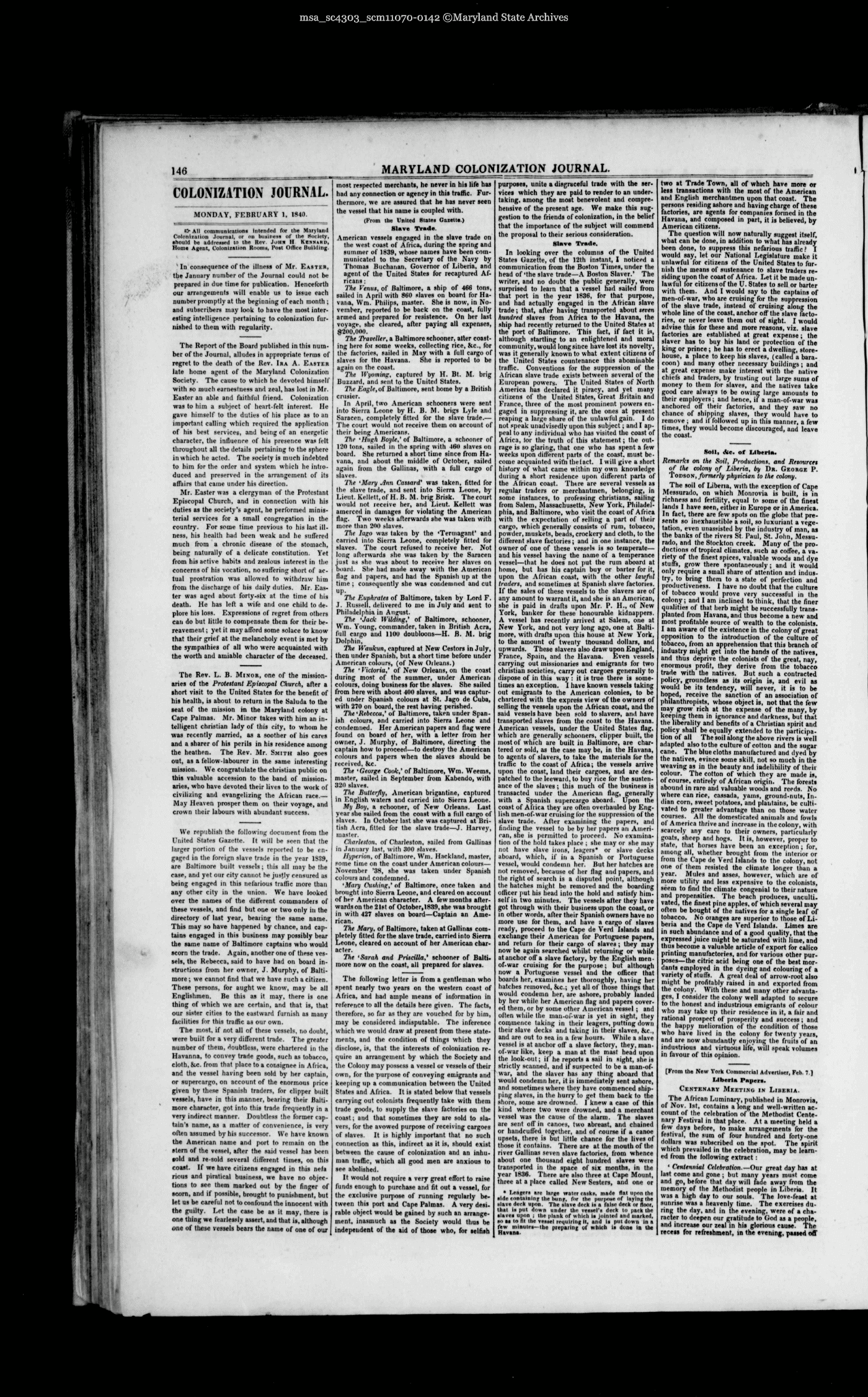
| 146 MARYLAND COLONIZATION JOURNAL. COLONIZATION JOURNAL. MONDAY, FEBRUARY 1, 1840. All communirations intended for the Maryland Colonization Journal, or on business of the Society, ahould be addressed to the Rev John H Kennard, Home Agent, Colonization Rooms, Post Office Building. In consequence of the illness of Mr. Easter, the January number of the Journal could not be prepared in due time for publication. Henceforth our arrangements will enable us to is9ue each number promptly at the beginning of each month ; and subscribers may look to have the most inter- esting intelligence pertaining to colonization fur- nished to them with regularity. The Report of the Board published in this num- ber of the Journal, alludes in appropriate terms of regret to the death of the Rev. Ira A. Easter late home agent of the Maryland Colonization Society. The cause to which he devoted himself with so much earnestness and zeal, has lost in Mr. Easter an able and faithful friend. Colonization was to him a subject of heart-felt interest. He gave himself to the duties of his place as to an important calling which required the application of his best services, and being of an energetic character, the influence of his presence was felt throughout all the details pertaining to the sphere in which he acted. The society is much indebted to him for the order and system which he intio- duced and preserved in the arrangement of its affairs that came under his direction. Mr. Easter was a clergyman of the Protestant Episcopal Church, and in connection with his duties as the society's agent, he performed minis- terial services for a small congregation in the country. For some time previous to his last ill- ness, his health had been weak and he suffered much from a chronic disease of the stomach, being naturally of a delicate constitution. Yet from his active habits and zealous interest in the concerns of his vocation, no suffering short of ac- tual prostration was allowed to withdraw him from the discharge of his daily duties. Mr. Eas- ter was aged about forty-six at the time of his death. He has left a wife and one child to de- plore his loss. Expressions of regret from others can do but little to compensate them for their be- reavement; yet it may afford some solace to know that their grief at the melancholy event is met by the sympathies of all who were acquainted with the worth and amiable character of the deceased. The Rev. L. B. Minor, one of the mission- aries of the Protestant Episcopal Church, after a ihort visit to the United States for the benefit of his health, is about to return in the Saluda to the •eat of the mission in the Maryland colony at Cape Palmas. Mr. Minor takes with him an in- telligent christian lady of this city, to whom he was recently married, as a soother of his cares and a sharer of his perils in his residence among the heathen. The Rev. Mr. Smith also goes out, as a fellow-labourer in the same interesting mission. We congratulate the christian public on this valuable accession to the band of mission- aries, who have devoted their lives to the work of civilizing and evangelizing the African race.— May Heaven prosper them on their voyage, and crown their labours with abundant success. We republish the following document from the United States Gazette. It will be seen that the larger portion of the vessels reported to be en- gaged in the foreign slave trade in the year 1S39, are Baltimore built vessels . this all may be the case, and yet our city cannot be justly censured as being engaged in this nefarious traffic more than any other city in the union. We have looked over the names of the different commandeis of these vessels, and find but one or two only in the directory of last year, beaiing the same name. This may so have happened by chance, and cap- tains engaged in this business may possibly bear the same name of Baltimore captains who would scorn the trade. Again, another one of these ves- sels, the Rebecca, said to have had on board in- structions from her owner, J. Murphy, of Balti- more; we cannot find that we have such a citizen. These persons, for aught we know, may be all Englishmen. Be this as it may, there is one thing of which we are certain, and that is, that our sister cities to the eastward furnish as many facilities for this traffic as our own. The most, if not all of these vessels, no doubt, were built for a very different trade. The greater number of them, doubtless, were chartered in the Havanna, to convey trade goods, such as tobacco, cloth, etc. from that place to a consignee in Africa, and the vessel having been sold by her captain, or supercargo, on account of the enormous price given by these Spanish traders, for clipper built vessels, have in this manner, bearing their Balti- more character, got into this trade frequently in a very indirect manner. Doubtless the former cap- tain's name, as a matter of convenience, is very often assumed by his successor. We have known the American name and port to remain on the stern of the vessel, after the said vessel has been told and resold several different times, on this coast. If we have citizens engaged in this nefa rioiis and piratical business, we have no objec- tions to see them marked out by the finger of scorn, and if possible, brought to punishment, but let us be careful not to confound the innocent with the guilty. Let the case be as it may, there is one thing we fearlessly assert, and that is, although one of these vessels bears the name of one of our most respected merchants, he never in his life has had any connection or agency in this traffic. Fur- thermore, we are assured that he has never seen the vessel that his name is coupled with. (From the United States Gazette.) Slave Trade. American vessels engaged in the slave trade on the west coast of Africa, during the spring and summer of 1839, whose names nave been com- municated to the Secretary of the Navy by Thomas Buchanan, Governor of Liberia, and agent of the United States for recaptured Af- ricans : The Venus, of Baltimore, a ship of 466 tons, sailed in April with 860 slaves on board for Ha- vana, Wm. Philips, master. She is now, in No- vember, reported to be back on the coast, fully armed and prepared for resistence. On her last voyage, she cleared, after paying all expenses, $200,000. The Traveller, a Baltimore schooner, alter coast- ing here foi some weeks, collecting rice, fcc, for the factories, sailed in May with a full cargo of slaves for the Havana. She is reported to be again on the coast. The Wyoming, captured by H. Bt. M. brig Buzzard, and sent to the United States. The Eagle,of Baltimore, sent home by a British crusier. In April, two American schooners were sent into Sierra Leone by H. B. M. brigs Lyle and Saracen, completely fitted for the slave trade.— The court would not receive them on account of their being Americans. The 'Hugh Boyle,' of Baltimore, a schooner of 120 tons, sailed in the spring with 460 slaves on board. She returned a short time since from Ha- vana, and about the middle of October, sailed again from the Gallinas, with a full cargo of slaves. The 'Mary Ann Cassard' was taken, fitted for the slave trade, and sent into Sierra Leone, by Lieut. Kellett, of H.B. M. brig Brisk. The court would not receive her, and Lieut. Kellett was amerced in damages for violating the American flag. Two weeks afterwards she was taken with more than 200 slaves. The lago was taken by the 'Termagant' and carried into Sierra Leone, completely fitted for slaves. The court refused to receive her. Not long afterwards she was taken by the Saracen just as she was about to receive her slaves on board. She had made away with the American flag and papers, and had the Spanish up at the time ; consequently she was condemned and cut up. The Euphrates of Baltimore, taken by Lord F. J. Russell, delivered to me in July and sent to Philadelphia in August. The 'Jack Wilding,' of Baltimore, schooner, Win. Young, commander, taken in British Acra, full cargo and 1100 doubloons—H. B. M. brig Dolphin, The Waukun, captured at New Cestors in July, then under Spanish, but a short time before under American colours, (of New Oileans.) The ' Victoria,' of New Orleans, on the coast during most of the summer, under American colours, doing business for the slaves. She sailed from here with about 400 slaves, and was captur- ed under Spanish colours at St. Jago de Cuba, with 270 on board, the rest having perished. The'Rebecca,' of Baltimore, taken under Span- ish colours, and carried into Sierra Leone and condemned. Her American papers and flag were found on board of her, with a letter from her owner, J. Murphy, of Baltimore, directing the captain how to proceed—to destroy the American colours and papers when the slaves should be received, &c. The 'George Cook,' of Baltimore, Wm. Weems, master, sailed in September from Kabendo, with 320 slaves. The Butterfly, American brigantine, captured in English waters and carried into Sierra Leone. My Boy, a schooner, of New Orleans. Last year she sailed from the coast with a full cargo of slaves. In October last she was captured at Bri- tish Acra, fitted for the slave trade—J. Harvey, master. Charleston, of Charleston, sailed from Gallinas in January last, with 300 slaves. Hyperion, of Baltimore, Wm. Hackland, master, some time on the coast under American colours— November '38, she was taken under Spanish colours and condemned. 'Mary Cushing,' of Baltimore, once taken and brought into Sierra Leone, and cleared on account of her American character. A few months after- wards on the 21st of October,1839, she was brought in with 427 slaves on board—Captain an Ame- rican. The Mary, of Baltimore, taken at Gallinas com- pletely fitted for the slave trade, carried into Sierra Leone, cleared on account of her American char- acter. The 'Sarah and Priscilla,' schooner of Balti- more now on the coast, all prepared for slaves. The following letter is from a gentleman who spent nearly two years on the western coast of Africa, and hail ample means of information in reference to all the details here given. The facts, therefore, so far as they are vouched for by him, may be considered indisputable. The inference which we would draw at present from these state- ments, and the condition of things which they disclose, is, that the interests of colonization re- quire an arrangement by which the Society and the Colony may possess a vessel or vessels of their own, for the purpose of conveying emigrants and keeping up a communication between the United States and Africa. It is stated below that vessels carrying out colonists frequently take with them trade goods, to supply the slave factories on the coast; and that sometimes they are sold to sla- vers, for the avowed purpose of receiving cargoes of slaves. It is highly important that no such connection as this, indirect as it is, should exist between the cause of colonization and an inhu- man traffic, which all good men are anxious to see abolished. It would not require a very great effort to raise funds enough to purchase and fit out a vessel, for the exclusive purpose of running regularly be- tween this port and Cape Palmas. A very desi. rable object would be gained by such an arrange- ment, inasmuch as the Society would thua be independent of the aid of thoae who, for selfish purposes, unite a disgraceful trade with the ser- vices which they are paid to render to an under- taking, among the most benevolent and compre- hensive of the present age. We make this sug- gestion to the friends of colonization, in the belief that the importance of the subject will commend the proposal to their serious consideration. Slave Trade. In looking over the columns of the United States Gazette, of the 12th instant, I noticed a communication from the Boston Times, under the head of'the slave trade—A Boston Slaver.' The writer, and no doubt the public generally, were surprised to learn that a vessel had sailed from that port in the year 1836, for that purpose, and had actually engaged in the African slave trade; that, after having transported about seven hundred slaves from Africa to the Havana, the ship had recently returned to the United States at the port of Baltimore. This fact, if fact it is, although startling to an enlightened and moral community, would long since have lost its novelty, was it generally known to what extent citizens of the United States countenance this abominable traffic. Conventions for the suppression of the African slave trade exists between several of the European powers. The United States of North America has declared it piracy, and yet many citizens of the United States, Great Britain and France, three of the most prominent powers en- gaged in suppressing it, are the ones at present reaping a large share of the unlawful gain. I do not speak unadvisedly upon this subject; and I ap- peal to any individual who has visited the coast of Africa, for the truth of this statement; the out- rage is so glaring, that one who has spent a few weeks upon different parts of the coast, must be- come acquainted with thelact. I will give a short history of what came within my own knowledge dining a short residence upon different part3 of the African coast. There are several vessels as regular traders or merchantmen, belonging, in some instances, to professing christians, sailing from Salem, Massachusetts, New York, Philadel- phia, and Baltimore, who visit the coast of Africa with the expectation of selling a part of their cargo, which generally consists of rum, tobacco, powder, muskets, beads, crockery and cloth, to the different slave factories; and in one instance, the owner of one of these vessels is so temperate— and his vessel having the name of a temperance vessel—that he does not put the rum aboard at home, but has his captain buy or barter for it, upon the African coast, with the other lawful traders, and sometimes at Spanish slave factories. If the sales of these vessels to the slavers are of any amount to warrant it, and she is an American, she is paid in drafts upon Mr. P. H., of New York, banker for these honourable kidnappers. A vessel has recently arrived at Salem, one at New York, and not very long ago, one at Balti- more, with drafts upon this house at New York, to the amount of twenty thousand dollars, and upwards. These slavers also draw upon England, France, Spain, and the Havana. Even vessels carrying out missionaries and emigrants for two christian societies, carry out cargoes generally to dispose of in this way : it is true there is some- times an exception. I have known vessels taking out emigrants to the American colonies, to be chartered with the express view of the owners of selling the vessels upon the African coast, and the said vessels have been sold to slavers, and have transported slaves from the coast to the Havana. American vessels, under the United States flag, which are generally schooners, clipper built, the most of which are built in Baltimore, are char- tered or sold, as the case may be, in the Havana, to agents of slavers, to take the materials lor the traffic to the coast of Africa; the vessels arrive upon the coast, land their cargoes, and are des- patched to the leewaid, to buy rice for the susten- ance of the slaves ; this much of the business is transacted under the American flag, generally with a Spanish supercargo aboard. Upon the coast of Allien they are often overhauled by Eng- lish men-of-war cruising lor the suppression of the slave trade. After examining the papers, and finding the vessel to be by her papers an Ameri- can, she is permitted to proceed. No examina- tion of the hold takes place ; she may or she may not have slave irons, leagers* or slave decks aboard, which, if in a Spanish or Poituguese vessel, would condemn her. But her hatches are not removed, because of her flag and papers, and the right of search is a disputed point, although the hatches might be removed and the boarding officer put his head into the hold and satisfy him- self in two minutes. The vessels alter they have got through with their business upon the coast, or in other words, after their Spanish owners have no more use for them, and have a cargo of slaves ready, proceed to the Cape de Verd Islands and exchange their American for Portuguese papers, and return lor their cargo of slaves ; they may now be again searched whilst returning or while at anchor off a slave factory, by the English men- of-war cruising for the purpose; but although now a Portuguese vessel and the officer that boards her, examines her thoroughly, having her hatches removed, etc.; yet all of those things that would condemn her, are ashore, probably landed by her while her American flag and papers cover- ed them, or by some other American vessel ; and often while the man-of-war is yet in sight, they commence taking in their leagers, putting down their slave decks and taking in their slaves, &c, and are out to sea in a few hours. While a slave vessel is at anchor off' a slave factory, they, man- of-war like, keep a man at the mast head upon the look-out; if he reports a sail in sight, she is strictly scanned, and if suspected to be a man-of- war, and the slaver has any thing aboard that would condemn her, it is immediately sent ashore, and sometimes where they have commenced ship- ping slaves, in the hurry to get them back to the shore, some are drowned. I knew a case of this kind where two were drowned, and a merchant vessel was the cause of the alarm. The slaves are sent off in canoes, two abreast, and chained or handcuffed together, and of course if a canoe upsets, there is but little chance for the lives of those it contains. There are at the mouth of the river Gallinas seven slave factories, from whence about one thousand eight hundred slavei were transported in the space of six months, in the year 1836. There are also three at Cape Mount, three at a place called New Sesters, and one or * Leagers are large water casks, made flat upon the aide containing the bunt, for the purpoae of laying the alave deck upon. The slave deck ia a false deck or floor, that ia put down under the vessel's deck to pack the alavea upon . tbe plank of which is jointed and marked, ao aa to fit the veaael requiring It, and la put down in a few minutes- the preparing of which is done in the Havana. two at Trade Town, all of which have more or leas transactions with the most of the American and English merchantmen upon that coast. The persons residing ashore and having charge of these factories, are agents for companies formed in the Havana, and composed in part, it is believed, by American citizens. The question will now naturally suggest itself, what can be done, in addition to what has already been done, to suppress this nefarious traffic.' I would say, let our National Legislature make it unlawful for citizens of the United States to fur- nish the means of sustenance to slave traders re- siding upon the coast of Africa. Let it be made un- lawful for citizens of the U. States to sell or barter with them. And I would say to the captains of men-of-war, who are cruising for the suppression of the slave trade, instead of cruising along the whole line of the coast, anchor off the slave facto- ries, or never leave them out of sight. I would advise this for these and more reasons, viz. slave factories are established at great expense ; the slaver has to buy his land or protection of the king or prince; he has to erect a dwelling, store- house, a place to keep his slaves, (called a bara- coon) and many other necessary buildings; and at great expense make interest with the native chiefs and traders, by trusting out large sums of money to them for slaves, and the natives take good care always to be owing large amounts to their employers; and hence, if a man-of-war was anchored off their factories, and they saw no chance of shipping slaves, they would have to remove ; and if followed up in this manner, a few times, they would become discouraged, and leave the coast. Soil, &c. of Liberia. Remarks on the Soil, Productions, and Resources of the colony of Liberia, by Dr. George P. Todson, formerly physician to the colony. The soil of Liberia, with the exception of Cape Messurado, on which Monrovia is built, is in richness and fertility, equal to some of the finest lands I have seen, either in Europe or in America. In fact, there are few spots on the globe that pre- sents so inexhaustible a soil, so luxuriant a vege- tation, even unassisted by the industry of man, as the banks of the rivers St. Paul, St. John, Messu- rado, and the Stockton creek. Many of the pro- ductions of tropical climates, such as coffee, a va- riety of the finest spices, valuable woods and dye stuffs, grow there spontaneously ; and it would only require a small share of attention and indus- try, to bring them to a state of perfection and productiveness. I have no doubt that the culture of tobacco would prove very successful in the colony; and I am inclined to think, that the finer qualities of that herb might be successfully trans- planted from Havana, and thus become a new and most profitable source of wealth to the colonists. I am aware of the existence in the colony of great opposition to the introduction of the culture of tobacco, from an apprehension that this branch of industry might get into the hands of the natives, and thus deprive the colonists of the great, nay, enormous profit, they derive from the tobacco trade with the natives. But such a contracted policy, groundless as its origin is, and evil as would be its tendency, will never, it is to be hoped, receive the sanction of an association of philanthropists, whose object is, not that the few may grow rich at the expense of the many, by keeping them in ignorance and darkness, but that the liberality and benefits of a Christian spirit and policy shall be equally extended to the participa- tion of all The soil along the above rivers is well adapted also to the culture of cotton and the sugar cane. The blue cloths manufactured and dyed by the natives, evince some skill, not so much in the weaving as in the beauty and indelibility of their colour. The cotton of which they are made is, of course, entirely of African origin. The forests abound in rare and valuable woods and reeds. No where can rice, cassada, yams, ground-nuts, In- dian corn, sweet potatoes, and plantains, be culti- vated to greater advantage than on those water courses. All the domesticated animals and fowls of America thrive and increase in the colony, with scarcely any care to their owners, particularly goats, sheep and hogs. It is, however, proper to state, that horses have been an exception ; for, among all, whether brought from the interior or from the Cape de Verd Islands to the colony, not one of them resisted the climate longer than a year. Mules and asses, however, which are of more utility and less expensive to the colonists, seem to find the climate congenial to their nature and propensities. The beach produces, unculti. vated, the finest pine apples, of which several may often be bought of the natives for a single leaf of tobacco. No oranges are superior to those of Li- beria and the Cape de Verd Islands. Limes are in such abundance and of a good quality, that the expressed juice might be saturated with lime, and thus become a valuable article of export for calico printing manufactories, and for various other pur- poses—the citric acid being one of the best mor- dants employed in the dyeing and colouring of a variety of stuffs. A great deal of arrow-root also might be profitably raised in and exported from the colony. With these and many other advanta- ges, I consider the colony well adapted to secure to the honest and industrious emigrants of colour who may take up their residence in it, a fair and rational prospect of prosperity and success; and the happy melioration of the condition of those who have lived in the colony for twenty years, and are now abundantly enjoying the fruits of an industrious and virtuous life, will speak volumes in favour of this opinion. [From the New York Commercial Advertiser, Feb. 7.) Liberia Papers. Centenary Meeting in Liberia. The African Luminary, published in Monrovia, of Nov. 1st, contains a long and well-written ac- count of the celebration of the Methodist Cente- nary Festival in that place. At a meeting held a few days before, to make arrangements for the festival, the sum of four hundred and forty-one dollars was subscribed on the spot. The spirit which prevailed in the celebration, may be learn- ed from the following extract : 'Centennial Celebration—Our great day has at last come and gone ; but many years must come and go, before that day will fade away from the memory of the Methodist people in Liberia. It was a high day to our souls. The love-feaat at sunrise was a heavenly time. The exereises du- ring the day, and in the evening, were of a cha- racter to deepen our gratitude to God as a people, and increase our zeal in hia glorious cause. The reeeti for refreshment, in the evening, passed off |