 |
|
|
 |
|
 |
|
|||
|
||||
|
||||
|
Maryland State Archives Maryland Colonization Journal Collection MSA SC 4303 msa_sc4303_scm11070-0144 Enlarge and print image (5M) |
|
|
|
|
|
|
|
|||
|
||||
|
||||
|
Maryland State Archives Maryland Colonization Journal Collection MSA SC 4303 msa_sc4303_scm11070-0144 Enlarge and print image (5M) |
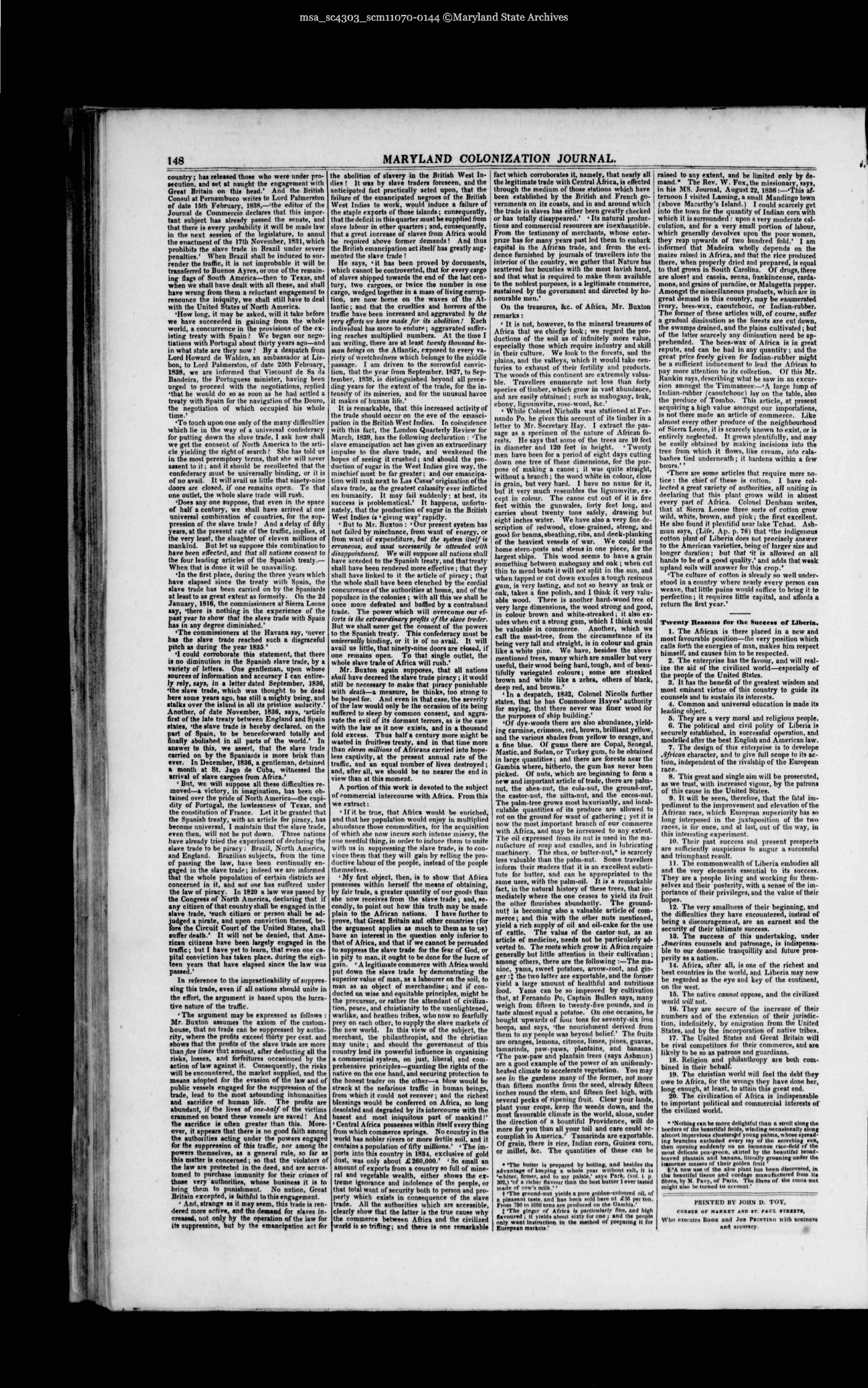
| 148 MARYLAND COLONIZATION JOURNAL. country; has released those who were under pro- secution, and set at naught the engagement with Great Britain on this head.' And the British Consul at Pernambuco writes to Lord Paltnerston of date 15th February, 1838,—'the editor of the Journal de Commercio declares that this impor- tant subject has already passed the senate, and that there is every probability it will be made law in the next session of the legislature, to annul the enactment of the 17th November, 1831, which prohibits the slave trade in Brazil under severe penalties.' When Brazil shall be induced to sur- render the frame, it is not improbable it will be transferred to Buenos Ayres, or one of the remain- ing flags of South America—then to Texas, and when we shall have dealt with all these, and shall hive wrung from them a reluctant engagement to renounce the iniquity, we shall still have to deal with the United States of North America. 'How long, it may be asked, will it take before we have succeeded in gaining from the whole world, a concurrence in the provisions of the ex- isting treaty with Spain ? We began our nego- tiations with Portugal about thirty years ago—and in what state are they now ? By a despatch from Lord Howard de Walden, an ambassador at Lis- bon, to Lord Palmerston, of date 25th February, 1838, we are informed that Viscount de Sa da Bandeira, the Portuguese minister, having been urged to proceed with the negotiations, replied 'that he would do so as soon as he had settled a treaty with Spain for the navigation of the Douro, the negotiation of which occupied his whole time.' 'To touch upon one only of the many difficulties which lie in the way of a universal confederacy for putting down the slave trade, I ask how shall we get the consent of North America to the arti- cle yielding the right of search ? She has told us in the most peremptory terms, that she will never assent to it; and it should be recollected that the confederacy must he universally binding, or it is of no avail. It will avail us little that ninety-nine doors arc closed, if one remains open. To that one outlet, the whole slave trade will rush. 'Does any one suppose, that even in the space of half a century, we shall have arrived at one universal combination of countries, for the sup- pression of the slave trade ? And a delay of fifty years, at the piesent rate of the traffic, implies, at the very least, the slaughter of eleven millions of mankind. But let us suppose this combination to hive been effected, and that all nations consent fo the four leading articles of the Spanish treaty.— When that is done it will be unavailing. 'In the first place, during the three years which have elapsed since the treaty with Spain, the slave trade has been carried on by the Spaniards at least to as great extent as formerly. On the 2d January, 1816, the commissioners at Sierra Leone say, 'there is nothing in the experience of the past year to show that the slave trade with Spain has in any degree diminished.' 'The commissioners at the Havana say, 'never has the slave trade reached such a disgraceful pitch as during the year 1835 ' 'I could corroborate this statement, that there is no diminution in the Spanish slave trade, by a variety of letteri. One gentleman, upon whose sources of information and accuracy I can entire- ly rely, says, in a letter dated September, 1836, 'the slave trade, which was thought to be dead here some years ago, has still a mighty being, and stalks over the island in all its pristine audacity.' Another, of date November, 1836, says, 'article first of the late treaty between England and Spain states, 'the slave trade is heieby declared, on the part of Spain, to be henceforward totally and finally abolished in all parts of the world.' In answer to this, we assert, that the slave trade carried on by the Spaniards is more brisk than ever. In December, 1836, a gentleman, detained a month at St. Jago de Cuba, witnessed the arrival of slave cargoes from Africa.' ' But, we will suppose all these difficulties re- moved—a victory, m imagination, has been ob- tained over the pride of North America—the cupi- dity of Portugal, the lawlessness of Texas, and the constitution of France. Let it be granted that the Spanish treaty, with an article for piracy, has become universal, I maintain that the slave trade, even then, will not be put down. Three nations have already tried the experiment of declaring the slave trade to be piracy: Brazil, North America, and England. Brazilian subjects, from the time of passing the law, have been continually en- gaged in the slave trade; indeed we are informed that the whole population of certain districts are concerned in it, and not one has suffered under the law of piracy. In 1820 a law was passed by the Congress of North America, declaring that if any citizen of that country shall be engaged in the slave trade, 'such citizen or person shall he ad- judged a pirate, and upon conviction thereof, be- fore the Circuit Court of the United States, shall •urter death.' It will not be denied, that Ame- rican citizens have been largely engaged in the traffic ; but I have yet to learn, that even one ca- pital conviction has taken place, during the eigh- teen years that have elapsed since the law was passed.' In reference to the impracticability of suppres- sing this trade, even if all nations should unite in the effort, the argument is based upon the lucra- tive nature of the traffic. ' The argument may be expressed as follows : Mr. Buxton assumes the axiom of the custom- house, that no trade can be suppressed by autho- rity, where the profits exceed thirty per cent, and shows that the profits of the slave trade are more than ./ire times that amount, after deducting all the risks, losses, and forfeitures occasioned by the action of law against it. Consequently, the risks will be encountered, the market supplied, and the means adopted for the evasion of the law and of public vessels engaged for the suppression of the trade, lead to the most astounding inhumanities and sacrifice of human life. The profits are abundant, if the lives of one-half of the victims crammed on board these vessels are saved ! And the sacrifice is often greater than this. More- over, it appears that there is no good faith among the authorities acting under the powers engaged for the suppression of this traffic, nor among the powers themselves, as a general rule, so far as this matter is concerned; so that the violators of the law are protected in the deed, and are accus- tomed to purchase immunity for their crimes of those very authorities, whose business it is to bring them to punishment. No nation, Great Britain excepted, is faithful to this engagement. ' And, strange as it may seem, this trade is ren- dered more active, and tha demand for slaves in- creased, not only by the operation of the law for its suppression, but by the emancipation act for the abolition of silvery in the British West In- dies ! It was hy slave traders foreseen, and the anticipated fact practically acted upon, that the failure of the emancipated negroes of the British West Indies to work, would induce a failure of the staple exports of those islands ; consequently, that the deficit in this quarter must be supplied from slave labour in other quarters; and, consequently, that a great increase of slaves from Africa would be required above former demands! And thus the British emancipation act itself has greatly aug- mented the slave trade ! He says, ' it has been proved by documents, which cannot be controverted, that for every cargo of slaves shipped towards the end of the last cen- tury, two cargoes, or twice the number in one cargo, wedged together in a mass of living corrup- tion, are now borne on the waves of the At- lantic; and that the cruelties and horrors of the traffic have been increased and aggravated by ike very efforts we have made for its abolition ! Each individual has more to endure; aggravated suffer- ing reaches multiplied numbers. At the time I am writing, there are at least twenty thousand hu- man beings on the Atlantic, exposed to every va- riety of wretchedness which belongs to the middle passage. I am driven to the sorrowful convic- tion, that the year from September. 1837, to Sep- tember, 1838, is distinguished beyond all prece- ding years for the extent of the trade, for the in- tensity of its miseries, and for the unusual havoc it makes of human life.' It is remarkable, that this increased activity of the trade should occur on the eve of the emanci- pation in the British West Indies. In coincidence with this fact, the London Quarterly Review for March, 1839, has the following declaration : 'The slave emancipation act has given an extraordinary impulse to the slave trade, and weakened the hopes of seeing it crushed ; and should the pro- duction of sugar in the West Indies give way, the mischief must be far greater; and our emancipa- tion will rank next to Las Casas'origination of the slate trade, as the greatest calamity ever inflicted on humanity. It may fail suddenly; at best, its success is problematical.' It happens, unfortu- nately, that the production of sugar in the British West Indies is 'giving way' rapidly. ' But to Mr. Buxton ; 'Our present system has not failed by mischance, from want of energy, or from want of expenditure, but the system itself is erroneous, and must necessarily be attended with disappointment. We will suppose all nations shall have acceded to the Spanish treaty, and that treaty shall have been rendered more effective; that they shall have linked to it the article of piracy; that the whole shall have been clenched by the cordial concurrence of the authorities at home, and of the populace in the colonies ; with all this we shall be once more defeated and baffled by a contraband trade. The power which will overcome our ef- forts is the extraordinary profits of the slave trader. But we shall never get the consent of the powers to the Spanish treaty. This confederacy must be universally binding, or it is of no avail. It will avail us little, that ninety-nine doors are dosed, if one remains open. To that single outlet, the whole slave trade of Africa will rush.' Mr. Buxton again supposes, that all nations shall have decreed the slave trade piracy ; it would still be necessary to make that piracy punishable with death—a measure, he thinks, too strong to be hoped for. And even in that case, the severity of the law would only be the occasion of its being suffered to sleep by common consent, and aggra- vate the evil of its dormant terrors, as is the case with the law as it now exists, and in a thousand fold excess. Thus half a century more might be wasted in fruitless treaty, and in that time more than eleven millions of Africans carried info hope- less captivity, at the present annual rate of the traffic, and an equal number of lives destroyed; and, after all, we should be no nearer the end in view than at this moment. A portion of this work is devoted to the subject of commercial intercourse with Africa. From this we extract: ' If it be true, that Africa would be enriched, and that her population would enjoy in multiplied abundance those commodities, for the acquisition of which she now incurs such intense misery, the one needful thing, in order to induce them to unite w ith us in suppressing the slave trade, is to con- vince them that they will gain by selling the pro- ductive labour of the people, instead of the people themselves. ' My first object, then, is to show that Africa possesses within herself the means of obtaining, hy fair trade, a greater quantify of our good? than she now receives from the slave trade ; and, se- condly, to point out how this truth may be made plain to the African nations. I have further to prove, that Great Britain and other countries (for the argument applies as much to them as to us) have an interest in the question only inferior to that of Africa, and that if we cannot be persuaded to suppress the slave trade for the fear of God, or in pity to man, it ought to be done for the lucre of gain. 'A legitimate commerce with Africa would put down the slave trade by demonstrating the superior value of man, as a labourer on the soil, to man as an object of merchandise; and if con- ducted on wise and equitable principles, might be the precursor, or rather the attendant of civiliza- tion, peace, and Christianity to the unenlightened, warlike, ami heathen tribes, who now so fearfully prey on each uther, to supply the slave markets of the new world. In this view of the subject, the merchant, the philanthropist, and the christian may unite; and should the government of this country lend its powerful influence in organizing a commercial system, on just, liberal, and com- prehensive principles—guarding the rights of the native on the one hand, and securing protection to the honest trader on the other—a blow would be stmck at the nefarious traffic in human beings, from which it could not recover; and the richest blessings would be conferred on Africa, so long desolated and degraded by its intercourse with the basest and most iniquitous part of mankind!' 'Central Africa possesses within itself every thing from which commerce springs. No country in the world has nobler rivers or more fertile soil, and it contains a population of fifty millions.' 'The im- ports into this country in 1834, exclusive of gold dust, was only about $260,000.' 'So small an amount of exports from a country so full of mine- ral and vegetable wealth, either shows the ex- treme ignorance and indolence of the people, or that total want of security both to person and pro- perty which exists in consequence of the slave trade. All the authorities which are accessible, clearly show that the latter is the true cause why the commerct batween Africa and the civilized world is so trifling; and there is one remarkable fact which corroborates it, namely, that nearly all the legitimate trade with Central Africa, is effected j through the medium of those stations which have been established by the British and French go- I vernmenti on its coasts, and in and around which the trade in slaves has either been greatly checked ' or has totally disappeared.' ' Its natural produc- tions and commercial resources are inexhaustible. From the testimony of merchants, whose enter- pnze has for many years past led them to embark capital iu the African trade, and from the evi- ! dence furnished by journals of travellers into the interior of the country, we gather that Nature has scattered her bounties with the most lavish hand, and that what is required to make them available to the noblest purposes, is a legitimate commerce, sustained by the government and directed by ho- nourable men.' On the treasures, &c. of Africa, Mr. Buxton remarks: ' It is not, however, to the mineral treasures of Africa that wc chiefly look; we regard the pro- ductions of the soil as of infinitely more value, especially those which require industry and skill in their culture. We look to the forests, and the plains, and the valleys, which it would take cen- turies to exhaust of their fertility and products. The woods of this continent are extremely valua- ble. Travellers enumerate not less than forty species of timber, which grow in vast abundance, and are easily obtained; such as mahogany, teak, ebony, lignumvits-, rose-wood, &c' ' While Colonel Nicholls was stationed at Fer- nando Po. he gives this account of its timber in a letter to Mr. Secretary Hay. I extract the pas- sage as a specimen of the nature of African fo- rests. He says that some of the trees are 10 feet in diameter and 120 feet in height. 'Twenty men have been for a period of eight days cutting down one tree of these dimensions, for the pur- pose of making a canoe ; it was quite straight, without a branch ; the wood white in colour, close in grain, but very hard. I have no name for it, but it very much resembles the lignumvita?, ex- cept in colour. The canoe cut out of it is five feet within the gunwales, forty feet long, and carries about twenty tons safely, drawing but eight inches water. We have also a very fine de- scription of redwood, close-grained, strong, and good for beams, sheathing, ribs, and deck-planking of the heaviest vessels of war. We could send home stern-posts and stems in one piece, for the largest ships. This wood seems to have a grain something between mahogany and oak ; when cut thin to mend boats it will not split in the sun, and when tapped or cut down exudes a tough resinous gum, is very lasting, and not so heavy as teak or oak, takes a fine polish, and I think it very valu- able wood. There is another hard-wood tree of very large dimensions, the wood strong and good, in colour brown and white-streaked; it also ex- udes when cut a strong gum, which I think would be valuable in commerce. Another, which we call the mast-tree, from the circumstance of its being very tall and straight, is in colour and grain like a white pine. We have, besides the above mentioned trees, many which are smaller but very useful, their wood being hard, tough, and of beau- tifully variegated colours; some are streaked brown and white like a zebra, others of black, deep red, and brown.' 'In a despatch, 1832, Colonel Nicolls further states, that he has Commodore Hayes' authority for saying, that there never was finer wood for the purposes of ship building.' 'Of dye-woods there are also abundance, yield- ing carmine, crimson, red, brown, brilliant yellow, and the various shades from yellow to orange, and a fine blue. Of gums there are Copal, Senegal, Mastic, and Sudan, or Turkey gum, to be obtained in large quantities; and there are forests near the Gambia where, hitherto, the gum has never been picked. Of nuts, which are beginning to form a new and important article of trade, there are palm- nut, the shea-nut, the cola-nut, the ground-nut, the castor-nut, the nitta-nut, and the cocoa-nut. The palm-tree grows most luxuriantly, and incal- culable quantities of its produce are allowed to rot on the ground for want of gathering; yet it is now the most important branch of our commerce with Africa, and may be increased to any extent. The oil expressed from its nut is used in the ma- nufacture of soap and candles, and la lubricating machinery. The shea, or butter-nut,* is scarcely less valuable than the palm-nut. Some travellers inform their readers that it is an excellent substi- tute for butter, and can be appropriated to the same uses, with the palm-oil. It is a remarkable fact, in the natural history of these trees, that im- mediately wheie the one ceases to yield its fruit the other flourishes abundantly. The ground- nutt is becoming also a valuable article of com- merce ; and this with the other nuts mentioned, yield a rich supply of oil and oil-cake for the use of cattle. The value of the castor nut, as an article of medicine, needs not be particularly ad- verted to. The roots which grow in Africa require generally but little attention in their cultivation ; among others, there are the following :—The ma- nioc, yams, sweet potatoes, arrow-root, and gin- ger :% the two latter are exportable, and the former yield a large amount of healthful and nutritious food. Yams can be so improved by cultivation that, at Fernando Po, Captain Bullen says, many weigh from fifteen to twenty-five pounds, and in taste almost equal a polatoe. On one occasion, he bought upwards of Juttr tons for seventy-six iron hoops, and says, 'the nourishment derived from them to my people was beyond belief.' The fruits are oranges, lemons, citrons, limes, pines, guavas, tamarinds, paw-paws, plantains, and bananas. 'The paw-paw and plantain trees (says Ashmun) are a good example of the power of an uniformly- heated climate to accelerate vegetation. You may see in the gardens many of the former, not more than fifteen months from the seed, already fifteen inches round the stem, and fifteen feet high, with several pecks of ripening fruit. Clear your lands, plant your crops, keep the weeds down, and the most favourable climate in the world, alone, under the direction of a bountiful Providence, will do more for you than ail your toil and care could ac- complish in America.' Tamarinds are exportable. Of grain, there is rice, Indian corn, Guinea corn, or millet, &c. The quantities of these can be • 'The butter is prepared by boiling, and besides the advantage of keeping a whole year without salt, it is 'whiter, firmer, and to my palate.' says Park, (vol i p 302,) 'of a richer flavour than the best butter I ever tasted made of cow's milk.'' \ 'The ground-nut yields a pure golden-coloured oil, of a pleasant taste, and has been sold here at £56 per ton. From 750 to 1000 tons are produced on the Gambia ' J 'The ginger of Africa is particularly fine, and high flavoured . it yields about sixty for one ; and the people only want instruction in the method of preparing it for European markets.' raised to iny extent, and be limited only by de- mand.* The Rev. W. Fox, the missionary, says, in his M S. Journal, August 22, 1836:—'This af- ternoon I visited Laming, a small Mandingo town (above Macarthy's Island.) I could scarcely get into the town for the quantity of Indian corn with which it is surrounded : upon a very moderate cal- culation, and for a very small portion of labour, which generally devolves upon the poor women, they reap upwards of two hundred fold.' I am informed that Madeira wholly depends on the maize raised in Africa, and that the rice produced there, when properly dried and prepared, is equal to that grown in South Carolina. Of drugs, there are aloesf and cassia, senna, frankincense, carda- mons, and grains of paradise, or Malagetta pepper. Amongst the miscellaneous products, which are in great demand in this country, may be enumerated ivory, bees-wax, caoutchouc, or Indian-rubber. The former of these articles will, of course, suffer a gradual diminution as the forests are cut down, the swamps drained, and the plains cultivated; but of the latter scarcrly any diminution need be ap- prehended. The becs-wax of Africa is in great repute, and can be had in any quantity; and the great price freely given for Indian-rubber might be a sufficient inducement to lead the African to pay more attention to its collection. Of this Mr. Rankin says,describing what he saw in an excur- sion amongst the Timmances:—'A large lump of Indian-rubber (caoutchouc/) lay on the table, also the produce of Toinbo. This article, at present acquiring a high value amongst our importations, is not there made an article of commerce. Like almost every other produce of the neighbourhood of Sierra Leone, it is scarcely known to exist, or is entirely neglected. It grows plentifully, and may he easily obtained by making incisions into the tree from which it flows, like cream, into cala- bashes tied underneath; it hardens within a few hours.'' 'There are some articles that require more no- tice : the chief of these is cotton. I have col- lected a great variety of authorities, all uniting in declaring that this plant grows wild in almost every part of Africa. Colonel Denham writes, that at Sierra Leone three sorts of cotton grow wild, white, brown, and pink; the first excellent. He also found it plentiful near lake Tchad. Ash- mun says, (Life. Ap. p. 76) that 'the indigenous cotton plant of Liberia does not precisely answer to the American varieties, being of larger size and longer duration; but that 'it is allowed on all hands to be of a good quality,' and adds that weak upland soils will answer for this crop.' 'The culture of cotton is already so well under- stood in a country where nearly every person can weave, that little pains would suffice to bring it to perfection; it requires little capital, and affords a return the first year.' Twenty Reasons for the Success of Liberia. 1. The African is there placed in a new and most favourable position—the very position which calls forth the energies of man, makes him respect himself, and causes him to be respected. 2. The enterprise has the favour, and will real- ize the aid of the civilized world—especially of the people of the United States. 3. It has the benefit of the greatest wisdom and most eminent virtue of this country to guide its counsels and to sustain its interests. 4. Common and universal education is made its leading object. 6. They are a very moral and religious people. 6. The political and civil polity of Liberia is securely established, in successful operation, and modelled after the best English and American law. 7. The design of this enterprise is to develope African character, and to give full scope to its ac- tion, independent of the rivalship of the European race. 8. This great and single aim will be prosecuted, as we trust, with increased vigour, by the patrons of this cause in the United States. 9. It will be seen, therefore, that the fatal im- pediment to the improvement and elevation of the African race, which European superiority has so long interposed in the juxtaposition of the two races, is for once, and at last, out of the way, in this interesting experiment. 10. Their past success and present prospects are sufficiently auspicious to augur a successful and triumphant result. 11. The commonwealth of Liberia embodies all and the very elements essential to its success. They are a people living and working foi them- selves and their posterity, with a sense of the im- portance of their privileges, and the value of their hopes. 12. The very smallness of their beginning, and the difficulties they have encountered, instead of being a discouragement, are an earnest and the security of their ultimate success. 13. The success of this undertaking, under American counsels and patronage, is indispensa- ble to our domestic tranquillity and future pros- perity as a nation. 14. Africa, after all, is one of the richest and best countries in the world, and Liberia may now be regarded as the eye and key of the continent, on the west. 15. The native cannot oppose, and the civilized world will not. 16. They arc secure of the increase of their numbers and of the extension of their jurisdic- tion, indefinitely, by emigration from the United States, and by the incorporation of native tribes. 17. The United States and Great Britain will be rival competitors for their commerce, and are likely to be so as patrons and guardians. 18. Religion and philanthropy are both com- bined in their behalf. 19. The christian world will feel the debt they owe to Africa, for the wrongs they have done her, long enough, at least, to attain this gteat end. 20. The civilization of Africa is indispensable to important political and commercial interests of the civilized world. * 'Nothing ran be more delightful than a stroll along the borders of the beautiful fields, winding occasionally along almost impervious clusters of young palms, whose spread- ing branches excluded every ray of the scorching sun, then opening suddenly on an immense rice-field of the most delicate pea-green, skirted by the beautiful broad- leaved plantain and banana, literally groaning under the immense masses of their golden fruit' t 'A new use of the aloe plant has been discovered, in the beautiful tissue and cordage manufactured from its fibres, by M. Pavy, of Paris. The fibres of the cocoa nut might also be turned to account.' PRINTED BY JOHN D. TOY, CORNER OF MARKET AND ST. PAUL STREETS. Who executes Book and Job Printing with neatness and accuracy. |