 |
|
|
 |
|
 |
|
|||
|
||||
|
||||
|
Maryland State Archives Maryland Colonization Journal Collection MSA SC 4303 msa_sc4303_scm11070-0146 Enlarge and print image (4M) |
|
|
|
|
|
|
|
|||
|
||||
|
||||
|
Maryland State Archives Maryland Colonization Journal Collection MSA SC 4303 msa_sc4303_scm11070-0146 Enlarge and print image (4M) |
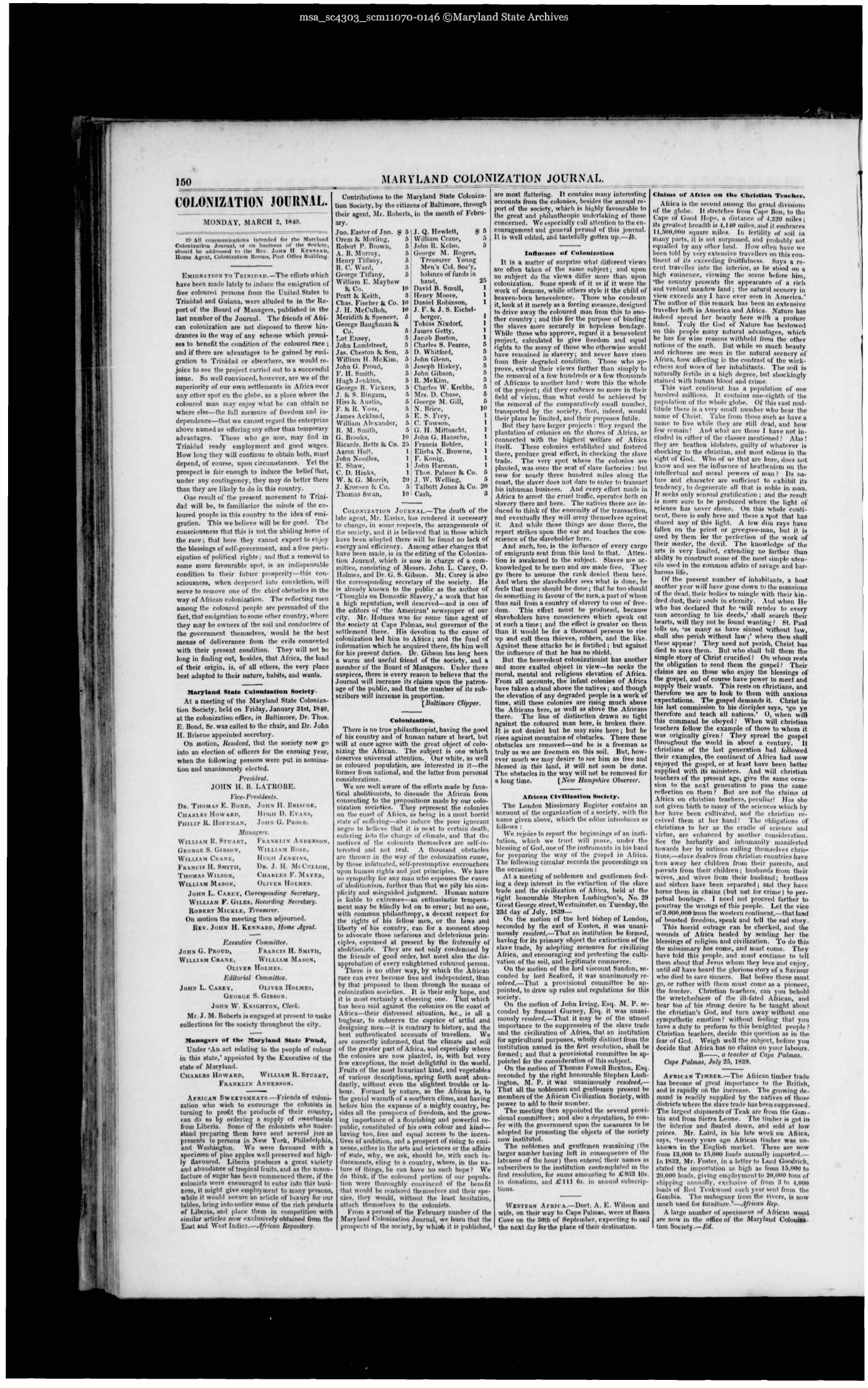
| 150 MARYLAND COLONIZATION JOURNAL. COLONIZATION JOURNAL. MONDAY, MARCH 2, 1840 All communications intended for the Maryland Colonization Journal, or on business of the Society, should be addressed to the Rev John H. Kennard, Home Agent, Colonization Rooms, Post Office Building. Emigration to Trinidad.— The eirorts which have been made lately to imluce the emigration of free coloured persons from the United States to Trinidad and Guiana, were alluded to in the Re- port of the Board of Managers, published in the last number of the Journal. The friends of Afri- can colonization are not disposed to throw hin- drances in the way of any scheme which promi- ses to benefit the condition of the coloured race ; and if there are advantages to be gained by emi- gration to Trinidad or elsewhere, we would re- joice to see the project carried out to a successful issue. So well convinced, however, are we of the superiority of our own settlements in Africa over any other spot on the globe, as a pl.ice where the coloured man may enjoy what he can obtain no where else—the full measure of freedom and in- dependence—that we cannot regard the enterprize above named as nflering any other than temporary advantages. Those who go noie, may find in Trinidad ready employment and good wages. How long they will continue to obtain both, must depend, of course, upon circumstances. Yet the prospect is fair enough to induce the belief that, under any contingency, they may do better there than they are likely to do in this country. One result of the present movement to Trini- dad will be, to familiarize the minds of the co- loured people in this country to the idea of emi- gration. This we believe will be for good. The consciousness that this is not the abiding home of the race; that here they cannot expect to enjoy the blessings of self-government, and a free parti- cipation of political rights: and that a removal to some more favourable spot, is an indispensable condition to their future prosperity—this con- sciousness, when deepened into conviction, will serve to remove one of the chief obstacles in the way of African colonization. The relleetinir men among the coloured people are persuaded of the fact, that emigration to some other country, w here they may be owners of the soil and conductors of the government themselves, would be the best means of deliverance from the evils connected with their present condition. They will not be long in finding out, besides, that Africa, the land of their origin, is, of all others, the very place best adapted to their nature, habits, and wants. Maryland State Colonization Society, At a meeting of the Maryland State Coloniza- tion Society, held on Friday, January 31st, 1840 at the colonization office, in Baltimore, Dr. Thos. E. Bond, Sr. was called to the chair, and Dr. John H. Briscoe appointed secretary. On motion, Resolved, that the society now go into an election of ollicers for the ensuing year, when the following persons were put in nomina- tion and unanimously elected. President. JOHN H. B. LATROBE. Viee-I'retitlents. Dr. Thomas E. Bond, John H. Briscoe, Charles Howarp, Hugh D. Evans, Philip K. Hoffman, John G. Proudfit. Managers. William R.Stuart, Franklin Anderson, George S. Gibson, William Bose . William Crane, Hugh Jenkins, Francis H. Smith, Dr. J. H Mc Culloh, Thomas Wilson, Charles F. Mayer, William Mason, Oliver Holmes. John L. Carey, Corresponding Secretary. William F. Giles, Recording Secretary. Robert Mickle, Treamrcr. On motion the meeting then adjourned. Rev. John H. Kennard, Home Agent. Executive Committee. John G. Proud, Francis H. Smith, William Crane, William Mason, Oliver Holmes. Editorial Committee. John L. Carey, Oliver Holmes, George S. Gibson. John W. Knighton, Clerk. Mr. J. M. Roberts is engaged at present to make collections for the society throughout the city. Managers of the Maryland State Fund. Under 'An act relating to the people of colour in this state,' appointed by the Executive of the state of Maryland. Charles Howard, William R. Stuart, Franklin Anderson. Contributions to the Maryland State Coloniza- tion Society, by the citizens of Baltimore, through their agent, Mr. Roberts, in the month of Febru- ary. Jno. Faster of Jno. $ 5 Orem & Morling, 5 Robert P. Brown, 5 A. B. Murray, 5 Henry Tiffany, 5 B. C. Ward,' 5 George Tillany, 5 William E, Mayhew 8c Co. 10 Pratt & Keith, 5 Chas. Fischer &. Co. 10 J. H. McCulloh, 10 Meridith 8c Spencer, 5 George Baughman & Co. 5 Lot Ensey. 5 John Landstreet, 5 Jas. Cheston & Son, 5 William II. McKim, 5 John G. Proud, 5 F. H. Smith, 5 Hugh Jenkins, 5 George H. Vickers, 5 J. &S. Bingham, 5 Hiss & Austin, 5 F. & R. Voss, 5 James Ackland, 5 William Alexander, 5 R. M. Smith, 5 G. Brooke, 15 Ricards. Betts & Co. 25 Aaron Holt, 1 John Needles, 1 E. Shaw, 1 C. D. Hinks, 1 W. & G. Morris, 20 J. Kroesen & Co. 5 Thomas Swan, 10 African Sweetsmeats.—Friends of coloni- zation who wish to encourage the colonists in turning to profit the products of their country, can do so by ordering a supply of sweetmeats lioin Liberia. Some of the colonists who under- stand preparing them have sent several jars as presents to persons in New York, Philadelphia, and Washington. We were favoured with a specimen of pine apples well preserved and high- ly flavoured. Liberia produces a great variety and abundance of tropical fruits.and as the manu- facture of sugar has been commenced there, if the colonists were encouraged to enter into this busi- ness, it might give employment to many persons, while it would secure an article of luxury for our tables, bring into notice some of the rich products of Liberia, and place them in competition with similar articles now exclusively obtained from the East ami West Indies.---African Repository. J. Q. Hewlett, $ 5 William Crane, 5 John R. Kelso, 5 George M. Rogers, Treasurer Young Men's Col. Soc'y, balance of funds in hand. 25 David B. Smull, 1 Henry Moore, 1 Daniel Robinson, 1 J.F.& J.S. Eichel- berger, 1 Tobias Nixdorf, 1 .lames Getty, 1 Jacob Boston, 1 Charles S. Pearce, 5 D. Whitford, 5 John Glenn, 5 Joseph Hiskey, 5 John Gibson, 5 R. McKim, 5 Charles W. Krebbs, 5 Mrs. D< Chase, 5 George M. Gill, 5 N. Brice, 10 E. S. Frey, 1 C, Towson, 1 G. H. Mittnacht, 1 John G. Hansche, 1 Francis Behler, 1 Elisha N. Browne, 1 F. Konig, 1 John Harman, 1 Thos. Palmer & Co. 5 J. W. Welling, 5 Talbott Jones & Co. 20 Cash, 3 Colonization Journal.—The death of the late agent, Mr. Easter, has rendered it necessary to change, in some respects, the arrangements of the society, and it is believed that in those which have been adopted there will be found no lack of energy and efficiency. Among other changes that have been male, is in the editing of the Coloniza- tion Journal, which is now in charge of a com- mittee, consisting of Messrs. John L. Carey, O. Holmes, and Dr. G. S. Gibson. Mr. Carey is also the corresponding secretary of the society. He is already known to the public as the author of 'Thoughts on Domestic Slavery,' a work that has a high reputation, well deserved—and is one of the editors of 'the American' newspaper of our city. Mr. Holmes was lor some time agent of the society at Cape Palmas, and governor of the settlement there. His devotion to the cause of colonization led him to Alrica; and the fund of information which he acquired there, fits him well for his present duties. Dr. Gibson has long been a win-in and useful friend of the society, and a member of the Board of Managers. Under these auspices, there is every reason to believe that the Journal will increase its claims upon the patron- age of the public, and that the number of its sub- scribers will increase in proportion. [Baltimore Clipper. are most flattering. It contains many interesting accounts from the colonies, besides the annual re- port of the society, which is highly favourable to the great and philanthropic undertaking of those concerned. We especially call attention to the en- couragement and general perusal of this journal. It is well edited, and tastefully gotten up.—lb. Colonization. There is no true philanthropist, having the good of his country ami of human nature at heart, but will at once agree with the great object of colo- nizing the African, The subject is one which deserves universal attention. Our white, as well as coloured population, are interested in it—the former from national, and the latter from personal considerations. We are well aware of the efforts made by fana- tical abolitionists, to dissuade the African from consenting to the propositions made by our colo- nization societies. They represent the colonies on the coast of Africa, as being in a most horrid state of suffering—also induce the poor ignorant negro to believe that it is in xt to certain death, entering into the change of climate, and that the motives of the colonists themselves are sell-in- terested and not leal. A thousand obstacles are thrown in the way of the colonization cause, by those infatuated self-presumptive encroachers upon human rights and just principles. We have no sympathy for any man who espouses the cause of abolitionism, further than that we pity his sim- plicity and misguided judgment. Human nature is liable to extremes—an enthusiastic tempera- ment may be blindly led on to enor; but no one, with common philanthropy, a decent lespect for the rights of his fellow men, or the laws and liberty of his country, can for a moment stoop to advocate those nefarious and deleterious prin- ciples, espoused at present by the fraternity of abolitionists. They are not only condemned by the fiiends of good order, but meet also the dis- approbation of every enlightened coloured person. There is no other way, by which the African race can ever become free and independent, than by that proposed to them through the means of colonization societies, it is their only hope, and it is most certainly a cheering one. That which has been said against the colonies on the coast of Africa—their distressed situation, Sic, is all a bugbear, to subserve the caprice of artful and designing men—it is contrary to history, and the best authenticated accounts of travellers. We are correctly informed, that the climate and soil of Hie greater part of Alrica, and especially where the colonies are now planted, is, with but very few exceptions, the most delightful in the world. Fruits of the most luxuriant kind, and vegetables of various descriptions, spring forth most abun- dantly, without even the slightest trouble or la- bour. Formed by nature, as the African is, to the genial warmth of a southern clime, and having before him the expanse of a mighty country, be- sides all the prospecis of freedom, and the grow- ing importance of a llourishing and powerful re- public, constituted of his own colour and kind— liaving too, free and equal access lo the incen- tives of ambition, and a prospect of rising lo emi- nence, either in the arts and sciences or the all.iirs of slate, why, we ask, should he, with such in- ducements, cling to a country, where, in the na- ture of things, he can have no such hope I We do think, if the coloured portion of our popula- tion were thoroughly cnnwneoil of t|,,. |,, ,,, tit that would be rendered themselves and their spe- cies, they would, without the least hesitation, attach themselves to the colonists. From a perusal of the February number of the Maryland Colonization Journal, we learn that the prospects of the society, by which it is published, Influence of Colonization It is a matter of surprise what dill'erent views are often taken of the same subject; and upon no subject do the views differ more than upon colonization. Some speak of it as if it were the work of demons, while others style it the child of heaven-bom benevolence. Those who condemn it, look at it merely as a forcing measure,designed to drive away the coloured man from this to ano- ther country ; and this for the purpose of binding the slaves more securely in hopeless bondage. While those who approve, regard it a benevolent project, calculated to give freedom and equal rights to the many of those who otherwise would have remained in slavery; and never have risen fiom their degraded condition. Those who ap- prove, extend their views further than simply to the removal of a few hundreds or a few thousands of Africans to another land: were this the whole of the project; did they embrace no more in their field of vision, than what could he achieved by the removal of the comparatively small number, transported by the society, then, indeed, would their plans be limited, and their purposes futile. But they have larger projects : they regard the plantation of colonics on the shores of Alrica, as connected with the highest welfare of Africa itself. These colonies established and fostered there, produce great etlect, in checking the slave trade. The very spot where the colonies are planted, was once the seat of slave factories: but now for nearly three hundred miles along the coast, the slaver does not dare to enter to transect his inhuman business. And every effort made in Africa to arrest the cruel traffic, operates both on slavery there and here. The natives there aie in- duced to think of the enormity of the transaction, and eventually they will array themselves against it. And while these things are done there, the report strikes upon the ear and touches the con- science of the slaveholder here. And such, too, is the influence of every cargo of emigrants scut from this laud to that. Atten- tion is awakened to the subject. Slaves aie ac- knowledged to be men and are made free. They go there to assume the rank denied them here. And when the slaveholder sees what is done, he feels that more should be done; that he too should do something in favour of the men, a part of whom thus sail from a country of slavery to one of free- dom This effect must be produced, because slaveholders have consciences which speak out at such a time; and the effect is greater on them than it would be for a thousand persons lo rise up and call them thieves, robbers, and the like. Against these attacks he is fortified; but against the influence of that he has no shield. But the benevolent cnlonizationist has another and more exalted object in view—he seeks the moral, mental and religious elevation of Africa. From all accounts, the infant colonies of Alrica have taken a stand above the natives; and though the elevation of any degraded people is a work of time, still these colonies are rising much above the Africans here, as well as above the Africans there. The line nf distinction drawn so tight against the coloured man here, is broken there. It is not denied but he may raise here; but he rises against mountains of obstacles. There these obstacles are removed—and he is a freeman as truly as we are freemen on this soil. But, how- ever much we may desire to see him as free and blessed in this land, it will not soon be done. The obstacles in the way will not be removed for a long time. [New Hampshire Observer. African Civilization Society. The London Missionary Register contains an account of the organization of a society, with the name given above, which the editor- introduce! as follows : We rejoice to report the beginnings of an insti- tution, which we trust will prove, under the blessing of God, one of the instruments in his baud lor preparing the way of the gospel in Africa. The following circular records the proceedings on the occasion : At a meeting of noblemen and gentlemen feel- ing a deep interest in the extinction of the slave trade and the civilization of Africa, held at the right honourable Stephen Lushington's, No. 29 Great George street, Westminster, on Tuesday, the 23d day of July, 1839— On the motion of the lord bishop of London, seconded by the earl of Euston, it was unani- mously resolved,—That an institution he formed, having for its primary object the extinction of the slave trade, by adopting measures for civilizing Alrica, and encouraging and protecting the culti- vation of the soil, and legitimate commerce. On the motion of the lord viscount Sainton, se- conded by lord Seaford, it was unanimously re- solred,—That a provisional committee he ap- pointed, to draw up rules and regulations lor this society. On the motion of John Irving, Esq. M. P. se- conded by Samuel Gurncy, Esq. it was unani- mously resolved,—That it may be of the utmost importance to the suppression of the slave trade and the civilization of Africa, that an institution for agricultural purposes, wholly distinct from the institution named in the first resolution, shall be formed; and that a provisional committee be ap- pointed for the consideration of this subject. On the motion of Thomas Fowell Buxton, Esq. seconded by the right honourable Stephen Lush- ington, M. P. it was unanimously resolved,— That all the noblemen and gentlemen present be members of the African Civilization Society, with power to add to their number. The meeting then appointed the several provi- sional committees; ami also a deputation, to con- fer with the government upon the measures lo be adopted for promoting the objects of the society now instituted. The noblemen and gentlemen remaining (the larger number having left in consequence of the lateness of the hour) then entered their names as subscribers to the institution contemplated in the first resolution, for sums amounting to 933 10s. in donations, and 111 6s. in annual subscrip- tions. Claims of Africa on the Christian Teacher. Africa is the second among the grand divisions of the globe. It stretches fiom Cape Hon, to the Cape of Good Hope, a distance of 4,320 miles; its greatest breadth is 4,140 miles, and it embraces 11,500,000 square miles. In fertility of soil in many parts, it is not surpassed, and probably not equalled by any other land. How often have we been told by very extensive travellers on this con- tinent of its exceeding friiitfulness. Says a re- cent traveller into the interior, as he stood on a high eminence, viewing the scene before him, 'the country presents the appearance of a rich and verdant meadow land ; the natural scenery in view exceeds any I have ever seen in America.' The author of this remark has been an extensive traveller both in America and Aliica. Nature has indeed spread her beauty here with a profuse hand. Truly the Cod of Nature has bestowed on this people many natural advantages, which he has for wise reasons withheld from the other nations of the earth. But while so much beautv and richness are seen in the natural scenery of Africa, how affecting is the contrast of the wick- edness: and woes of her inhabitants. The soil is naturally fertile in a high degree, but shockingly stained with human blood and crime. This vast continent has a population of one hundred millions, ft contains one-eighth of tile population of the whole globe, Of this vast mul- titude there is a very small number who bear the name of Clnist. Take from those such as b:ive a name to live while they are still dead, and how few remain! And what are those I have not in- cluded in either of the classes mentioned ? Alas ! they are heathen idolaters, guilty of whatever is shocking to the christian, and most odious in the sight of God. Who of us that are here, does not know ami see the inllucnce of heathenism on the intellectual and moral powers of man ? Its na- ture ami character are siifiirieut lo exhibit its tendency, to degenerate all that is noble in man. If seeks only sensual gratification ; and the result is more sure to be produced where the light of science has never shone. On this whole conti- nent, there is only here and there a spot that has shared any of this light. A lew dim rays have fallen on the priest or grcegrce-man, but it is used by them for the perfection of the work of their master, the devil. The knowledge of the arts is very limited, extending no farther than ability to construct some of the most simple uten- sils used in the common affairs ol savage and bar- barous life. Of the present number of inhabitants, a host another year will have gone down to the mansions of the dead, their bodies to mingle with their kin- dred dust, their souls in eternity. And when He who has declared that he •will render to every man according to bis deeds,' shall search their hearts, will they not be found wanting? St. Paul tells us, 'as many as have sinned without law, shall also perish without law;' where then shall these appear? They need not perish, Christ has died to save them. But who shall ti II them fhe simple story of Christ crucified? On whom resis the obligation to send them the gospel ? Their claims arc on those who enjoy the blessings of the gospel, and of course have power to meet and supply their wants. This rests on christians, and therefore we are to look to them with anxious expectations. The gospel demands it. Christ in his last commission to his disciples says, 'go ye therefore and teach all nations.' O, when will this command be obeyed? When will christian teachers follow the example of those to whom it was originally given? They spread the gospel throughout the world in about a century. II christians of the last generation had billowed their examples, the continent of Africa had now enjoyed the gospel, or at least have been better supplied with its ministers. And will christian teachers of the present age, give the same occa- sion to the next geneiation to pass ttie same reflection 011 them ? But arc not the claims of Africa 011 christian teachers, peculiar? Has she not given birth to many of the .sciences which by her have been cultivated, and the christian re- ceived them at her hand? The obligations of christians to her as the cradle of science and virtue, are enhanced by another consideration. See the barbarity and inhumanity manifested towards her by nations calling themselves chris- tians,—slave dealers from christian countries have torn away her children from their parents, and parents from their children ; husbands from their wives, .and wives from their husband; brothers and sisters have been separated ; and they have borne them in chains (but not for crime) to per- petual bondage. I need not proceed farther to pourtray the wrongs of this people. Let the vice 3,.000,000 from the western continent,--that land of boasted freedom, speak and tell the sad story. This horrid outrage can be checked, and the wounds of Africa healed by sending her the blessings of religion and civilization. To do this the missionary has come, and must come. They have told this people, and must continue to tell them about that Jesus whom they love and enjoy, until all have heard the glorious story of a Saviour who died to save sinners. But before these must go, or rather with them must come as a pioneer, the teacher. Christian teachers, can you behold the wretchedness of the ill-fated African, and hear too of his strong desire to be taught about the christian's God, and turn away without one sympathetic emotion? without feeling that yon have a duty to perform to this benighted people ? Christian teachers, decide this question as in the fear of God. Weigh well the subject, before you decide that Africa has no claims on your labours. B------, a teacher at Cape Palmas. Cape Palmas, July 25, 1839, Western Africa.—Doct. A. E. Wilson and wife, on their way to Cape Palmas, were at Bassa Cove on the ;inth of September, expecting to sail the next day for the place of then destination. African Timber.—The African timber trade has become of great importance to the British. and is rapidly on the increase. The growing de- mand is readily supplied by the natives of those districts where the slave trade has been suppress, ,| The largest shipments of Teak arc from the Gam- bia and from Sierra Leone. The timber m got in the interior and floated down, and sold at low prices. Mr. Laird, in his late work on Africa, says, 'twenty years ago African timber was un. known in the English market. There are now from 13,000 to 15,000 loads annually imported.— In 1832, Mr. Foster, in a letter to Lord Goodrich, stated the importation as high as from 15,000 to 20.000 loads, giving employment to 20,000 tons of shipping annually, exclusive of from 3 to 4,000 loads of Red Teakwood each year sent from the Gambia. The mahogany from the river, is now much used for furniture.'—.Africa Rep. A large number of specimens of African wood are now in the office of the Maryland Coloniza- tion Society.—Ed. |