 |
|
|
 |
|
 |
|
|||
|
||||
|
||||
|
Maryland State Archives Maryland Colonization Journal Collection MSA SC 4303 msa_sc4303_scm11070-0148 Enlarge and print image (5M) |
|
|
|
|
|
|
|
|||
|
||||
|
||||
|
Maryland State Archives Maryland Colonization Journal Collection MSA SC 4303 msa_sc4303_scm11070-0148 Enlarge and print image (5M) |
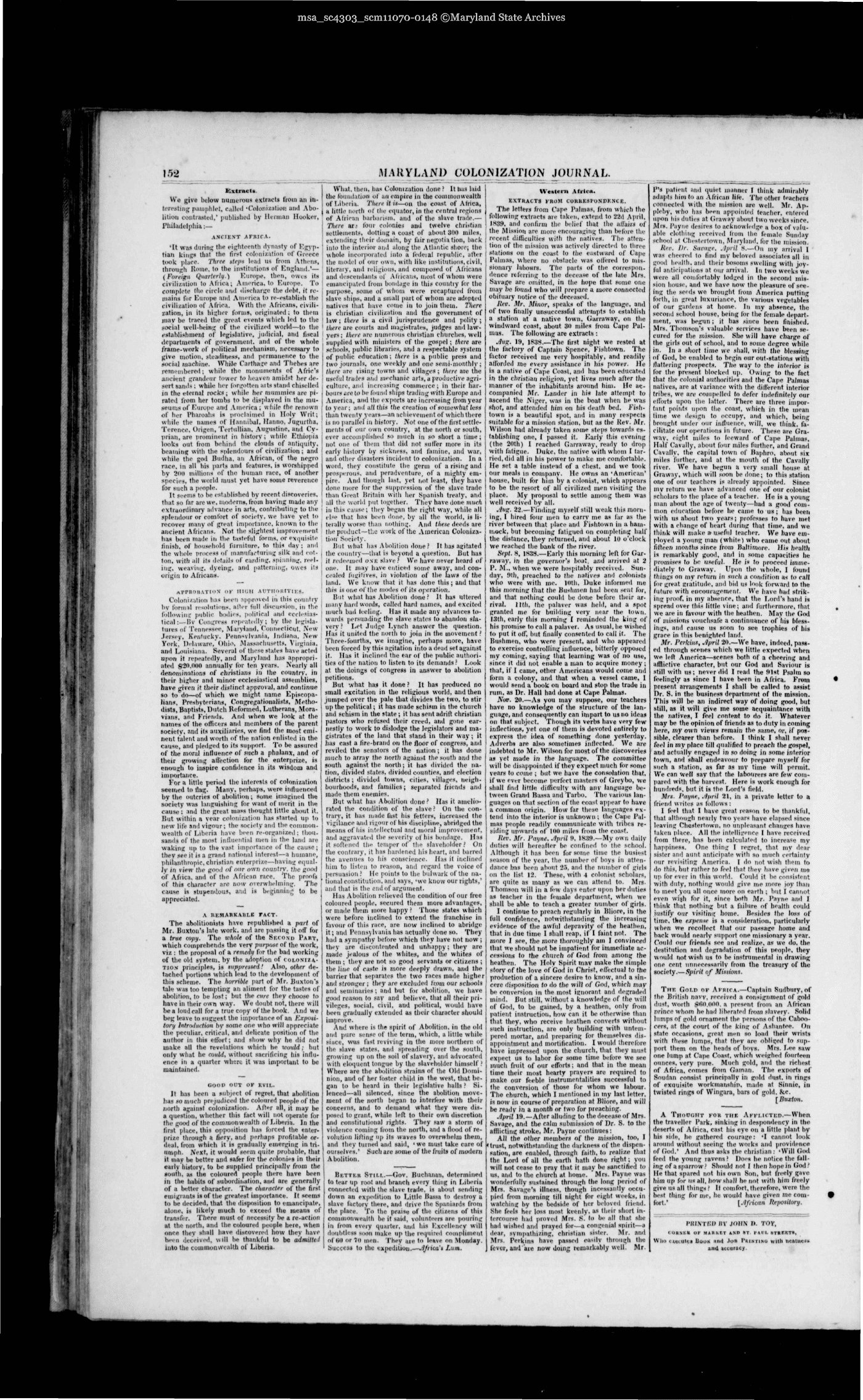
| 152 MARYLAND COLONIZATION JOURNAL. Extracts. We give below numerous extracts from an in- teresting pamphlet, called 'Colonization and Abo- lition contrasted,' published by Herman Hunker, Philadelphia:— ANCIENT AFRICA. 'It was during the eighteenth dynasty of I'.gyp. tian kings that the lirst colonization of Greece took place. Three steps lead us from Athens, through Home, to the institutions of England.1— ( Foreign Quarterly.) Europe, then, QWei its civilization to Africa; America, to Europe. To complete the circle and discharge the debt, it re- mains fur Kurope and America to re-establish the civilization of Africa. With the Africans, civili- zation, in its higher forms, originated ; to them inav be traced the 11—1 events which led to the social well-being of the civilized world—to the establishment of legislative, judicial, and fiscal departments of government, and of the whole frame-work of political mechanism, necessary to give motion, steadiness, and permanence to the social machine. While Carthago and Thebes are remembered; while the monuments of Afric's ancient grandeur lower to heaven amidst her de- sert sands: while her forgotten aits stand chiselled in the eternal rocks; while her mummies are pi- rated from her tombs to be displayed in the mu- seums of Europe and America; while the renown of h.r I'haroahs is proclaimed in Holy Writ; while the names of Ilaunibal. Ilaiino, Jugurtha, Terence. Origcn, Tertiillian, Augustine, and Cy- prian, are prominent in history; while Ethiopia looks out from behind the clouds of antiquity, beaming with the splendours of civilization j and while the god Hinltia, an African, of the negro race, in all his parts and features, is worshipped by 2ni» millions of the human race, of another species, the world must yet have some reverence for such a people. It seems to be established by recent discoveries, that so far are we, moderns, from having made any extraordinary advance in arts, contributing to the splendour or comfort of society, we have yet to recover many of great importance, known to Mm ancient Africans. Not the slightest improvement has been made in the tasteful forms, or exquisite finish, of household furniture, to this day ; and the whole process of manufacturing silk and cot- t.ui. with .ill its detain of carding, spinning, reel- nig, weaving, dyeing, and patterning, owes its origin to Africans. APPROBATION OF HIGH AUTHORITIES. Colonization has been approved in this country by formal resolutions, after full discussion, in the following public bodies, political and ecclesias- tical:—By Congress repeatedly; by the legisla- tures of Tennessee, Maryland, Connecticut, New Jersey. Kentucky. Pennsylvania, Indiana. New York, Delaware, Ohio, Massachusetts. Virginia, and Louisiana. Several of these states have acted upon it repeatedly, and Maryland has appropri- ated $20,000 annually for ten years. Nearly all denominations of christians in the country, in their higher and minor ecclesiastical assemblies. have given it their distinct approval, and continue so to do—of which we miglit name Episcopa- lians', Presbyterians, Congregatioiialists, Metho- dists, Baptists, Dutch Reformed, Lutherans, Mora- vians, and Friends. And when we look at the names of the officers and members of the parent soeietv, and its auxiliaries, we rind the most emi- nent talent and worth of the nation enlisted in the cause, and pledged to its support. To be assured of the moral influence of such a phalanx, and of their ilimlag affection lor the enterprise, is tTrnrh to inspire confidence in its wisdom and importance. For a little period the interests of colonization seemed to Has;. Many, perhaps, were influenced by the outcries of abolition; suine imagined the society was languishing for want of merit in the cause: and the great mass thought little about it. Hut within a year colonization has started up to new life and vigour; the society and the common- wealth of Liberia have been re-organized: thou- sands of the most influential men in the hind are waking up to the vast important* of the cause; they see it is a era ml national interest—a humane, philanthropic, christian •atarpriaa—having equal- ly in view the good of our own country, the good of Afiica, and of the African race. The proofs of this character are now overwhelming. The cause is stupendous, and is beginning to be appreciated. A REMARKABLE FACT. The abolitionists have republished a part of Mr. Buxton's late work, and are passing it ntf for a true copy. The whole of the Second Part, which comprehends the very purpose of the work, viz : the proposal of a remedy for the bad working of the old system, by the adoption of coloniza- tion principles, is tup/tressed! Also, other de- tached portions which lead to the development of this scheme. The horrible part of Mr. Buxton's tale was too tempting an aliment for the tastes of abolition, to be lost; but the rare they choose to have in their own way. We doubt not, there will bea loud call fora true copy of the book. And we beg leave to suggest the importance of an /•'x/iosi- tory Introduction by some one who will appreciate the peculiar, critical, and delicate position of the author in this etfort; and show why he did not make all the revelations which be xcould; hut only what he coiiW, without sacrificing his influ- ence in a quarter where it was important to be maintained. GOOD OUT OF EVIL. It has been a subject of regret, that abolition has so much prejudiced the coloured people of the north against colonization. After all, it may be a question, whether this fact will not operate for the good of the commonwealth of Liberia. In the lirst place, this opposition has forced the enter- prize through a fiery, and perhaps profitable or- deal, from which it is gradually emerging in tri- umph. Next, it would seem unite probable, that it may he better and safer lor the colonies in their early history, to be supplied principally from the aouth, as the coloured people there have been in the habits of subordination, and are generally of a better character. The character of the first emigrants is of the greatest importance. It seems to be decided, that the disposition to emancipate, alone, is likely much to exceed the means of transfer. There must of necessity be a re-action at the north, and the coloured people here, when once they shall have discovered how they have been deceived, will he thankful to be admitted into the commonwealth of Liberia. What, then,has Colonization done ? It has laid the foundation of an empire in the commonwealth ot Liberia. There it is—on the coast of Alrica, a little north of the equator, in the central regions of African barbarism. and of the slave trade.— There are four colonies and twelve christian settlements, dotting a coast of about 300 miles. extending their domain, by lair negotiation, hark into the interior and along the Atlantic shore; the whole incorporated into a federal republic, alter the model of OUT own, with like institutions, civil, Utenry, and religious, anil composed of Africans and descendants of Africans, most of whom were emancipated from bondage in this countiy for the purpose, some of whom were recaptiucd from slave ships, and a small part of whom are adopted natives that have eolne in to join thein. There is christian civilization and the government of law ; there is a civil jurisprudence and polity ; Men' are courts and magistrates, judges and law- yers; Were are numerous christian churches, well supplied with ministers of the gospel; there are schools, public libraries, and I respectable system of public education; there is a public press and two journals, one weekly ami one scrnirnonthlv; there are rising towns and villages ; there ale the useful trade* and mechanic arts, a productive agri- culture, ami increasing commerce ; in their har- bours are to be found ships trading with Kurope arid America, and the exports are increasing from year to year; and all (his the creation of somewhat less than twenty years—an achievement of which there is no parallel in history. Not one of the first settle- ments of our own country, at the north or south, ever accomplished so much in so short a time ; not one of them that diil not sutler more in its early history by sickness, and famine, and war, and other disasters incident to colonization. In a wold, they constitute the germ of a rising and prosperous, and pcradvcntiire, of a mighty em- pire. And though last, yet not least, they have dour more lor the suppression of the slave trade than Greet Britain with her Spanish treaty, and all the world put together. They have done mueh in tin- cause; they began the right way, while all else that has been done, by all the world, is li- terally worse than nothing. And these deeds are the product—the work of the American Coloniza- tion Society. But what has Abolition done I It has agitated the country—that is beyond a tpiestion. But has it redeemed one slave? We have never heard of one. It may have enticed some away, and con- cealed fugitives, in violation of the fans of the land. We know that it has done this; and that this is one Of the rnoilcs of its operation. But what has Abolition done! It has uttered many hard words, called hard names, and excited much bad leeling. Has it made any advances to- wards persuading the slave states to abandon sla- very ? Let Judge Lynch answer the cpiestion. Has it united the north to join in the movement i Three-fourths, we imagine, perhaps more, have been forced by this agitation into a dead set against it. Has it inclined the ear of the public authori- ties of the nation to listen to its demands I Look at the doings of congress in answer to abolition petitions. But what has it done ? It has produced no small excitation in the religious world, and then jumped over the pale that divides the two, to stir up the political; it has made schism in the church and schism in the state ; it has sent adrift christian pastors who refused their creed, and gone ear- nestly to work to dislodge the legislators and ma- gistrates of the land that stand in their way; it has cast a lire-brand on the floor of congress, and reviled the senators of the nation; it lias done much to array the north against the south and the south against the north; it has divided the na- tion, divided states, divided counties, and election districts ; divided towns, cities, villages, neigh- bourhoods, and families; separated friends and made them enemies. But what has Abolition done? Has it amelio- rated the condition of the slave I On the con- trary, it has made fast his fetters, increased the vigilance and rigour of his discipline, abridged the means of his intellectual and moral improvement, and aggravated the severity of his bondage. Has it softened the temper of the slaveholder? On the contrary, it has hardened his heart, and barred the avenues to his conscience. Has it inclined him to listen to reason, and regard the voice of persuasion? He points to the bulwark of the na- tion,d constitution, and says, 'we know our rights,' and that is the end of argument. Has Abolition relieved the condition of our free coloured people, secured them more advantages, or made them more happy ? Those states which were before inclined to extend the franchise in favour id' this net, are now inclined to abridge it; and Pennsylvania, has actually done so. They had a sympathy before which they have not now ; they arc discontented and unhappy; they are maile j.alous of the whites, and the whites of them ; they are not so good servants or citizens ; the line of caste is more deeply drawn, and the barrier that separates the two races made higher and stronger; they are excluded from our schools and seminaries ; and but for abolition, we have good reason to say and believe, that all their pri- vileges, social, civil, and political, would have been gradually extended as their character should improve. And where is the spirit of Abolition, in the old and pure sense of the term, which, a little while since, wvis fast reviving in the more northern of the slave states, and spreading over the south, growing up on the soil of slavery, and advocated with eloquent tongue by the slaveholder himself ? Where are the abolition strains of the Old Domi- nion, and of her foster child in the west, that be- gan to be heard in their legislative halls ? Si- lenced—all silenced, since the abolition move- ment of the north began to interfere with their concerns, and to demand what they were dis. posed to grant, while left to their own discretion ami constitutional rights. They saw a storm of violence coming from the north, and a flood of re- volution lifting up its waves to overwhelm lhein, and they turned and said, 'we must take care of ourselves.' Such are some of the fruits of modern Abolition. Better Still.—Gov. Buchanan, determined to tear up root and branch every thing in Liberia connected with the slave trade, is about sending down an expedition to Little Bassa to destroy a slave factory there, and drive the Spaniards from the place. To the praise of the citizens of this commonwealth be it said, volunteers are pouring in from every quarter, and his Excellency will doubtless soon make up the required compliment ol 60 or 70 men. They aie to leave on Monday. Success to the expedition.—Africa's Lum. Western Africa. EXTRACTS FROM CORRESPONDENCE. The letters from Cape Palmas, from which (lie following extracts are taken, extend to 22d April, 1839. ami confirm the belief that the affairs of the Mission are more encouraging than before the recent difficulties with the natives. The atten- tion of the mission was actively directed to three stations on the coast to the eastwanl of Cape Palmas, where no obstacle was ottered to mis- sionary labours. The parts of the correspon- dence referring to the decease of the late Mrs. Savage arc omitted, in the hope that some one may he found who will prepare a more connected obituary notice of the deceased. Rev. Mr. Minor, speaks of the language, and of two finally unsuccessful attempts to establish a station at a native town, Garraway, on the windward coast, about 30 miles trom Cape Pal- mas. The following are extracts : Aug. 19, 1838.—The first night we rested at the factory of Captain Spence, Fishtown. The factor received me very hospitably, and readily afforded me every assistance in his power. He is a native of Cape Coast, and has been educated in the christian religion, yet lives much after the manner of the inhabitants around him. He ac- companied Mr. Lander in his late attempt to ascend the Niger, was in the boat when he was shot, and attended him on his death bed. Fish- town is a beautiful spot, and in many respects suitable lor a mission station, but as the Rev. Mr. Wilson had already taken some steps towards es- tablishing one, J passed it. Karly this evening (the 20th) I reached Garraway, ready to drop with fatigue. Duke, the native "with whom I tar- ried, did all in his power to make me comfortable. He set a table instead of a chest, and we took our meals in company. He owns an -American' house, built for him by a colonist, which appears to be the resort of all civilized men visiting tin- place. My proposal to settle among them was Well received by all. Aug 22.—finding myself still weak this morn- ing, I hired four men to carry me as far as the river between that place and Fishtown in a ham- mock, but becoming fatigued on completing half the distance, they returned, and about 10 o'clock we reached the bank of the river. Sept. 8, 1838.—Early this morning left for Gar- raway, in the governor's boat, ami arrived at 2 P. M., when we were hospitably received. Sun- day, 9th, preached to the natives and colonists who were with me. loth, Duke informed me this morning that the Bushmen had been sent for, and that nothing could be done before their ar- rival. 11th, the palaver was held, and a spot granted me for building very near the town. 13th, early this morning I reminded the king of his promise to call a palaver. As usual, be wished fo put it otf, but filially consented to call it. The Bushmen, who were present, and who appeared to exercise controlling influence, bitterly opposed my coining, saying that learning was of no use, since it did not enable a man to acquire money ; that, if I came, other Americans would come ami form a colony, and that when a vessel came, I would send a book on board and stop the trade in ruin, as Dr. Hall had done at Cape Palinas. Nov. 20.—As you may suppose, our teachers have no knowledge of the structure of the lan- guage, and consequently can impart to us no ideas on that subject. Though its verbs have very few inflections, yet one of them is devoted entirely to express the idea of something done yesterday. Adverbs are also sometimes inflected. We are indebted to Mr. Wilson for most of the discoveries as yet made in the language. The committee will be disappointed if they expect much for some vears to come ; hut we have the consolation that, if we ever become perfect masters of Grcvbo, we shall find little difficulty With auv language be- tween Grand Hassa and Tarbo. The various lan- guages on that section of the coast appear to have a common origin. How far these languages ex- tend into the interior is unknown; the (.'ape l'al- mas people readily communicate with tribes re- siding upwards of 100 miles from the coast. Rev. Mr. Payne. April 9 1839.—My own daily duties will hereafter be confined to the school. Although it has been for some time the busiest season of the year, the number of boys in atten- dance Iras been about 25. and the number of girls on the list 12. These, with 4 colonist scholars, are quite as many as we can attend to. Mrs. Thomson will in a few days enter upon her duties as teacher in the female department, when we shall be able to teach a greater number of girls. I continue to preach regularly in Hliore, in the full confidence, notwithstanding the increasing evidence of the awful depravity of the heathen, that in due time I shall reap, if I faint not. The more I see, the more thoroughly am I convinced that we should not he impatient for immediate ac- cessions to the chinch of God from among the heathen. The Holy Spirit may make the simple story of the love of God in Christ, ellectual to the production of a sincere desire to know, and a sin- cere disposition to do the will of God, which mav be conversion in the most ignorant and degraded mind. But still, without a knowledge of the will of God, to be gained, by a heathen, only from patient instruction, how can it be otherwise than that they, who receive heathen converts without such instruction, are only building with iintem- pered mortar, and preparing for themselves dis- appointment and mortification. I would therefore have impressed upon the church, that they must expect us to labor for some time before we see much fruit of our efforts; and that in the mean time their most hearty prayers are required to make our feeble instrumentalities successful to the conversion of those for whom we labour. The church, which I mentioned in my last letter, is now in course of preparation at Bliore, and will be ready in a month or two for preaching. April 19.—After alluding to the decease of Mrs. Savage, and the calm submission of Dr. S. to the afllicting stroke, Mr. Payne continues All the other members of the mission, too, I trust, notwithstanding the darkness of the dispen- sation, are enabled, through faith, to realize that the Lord of all the earth hath done right | yon will not cease to pray that it may he sanctified lo us, and to the church at home. 'Mrs. Payne was wonderfully sustained through the long period of Mrs. Savage's illness, though incessantly occu- pied from morning till night for eight weeks, in watching by the bedside of her beloved friend. She feels her loss most keenly, as their short in- tercourse had proved Mrs. S! to be all that she had wished and prayed for—a congenial spirit—a dear, sympathizing, christian sister. Mr. and Mrs. Perkins have passed ea-ilv through the fever, and aie now doing remarkably well. Mr. P's patient andquiet manner I think admirably adapts him to an African lile. The other teachers connected with the mission are well. Mr. Ap- pleby, who has been appointed teacher, entered upon his duties at Graway about two weeks since. Mrs. Payne desires to acknowledge a box of valu- able clothing received from the female Sunday school at (.'hostortovvn, Maryland, for the mission. Rev. Dr. Savage, April 8.—On my arrival 1 was cheered to find my beloved associates all in good beallb, and their bosoms swelling with joy- ful anticipations at our arrival. In two weeks we were all comfortably lodged in the second mis- sion house, and we have now the pleasure of see- ing the seeds we brought from America putting forth, in great luxuriance, the various vegetables of our gardens at home. In my absence, the second school bouse, being lor the'female depart- ment, was begun; it has since been fmish> d. Mrs. Thomson's valuable Service* have been se- cured for the mission. She will have charge of the girls out of school, and to some degree while in. In a short time we shall, with the blessing of God, be enabled to begin our out-stations with Satteriag prospects. The way lo the interior is for the present blocked up. Owing to the fact that the colonial authorities and the Cape Palmas natives, are at variance with the dilferent interior tribes, we are compelled to defer indefinitely our elforts upon the latter. There are three impor- tant points upon the coast, which in the moan time we design to occupy, and which, being brought under our influence, will, we think, fa- cilitate our operations in future. These are Gra- way. eight miles to leeward of Cape Palinas, Half Cavalry, about four miles further, and Grand Cavalry, the capital town of Bapbro, about six miles further, and at the mouth of the Cavalry river. We have begun a very small house at Graway, which will soon be done; to this station one of our teachers is already appointed. Since my return we have advanced one of our colonist scholars to the place of a teacher. He is a young man about the ago of twenty—had a good com- mon education before he came to us; has been with us about two years; professes to have met with a change of heart during that time, and we think will make a useful teacher. We have em- ployed a young man (white) who came out about Mara months since from Baltimore. His health is remarkably good, and in some capacities he promises to be useful. He is to proceed imme- diately to Graway, Upon the whole, I (bund things on my return in such a condition as to call for great gratitude, and bid us look forward to the future with encouragement. We have had strik- ing proof, in my absence, that the Lord's hand is spread over this little vine; ami furthermore, that we are in favour with the heathen. May the God of missions vouchsafe a continuance of his bless- ings, and cause us soon to see trophies of his grace in this benighted land. Mr. Perkins, April 20.—We have, indeed, pass- ed through scenes wdiich we little expected when we left America—scenes both of a cheering and afflictive character, but our God and Saviour is still with ns; never did I read the fist Psalm so feelingly as since I have been in Africa. From present arrangements I shall be called to assist Dr. S. in the business department of the mission. This will be an indirect way of doing good, but still, as it will give me some acquaintance with the natives, I feel content to do it. Whatever may be the opinion of friends as to duty in coining here, my own views remain the same, or, if pos- sible, clearer than before. I think I shall never feel in my place till qualified to preach the gospel, ami actually engaged in so doing in some interior town, and shall endeavour to prepare myself for such a station, as far as my time will' permit. We can Well sav that the labourers are few com- pared with the harvest. Here is work enough for hundreds, but it is the Lord's field. Mrs. Payne, April 21, in a private letter to a friend writes as follows : I feel that I have great reason to he thankful, that although neatly two years have elapsed since leaving Chcstertown, no unpleasant changes have taken place. All the intelligence I have received from there, has been calculate,| to increase my happiness. One thing I regret, that my dear sister and aunt anticipate with so much certainty our revisiting America. I do not wish them to do this, but rather to feel that they have given mo up for ever in this world. Could it be consistent with duty, nothing would give me more joy than to meet you all once more on earth ; but I cannot even wish for it, since both Mr. Payne and I think that nothing but a failure of health could justify our visiting home. Besides the loss of time, the expense is a consideration, particularly when we recollect that our passage home and back would nearly support one missionary a year. Could our friends see and realize, as we do, the destitution and degradation of this people, they would not wish us to be instrumental in drawing one cent unnecessarily from the treasury of the society.— Spirit of Missions. The Gold of Africa.—Captain Sudbury, of the British navy, received a consignment of gold dust, worth $60,000. a present from an African prince whom he had liberated from slavery. Solid lumps of gold ornament the persons of the Caboo- cers, at the court of the king of Ashantee. On state occasions, great men so load their wrists with these lumps, that thev are obliged to sup- port them on the heads of boys. Mrs. Lee saw one lump at Cape Coast, which weighed fourteen ounces, very pure. Much gold, and the richest of Africa, comes from Gaman. The exports of Soudan consist principally in gold dust, in rings of exnuisite workmanship, made at Sinnie, in twisted rings of Wingara, bars of gold. fee. [Buxton. A Thought for the Afflicted.—When the traveller Park, sinking in despondency in the deserts of Africa, cast his eye on a little plant by his side, he gathered courage: 'I cannot look around without seeing the woiks and providence of God.' And thus asks the christian : 'Will (bid feed the young ravens? Does he notice the bill- ing of a sparrow? Should not I then hope in God? He that spared not his own Son, but freely gave him up for us all, how shall he not with him freely give us all things ? II comfort, therefore, were the host thing far me, he would have given me com- fort.' [African Repository. PRINTED BY JOHN D. TOY, CORNER OF MARKET AND ST, PAUL STREETS., Who executes Book and Job Printing with neatness and accuracy. |