 |
|
|
 |
|
 |
|
|||
|
||||
|
||||
|
Maryland State Archives Maryland Colonization Journal Collection MSA SC 4303 msa_sc4303_scm11070-0151 Enlarge and print image (5M) |
|
|
|
|
|
|
|
|||
|
||||
|
||||
|
Maryland State Archives Maryland Colonization Journal Collection MSA SC 4303 msa_sc4303_scm11070-0151 Enlarge and print image (5M) |
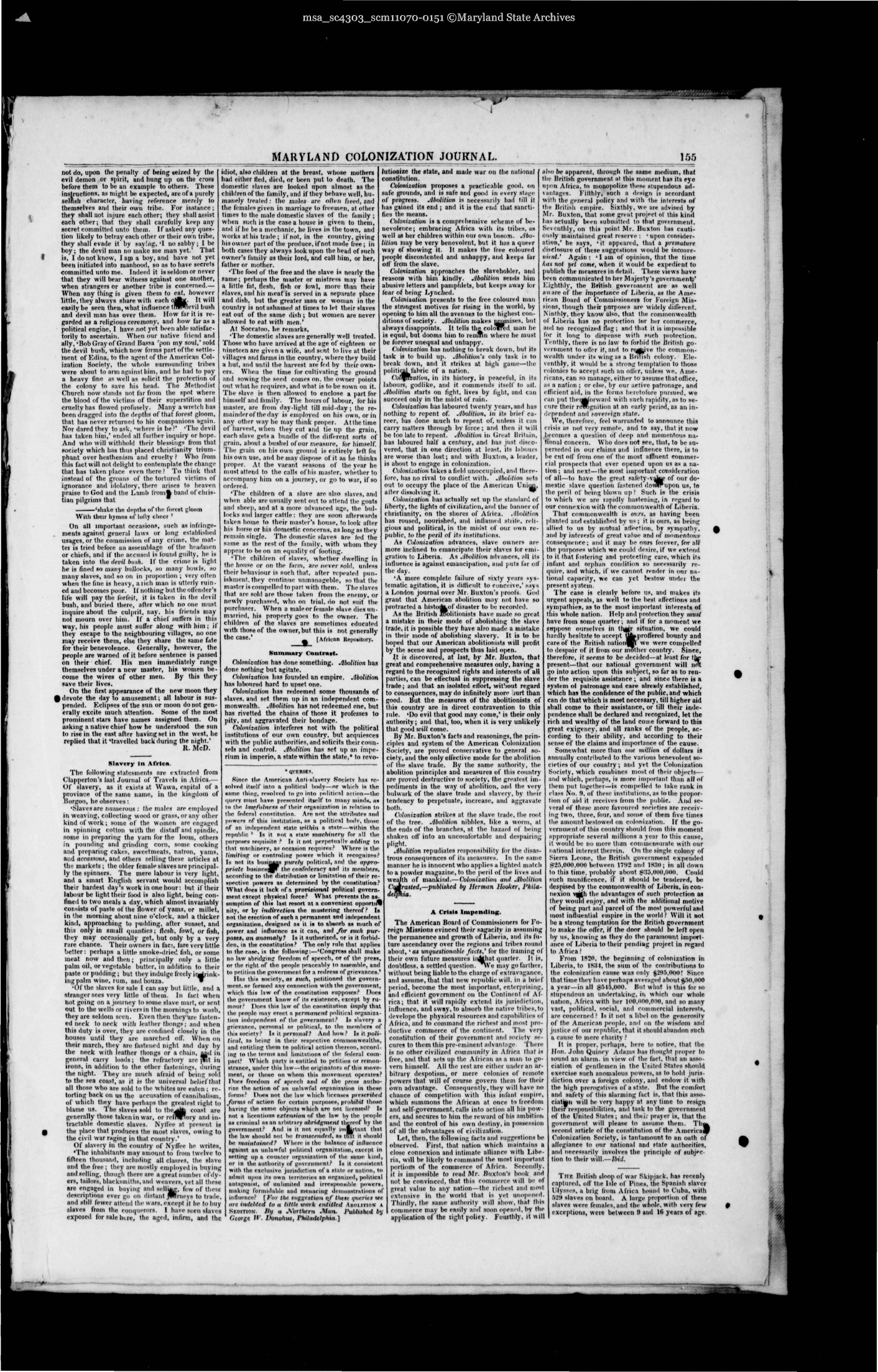
| MARYLAND COLONIZATION JOURNAL. 155 not do, upon the penalty of being seized by the evil demon or spirit, and hung up on the cross before them to be an example to others. These instructions, as might be expected, areola purely selfish character, having reference merely to themselves and their own tribe. For instance; they shall not injure each other; they shall assist each other; that they shall carefully keep any secret committed unto them. If asked any ques- tion likely to betray each other or their own tribe, they shall evade it by saying,'I nosabhy; I be boy; the devil man no make me man yet.' That is, I do not know, I am a boy, and have not yet been initiated into manhood, so as to have secrets committed unto me. Indeed it is seldom or never that they will bear witness against one another, when strangers or another tribe is concerned.— When any thing is given them to eat, however little,they always share with each other. It will easily be seen then, what influence the devil bush and devil man has over them. How far it is re- garded as a religions ceremony, and how far as a political engine, I have not yet been able satisfac- torily to ascertain. When our native Mead and ally, 'BobGray of Grand Bassa 'pea my soul,' sold the devil bush, which now forms part of the settle- ment of Kdina, to the agent of the American Col- izatinn Society, the whole surrounding tribes were about to arm against him, and he had to pay a heavy fine as well as solicit the protection of the colony to save his head. The Methodist Church now stands not far from the spot where the blood of the victims of their superstition and cruelty has flowed profusely. Many a wretch has been dragged into the depths of that forest gloom, that has never returned to his companions again. Nor dared they to ask, 'where is he?' 'The devil has taken him,' ended all further inquiry or hope. And who will withhold their blessings from that society which has thus placed Christianity trium- phant over heathenism and cruelty ? Who from this fact will not delight to contemplate the change that has taken place even there I To think that instead of the groans of the tortured victims of ignorance and idol.itory, there arises to heaven praise to God and the Lamb frouife band of chris- tian pilgrims that ---------'shake the depths of the forest gloom With their hymns of toft} theer ' On all important occasions, such as infringe- ments against general laws or long established usages, or the commission of any crime, the mat- tei is tried before an assemblage of the headmen or chiefs, and if the accused is found guilty, he is taken into the decil bush. If the crime is light he is fined so many bullorks, so many bowls, so many slaves, and so on in proportion ; very olten when the fine is heavy, aiich man is utterly ruin- ed and becomes poor. If nothing but thcoifender's life will pay the liirfeit, it is taken in the devil bush, and buried there, alter which no one must inquire about the culprit, nay, his friends may not mourn over him. If a chief suffers in this way, his people must sutrer along with him; if they escape to the neighbouring villages, no one may receive them, else they share the same fate for their benevolence. Generally, however, the people are warned of it before sentence is passed on their chief. His men immediately range themselves under a new master, his women be- come the wives of other men. By this they save their lives. On the first appearance of the new moon they Q devote the day to amusement; all labour is sus- pended. Kclipses of the sun or moon do not gen- erally excite much attention. Some of the most prominent stars have names assigned (hem. On asking a native chief how he understood the sun to rise in the east after having set in the west, he replied that it 'travelled back during the night.' It. McD. idiot, also children at the breast, whose mothers had either lied, died, or been put to death. The domestic? slaves are looked upon almost as the children of the family, and if they behave well, hu- manely treated : the moles are often freed, and the females given in marriage to freemen, at other times to the male domestic slaves of the family ; when such is the case a house is given to them, and if he be a mechanic, he lives in the town, and works at his trade ; if not, in the country, [riving his owner part of the produce, if not made free; in both cases they always look upon the head of such owner's family as their lord, and call him, or her, father or mother. 'The food of the free and the slave is nearly the same; perhaps the master or mistress may have a little fat, flesh, fish or fowl, more than their slaves, and his meat is served in a separate place and dish, but the greater man or woman in the country is not ashamed at times to let their slaves eat out of the same dish ; but women are never allowed to eat with men.' Af Soccatoo. he remarks, 'The domestic slaves are generally well treated. Those who have arrived at the age of eighteen or nineteen are given a wife, and sent to live at their villages and farms in the country, where they build a hut, and until the harvest are fed by their own- ers. When the time for cultivating the ground ami sowing the seed comes on. the owner points out what he recpiires, and what is to be sown on it. The slave is then allowed to enclose a part for himself and family- The hours of labour, lor his master, are from day-light till mid-day; the re- mainderof theday is employed on his own, or in any other way he may think proper. Atthetime of harvest, when they cut and tie tip the grain, each slave gets a bundle of the different sorts of grain, about a bushel of our measure, for himself. The grain on his own ground is entirely left foi his own use, and he may dispose of it as he thinks proper. At the vacant seasons of the year he must attend to the calls of his master, whether to accompany him on a journey, or go to war, if so ordered. 'The children of a slave are also slaves, and when able are usually sent out to attend the goats and sheep, and at a more advanced age, the bul- locks ami larger cattle : they are soon afterwards taken home to Iheir master's house, to look after his horse or his domestic concerns, as long as they remain single. The domestic slaves are fed the same as the rest of the family, with whom they appear to be on an equality of footing. 'The children of slaves, whether dwelling in the house or on the farm, are never sold, unless their behaviour is such that, alter repeated pun- ishment, they continue uninamigeble, so that the master is compelled to part with them. The slaves that are sold are those taken from the enemy, or newly purchased, who on trial, do not suit the purchaser. When a male or female slave dies un- married, his properly goes to the owner. The children of the slaves are sometimes educated with those of the owner, but this is not generally the case.' - [African Repository. Slavery In Africa. The following statements are extracted from Clapperton's last Journal of Travels in Africa.— Of slavery, as it exists at Wawa, capital of a province of the same name, in the kingdom of llorgoo, he observes: 'Slaves are numerous : the males are employed in weaving, collecting wood or grass, or any other kind of work; some of the women are engaged in spinning cotton with the distafl and spindle, some in preparing the yarn for the loom, others ;n pounding and grinding corn, some cooking and preparing cakes, sweetmeats, natron, yams, and accassoHj, and others selling these articles at the markets; the older female slaves are principal- ly the spinners. The mere labour is very light, and a smart F.nglish servant would accomplish their hardest day's work in one hour: but if their labour be light their food is also light, being con- fined to two meals a day, which almost invariably consists of paste of the "flower of yams, or millet, in Hie morning about nine o'clock, and a thicker kind, approaching to pudding, alter sunset, and this only in small qualities; flesh, fowl, or fish, they may occasionally get, but only by a very rare chance. Their owners in fact, lare very little better: perhaps a little smoke-dried fish, or some meat now and then; principally only a little palm oil, or vegetable butter, in addition to their paste or pudding ; but they indulge freely to drink- ing palm wine, rum, and bouza. • 'Of the slaves lor sale I can say but little, and a stranger sees very little of them. In fact when not going on a journey to some slave mart, or sent out to the wells or livers in the mornings to wash, they are seldom seen. F.ven then they are fasten- ed neck to neck with leather thongs; and when this duty is over, they are confined closely in the houses until they are marched otf. When on their march, they are fastened night and day by the neck with leather thongs or a chain, and in general carry loads; the refractory are put in irons, in addition to the other fastenings, during the night. They are much afraid of being sold to the sea coast, as it is the universal belief that all those who are sold to the whites are eaten ; re- torting back on us the accusation of cannibalism, of which they have perhaps the greatest right to blame us. '1 he slaves sold to the old coast arc generally those taken in war, or refractory and in- tractable domestic slaves. Nyffee at present is the place that produces the most slaves, owing to the civil war raging in that country.' Of slavery in the country of Nyffee he writes, •The inhabitants may amount to from twelve to fifteen thousand, including all classes, the slave and the free ; they are mostly employed in buying and selling, though there are a great iiumbei id dy- ers, tailors, blacksmith-, and weavers, vet all these are engaged in buying and seller, few of these descriptions ever gii on distant journeys to trade, and still fewer attend the wars.except it be to buy slaves from the conquerors. I have seen slaves exposed for sale lure, the aged, infirm, and the Summary Contrast. Colonization has done something. Abolition has done nothing but agitate. Colonization has founded an empire. Abolition has laboured hard to upset one. Colonization has redeemed some thousands of slaves, and set them up in an independent com- monwealth. Molition has not redeemed one, but has rivetled the chains of those it professes to pity, and aggravated their bondage. Colonization interferes not with the political institutions of our own country, but acquiesces with the public authorities, and solicits their coun- sels and control. Abolition has set up an impe- rium in imperio, a state within the state,' to revo- QUERIES. Since the American Ann slavery Soeietv lias re- solved itself into a political body—or which is the same thing, resolved to en into political tctlofl—the query must have presented itself to many minds, as to the lawfulness of their organization in relation to the federal constitution. Are not the attributes and powers of this institution, as a political tmdv, those of an independent stale within a state—within Ihe republic. * la it not a state machinery for all the purposes requisite t la it not perpetually adding to that machinery, as occasion requires? Where is the limiting or contrnling power which it recognizes? Is not its business purely political, and the appro- priate business the confederacy and its members, according to the distribution or limitation of their re- spective powers aa determined by the constitution? What does it lack of a provisional political gnvern- ment except physical force? What prevents the as- sumption of this last resort at a convenient opportiw nily, or by indirection the mustering thereof? la not the erection of such a permanent and independent organization, designed as it ia to absorb aa much of power and influence as it can, and Jbr such pur- poses, an anomaly? Is it authorized, or is it forbid- den, in the constitution? The only rule that applies to the rase, is the following:—'Congreaa shall make no law abridging freedom of apcecb, or of the press, or the right of the people peaceably to assemble, and to petition the government for a redress of grievances.' Has this society, as such, petitioned the govern- ment, or formed anv connect ion with the government, which this law of the constitution supposes? Does the government know of its eiistence, except by ru- mour? Ones this law of the constitution imply that the people may erect a permanent political organiza- tion independent of the government? Is slavery a grievance, personal or pohticat, to the inctnliera of thiasocietv? la it personal} And how? Is it poli- tical, as being in their respective commonwealths, and entitling them to political action thereon, acroni. ing to the terms and limitations of the federal coin pact? Which party ia entitled to petition or remon- strance, under this law — the originators of this move- ment, or those on whom this movement operates? DoM freedom of apeecli and of ihe press autho- rize the action of an unlawful organization in these forms? lines not the law which licenses prescribed Jbrms of action for certain purposes, prohibit those having the same objects which are not licensed? Is not a licentious extension of the law bv the people as criminal as an arbitrary abridgment thereof by the government? And ia it not equally important that the law should not tie transcended, as that it should be maintained? Where is the balance of inlhlence against an unlawful political organization, except in setting up a counter organization of the aaine kind, or in the authority of government? Is it consistent with the exclusive jurisdiction of a state nr nation, to admit upon its own territories an organizedl, political antagonist, of unlimited and irresponsible powers, making formidable and menacing demonstrations of influence? [For the suggestion of these nucries we are indebted to a little work entitled Abolition a Sedition. By a Northern Man. Published by George W. Donohue, Philadelphia] lutionize the state, and made war on the national constitution. Colonization proposes a practicable good, on sale grounds, and is safe and good in every Stage of progress. Molition is necessarily bad till il has gained its end ; and it is the end that sancti- fies the means. Colonization is a comprehensive scheme of be- nevolence; embracing Africa with its tribes, as well as her children within our own boso*i. Abo- lition may be very benevolent, but it has a queer way of showing it. It makes the free coloured people discontented and unhappy, and keeps far off from the slave. Colonization approaches the slaveholder, and reasons with him kindly. Abolition sends him abusive letters and pamphlets, but keeps away lor lear of being Lynched. Colonization presents to the free coloured man the strongest motives for rising in the world, by opening to him all the avenues to the highest con- ditions of society. Abolition makes promises, but always disappoints. It tells the coloured man he is equal, but dooms him to remain where he must be forever unequal and unhappy. Colonization has nothing to break down, hut its task is to build up. Abolition's only task is to break down, and it strikes at high game—the politic^fabric of a nation. Colonization in its history, is peaceful, in its labours, godlike, and it commends itself to all. Abolition starts on fight, lives by tight, and can succeed only in the midst of ruin. Colonization has laboured twenty years,and has nothing to repent of. Abolition, in its brief ca- reer, has done much to repent of, unless it can carry matters through by force; and then il will be too late to repent. Abolition in Great Britain, has laboured half a century, and has just disco- vered, that in one direction at least, its labours are worse than lost; and with Buxton, a leader, is about to engage in colonization. Colonization takes a field unoccupied, and there- fore, has no rival to conflict with. Abolition sets out to occupy the place of the American Union, alter dissolving it. " Colonization has actually set up the standard of liberty, the lights of civilization, and the banner of Christianity, on the shores of Africa. Abolition has roused, nourished, and inflamed stiile, reli- gious and political, in the midst of our own re- public, to the peril of its institutions. As Colonization advances, slave owners an- more inclined to emancipate their slaves lor emi- gration to Liberia. As Abolition advances, all its influence is against emancipation, and puts far oil the day. 'A more complete failure of sixty years sys- tematic agitation, it is difficult to conceive,' says a Loudon journal over Mr. Buxton's proofs. God grant that American abolition may not have so protracted a history of disaster to be recorded. As the British abolitionists have made so great a mistake in their mode of abolishing the slave trade, it is possible they have also made a mistake in their mode of abolishing slavery. It is to be hoped that our American abolitionists will profit by the scene and prospects thus laid open. It is discovered, at last, by Mr. Buxton, that great and comprehensive measures only, having a regard to the recognized rights and interests of all parties, can be effectual in suppressing the slave trade; and that an isolated ellort, witbout regard to consequences, may do infinitely more nirt than good. But the measures of the abolitionists of this country are in direct contravention to this rule. 'Do evil that good may come,' is their only authority; and that, too, when it is veiy unlikely that good will come. By Mr. Buxton's facts and reasonings, the prin- ciples and system of the American Colonization Society, are proved conservative to general so- ciety, and the only effective mode for the abolition of the slave trade. By the same authority, the abolition principles and measures of this country are proved destructive to society, the greatest im- pediments in the way of abolition, and the very bulwark of the slave trade and slavery, by their tendency to perpetuate, increase, and aggravate both. Colonization strikes at the slave trade, the root of the tree. Abolition nibbles, like a worm, at the ends of the branches, at the hazard of being shaken oil' into an uncomfortable and despairing plight. Abolition repudiates responsibility for the disas- trous consequences of its measures. In the same manner he is innocent who applies a lighted match to a powder magazine, to the peril of the lives and wealth of mankind.—Colonization and Abolition Contrasted,—published by Herman Hooker, Phila- delphia. A Crisis Impending. The American Board of Commissioners for Fo- reign Missions evinced their sagacity in assuming the permanence and growth of Liberia, and its fu- ture ascendancy over the regions and tribes round about, ' at unquestionable facts,' for the training of their own future measures in that quarter. It is, doubtless, a settled question. We may go farther, without being liable to the charge of extravagance, and assume, that that new republic will, in a brief period, become the most important, enterprising, and efficient government on the Continent of Af- rica; that it will rapidly extend its jurisdiction, influence, and sway, to absorb the native tribes.to dcvelopc the physical resources and capabilities of Africa, and to command the richest and most pro- ductive commerce of the continent. The very constitution of their government and society se- cures to them this pre-eminent advantage There is no other civilized community in Atnca that is free, and that sets up the African as a man to go- vern himself. All the rest are either under an ar- bitrary despotism, or mere colonies of remote powers that will of course govern them liir their own advantage. Consequently,they will have no chance of competition with this lnlant empire, which summons the African at once to freedom and self-government, calls into action all his pow- ers, and secures to him the reward of his ambition and the control of his own destiny, in possession of all the advantages of civilization. Let, then, the following facts and suggestions he observed. First, that nation which maintains a close connexion and intimate alliance with Libe- ria, will be likely to command the most important portions of the commerce of Africa. Secondly. it is impossible to read Mr. fluxion's hook and not be convinced, that this commerce will be of great value to any nation—the richest and most extensive in the world that is yet unopened. Thirdly, the same authority will show, Unit this commerce may be easily and soon opened, by the application of the right policy. Fourthly, it will also be apparent, through the same medium, that tin- British government at this moment has its eye upon Africa, to monopolize these stupendous ad- vantages. Fifthly, such a design is accordant with the general policy and with the interests of the British empire. Sixthly, we are advised by Mr. Buxton, that some great project ot this kind has actually been submitted to that government. Seventhly, on this point Mr. Buxton has cauti- ously maintained great reserve : ' upon consider- ation,' he says, ' it appeared, that a premature diselosuie of these suggestions would he inconve- nient.' Again: 'Iain of opinion, that the time has not yet come, when it would be expedient to publish the measnres in detail. These views have been communicated to her Majesty's government*' Eighthly, the British government are as well aware Of the importance of Liberia, as the Ame- rican Board of Commissioners for Foreign Mis- sions, though their purposes are widely ditl'erent. Ninthly, they know also, that the commonwealth o! Liberia has no protection tor her commerce, and no recognized Hag ; and that it is impossible lor it long to dispense with such protection. T(nthly, there is no law to forbid the British go- vernment to offer it, and to receive the common- wealth under its wing as a British colony. Ele- venthly, it would be a strong temptation to those colonies to accept such an offer, unless we, Ame- ricans, can so manage, either to assume that office, as a nation ; or else, by our active patronage, and elhcient aid, in the forms heretofore pursued, we can put them forward with such rapidity, as to se- cure their recognition at an early period, as an in- dependent and sovereign state. We, therefore, feel warranted to announce this crisis as not very remote, and to say, that it now becomes a question of deep and momentous na- tional concern. Who does not see, that, to be su- perseded in our claims and influence there, is to be cut off from one of the most affluent commer- cial prospects that ever opened upon us as a na- tion; and next—the most important consideration of all—to have the great salety-val^ of our do- mestic slave question fastened dow^upon us, to the peril of being blown up ? Such is the crisis to which we are rapidlv hastening, in regard to our connexion with the commonwealth of Liberia. That commonwealth is ours, as having been planted and established by us ; it is ours, as being allied to us by mntual allection, by sympathy, and by interests of great value and of momentous consequence ; anil it may be ours forever, for all the purposes which we could desire, if we extend to it that fostering and protecting care, which its infant and orphan condition so necessarily re- quire, and which, if we cannot rentier in our na- tional capacity, we can yet bestow nnder the present system. The ease is cleailv before us, and makes its urgent appeals, as well to the best affections and sympathies, as to the most important interests of this whole nation. Help and protection they imtsl have from some quarter; and if for a moment we snppose ourselves in their situation, we could hardly hesitate to accept the proffered bounty and care of the British nation we were compelled to despair of it from our mother country. Since, therefore, it seems to be decided—at least for t|^ present—that our national government will nrft go into action upon this subject, so far as to ren- der the requisite assistance ; and since there is a system ot patronage and care already established, which has the confidence of the public, and which can do that which is most necessary, till higher aid shall come to their assistance, or till their inde- pendence shall be declared and recognized, let the rich and wealthy of the land come forward to this great exigency, and all ranks of the people, ac- cording to their ability, and according to their sense of the claims and importance of the cause. Somewhat more than one million of dollars is annually contributed to the various benevolent so- cieties of our country; and yet the Colonization Society, which combines most of their objects— and which, perhaps, is more important than all of them put together—is compelled to take rank in class No. H, of these institutions, as to the propor- tion of aid it receives from tko public. And se- veral of these more favoured societies are receiv- ing two, three, four, and some of them five times the amount bestowed on colonization. If the go- vernment of this country should from this moment appropriate several millions a year to this cause, it would be no more than commensurate with our national interest therein. On the single colony of Sierra Leone, the British government expended $25,000,000 between 1792 and 1830 in all down to this time, probably about $35,000,000. Could such munificence, if it should be tendered, be despised by the commonwealth of Liberia, in con- nexion with the advantages of such protection as they would enjoy, and with the additional motive of being part and parcel of the most powerful and most influential empire in the world? Will it not he a strong temptation for the British government to make the oiler, if the door should be left open by us, knowing as they do the paramount import- ance of Liberia to their pending project in regard to A frica ? From 1820, the beginning of colonization in Liberia, to 1834, the sum of the contributions to the colonization cause was only $295,000! Since that time they have perhaps averaged about $50,000 a year—in all $545,000. But what is this for so stupendous an undertaking, in which our whole nation, Africa with her 100,000,000, and so many vast, political, social, and commercial interests, are concerned ? Is it not a libel on the generosity of the American people, and on the wisdom and justice of our republic, that it should abandon such a cause to mere charity ? It is proper, perhaps, here to notice, that the Hon. John Quiney Adams has thought proper to sound an alarm, in view of the fact, that an asso- ciation of gentlemen in the United States should exercise such anomalous powers, as to hold juris- diction over a liireign colony, and endow it with the high prerogatives of a state. But the comfort and safety of this alarming fact is, that this asso- ciation will be very happy at any time to resign their responsibilities, and task to the government of the United States; and ttttlr prayer is, that the government will please to assume them. That second article of the constitution of the American Colonization Society, is tantamount to an oath of allegiance to our national and state authorities, and necessarily involves the principle of subjec- tion to their will.—Ibid. Tnr. Biitish sloop of war Skipjack, has recenlv captured, nil the Isle of Pines, the Spanish slaver Ulysses, a brig from Africa bound to Cuba, with 529 slaves on board. A large proportion of these slaves were females, and the whole, with very few exceptions, were between 9 and 16 years of age. |