 |
|
|
 |
|
 |
|
|||
|
||||
|
||||
|
|
|
|
|
|
|
|||
|
||||
|
||||
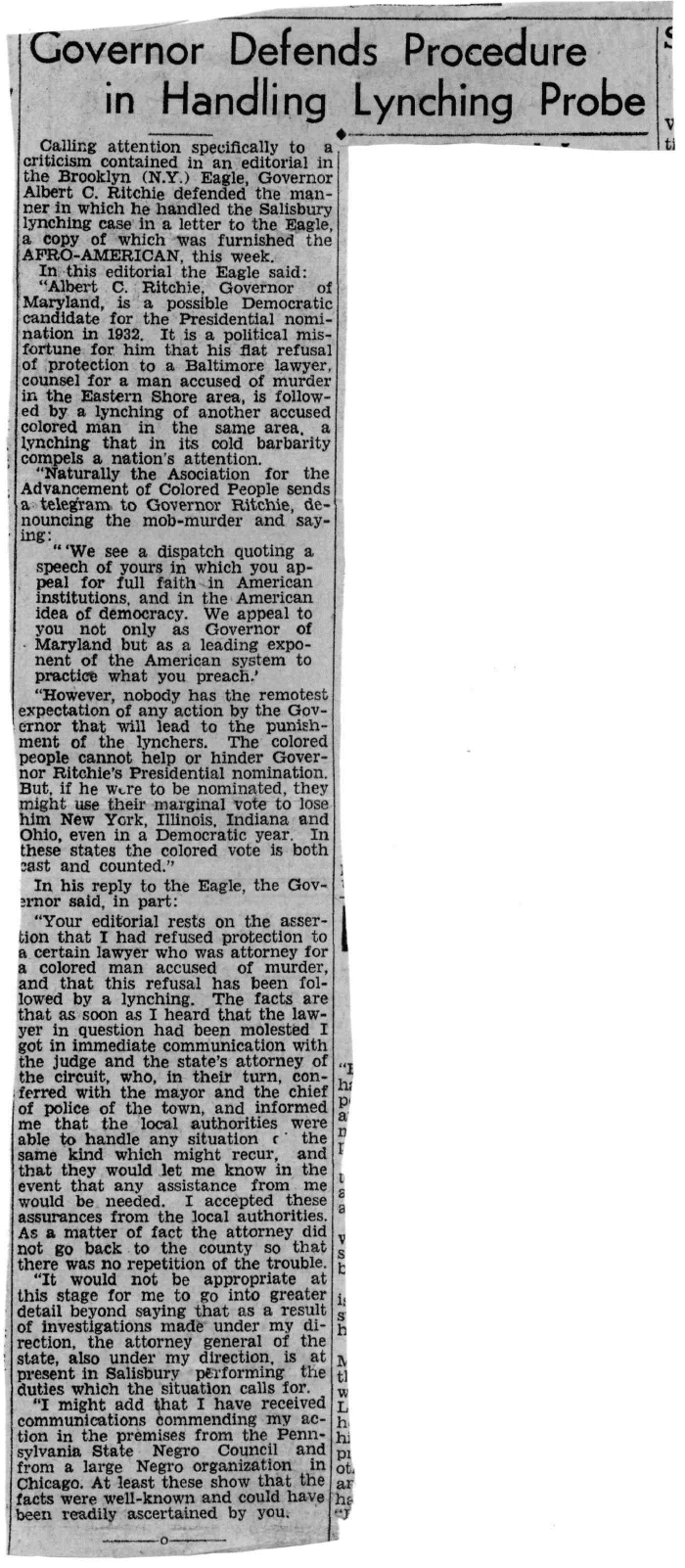
| Governor Defends Procedure in Handling Lynching Probe Calling attention specifically to a criticism contained in an editorial in the Brooklyn (N.Y.) Eagle, Governor Albert C. Ritchie defended the manner in which he handled the Salisbury lynching case in a letter to the Eagle, a copy of which was furnished the AFRO-AMERICAN, this week. In this editorial the Eagle said: "Albert C. Ritchie, Governor of Maryland, is a possible Democratic candidate for the Presidential nomination in 1932. It is a political misfortune for him that his flat refusal of protection to a Baltimore lawyer, counsel for a man accused of murder in the Eastern Shore area, is followed by a lynching of another accused colored man in the same area, a lynching that in its cold barbarity compels a nation's attention. "Naturally the Asociation for the Advancement of Colored People sends a telegram to Governor Ritchie, denouncing the mob-murder and saying: "'We see a dispatch quoting a speech of yours in which you appeal for full faith in American institutions, and in the American idea of democracy. We appeal to you not only as Governor of Maryland but as a leading exponent of the American system to practice what you preach.' "However, nobody has the remotest expectation of any action by the Governor that will lead to the punishment of the lynchers. The colored people cannot help or hinder Governor Ritchie's Presidential nomination. But, if he Wi.re to be nominated, they might use their marginal vote to lose him New York, Illinois, Indiana and Ohio, even in a Democratic year. In these states the colored vote is both ;ast and counted." In his reply to the Eagle, the Gov-2rnor said, in part: "Your editorial rests on the assertion that I had refused protection to a certain lawyer who was attorney for a colored man accused of murder, and that this refusal has been followed by a lynching. The facts are that as soon as I heard that the lawyer in question had been molested I got in immediate communication with the judge and the state's attorney of the circuit, who, in their turn, conferred with the mayor and the chief of police of the town, and informed me that the local authorities were able to handle any situation c' the same kind which might recur, and that they would let me know in the event that any assistance from me would be needed. I accepted these assurances from the local authorities. As a matter of fact the attorney did not go back to the county so that there was no repetition of the trouble. "It would not be appropriate at this stage for me to go into greater detail beyond saying that as a result of investigations made under my direction, the attorney general of the state, also under my direction, is at ^ present in Salisbury performing the y duties which the situation calls for. w "I might add that I have received L communications commending my ac- jj tion in the premises from the Penn- ft, sylvania State Negro Council and pl from a large Negro organization in 0t. Chicago. At least these show that the ar facts were well-known and could have ht been readily ascertained by you. ejr |