 |
|
|
 |
|
 |
|
|||
|
||||
|
||||
|
|
|
|
|
|
|
|||
|
||||
|
||||
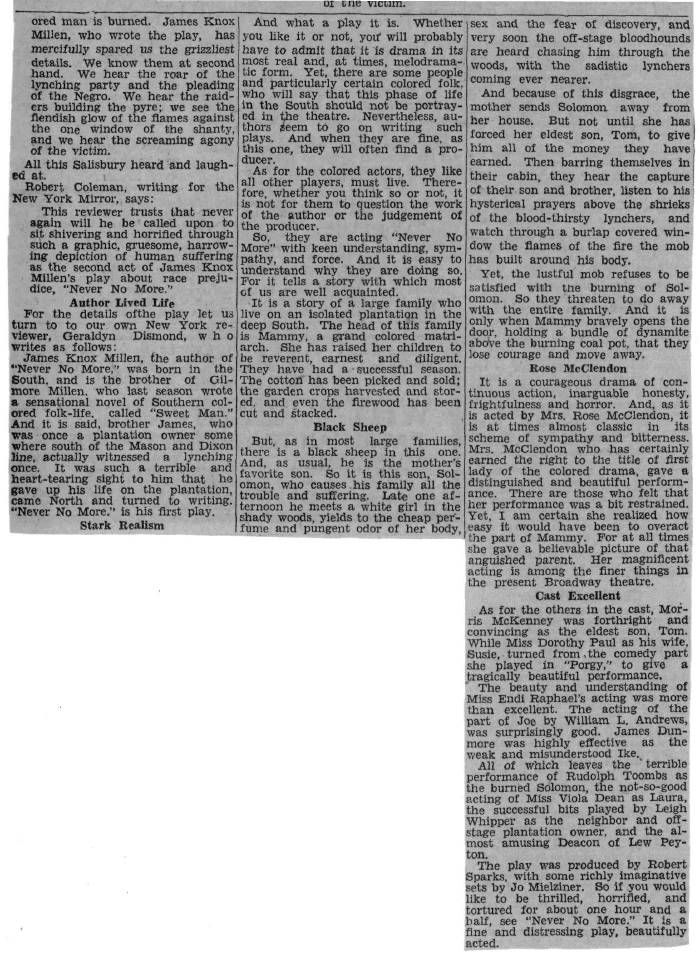
| oi one viciim. ored man is burned. James Knox Millen, who wrote the play, has mercifully spared us the grizzliest details. We know them at second hand. We hear the roar of the lynching party and the pleading of the Negro. We hear the raiders building the pyre; we see the fiendish glow of the flames against the one window of the shanty, and we hear the screaming agony of the victim. All this Salisbury heard and laughed at. Robert Coleman, writing for the New York Mirror, says: This reviewer trusts that never again will he be called upon to sit shivering and horrified through such a graphic, gruesome, harrowing depiction of human suffering as the second act of James Knox Millen's play about race prejudice, "Never No More." Author Lived Life For the details ofthe play let us turn to to our own New York reviewer, Geraldyn Dismond, who writes as follows: James Knox Millen, the author of "Never No More," was born in the Bouth, and is the brother of Gil-more Millen, who last season wrote a sensational novel of Southern colored folk-life, called "Sweet Man." And it is said, brother James, who Śwas once a plantation owner some where south of the Mason and Dixon line, actually witnessed a lynching once. It was such a terrible and heart-tearing sight to him that he gave up his life on the plantation, came North and turned to writing. "Never No More." is his first play. Stark Realism And what a play it is. Whether you like it or not, you* will probably have to admit that it is drama in its most real and, at times, melodramatic form. Yet, there are some people and particularly certain colored folk, who will say that this phase of life in the South should not be portrayed in the theatre. Nevertheless, authors seem to go on writing such plays. And when they are fine, as this one, they will often find a producer. As for the colored actors, they like all other players, must live. Therefore, whether you think so or not, it is not for them to question the work of the author or the judgement of the producer. So, they are acting "Never No More" with keen understanding, sympathy, and force. And it is easy to understand why they are doing so. For it tells a story with which most of us are well acquainted. It is a story of a large family who live on an isolated plantation in the deep South. The head of this family is Mammy, a grand colored matriarch. She has raised her children to be reverent, earnest and diligent. They have had a successful season. The cotton has been picked and sold; the garden crops harvested and stored, and even the firewood has been cut and stacked. Black Sheep But, as in most large families, there is a black sheep in this one. And, as usual, he is the mother's favorite son. So it is this son, Solomon, who causes his family all the trouble and suffering. Late one afternoon he meets a white girl in the shady woods, yields to the cheap perfume and pungent odor of her body, sex and the fear of discovery, and very soon the off-stage bloodhounds are heard chasing him through the woods, with the sadistic lynchers coming ever nearer. And because of this disgrace, the mother sends Solomon away from her house. But not until she has forced her eldest son, Tom, to give him all of the money they have earned. Then barring themselves in their cabin, they hear the capture of their son and brother, listen to his hysterical prayers above the shrieks of the blood-thirsty lynchers, and watch through a burlap covered window the flames of the fire the mob has built around his body. Yet, the lustful mob refuses to be satisfied with the burning of Solomon. So they threaten to do away with the entire family. And it is only when Mammy bravely opens the door, holding a bundle of dynamite above the burning coal pot, that they lose courage and move away. Rose McClendon It is a courageous drama of continuous action, inarguable honesty, frightfulness and horror. And, as it is acted by Mrs. Rose McClendon, it is at times almost classic in its scheme of sympathy and bitterness. Mrs. McClendon who has certainly earned the right to the title of first lady of the colored drama, gave a distinguished and beautiful performance. There are those who felt that her performance was a bit restrained. Yet, I am certain she realized how easy it would have been to overact the part of Mammy. For at all times she gave a believable picture of that anguished parent. Her magnificent acting is among the finer things in the present Broadway theatre. Cast Excellent As for the others in the cast, Morris McKenney was forthright and convincing as the eldest son, Tom. While Miss Dorothy Paul as his wife, Susie, turned from - the comedy part she played in "Porgy," to give a tragically beautiful performance. The beauty and understanding of Miss Endi Raphael's acting was more than excellent. The acting of the part of Joe by William L. Andrews, was surprisingly good. James Dun-more was highly effective as the weak and misunderstood Ike. All of which leaves the ' terrible performance of Rudolph Toombs as the burned Solomon, the not-so-good acting of Miss Viola Dean as Laura, the successful bits played by Leigh Whipper as the neighbor and offstage plantation owner, and the almost amusing Deacon of Lew Peyton. The play was produced by Robert Sparks, with some richly imaginative sets by Jo Mielziner. So if you would like to be thrilled, horrified, and tortured for about one hour and a half, see "Never No More." It is a fine and distressing play, beautifully acted. |