 |
|
|
 |
|
 |
|
|||
|
||||
|
||||
|
|
|
|
|
|
|
|||
|
||||
|
||||
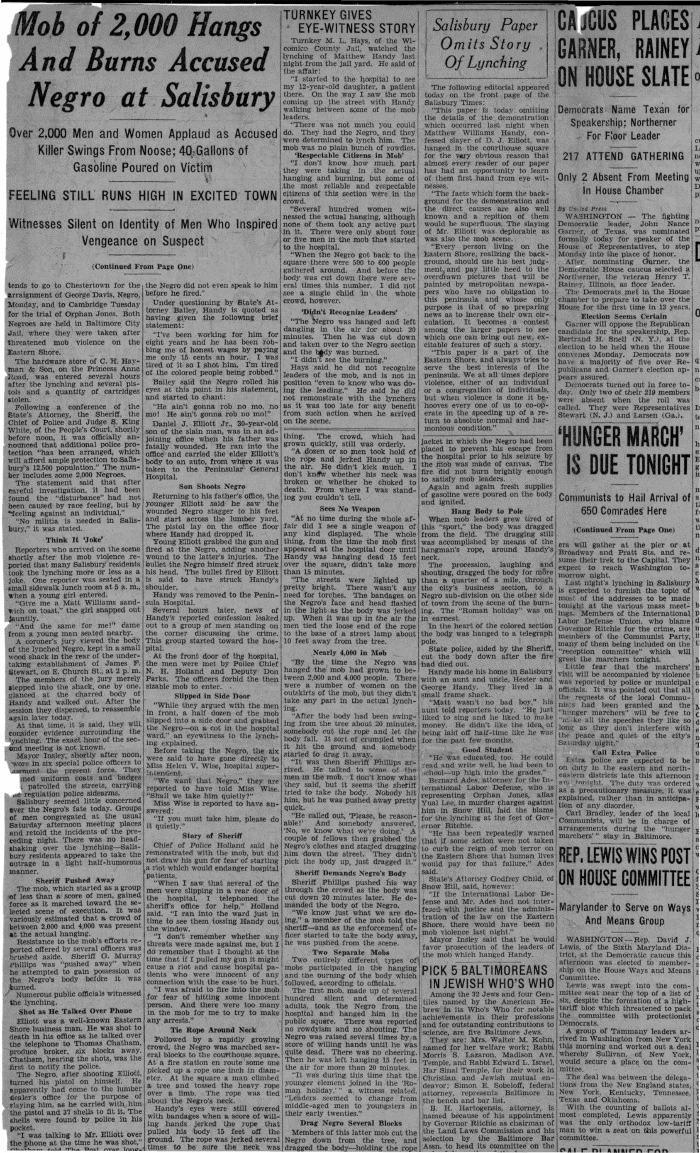
| Mob of 2,000 Hangs And Burns Accused Negro at Salisbury Over 2,000 Men and Women Applaud as Accused Killer Swings From Noose; 4Q;Gallons of Gasoline Poured on Victim FEELING STILL RUNS HIGH IN EXCITED TOWN Witnesses Silent on Identity of Men Who Inspired Vengeance on Suspect (Continued From Page One) tends to go to Chestertown for the arraignment of George Davis, Negro, Monday, and to Cambridge Tuesday for the trial of Orphan Jones. Both Negroes are held in Baltimore City-Jail, where they were taken after threatened mob violence on the Eastern Shore. The hardware store of C. H. Hay-man & Son, on the Princess Anne Road, was entered several hours after the lynching and several pistols and a quantity of cartridges stolen. Following a conference of the State's Attorney, the Sheriff, the Chief of Police and Judge S. King "White, of the People's Court, shortly before noon, it was officially announced that additional police protection "has been arranged, which will afford ample protection to Salisbury's 12,500 population." The num-toer includes some 2,000 Negroes. The statement said that after careful investigation, it had been found the "disturbance" had not been caused by race feeling, but by •feeling against an individual." "No militia is needed in Salisbury," it was stated. Think It 'Joke' Reporters who arrived on the scene shortly after the mob violence reported that many Salisbury residents took the lynching more or less as a joke. One reporter was seated in a tmall sidewalk lunch room at 5 a. m., when a young girl entered. "Give me a Matt Williams sandwich on toast," the girl snapped out jauntily. "And the same for me!" came from a young man seated nearby. A coroner's jury viewed the body of the lynched Negro, kept in a small wood shack in the rear of the undertaking establishment of James P. Stewart, on E. Church St., at 2 p. m. The members of the jury merely stepped into the shack, one by one, glanced at the charred body of Handy and walked out. After the session they dispersed, to reassemble again later today. At that time, it is said, they will consider evidence surrounding the inching. The exact hour of the second meeting is not known. Mayor Insley, shortly after noon, ¦wore in six special police officers to Element the present force. They med uniform coats and badges i patrolled the streets, carrying ..e regulation police sidearms. Salisbury seemed little concerned over the Negro's fate today. Groups of men congregated at the usual Saturday afternoon meeting places and retold the incidents of the preceding night. There was no head-shaking over the lynching—Salisbury residents appeared to take the outrage in a light half-humorous manner. Sheriff Pushed Away The mob, which started as a group of less than a score of men, gained force as it marched toward the selected scene of execution. It was variously estimated that a crowd of between 2,000 and 4,000 was present at the actual hanging. Resistance to the mob's efforts reported offered by several officers was brushed aside. Sheriff G. Murray Phillips was "pushed away" when he attempted to gain possession of the Negro's body before it was burned. ' Numerous public officials witnessed the lynching. Shot as He Talked Over Phone Elliott was a well-known Eastern Shore business man. He was shot to death in his office as he talked over the telephone to Thomas Chatham, produce broker, six blocks away. Chatham, hearing the shots, was the first to notify the police. The Negro, after shooting Elliott, turned his pistol on himself. He apparently had come to the lumber dealer's office for the purpose of slaying him, as he carried with^him the pistol and 37 shells to fit it. The shells were found by police in his pocket. "I was talking to Mr. Elliott over the phone at the time he was shot," *^\A Tko 3/\cf r*vt>v Inner. the Negro did not even speak to him before he fired." Under questioning by State's Attorney Bailey, Handy is quoted as having given the following brief statement: "I've been working for him for eight years and he has been robbing me of honest wages by paying me only 15 cents an hour. I was tired of it so I shot him. I'm tired of the colored people being robbed." Bailey said the Negro rolled his eyes at this point in his statement, and started to chant: "He ain't gonna rob no mo, no mo! He ain't gonna rob no mo!" Daniel J. Elliott Jr., 30-year-old son of the slain man, was in an adjoining office when his father was fatally wounded. He ran into the office and carried the elder Elliott's body to an auto, from where it was taken to the Peninsular General Hospital. Son Shoots Negro Returning to his father's office, the younger Elliott said he saw the wounded Negro stagger to his feet and start across the lumber yard. The pistol lay on the office floor where Handy had dropped it. Young Elliott grabbed the gun and fired at the Negro, adding another wound to the latter's injuries. The bullet the Negro himself fired struck his head. The bullet fired by Elliott is said to have struck Handy's shoulder. Handy was removed to the Peninsula Hospital. Several hours later, news of Handy's reported confession leaked out to a group of men standing on the corner discussing the crime. This group started toward the hospital. At the front door of the hospital, the men were met by Police Chief N. H. Holland and Deputy Don Parks. The officers forbid the then sizable mob to enter. Slipped in Side Door "While they argued with the men in front, a half dozen of the mob slipped into a side door and grabbed the Negro—on a cot in the hospital ward." an eyewitness to the lynching explained. Before taking the Negro, the six were said to have gone directly to Miss Helen V. Wise, hospital superintendent. "We want that Negro," they are reported to have told Miss Wise. "Shall we take him quietly?" Miss Wise is reported to have answered: "If you must take him, please do it quietly." Story of Sheriff Chief of Police Holland said he remonstrated with the mob, but did not draw his gun for fear of starting ;a riot which would endanger hospital patients. "When I saw that several of the men were slipping in a rear door of the hospital, I telephoned the sheriff's office for help," Holland said. "I ran into the ward just in time to see them tossing Handy out the window. "I don't remember whether any threats were made against me, but I do remember that I thought at the time that if I pulled my gun it might cause a riot and cause hospital patients who were innocent of any connection with the case to be hurt. "I was afraid to fire into the mob for fear of hitting some innocent person. And there were too many in the mob for me to try to make any arrests." Tie Rope Around Neck Followed by a rapidly growing crowd, the Negro was marched several blocks to the courthouse square. At a fire station en route some one picked up a rope one inch in diameter. At the square a man climbed a tree and tossed the heavy rope over a limb. The rope was tied about the Negro's neck. Handy's eyes were still covered with bandages when a score of willing hands jerked the rope that pulled his body 15 feet off the ground. The rope was jerked several times to be sure the neck was IRNKEY GIVES EYE-WITNESS STORY Turnkey M. L. Hays, of the Wicomico County Jail, watched the lynching of Matthew Handy last night from the jail yard. He said of the affair: "I started to the hospital to see my 12-year-old daughter, a patient there. On the way I saw the mob coming up the street with Handy walking between some of the mob leaders. 'There was not much you could do. They had the Negro, and they were determined to lynch him. The mob was no plain bunch of rowdies. 'Respectable Citizens in Mob' I don't know how much part they were taking in the actual hanging and burning, but some of the most reliable and respectable citizens of this section were in the crowd. Several hundred women witnessed the actual hanging, although none of them took any active part in it. There were only about four or five men in the mob that started to the hospital. When the Negro got back to the square there were 500 to 600 people gathered around. And before the body was cut down there were several times this number. I did not see a single child in the whole crowd, however. "Didn't Recognize Leaders' "The Negro was hanged and left dangling in the air for about 20 minutes. Then he was cut down and taken over to the Negro section and the h*dy was burned. "I didn't see the burning." Hays said he did not recognize leaders of the mob, and is not in position "even to know who was doing the leading." He said he did not remonstrate with the lynchers as it was too late for any benefit from such action when he arrived on the scene. Salisbury Paper Omits Story Of Lynching thing. The crowd, which had grown quickly, still was orderly. "A dozen or so men took hold of the rope and jerked Handy up in the air. He didn't kick much. I don't knftv whether his neck was broken or whether he choked to death. From where I was standing you couldn't tell. Sees No Weapon "At no time during the whole affair did I see a single weapon of any kind displayed. The whole thing, from the time the mob first appeared at the hospital door until Handy was hanging dead 15 feet over the square, didn't take more than 15 minutes. "The streets were lighted up pretty bright. There wasn't any need for torches. The bandages on the Negro's face and head flashed in the light as the body was jerked up. When it was up in the air the men tied the loose end of the rope to the base of a street lamp about 10 feet away from the tree. Nearly 4,000 in Mob "By the time the Negro was hanged the mob had grown to between 2,000 and 4,000 people. There were a number of women on the outskirts of the mob, but they didn't take any part in the actual lynching. "After the body had been swinging from the tree about 20 minutes, somebody cut the rope and let the body fall. It sort of crumpled when it hit the ground and somebody started to drag it away. "It was then Sheriff Phillips arrived. He talked to some of the men in the mob. I don't know what they said, but it seems the sheriff tried to take the body. Nobody hit him, but he was pushed away pretty quick. "He called out, 'Please, be reasonable!' And somebody answered, 'No, we know what we're doing.' A couple of fellows then grabbed the Negro's clothes and started dragging him down the street. They didn't pick the body up, just dragged it." Sheriff Demands Negro's Body Sheriff Phillips pushed his way through the crowd as the body was cut down 20 minutes later. He demanded the body of the Negro. "We know just what we are doing," a member of the mob told the sheriff—and as the enforcement officer started to take the body away, he was pushed from the scene. Two Separate Mobs Two entirely different types of* mobs participated in the hanging and the burning of the body which followed, according to officials. The first mob. made up of several hundred silent and determined adults, took the Negro from the hospital and hanged him in the public square. There was reported no rowdyism and no shouting. The Negro was raised several times by a score of willing hands until he was quite dead. There was no cheering. Then he was left hanging 15 feet in the air for more than 20 minutes. "It was during this time that the younger element joined in the Roman holiday,'" a witness related. "Leaders seemed to change from middle-aged men to youngsters in their early twenties." Drag Negro Several Blocks Members of this latter mob cut the Negro down from the tree, and dragged the body—holding the rope The following editorial appeared today on the front page of the j Salisbury Times: "This paper is today omitting the details of the demonstration ! which occurred last night when i Matthew Williams Handy, con- f fessed slayer of D. J. Elliott, was j hanged in the courthouse square for the vary obvious reason that almost every reader of our paper has had an opportunity to learn of them first hand from eye witnesses. "The facts which form the background for the demonstration and the direct causes are also well known and a repition of them would be superfluous. The slaying of Mr. Elliott was deplorable as was also the mob scene. "Every person living on the Eastern Shore, realizing the background, should use his best judgment, and pay little heed to the overdrawn pictures that will be painted by metropolitan newspapers who have no obligation to this peninsula and whose only purpose is that of so preparing news as to increase their own circulation. It becomes a contest among the larger papers to see which one can bring out new, excitable features of such a story. "This paper is a part of the Eastern Shore, and always tries to serve the best interests of the peninsula. We at all times deplore violence, either of an individual or a congregation of individuals, but when violence is done it behooves every one of us to co-operate in the speeding up of a return to absolute normal and harmonious condition." jacket in which the Negro had been placed to prevent his escape from the hospital prior to his seizure by the mob was made of canvas. The fire did not burn brightly enough to satisfy mob leaders. Again and again fresh supplies of gasoline were poured on the body and ignited. Hang Body to Pole When mob leaders grew tired of this "sport," the body was dragged from the field. The dragging still was accomplished by means of the hangman's rope, around Handy's neck. The procession, laughing and shouting, dragged the body for m8re than a quarter of a mile, through the city's business section, to a Negro sub-division on the other side of town from the scene of the burning. The "Roman holiday" was on in earnest. In the heart of the colored section the body was hanged to a telegraph pole. State police, aided by the Sheriff, cut the body down after the fire had died out. Handy made his home in Salisbury with an aunt and uncle, Hester and George Handy. They lived in a small frame shack. "Matt wasn't no bad boy," his aunt told reporters today. "He just liked to sing and lie liked to make money. He didn't like the idea^ of being laid off half-time like he was for the past few months. Good Student "He was educated, too. He could read and write well, he had been to school—up high into the grades." Bernard Ades, attorney for the International Labor Defense, who is representing Orphan Jones, alias Yual Lee, in murder charges against him in Snow Hill, laid the blame for the lynching at the feet of Governor Ritchie. "He has been repeatedly warned that if some action were not taken 10 curb the reign of mob terror on the Eastern Shore that human lives would pay for that failure," Ades said. State's Attorney Godfrey Child, of Snow Hill, said, however: "If the International Labor Defense and Mr. Ades had not interleaf with justice and the administration of the law on the Eastern Shore, there would have been no mob violence last night." Mayor Insley said that he would favor prosecution of the leaders of the mob which hanged Handy. CAjCUS PLACES GARNER, RAINEY ON HOUSE SLATE Democrats Name Texan for Speakership; Northerner - For Floor Leader 217 ATTEND GATHERING Only 2 Absent From Meeting In House Chamber By United Press WASHINGTON — The fighting Democratic leader, John Nance Garner, of Texas, was nominated formally today for speaker of the House of Representatives, to step Monday into the place of honor. After nominating Garner, the Democratic House caucus selected a Northerner, the veteran Henry T. Rainey, Illinois, as floor leader. The Democrats met in the House chamber to prepare to take over the House for the first time in 13 years. Election Seems Certain Garner will oppose the Republican candidate for the speakership, Rep. Bertrand H. Snell (N. Y.), at the election to be held when the House convenes Monday. Democrats now have a majority of five over Republicans and Garner's election appears assured. Democrats turned out in force today. Only two of their 219 members were absent when the roll was called. They were Representatives Stewart (N. J.) and Larsen (Ga.). 'HUNGER MARCH' IS DUE TONIGHT Communists to Hail Arrival of 650 Comrades Here (Continued From Page One) ers will gather at the pier or at Broadway and Pratt Sts. and resume their trek to the Capital. They expect to reach Washington tomorrow night. Last night's lynching in Salisbury is expected to furnish the topic of mos>t of the addresses to be made tonight at the various mass meetings. Members of the International Labor Defense Union, who blame Governor Ritchie for the crime, are members of the Communist Party, many of them being included on the "reception committee" which will greet the marchers tonight. 1 iitle fear that the marchers' visit will be accompanied by violence was reported by police or municipal officials. It was pointed out that all the requests of the local Communists had been granted and the "hunger marchers" will be free to "n: k.e all the speeches they like so Ion? as they don't interfere with the peace and quiet- of the city's Saturday night." Call Extra Police Extra police are expected to be on duty in the eastern and north-eas ern districts late this afternoon h"i irmight. The duty was ordered as a precautionary measure, it was explained, rather than in anticipation of any disorder. Carl Bradley, leader of the local Communists, will be in charge of arrangements during the "hunger marchers'" stay in Baltimore. REP. LEWIS WINS POST ON HOUSE COMMITTEE Marylander to Serve on Ways And Means Group PICK5BALTIM0REANS IN JEWISH WHO'S WHO Among the 32 Jews and four Gentiles named by the American Hebrew in its Who's Who for notable achievements in their professions and for outstanding contributions to science, are five Baltimore Jews. They are: Mrs. Walter M. Kohn, named for her welfare work; Rabbi Morris S. Lazaron, Madison Ave. Temple, and Rabbi Edward L. Israel, Har Sinai Temple, for their work in Christian and Jewish mutual endeavor; Simon E. Sobeloff, federal attorney, represents Baltimore in the bench and bar list. B. H. Hartogensis, attorney, is named because of his appointment by Governor Ritchie as chairman of the Land Laws Commission and his selection by the Baltimore Bar Assn. to head its committee on the WASHINGTON —Rep. David J. Lewis, of the Sixth Maryland District, at the Democratic caucus this afternoon was elected to membership on the House Ways and Means Committee. Lewis, was swept into the committee seat near the top of a list of six, despite the formation of a high-tariff bloc which threatened to pack the committee with protectionist Democrats. A group of Tammany leaders arrived in Washington from New York this morning and worked out a deal whereby Sullivan, of New York, would secure a place on the committee. The deal was between the delegations from the New England states, New York, Kentucky, Tennessee, Texas and Oklahoma. With the counting of ballots almost completed, Lewis apparently was the only orthodox low-tariff man to win a seat on tills powerful committee. on i |