 |
|
|
 |
|
 |
|
|||
|
||||
|
||||
|
|
|
|
|
|
|
|||
|
||||
|
||||
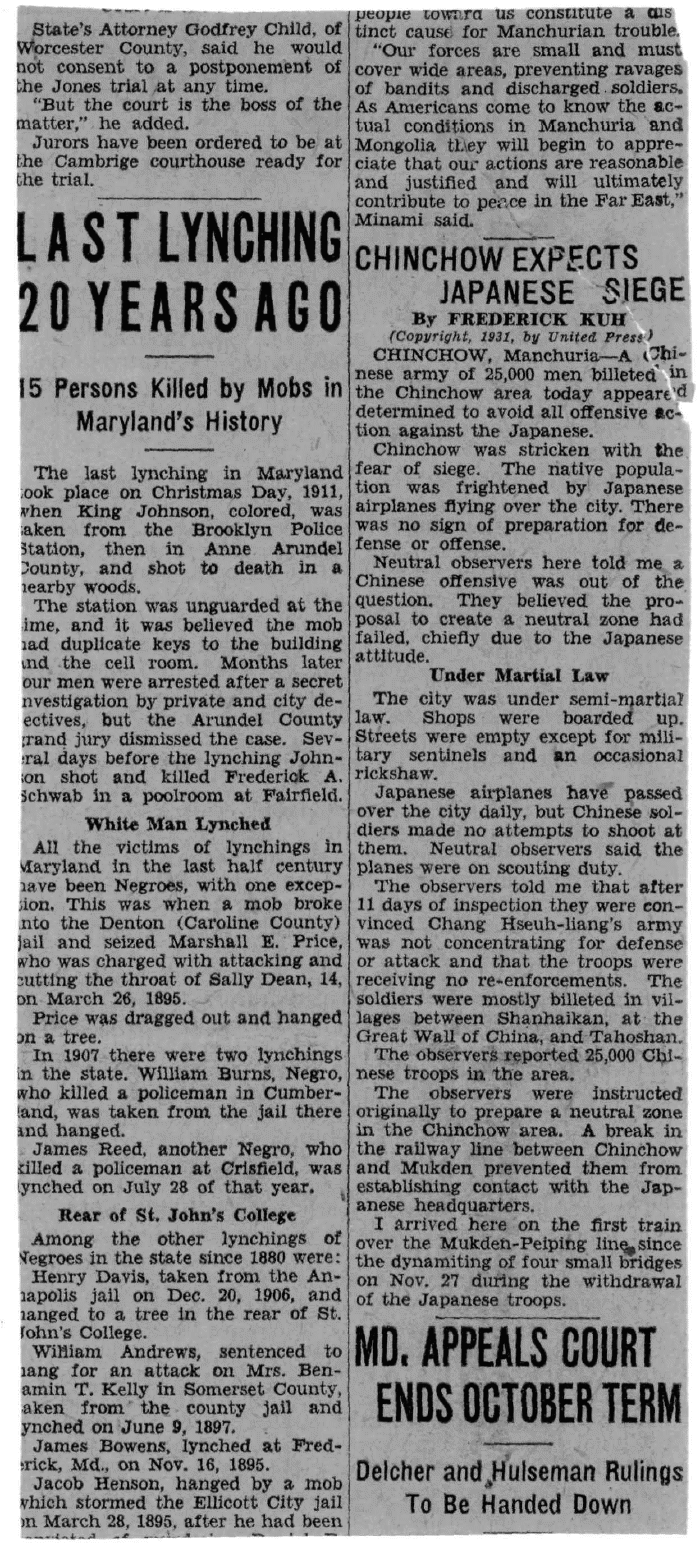
| " - — - State's Attorney Godfrey Child, of Worcester County, said he would not consent to a postponement of the Jones trial at any time. "But the court is the boss of the matter," he added. Jurors have been ordered to be at the Cambrige courthouse ready for the trial. LAST LYNCHING 20 YEARS AGO 15 Persons Killed by Mobs in Maryland's History The last lynching in Maryland ook place on Christmas Day, 1911, vhen King Johnson, colored, was aken from the Brooklyn Police Station, then in Anne Arundel bounty, and shot to death in a learby woods. The station was unguarded at the ime, and it was believed the mob lad duplicate keys to the building ind the cell room. Months later our men were arrested after a secret nvestigation by private and city de-ectives, but the Arundel County :rand jury dismissed the case. Several days before the lynching John-;on shot and killed Frederiok A. Schwab in a poolroom at Fairfield. White Man Lynched All the victims of lynchings in Maryland in the last half century lave been Negroes, with one excep-;ion. This was when a mob broke nto the Denton (Caroline County) Jail and seized Marshall E. Price, who was charged with attacking and jutting the throat of SaUy Dean, 14, on March 26, 1895. Price was dragged out and hanged an a tree. In 1907 there were two lynchings in the state. William Burns, Negro, who killed a policeman in Cumberland, was taken from the jail there md hanged. James Reed, another Negro, who rilled a policeman at Crisfield, was .ynched on July 28 of that year. Rear of St. John's College Among the other lynchings of Negroes in the state since 1880 were: Henry Davis, taken from the An-lapolis jail on Dec. 20, 1906, and langed to a tree in the rear of St. rohn's College. William Andrews, sentenced to lang for an attack on Mrs. Ben-amin T. Kelly in Somerset County, aken from the county jail and ynched on June 9, 1897. James Bowens, lynched at Fredrick, Md., on Nov. 16, 1895. Jacob Henson, hanged by a mob vhich stormed the Ellicott City jail >n March 28, 1895, after he had been peopie tovntra us constitute a cus tinct cause; for Manchurian trouble. "Our forces are small and must cover wide areas, preventing ravages of bandits and discharged soldiers. As Americans come to know the actual conditions in Manchuria and Mongolia they will begin to appreciate that our actions are reasonable and justified and will ultimately contribute to pe.ice in the Far East," Minami said. CHINCH0W EXPECTS JAPANESE SIEGE By FREDERICK KTJH (Copyright, 1931, by United Press > CHINCHOW, Manchuria—A Chinese army of 25,000 men billeted* In the Chinchow area today appeart'd determined to avoid all offensive action against the Japanese. Chinchow was stricken with the fear of siege. The native population was frightened by Japanese airplanes flying over the city. There was no sign of preparation for defense or offense. Neutral observers here told me a Chinese offensive was out of the question. They believed the proposal to create a neutral zone had failed, chiefly due to the Japanese attitude. Under Martial Law The city was under semi-martial law. Shops were boarded up. Streets were empty except for military sentinels and an occasional rickshaw. Japanese airplanes have passed over the city daily, but Chinese soldiers made no attempts to shoot at them. Neutral observers said the planes were on scouting duty. The observers told me that after 11 days of inspection they were convinced Chang Hseuh-liang's army was not concentrating for defense or attack and that the troops were receiving no re-enforcements. The soldiers were mostly billeted in villages between Shanhaikan, at the Great Wall of China, and Tahoshan, The observers reported 25,000 Chinese troops in the area. The observers were instructed originally to prepare a neutral zone in the Chinchow area. A break in the railway line between Chinchow and Mukden prevented them from establishing contact with the Japanese headquarters. I arrived here on the first train over the Mukdeh-Peiping lin^ since the dynamiting of four small bridges on Nov. 27 during the withdrawal of the Japanese troops. . APPEALS COURT ENDS OCTOBER TERM Delcher and^Hulseman Rulings To Be Handed Down |