 |
|
|
 |
|
 |
|
|||
|
||||
|
||||
|
|
|
|
|
|
|
|||
|
||||
|
||||
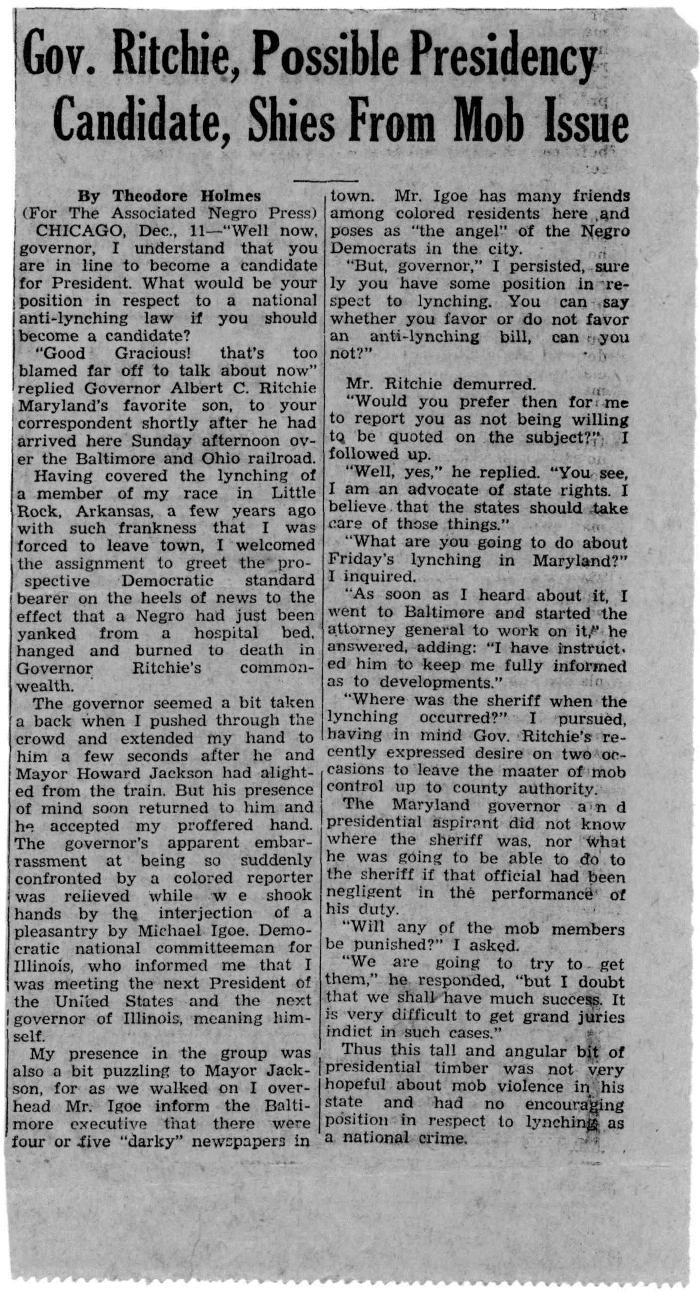
| .!. ... Gov. Ritchie, Possible Presidency Candidate, Shies From Mob Issue By Theodore Holmes (For The Associated Negro Press) CHICAGO, Dec, 11—"Well now, governor, I understand that you are in line to become a candidate for President. What would be your position in respect to a national anti-lynching law if you should become a candidate? "Good Gracious! that's too blamed far off to talk about now" replied Governor Albert C. Ritchie Maryland's favorite son, to your correspondent shortly after he had arrived here Sunday afternoon over the Baltimore and Ohio railroad. Having covered the lynching of a member of my race in Little Rock, Arkansas, a few years ago with such frankness that I was forced to leave town, I welcomed the assignment to greet the prospective Democratic standard bearer on the heels of news to the effect that a Negro had just been yanked from a hospital bed, hanged and burned to death in Governor Ritchie's commonwealth. The governor seemed a bit taken a back when I pushed through the crowd and extended my hand to him a few seconds after he and Mayor Howard Jackson had alighted from the train. But his presence of mind soon returned to him and he accepted my proffered hand. The governor's apparent embarrassment at being so suddenly confronted by a colored reporter was relieved while w e shook hands by the interjection of a pleasantry by Michael Igoe. Democratic national committeeman for Illinois, who informed me that I was meeting the next President of the United States and the next I governor of Illinois, meaning himself. My presence in the group was also a bit puzzling to Mayor Jackson, for as we walked on I overhead Mr. Igoe inform the Baltimore executive that there were four or .five "darky" newspapers in town. Mr. Igoe has many friends among colored residents here ,a.nd poses as "the angel" of the Negro Democrats in the city. ,, "But, governor," I persisted, sure ly you have some position in respect to lynching. You can say whether you favor or do not favor an anti-lynching bill, can you not?" • ¦ Mr. Ritchie demurred. t "Would you prefer then for; me to report you as not being willing to, be quoted on the subject?" I followed up. "Well, yes," he replied. "You see, I am an advocate of state rights. I believe that the states should take care of those things." "What are you going to do about Friday's lynching in Maryland?" I inquired. "As soon as I heard about it, I went to Baltimore and started the attorney general to work on it,'' he answered, adding: "I have instruct, ed him to keep me fully informed as to developments." "Where was the sheriff when the lynching occurred?" I pursued, having in mind Gov. Ritchie's recently expressed desire on two occasions to leave the maater of mob control up to county authority. The Maryland governor and presidential aspirant did not know where the sheriff was, nor what he was going to be able to 6*o to the sheriff if that official had been negligent in the performance of his duty. "Will any of the mob members be punished?" I asked. "We are going to try to. get them," he responded, "but I doubt that we shall have much success. It is very difficult to get grand juries indict in such cases." Thus this tall and angular bjt of presidential timber was not very hopeful about mob violence in his state and had no encouraging position in respect to lynching as a national crime. |