 |
|
|
 |
|
 |
|
|||
|
||||
|
||||
|
Maryland State Archives Maryland Suffrage News Collection MSA SC 3286 msa_sc3286_scm7805-0098 Enlarge and print image (1M) |
|
|
|
|
|
|
|
|||
|
||||
|
||||
|
Maryland State Archives Maryland Suffrage News Collection MSA SC 3286 msa_sc3286_scm7805-0098 Enlarge and print image (1M) |
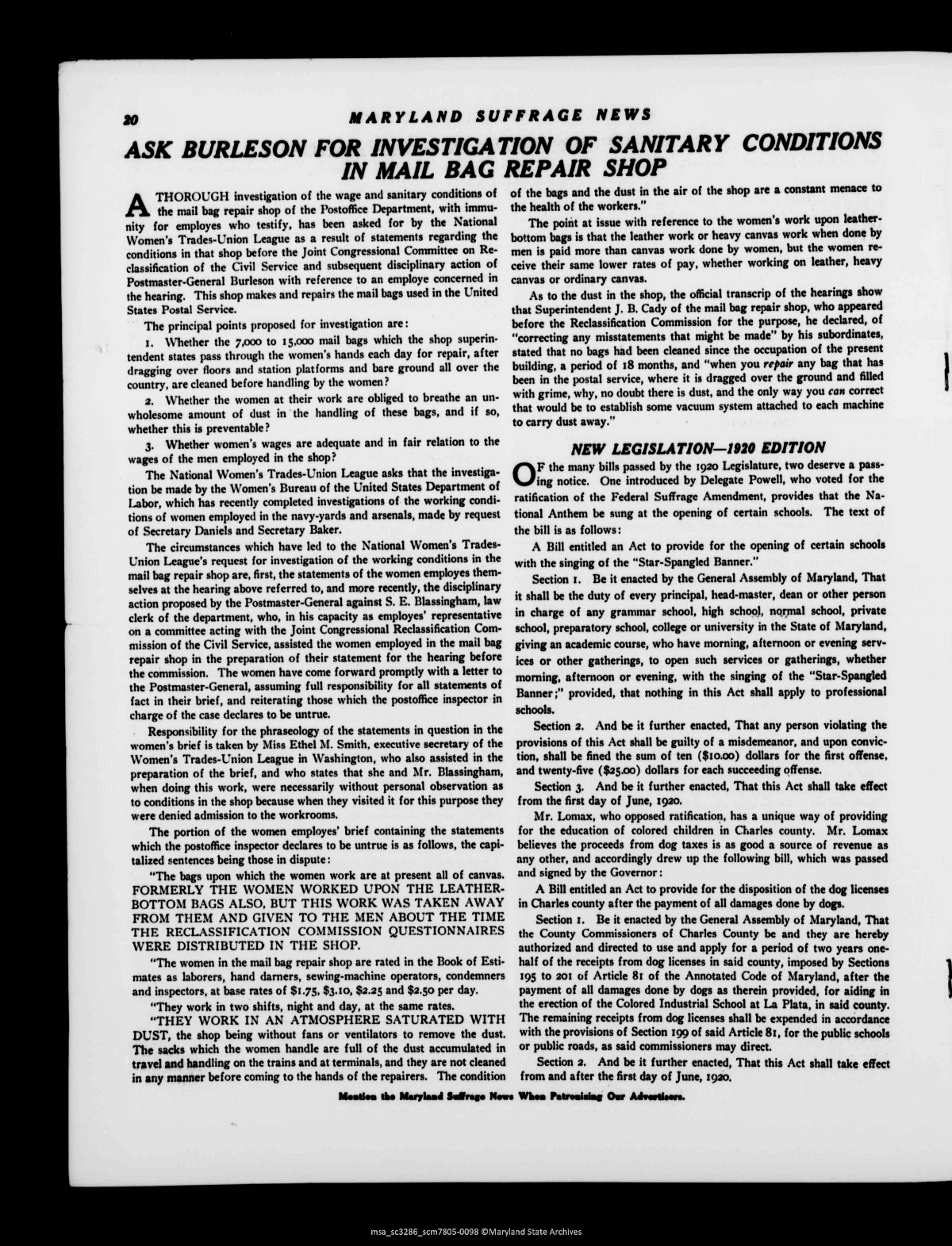
| 20 MARYLAND SUFFRAGE NEWS ASK BURLESON FOR INVESTIGATION OF SANITARY CONDITIONS IN MAIL BAG REPAIR SHOP A THOROUGH investigation of the wage and sanitary conditions of the mail bag repair shop of the Postoffice Department, with immu- nity for employes who testify, has been asked for by the National Women's Trades-Union League as a result of statements regarding the conditions in that shop before the Joint Congressional Committee on Re- classification of the Civil Service and subsequent disciplinary action of Postmaster-General Burleson with reference to an employe concerned in the hearing. This shop makes and repairs the mail bags used in the United States Postal Service. The principal points proposed for investigation are: 1. Whether the 7,000 to 15.000 mail bags which the shop superin- tendent states pass through the women's hands each day for repair, after dragging over floors and station platforms and bare ground all over the country, are cleaned before handling by the women? 2. Whether the women at their work are obliged to breathe an un- wholesome amount of dust in the handling of these bags, and if so, whether this is preventable ? 3. Whether women's wages are adequate and in fair relation to the wages of the men employed in the shop? The National Women's Trades-Union League asks that the investiga- tion be made by the Women's Bureau of the United States Department of Labor, which has recently completed investigations of the working condi- tions of women employed in the navy-yards and arsenals, made by request of Secretary Daniels and Secretary Baker. The circumstances which have led to the National Women's Trades- Union League's request for investigation of the working conditions in the mail bag repair shop are, first, the statements of the women employes them- selves at the hearing above referred to, and more recently, the disciplinary action proposed by the Postmaster-General against S. E. Blassingham, law clerk of the department, who, in his capacity as employes' representative on a committee acting with the Joint Congressional Reclassification Com- mission of the Civil Service, assisted the women employed in the mail bag repair shop in the preparation of their statement for the hearing before the commission. The women have come forward promptly with a letter to the Postmaster-General, assuming full responsibility for all statements of fact in their brief, and reiterating those which the postoffice inspector in charge of the case declares to be untrue. Responsibility for the phraseology of the statements in question in the women's brief is taken by Miss Ethel M. Smith, executive secretary of the Women's Trades-Union League in Washington, who also assisted in the preparation of the brief, and who states that she and Mr. Blassingham, when doing this work, were necessarily without personal observation as to conditions in the shop because when they visited it for this purpose they were denied admission to the workrooms. The portion of the women employes' brief containing the statements which the postoffice inspector declares to be untrue is as follows, the capi- talized sentences being those in dispute: "The bags upon which the women work are at present all of canvas. FORMERLY THE WOMEN WORKED UPON THE LEATHER. BOTTOM BAGS ALSO, BUT THIS WORK WAS TAKEN AWAY FROM THEM AND GIVEN TO THE MEN ABOUT THE TIME THE RECLASSIFICATION COMMISSION QUESTIONNAIRES WERE DISTRIBUTED IN THE SHOP. "The women in the mail bag repair shop are rated in the Book of Esti- mates as laborers, hand darners, sewing-machine operators, condemners and inspectors, at base rates of $175, $3.10, $2.25 and $2.50 per day. "They work in two shifts, night and day, at the same rates. "THEY WORK IN AN ATMOSPHERE SATURATED WITH DUST, the shop being without fans or ventilators to remove the dust. The sacks which the women handle are full of the dust accumulated in travel and handling on the trains and at terminals, and they are not cleaned in any manner before coming to the hands of the repairers. The condition of the bags and the dust in the air of the shop are a constant menace to the health of the workers." The point at issue with reference to the women's work upon leather- bottom bags is that the leather work or heavy canvas work when done by men is paid more than canvas work done by women, but the women re- ceive their same lower rates of pay, whether working on leather, heavy canvas or ordinary canvas. As to the dust in the shop, the official transcrip of the hearings show that Superintendent J. B. Cady of the mail bag repair shop, who appeared before the Reclassification Commission for the purpose, he declared, of "correcting any misstatements that might be made" by his subordinates, stated that no bags had been cleaned since the occupation of the present building, a period of 18 months, and "when you repair any bag that has been in the postal service, where it is dragged over the ground and filled with grime, why, no doubt there is dust, and the only way you can correct that would be to establish some vacuum system attached to each machine to carry dust away." NEW LEGISLATION?1920 EDITION OF the many bills passed by the 1920 Legislature, two deserve a pass- ing notice. One introduced by Delegate Powell, who voted for the ratification of the Federal Suffrage Amendment, provides that the Na- tional Anthem be sung at the opening of certain schools. The text of the bill is as follows: A Bill entitled an Act to provide for the opening of certain schools with the singing of the "Star-Spangled Banner." Section I. Be it enacted by the General Assembly of Maryland, That it shall be the duty of every principal, head-master, dean or other person in charge of any grammar school, high school, normal school, private school, preparatory school, college or university in the State of Maryland, giving an academic course, who have morning, afternoon or evening serv- ices or other gatherings, to open such services or gatherings, whether morning, afternoon or evening, with the singing of the "Star-Spangled Banner;" provided, that nothing in this Act shall apply to professional schools. Section 2. And be it further enacted, That any person violating the provisions of this Act shall be guilty of a misdemeanor, and upon convic- tion, shall be fined the sum of ten ($10.00) dollars for the first offense, and twenty-five ($25x10) dollars for each succeeding offense. Section 3. And be it further enacted, That this Act shall take effect from the first day of June, 1920. Mr. Lomax, who opposed ratification, has a unique way of providing for the education of colored children in Charles county. Mr. Lomax believes the proceeds from dog taxes is as good a source of revenue as any other, and accordingly drew up the following bill, which was passed and signed by the Governor: A Bill entitled an Act to provide for the disposition of the dog licenses in Charles county after the payment of all damages done by dogs. Section 1. Be it enacted by the General Assembly of Maryland, That the County Commissioners of Charles County be and they are hereby authorized and directed to use and apply for a period of two years one- half of the receipts from dog licenses in said county, imposed by Sections 195 to 201 of Article 81 of the Annotated Code of Maryland, after the payment of all damages done by dogs as therein provided, for aiding in the erection of the Colored Industrial School at La Plata, in said county. The remaining receipts from dog licenses shall be expended in accordance with the provisions of Section 199 of said Article 81, for the public schools or public roads, as said commissioners may direct. Section 2. And be it further enacted. That this Act shall take effect from and after the first day of June, 1920. Wk*a f.tr.miiim. Oar AaWtftan. M..U.? Ik. tkrrU.4 S?*r.,. N?n WlMa f.tr.?M, |? AJ.wB.rn. |