 |
|
|
 |
|
 |
|
|||
|
||||
|
||||
|
Maryland State Archives Jeffersonian, Towson, Maryland mdsa_sc3410_1_63-0335 Enlarge and print image (6M) |
|
|
|
|
|
|
|
|||
|
||||
|
||||
|
Maryland State Archives Jeffersonian, Towson, Maryland mdsa_sc3410_1_63-0335 Enlarge and print image (6M) |
|
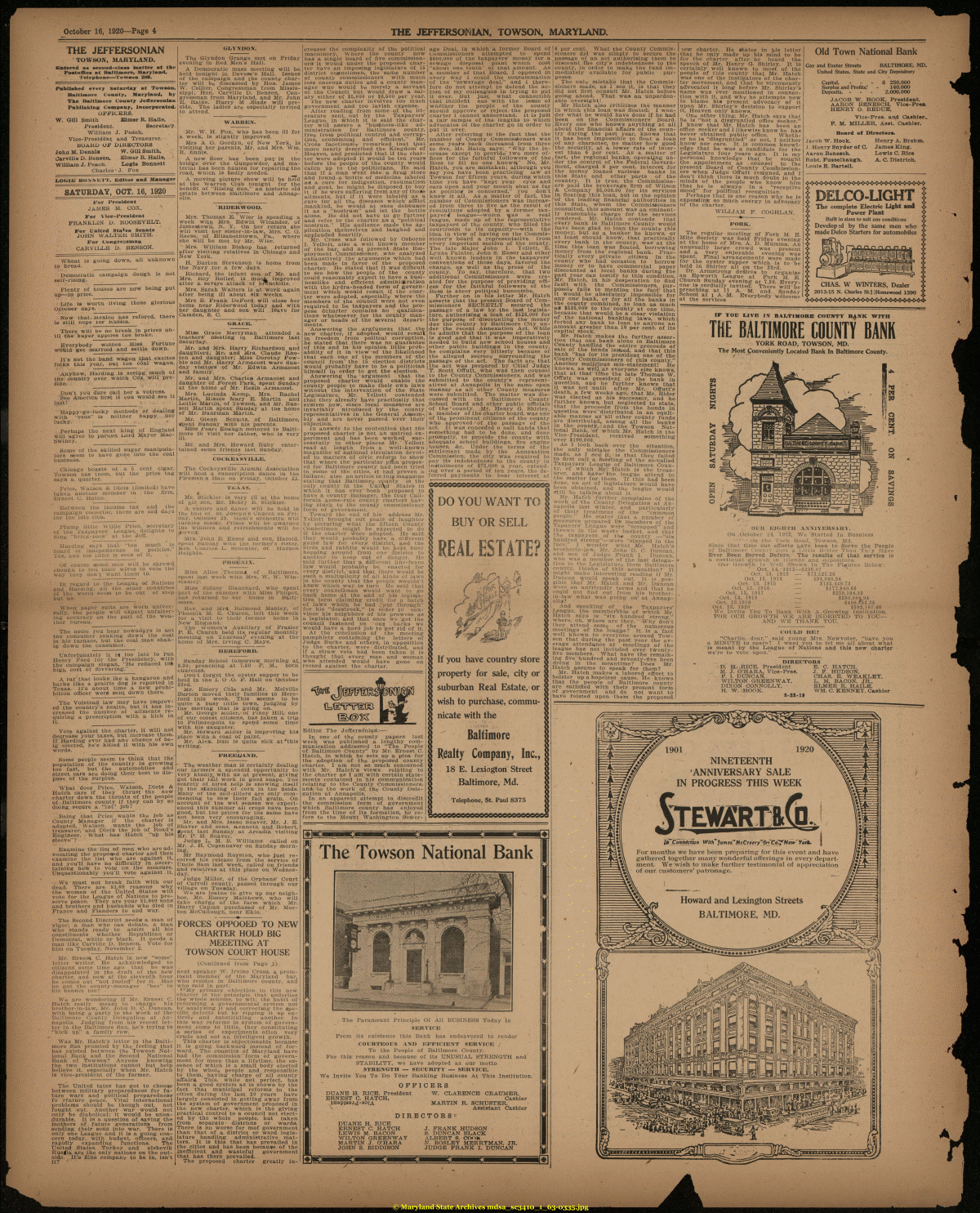
October 16, 1920—Page 4
THE JEFFERS«4lAN, TOWSON, MARYLAND.
THE JEFFERSON1AN
TOWSON, MARYLAND.
IQntered am »ect>ud-cla«»» matter at the
Poatufflce at Baltimore, Maryland.
Telephone----lowiun 280.
PubllMbt-U every Saturday at Towwn, Baltimore County, Maryland, by The Baltimore County JeflerMonlan PubliethlnK Company, Incorporated.
OFFICERS. W. Gill Smith Elmer R. Halle.
President. Secretary-
William J. Peach, Vice-President and Treasurer. BOARD OF DIRECTORS John M. Dennis W. Gill Smith,
Carville D. Benson. Elmer R. Halle, William J. Peach, Logic Bonnett
Charles ¦ J. Fox
LOUIE BUAJ>KTT, Editor and Manager
SATURDAY, J)CT. 16, 1920
For President
JAMES M. COX. For Vice-President
FRANKLIN D. ROOSEVELT.
For United States Senate
JOHN WALTER SMITH.
For Congressman CARV1LLE D. BENSON.
Wheat is going down, all unknown to bread. ¦;____________
Democratic campaign dough is not self-rising.______________
Plenty of houses are now being put up—in price.
Life is worth living these glorious October days._____________
Now that. Mexico has refored. there ia still nope ior -ttussia.
There will be no break in prices until the buyer applies tne brake.
Everybody wisnes Miss Fortune Wduld get married and settle down.
It's not the band wagon that excites folks tnis year, but tne coal wagon.
Anyhow, Harding is seeing much of the country over wnich Cox will presides :
Don't you dare call her a votress. See America first if vOU would see it last1.__________'
Happy-go-lucky methods of dealing with -reds" is neitner happy nor lucky. _______________
Perhaps the next king of England will agree to paruon Lord Mayor Mac-Swiney. ;'__________
Some of the skilled sugar manipulators seem to have gone into the coal business.
Chicago boasts of a 5 cent cigar. Towson nas tnem, but the price tag saysi a quarter. '
Price, Watson & Dietz (limited) have taken anotner member in the firm, Ernest C. Hatcn.
Between the income tax and the campaign collector, these are sad days tor tne idle ricn.
Plump little Willie Price, secretary of tne Taxpayers' League, delights to fling "bricK-oats" at tne Jeff.
Harding says that "too much is heard of independence in politics. Yes, and too little is seen of it.
Of course aome men will be shrewd enough to tea tneir wives to vote the way tney don t want tuem to.
In regard to the League of Nations and Hardmg, all the other countries of the world seem to be out of step but us. ______________
When paper suits are worn universally, the people will expect unfaltering accuracy on the part of the weather bureau.
The noise you hear nowadays is not the consumer snaking down the coal in his furnace, but the coal man shak-ig down tne consumer.
Unfortunately it iH too late to run Henry Ford for the Presidency, with the campaign slogan, "He reduced th% high cost of flivvering."
A rat'that looks Ike a kangaroo and barks like a prairie dog is reported in Texas. It's about time a new prohibition officer were sent down there.
The Volstead law may have improved the country's health, but it has increased the number of ailments requiring a prescription with a kick in it.________________
Vote against the charter, it will not decrease your taxes, but increase them. If Harding ever had any chance;of be-ig elected, he's killed it with his own words.
Some people seem to think that the population of the country is) growing too fast, but the automobiles and street cars are doing their best to dispose of the surplus.
What does Price, Watsjon, Dietz & Hatch care if they thrust the new-charter down the throats of the people of Baltimore county if they can by so doing, secure a "tat" job?
Being that Price wants the job as County Manager if the charter is adopted, Watson wants the job of treasurer, and Dietz the job of Roads Engineer. What has Hatch "up his sleeve"?
Examine the list of men who are advocating the proposed charter and then examine the list who are against it, and you'll have no difficulty in ascertaining how to vote on the measure. Unquestionably you'll vote against it.
. We must not break faith with our dead. There are 81,00 reasons why the women of the United States will vote for the League of Nations to preserve peace. They are your 81,000 sons and brothers and husbands who died in France and Flanders to end war.
The Second Disctrict needsi a man of vigor; a man who can debate, a man who stands ready to assist all his constituents whether Republican or Democrat, white or black. It needs a man like Carville D. Benson. Vote for him on Tuesday, November 2.
' Mr. Ernest C Hatch is now "some" letter writer. He acknowledged to citizens some time ago that he was disappointed in the draft of the new charter, and now at the eleventh hour he comes out "hot footed" for it. Has he got the county-manager "bee" in his bonnet too?
We are wondering if Mr. Ernest C. Hatch really meant to charge his brother-in-law, Mr. John D. C. Duncan, with being a party to the work of the Baltimore County Delegation at Annapolis. Judging from his recent letter in the Baltimore Sun, he's trying to "kick up" a family row.
Was Mr. Hatch's letter in the Baltimore Sun promted by the feeling that has existed between the Towson National Bank and the Second National Bank of Towson? Anyone knowing the two institutions cannot but help believe it, especially when Mr. Hatch is vice-president of the former.
The United tates has got to choose between military preparedness for future wars and political preparedness fo rfutiire peace. Vital international problems should be though out, not fought out. Another war would not only be diabolical; it would be unendurable. It is a question of saving the mothers of future generations from sending their sons into war. There is only one League and it is a going concern today, with budget, officers, and, rapidly expanding functions. The United States, Turkey and alshevik Russia are the only nations on the outside. It's nine company to be in, isn't it?
GLYNDON.
The Glyndon Grange met on Friday evening in Red Men's Hall.
A Democratic mass meeting will be held tonight in Devese's Hall. Issues of the campaign and the county charter will be discussed by Hon. James W. Collier, Congressman from Mississippi; Hon. Carville D. Benson, Congressman from Maryland, and Mr. John E. Raine. Harry M .Slade will preside. The ladies are especially invited to attend.
WARREN.
Mr. W. H. Fox, who has been ill for a week, is slightly improved.
Mrs A O. Gordyn, of New York, is visiting her parents, Mr. and Mrs. Wm. R. Ennis. *
A new floor has been put in the bridge over the Gunpowder, and material has been hauled tor repairing the road, which is badly needed.
A moving picture show will be held at the Warren Club tonight for the benefit of "Rising Sun," an historic old estate between Baltimore and Annapolis.
BIDERVVOOD.
Mrs. Thomas E. Wier is spending a week with Mrs. Edwin Wicander, of Jamestown, N. Y. On her return she will visit her sister-in-law, Mrs. C. G. Reese, of Elizabethtown, Pa., where she will be met by Mr. Wier.
Mrs. William Bishop has returned after visiting relatives in Chicago and New York.
H. Burton Stevenson is home from the Navy for a few days.
Richard, the infant son of Mr. and Mrs. Roy Roller, is mucJi improved atter a severe attack of bronchitis.
Mrs. Sarah Walters is at work again after being ill about six weeks.
Mrs B. Frank DeFord will close her home near Riderwood today and with her daughter and son\ will leave for Camden, S. C.
--------------o--------i-----
GRACE.
Miss Grace Merryman attended a teachers' meeting in Baltimore last Saturday.
Mr. and Mrs. Harry Richardson and daughters; Mr, and Mrs. Claude Rho-ten and daughter; Miss Dorotny Fow-ble and Mr. Harry Armacost were Sunday visitors of Mr. Edwin Armacost and family.
Mr. and Mrs. Charles) Armacost and daughter of Forest Park, spent Sunday at tne home of Mr. Rezin Armacost.
Mrs. Lucinda Kemp, Mrs. Rachel Martin, Misses Mary E. Martin and Lottie Marcin, of Towson, and Mr. Russell Martin spent Sunday at tne home of Mr. Bunrman Martin.
Mr. Glenn Scnuitz, of Baltimore, s/pent Sunday witn his parents.
Miss Pearl Eoaugh motored to Baltimore to visit her father, who is very ill.
Mr. and Mrs. Howard Ruby entertained some friends last Sunday.
COCKE 1SVILLE.
The Cockeysville Aiumni Association will hold a suoscription dance in tne Firemen sj Han on Friday, October 22.
TEA.AS.
Mr. Stickler is very ill at the home of nis son, Mr. Henry B. Stickler.
A eucnre and dance will be held in the hail of St. Josepn's Church on Friday, October 29. Haul's orchestra will lurnisn musac. Prizes will be awarded the winners and retreshments will be Served.
Mrs. John B. Ensor and son, Harold, spent bunuay witn the lormer's sister, Mrs. Onaries L. scuonter, of Hudson Heights.
PHOENIX.
Miss Alice Tnomaj, of Baltimore, spent last week witn Mrs. W. W. Wiii-stamey.
Miss Sidney Blanchard, who spent part of tne summer with Miss Philpot, nas returned to her home in Baltimore.
. Rev. and Mr^. Kalmond Manley, of Phoenix M. E. Churcn, left this week for a visit to their former home in New England.
The women's Auxiliary of Frazier P. E. Church held its regular monthly meeting on Tnursaay evening at the home of Mrs. Irving C. Mays.
HEREFORD.
Sunday School tomorrow morning at. 9.30; preaching at 7.30 P. M., both churches.
Don't forget the oyster supper to be held in the 1. O .O. F. Hall on October 23rd.
Mr. Emory Cole and Mr. Melville Burton moved tneir families to Hereford this week. This sieems to be quite a busy little town, judging by tne moving that is going on.
Mr. George Miller, of Piney Hill, one of our oldest citizens, has taken a trip to Pnilaueipnia to spend some time with his daugnter.
Mr. Howard miller is improving his place with a coat of paint.
Mr. Alex. Bun is quite sick at'this writing.
--------------o--------------
FREEIjAND.
creases the complexity of the political macninery. Wnere tne county now has a single board of five commission-era it would under the proposed charter have an imposing legislature of 15 district cottnciimen, the same number of county commissioners with much less onerous duties and a county manager who would be merely a servant ot the Council but would draw a salary either of $5,000 or $6,500 per year.
The new charter involves too much government and too lavish expense.
After reading from some of the literature sent, out by tne Taxpayers' League, in which it is said the charter will assure a "business-like administration for Baltimore county, free from political control and corruption, economical and efficient," Mr. Cross facetiouslv remarked that tOiat more nearly described the Kingdom of Heaven, and predicted that if the charter were adopted it would be ten years before the people of the county would catch up to the politicians. He said that if a man Went into a drug store and found a bottle of medicine labeled as. a cure for indigestion, rheumatism and gout, he might be disposed to buy it if he were suffering from any of those ailments, but if it were labeled as a cure for all the diseases which afflict mankind, he would at once denounce it as a "nostrum" and let the bottle alone. He did not have to go further and refer to the charter as a "political nostrum." His audience made the application themselves and laughed and applauded heartily.
Mr. Cross was followed by Osborne I. Yellott, also a well known member of the bar, and at present State Employment Commissioner, who analyzed exhaustively the arguments which had been made in favor of the proposed charter. He stated that it was difficult to see how the people of the county could reasonably expect to have a businesslike and efficient adminitjttrati/on with the hydra-headed form of government which would result if the cnar-ter were adopted, especially where the members of the council were not even required to be taxpayers and the propose dcharter contains no qualilica-tions whatsoever for the county manager or heads of the several departments.
Answering the argfument that the new charter, if adopted, would result in freedom from politcal corruption, he stated that there was no guarantee of this and in his opinion little probability of it in view of the likelihood that each one of the members of the council from the 15 election districts would probably have to be a politician himself in order to get the election.
Answering the argument that the proposed charter would enable the county people to make their own laws witnout the intervention of the State Legislature, Mr. Yellott contended that they already have practically that system now, since local measures are invariably ntroduced by the county representatives in the General Asoem-, bly and are never passed over their objection.
in answer to the contention that the proposed charter is not an untried experiment and has been worked successfully in other places Mr. Yellott read at length from a well-known magazine of national circulation devoted to matters of civic reform to show that where the particular plan proposed for Baltimore county had been tried in some of the cities, it had proven a failure; also an article in this magazine stating that Baltimore county is the only county in the UnitVd States in which it has ever been proposed to have a county manager, the four California home-rule county charters having stuck to the county commissioner form of government.
Toward the end of his address Mr. Yellott brought out peals of laughter by picturing what the fifteen County Councilmen might be expected to do if the charter were adopted. He said they would probably have a different game law for every district, and the birds and rabbits would be kept busy hopping around from one district to another to keep out of danger. He I said further that a different line-fence law would probably be enacted for every district, and that there would be such a multiplicity of all kinds of laws in the county that the people wouldn't know which way to turn He said that every councilman would want to go back home, at the end of his legislative term claiming credit for a batch of laws which he had "put through" for his "deestreek," in order to convince his neighbors of his prowess as a legislator, and that once we got the council fastened on our backs we would have a hard job to get rid of it.
At the conclusion of the meeting pamphlets containing the letters of Judge Burke and others, in opposition to the charter, were distributed, and if a straw vote had been taken it is thought that every man and woman who attended would have gone on record against the charter.
age Deal, in which a former Board of Commissioners attempted to spend j $6OO,UO0 of the taxpayers' money tor a sewage disposal plant wnich cost "about one tenth'' oi that amount. As a member of that Board, I opposed in every way 1 could tne consummation of tne "sewerage deal," and 1 therefore do not attempt to defend the action of my colleagues in trying to put it over. But just what connection tnat incident has with the issjue of whether the people of the county should approve or reject the proposed charter 1 cannot understand, it is just a fair sample of the lengths to which advocates of the charter go in order to put it over.
After referring to the fact that the number of County Commissioners was some years back increased from three to five, Mr. Hatch says: "Why the increase except to provide two more offices for the faithful followers of the Boss to fill no one knowst" No, Mr. Hatch, you are mistaken; although you say you have been practicing law at Towson for fifteen years, during which time you have "kept your eyes and ears open and your mouth shut as far as politic* is concerned," you don't know it all. As a matter of fact, the number of Commissioners was increased from three to five as the result of resolutions adopted by a former taxpayer^' league—which was a real league, made up of the representative taxpayers of the county, who filled the courtroom to its capacity—with the idea in view of having on the Commissioner's board a representative from every important section of the county. The late Major John I. Yellott, E. Lynne Painter, John S. Ensor and other well known leaders in the taxpayers' conventions of those days, favored the change, as well as the press of the county. To say, therefore, that two additional Commissioners were created for the purpose of providing offices for the faithful followers of the Boss is sheer political buncombe.
Further on in his letter Mr. Hatch asserts that the present Board of Commissioners SECRETLY secured the passage of a law by the last legislature, authorizing a loan of $525,000 for the purpose of discounting the money due the county by Baltimore City under the recent Annexation Act. While he admits that the purpose of the loan is good and that it was imperatively needed to build new school houses and other public buildings) in the county, he complains very bitterly because of the alleged secrecy surrounding the passage of the act. The facts are that the act was prepared by Chief Judge T. Scott Offutt, who was then counsel to the County Commissioners, and was submitted to the county's representatives at Annapolis in the same open manner as all other County measures were submitted. The matter was discussed with the Baltimore County School Board and other public officials of the'county. Mr. Henry G. Shirley, a member of the charter board, was one of the prominent citizens of the county who approved of the passage of the act. It was conceded o nail hands that something had to be done, and done promptly, to provide the county with adequate school buildings, fire engine houses, &c. Under the terms of the settlement made by the Annexation Commission, the city was required to pay its indebtedness to the county in instalments of $75,000 a year, extend- I ing over a period of ten years, the de- i ferred payments to bear interest at I
The weather man is certainly dealing our tarmers a spiendid opportunity to very kindly, witn us at present, giving get their tail work in good snape. Tne scarcty of hired help is showing itself in the standing of corn in tne fields. Many of tne soil-tillers are only commencing to sow tneir fall grain. On account of tne wet season we experienced this summer all crops have been good, but tne prices for the same have not been very encouraging.
Mr. and Mrs. Isaac Snaver, Mr. J. E. Shaver and sons, jK.enneth and Robert, ifpent last Sunday at Arcadia visiting Mr. P. H. Snaver.
Judge L. M. B. Williams called on Mr. J. H. Copennaver on Sunday morning.
Mr Raymond Royston, who just received his release from the service of Uncle Sam last week, called on friends and relatives at this place on Wednesday.
Judge Miller, of the Orphans' Court of Carroll county, passed through our village on Tuesday.
We are loatne to give up our neighbor, Mr. Emory Matthews, who will take charge of the farm which Mr. Harry Caplan purchased of Mr. Morton McCuilough, near Eklo.
FORCES OPPOOED TO NEW
CHARTER HOLD BIG
MEEETING AT
TOWSON COURT HOUSE
(Continued from Page 1)
next speaker W. Irvine Cross, a prominent member of the Maryland bar, who resides in Baltimore county, and who said in part:
•1'My primary, objection to this new charter is tne principle that underlies the whole scheme, to wit: the habit of reforming a governmental system not by analyzing it and correcting the specific defects but by ripping it up entirely and substituting another. In this way reforms in system of government come to little, they constituting a series of experiments often very crude and not an intelligent growth.
This charter is objectionable because it is going backward^ instead of forward. The counties of Maryland have had the commission form of government for more than a lifetime, the essence of which is a small body elected by the whole people and responsible to them, having charge of all county affairs. This, while not perfect, has been a good system as is shown by the fact that municipal reforms in the cities during the last 20 years have largely consisted in getting away from the system of government proposed in the new charter, which is the giving practical control to a council not elected by the whole people, but taken from separate districts or wards. There is no worse for mof government than that of a district or ward legislature handling administrative matters. It is this that has prevailed in the cities and has been because of the inefficient and wasteful government that has there prevailed.
The proposed charter greatly in-
(Le'CirlKS
Editor The Jeffersonian:—
In one of the county papers last week was published a lengthy communication addressed to "The People of Baltimore County" by Mr. Ernest C. Hatch, in which he sets up a plea for the adoption of the proposed county charter. I am not so much concerned with Mr. Hatch'si views relating to the charter as I aiii with certain statements contained in his communication relating to the County Commissioners, and to the work of the County Delegation at Annapolis.
In an apparent attempt to discredit the commission form of government which Baltimore county has enjoyed from the time of its formation, he refers to the Mount Washington Sewer-
bOOOOOOOOOOOOGOOOOOOOQCOO
The Towson National Bank
, The Paramount Principle Of All BUSINESS Today Is
SERVICE
From its existence this Bank has endeavored to render
COURTEOUS AND EFFICIENT SERVICE /
To the People of Baltimore County.
For this reason and because of its UNUSUAL STRENGTH and
STABILITY, we have adopted as our motto
STRENGTH — SECURITY — SERVICE.
We Invite You To Do Your Banking Business At This Institution.
OFFICERS
DUANE H. RICE, President W. CLARENCE CRAUMER,
ERNEST C. HATCH, }uapisaj |