 |
|
|
 |
|
 |
|
|||
|
||||
|
||||
|
Maryland State Archives Jeffersonian, Towson, Maryland mdsa_sc3410_1_81-0227 Enlarge and print image (6M) |
|
|
|
|
|
|
|
|||
|
||||
|
||||
|
Maryland State Archives Jeffersonian, Towson, Maryland mdsa_sc3410_1_81-0227 Enlarge and print image (6M) |
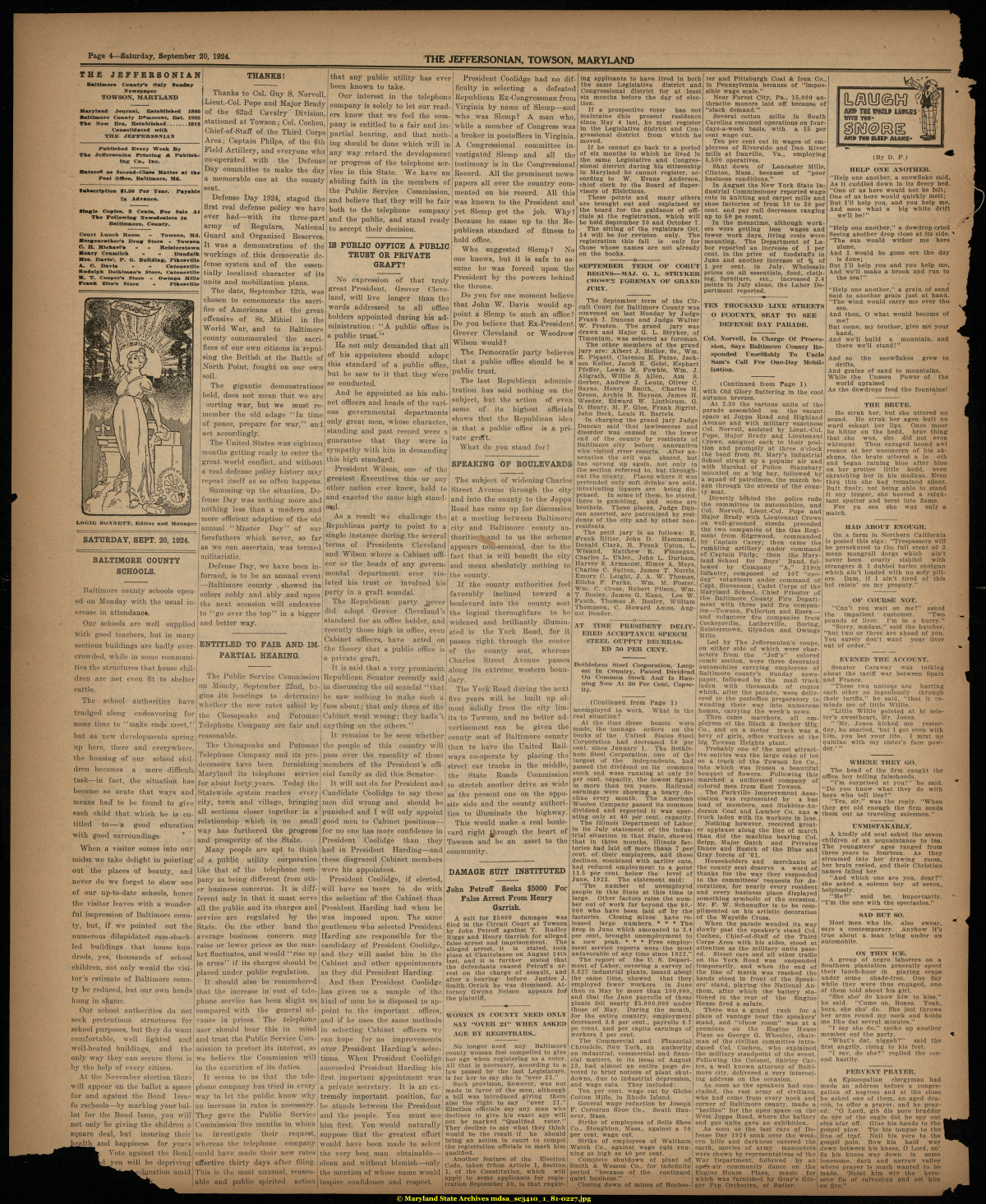
| Page 4—Saturday, September 20, 1924. THE JEFFERSONIAN, TOWSON, MARYLAND THE JEFFERSONIAN Baltimore Comntr'a Only Sunday Newspaper TOWSON, MARYLAND THANKS! Maryland Journal, Established 1865 Baltimore County Democrat, Est. 1885 Tae New Era, Established.......19 IS Consolidated with THE JEFFERSONIAN Published Every Week By The Jellersonlan Prlntinjr A Publishing Co., Ine. Battered as Second-Class Hatter at the Post Office, Baltimore, Bid. lahserlptlon $1.50 Per Year. Payable In Advance. Slaa-le Copies, 8 Cents, For Sale At The Following- Newsdealers In Baltiomore, County. Court Lunch Room - Towson, Mtl, ¦era-enrather's Drug Store - Towson C. H. Michael's - - Reisterstown Bleary Cramlich - - Dundalk Mrs. Davis', P. O. Building, Pikesvllle A. C. Davis - - Catonsville Rudolph Delhlman's Store, Catonsville M. T. Cooper's Store - Owlngs Mills Frank Zlto's Store - Pikesvllle LOGIE BOJVNETT, Editor and Manager SATURDAY, SEPT. 20, 1924. BALTIMORE COUNTY SCHOOLS. Baltimore county schools opened on Monday with the usual increase in attendance. Our schools are well supplied with good teachers, but in many sections buildings are badly overcrowded, while in some communities the structures that house children are not even fit to shelter cattle, The school authorities have) trudged along endeavoring for some time to "make ends meet," but as new developments spring-up here, there and everywhere, the housing of our school children becomes a more difficult task—in fact, the situation has become so acute that ways and means had to be found to give each child that which he is entitled to — a good education with good surroundings- When a visitor comes into our midst we take delight in pointing out the places of beauty, and never do we forget to show one of our up-to-date schools, hence the visitor leaves with a wonderful impression of Baltimore county, but, if we pointed out the numerous dilapidated ram-shackled buildings that house hundreds, yes, thousands of school children, not only would the visitor's estimate of Baltimore county be reduced, but our own heads hung in shame. Our school authorities do not seek pretentious structures for school purposes, but they do want comfortable, well lighted and well-heated buildings, and the only way they can secure them is by the help of every citizen. At the November election there* will appear on the ballot a space for and against the Bond Issue fo rschools—by marking your ballot for the Bond Issue, you will not only be giving the children a square deal, but insuring their hejilth and happiness for years Vote against the Bond i_you will be depriving education amid Thanks to Col. Guy S. Norvell, Lieut.-Col. Pope and Major Brady of the 62nd Cavalry Division, stationed at Towson; Col. Cocheu, Chief-of-Staff of the Third Corps Area; Captain Philps, of the 6th Field Artillery, and everyone who co-operated with the Defense Day committee to make the day a memorable one at the county seat. Defense Day 1924, staged the first real defense policy we have ever had—with its three-part army of Regulars, National Guard and Organized Reserves. It was a demonstration of the workings of this democratic defense system and of the essentially localized character of its units and mobilization plans. The date, September 12th, was chosen to comemorate the sacrifice of Americans at the great offensive of St. Mihiel in the World "War, and to Baltimore county comemorated the sacrifices of our own citizens in repulsing the British at the Battle of North Point, fought on our own soil. The gigantic demonstrations held, does not mean that we are ourting war, but we must remember the old adage "In time of peace, prepare for war," and act accordingly. The United States was eighteen months getting ready to enter the great world conflict, and without a real defense policy history may repeat itself as so often happens. Summing up the situation, Defense Day was nothing more and nothing less than a modern and more efficient adaption of the old annual "Muster Day" of our forefathers which never, so far as we can ascertain, was termed militaristic. Defense Day, we have been informed, is to be an annual event —Baltimore county showed its colors nobly and ably and upon the next occasion will endeavor to "go over the top" in a bigger and better way. that any public utility has ever been known to take. Our interest in the telephone company is solely to let our readers know that we feel the company is entitled to a fair and impartial hearing, and that nothing should be done which will in any way retard the development! or progress of the telephone service in this State. We have an abiding faith in the members of the Public Service Commission, and believe that they will be fair both to the telephone company and the public, and stand ready to accept their decision. IS PUBLIC OFFICE A PUBLIC TRUST OR PRIVATE GRAFT? ENTITLED TO FAIR AND IMPARTIAL HEARING. The Public Service Commission on Mondy, September 22nd, begins its hearings to determine whether the new rates asked by the Chesapeake and Potomac Telephone Company are fair and reasonable. The Chesapeaks and Potomac Telephone Company and its predecessors have been furnishing Maryland its telephone service for about forty years. Today the Statewide system reaches every city, town and village, bringing all sections closer together in a relationship which in no small way has furthered the progress and prosperity of the State. Many people are apt to think of a public utility corporation like that of the telephone company as being different from other business concerns. It is different only in that it must serve all the public and its charges and service are regulated by the State. On the other hand the average business concern may raise or lower prices as the market fluctuates, and would '' rise up in arms" if its charges should be placed under public regulation. It should also be remembered that the increase in cost of telephone service has been slight asj compared with the general advance in prices. The telephone user should bear this in mind and trust the Public Service Cora-mission to protect its interest, as we believe the Commission will in the execution of its duties. It seems to us that the telephone company has tried in every way to let the public know why an increase in rates is necessary. They gave the Public Service Commission five months in which to investigate their request, whereas the telephone company could have made their new rates effective thirty days after filing. This is the most unusual, reasonable and public spirited action No expression of that truly great President, Grover Cleveland, will live longer than the words addressed to all office holders appointed during his administration : "A public office is a public trust." He not only demanded that all of his appointees should adopt, this standard of a public office, but he saw to it that they were so conducted. And he appointed as his cabinet officers and heads of the various governmental departments only great men, whose character, standing and past record were a guarantee that they were in sympathy with him in demanding this high standard. President Wilson, one of the greatest Executives this or any other nation ever knew, held to and exacted the same high standard. As a result we challenge the Republican party to point to a single instance during the several terms of Presidents Cleveland and Wilson where a Cabinet officer or the heads of any governmental department ever violated his trust or involved his party in a graft scandal. The Republican party jiever did adopt Grover Cleveland's standard for an office holder, and recently those high in office, even Cabinet officers, have acted on the theory that a public office is a private graft. It is said that a very prominent Republican Senator recently said in discussing the oil scandal "that he saw nothing to make such a fuss about; that only three of the Cabinet went wrong; they hadn't anything on the others." It remains to be seen whether the people of this country will pass over the rascality of those members of the President's official family as did this Senator-It will not do for President and Candidate Coolidge to say these men did wrong and should be punished and I will only appoint good men to Cabinet positions—i for no one has more confidence in President Coolidge than they had in President Harding—and these disgraced Cabinet members were his appointees, President Coolidge, if elected, will have no more to do with the selection of the Cabinet than President Harding had when he was imposed upon. The same gentlemen who selected President Harding are responsible for the candidacy of President Coolidge, and they will assist him in the Cabinet and other appointments as they did President Harding. And then President Coolidge has given us a sample of the kind of men he is disposed to appoint to the important offices, and if he uses the same methods in selecting Cabinet officers we can hope for no improvements over President Harding's selections. When President Coolidge succeeded President Harding his first important appointment was a private secretary. It is an extremely important position, for he stands between the President and the people. You must see him first. You would naturally suppose that the greatest effort would have been made to select the very best man obtainable-clean and without blemish—only the mention of whose name would inspire confidence and respect. President Coolidge had no difficulty in selecting a defeated Republican Ex-Congressman from Virginia by name of Slemp—and who was Slemp? A man who, while a member of Congress was a broker in postoffices in Virginia. A Congressional committee investigated Slemp and all the testimony is in the Congressional Record. All the prominent newspapers all over the country commented on his record. All this was known to the President and yet Slemp got the job. Why? Because he came up to the Republican standard of fitness to hold office. Who suggested Slemp? No one knows, but it is safe to assume he was forced upon the President by the powers behind the throne. Do you for one moment believe that John W. Davis would appoint a Slemp to such an office? Do you believe that Ex-President Grover Cleveland or Woodrow Wilson would? The Democratic party believes that a public office should be a public trust. The last Republican administration has said nothing on the subject, but the action of even some of its highest officials shows that the Republican idea is that a public office is a private gra¥t. What do you stand for? ing applicants to have lived in both the same Legislative district and Congressional district for at , least six months before the day of election. If a prospective voter has not maintaine dhis present residence since May 4 last, he must register in the Legislative district and Con: gressional district from which he moved. If he cannot go back to a period of six months in which he lived in the same Legislative and Congressional district during his citizenship in Maryland he cannot register, according to W. Evans Anderson, chief clerk to the Board of Supervisors of Elelctions. These points and many others are brought out and explained by the board for the guidance of officials at the registration, which will be held September 30 and October 7. The sitting of the registrars Oct. 14 will be for revision only. The registration this fall is only for those whose names are not already on the books. ----------o---------- SEPTEMBER TERM OF CORUT BEGINS—MAJ. G. L. 8TRYKEB ORObwv FOREMAN OF GRAND JURY. SPEAKING OF BOULEVARDS The subject of widening Charles Street Avenue through the city and into the county to the Joppa Road has come up for discussion at a meeting between Baltimore city and Baltimore county authorities and to us the scheme appears noix-sensical, due to the fact that is will benefit the city and mean absolutely nothing to the county. If the county authorities feel favorably inclined toward a boulevard into the county seat the logical thoroughfare to be widened and brilliantly illuminated is the York Road, for it passes right through the center of the county seat, whereas Charles Street Avenue passes along its extreme western boundary. The York Road during the next five years will be built up almost solidly from the city limits to Towson, and no better advertisement can be given the county seat of Baltimore county than to have the United Railways co-operate by placing the street car tracks in the middle, the State Roads Commission to stretch another drive as wide as the present one on the opposite side and the county authorities to illuminate the highway. This would make a real boulevard right ihrough the heart of Towson and be an asset to the community. DAMAGE SUIT INSTITUTED John Petroff Seeks $5000 For False Arrest From Henry Garrish. A suit for $5000 damages was filed in the Circuit Court at Towsonj by John Petroff against T. Rudley Riggs and Henry Garrish for alleged false arrest and imprisonment. The alleged arrest, it is stated, took place at Chattolanee on August 2 4th last, and it is further stated that the defendants caused Petroff's arrest on the charge of assault, and after a hearing- before Justice J. Smith Orrick he was dismissed. Attorney Gwynn Nelson appears for; the plaintiff. WOMEN IN COUNTY NEED ONLY SAY "OVER 21" WHEN ASKED AGE BY REGISTRARS.. No longer need any Baltimore county woman feel compelled to give her age when registering as a voter. All that is necessary, according to a law passed by the last Legislature, is for her to say she is "over 21." Such provision, however, was not made in favor of the men, although a bill was introduced giving them also the right to say "over 21." Election officials say any man who declines to give his exact age will not be marked "Qualified voter." They decline to say what they think would be the result if he should bring an action in court to compel the registration officials to mark him qualified. Another feature of the Election Code, taken frfom Article 1, Section 1, of the Constitution, which will apply to some applicants for registration September 30, is that requir- The September term of the Circuit Court for Baltimore County was convened on last Monday by Judge Prank I. Duncan and Judge Walter W. Preston. The grand jury was drawn and Major G. L. Stryker, of Timonium, was selected as foreman. The other members of the grand jury are: Albert J. Mellor, Sr., Wm. E. Piquett, Clarence E. Paine, Jackson Keller, Jacob K. Geist, Kephart Pfeffer, Lewis M. Fowble, Wm. J. Aligrath, Willie S. Allen, Aza S. Gerber, Andrew J. Leutz, Oliver C. Bayne, Henry Smith, Charles H. Green, Archie B. Haynes, James H. Weeder, Edward W. Linthicum, G. D. Henry, M. F. Glos, Frank Sigrist, John Beck, Louis H. Bartels. In charging the grand jury Judge Duncan said that lawlessness and disorder was caused in the lower end of the county by residents of Baltimore city before annexation who visited river resorts. After annexation the evil was abated, but has sprung up again, not only in the section referred to, but throughout the county. Places where it was pretended only soft drinks are sold, intoxicating liquors are being dispensed. In some of them, he stated, there is gambling, and some are brothels. These places, Judge Duncan asserted, are patronized by residents of the city and by other nonresidents. The petit jury is as follows: E. Frank Ritter, John D. Hammond, Donald Clark, B. Frank Upton, L. Winand, Matthew R. Finnegan, Charles L. Uhler,, John L. Durham, Harvey S. Armacost, Elmer A. Mays, Charles C. Sutton, James T. Norris, Emory C. Leight, J. A. W. Thomas, Elisha F. Parks, Wm. M. Foster, Wm. C. Cross, Robert Pilson, Wm. T. Bosley, James G. Kane, Lee W. Fauth, Thomas -S. Bosley, William Thompson, C. Howard Amos, August Bender. ter and Pittsburgh Coal & Iron Co., in Pennsylvania because of "impos sible wage scale." Near Forest City, Pa., 15,000 anthracite moners laid off because of "slack demand." Several cotton mills in South Carolina resumed operations on four days-a-week basis, with a 15 per cent wage cut. Ten per cent cut in wages of em ployees of Riverside and Dan River mills at Danville, Va., employing 5,500 operatives. Shut down of Lancaster Mills, Clinton, Mass., because of "poor business conditions." In August the New York State In dustrial Commissioner reported wage cuts in knitting and carpet mills and shoe factories of from 10 to 20 per cent, and pay roll decreases ranging up to 50 pe rcent. In the meantime, although workers were getting less wages and fewer work days, living costs were mounting. The Department of Labor reported an increase of 1 per cent, in the price of foodstuffs in June and another increase of % of 1 per cent, in July. Wholesale prices on all essentials, food, clothing, furniture, etc., increased 2.4 points in July alone, the Labor Department reported. TEN THOUSAND LINE STREETS O FCOUNTY SEAT TO SEE DEFENSE DAY PARADE. Col. Norvell, In Charge Of Procession, Says Baltimore County Responded Unselfishly To Uncle Sam's Call For One-Day Mobile ization. AT TIME PRESIDENT DELIVERED ACCEPTANCE SPEECH STEEL OUPPUT DECREASED 50 PER CENT. Bethlehem Steel Corporation, Largest In Country, Passed Dividend On Common Stock And Is Running Now At 30 Per Cent. Capacity. (Continued from Page 1) unemployed to work. What is the real situation? At the time these boasts were, made, the tonnage orders on the books of the United States Steel Corporation had decreased 50 per cent, since January 1. The Bethlehem Steel Corporation, one of the largest of the independents, had passed the dividend on its common stock and wass running at only 30 per cent, capacity, the lowest figure in more than ten years. Railroad earnings were showing a heavy decline every month. The American Woolen Company passed its common dividend and reported it was operating only at 40 per cent, capacity. The Illinois Department of Labor in its July statement of the industrial situation in that State, showed that in three months, Illinois factories had laid off more thaan 7 per cent, of their employees, and these; declines, combined with earlier cuts, had reduced employment to a point 11.5 per cent, below the level of June, 1923. The statement said: "The number of unemployed people in this State at this time is large. Other factors raise the number out of work far beyond the 80,-000 who have been laid off by the factories. Closing mines have released large numbers. * * * The drop in June which amounted to 3.4 per cent, brought unemployment to a new peak. * * * Free employment service reports were the most unfavorable of any time since 1922." The report of the U. S. Department of Labor, covering a survey of 8,627 industrial plants, issued about the same time, showed that they employed fewer workers in June than in May by more than 100,000, and that the June payrolls of these plants fell nearly $5,000,000 under those of May. During the month, for the entire country, employment decreased 3.8 per cent., payrolls 6.7 pe rcent. and per capita earnings of workers 3 per cent. The Commercial and Financial Chronicle, New York, an authority on industrial, commercial and financial matters, in its issue of August 2 3, had almost an entire page devoted to brief notices of plant shutdowns, due to industrial depression, and wage cuts. They included: Ten per cent, wage cut by Globe Cotton Mills, in Rhode Island. General wage reduction by Joseph F. Corcoran Shoe Co., South Hanover, Mass. Strike of employees of Selis Shoe Co., Stoughton, Mass., against a 10 per cent, wage cut. Strike of employees of Walthamj Watch Co., against wage cuts run-, ning as high as 40 per cent. Complete shutdown of plant ofjj Smith & Wesson Co., for indefinite! period "because of the continued j quiet business." Closing down of mines of Roches-1 (Continued from Page 1) with Old Glory fluttering in the cool autumn breezes. At 2.30 the various units of the parade assembled on the vacant space at Joppa Road and Highland Avenue and with military exactness Col. Norvell, assisted by Lieut.-Col. Pope, Major Brady and Lieutenant Crowe, assigned each to their position and promptly at three o'clock the band from St. Mary's Industrial School struck up a popular air and with Marshal of Police Stansbury mounted on a big bay, followed by a squad of patrolmen, the march began through the streets of the county seat. Directly behind the police rode the committee in automobiles, and Col. Norvell, Lieut.-Col. Pope and Major Brady with Lieutenant Crowe on well-groomed steeds preceded the two companies of the Gas Regiment from Edgewood, commanded by Captain Carey; then came the rumbling artillery under command of Captain Philp; then the Maryland School for Boys' Band, followed by Company "A," 319th Infantry, composed of 107 "one-day" volunteers under command of Capt. Stevenson; Cadet Corps of the Maryland School, Chief Priester of the Baltimore County Fire Department with three paid fire companies—Towson, Fullerton and Essex— and volunteer fire companies from Cockeysville, Lutherville, Boring, Reisterstown, Glyndon and Owings Mills. Led by The Jeffersonian's coupe, on either side of which were characters from the "Jeff's" colored comic section, were three decorated automobiles carrying employees of Baltimore county's Sunday newspaper, followed by the mail truck laden with thousands of copies which, after the parade, were delivered to the postoffice preparatory to wending their way into numerous homes, carrying the week's news. Then came marchers, all employees of the Black & Decker Mfg.] Co., and on a motor truck was a, bevy of girls, office workers at the big Towson Heights plant. Probably one of the most attractive entries was the large cake of ice on a truck of the Towson Ice Co., into which was frozen a beautiful bouquet of flowers. Following this marched a uniformed company of colored men from East Towson. The Parkville Improvement Association was represented by a bus load of members, and Stebbins-An-derson Coal and Lumber Co. haa * truck laden with its workers in line. Nothing however, received greater applause along the line of march than did the machine bearing Col. Seipp, Major Gatch and Privates Dance and Busick of the Blue and Gray forces of '61. Householders and merchants at the county seat deserve a word of thanks for the way they responded to the committees' requests for decorations, for nearly every resident and every business place displayed something symbolic of the occasion. Mr. F. W. Schnauffer is to be complimented on his artistic decoration of the Wayside Cross. When the parade wended its way slowly past the speaker's stand Col. Cocheu, Chief-of-Staff of the Third Corps Area with his aides, stood at attention as the military units passed. Street cars and all other traffic on the York Road was suspended temporarily, and when the end of the line of march was reached the bands stood in front of the Speakers' stand, playing the National Anthem, after which the battery stationed in the rear of the Engine House fired a salute. There was a grand rush for a place of vantage near the speakers' stand, and "elbow room" was at a premium on the Engine House Plaze as George G. Wheeler, chairman of the civilian committee introduced Col. Cocheu, who explained the military standpoint of the event. Following the Colonel, Shirley Carter, a well known attorney of Baltimore city, delivered a very interesting address on the occasion. As soon as the speakers had concluded, the vast army of civilians, who had come from every nook and corner of Baltimore county, made a "beeline" for the open space on the West Joppa Road, where the battery and gas units gave an exhibition. As soon as the last rays of Defense Day 1924 sank over the western hills and darkness covered the earth, movies of army maneuvers were shown by representatives of the War Department, followed by an open-air community dance on the Engine House Plaza, music for which was furnished by Gray's Ginger Pep Orchestra, of Butler. » THE ttm9 I AV&ff WITH Y9E8- AN& Y@U SLEEP AL0NE- (By D. F.) HELP ONE ANOTHER. "Help one another, a snowflake said, As it cuddled down in its fleecy bed. "One of us here would not be felt; One of us here would quickly melt; But I'll help you, and you help me, And soon what a big white drift we'll be!" "Help one another," a dewdrop cried Seeing another drop close at its side. "The sun would wither me here alone, A.nd I would be gone ere the day is done; But I'll help you and you help me, 4nd we'll make a brook and run to the sea!" "Help one another," a grain of sand Said to another grain just at hand. "The wind would carry me over thej sea. And then, O what would become of me? But come, my brother, give me your hand, And we'll build a mountain, and there we'll stand!" And so the snowflakes grew to drifts, And grains of sand to mountains, While the Unseen Power of the world upraised As the dewdrops feed the fountains! THE BRUTE. He struk her, but she uttered no sound. He struk her agen butt no wurd eskapt her lipz. Once moor he hitter on the hedd, brav thing that she wuz, she did not even whimpur. Then enraged beond awl reezon at her unconcern of his ak-shuns, the brute uttered a lo oth and began raining bloo after bloo on her prettee little hedd, even skratching her in his madnus. Even thru this she had remained silent. Butt finely, not being able to stand it eny longer, she heeved a reluk-tant sputter and berst into flame. For yu sea she wuz only a match. HAD ABOUT ENOUGH. On a farm in Northern California is posted this sign: "Trespassers will be persekuted to the full etent of 2 mean mongrall dorgs which ain't never been ovarly sishibil with strangers & 1 dubbel barlet shotgun which ain't loaded with no sofy pill-ers. Dam, if I ain't tired of this hel raisin' on my proputy." OF COURSE NOT. "Can't you wait on me?" asked the impatient customer. "Two pounds of liver. I'm in a hurry." "Sorry, madam," said the butcher, "but two or three are ahead of you. You surely don't want your liver out of order." EVENED THE ACCOUNT. Senator Caraway was talking about the tariff war between Spain and France. "These two nations are hurting each other so ingeniously through their tariffs," he said, "that it reminds me of little Willie.. "Little Willie pointed at hi ssis-ter's sweetheart, Mr. Jones. " 'Mr. Jones kicked me yesterday, he snarled, 'but I got even with him, you bet your life. I mixt up quinine with my sister's face powder.' " WHERE THEY GO. The head of the Arm caught the office boy telling falsehoods. "I'm surprised at you!" he said. "Do you know what they do with boys who tell lies?" "Yes, sir," was the reply. "When they get old enough the firm sends them out as traveling salesmen." UNMISTAKABLY. A kindly old soul asked the seven children of an acquaintance to tea. The youngsters' ages ranged from three years to fourteen. As they streamed into her drawing room, her brain reeled, and their Christian names failed her. "And which one are you, dear?" she asked a solemn boy of seven, helplessly. "Me?i" said he, ' importantly. "I'm the one with the spectacles." SAD BUT SO. Most men who lie, also swear, says a contemporary. Anyhow it's true about a man lying under an automobile. ON THIN ICE. A group of negro laborers on a Southern plantation generally spent their lunch-hour in playing craps under some shade-tree. One day while they were thus engaged, one of them told about his girl. "She sho' do know hiw to kiss," he said. "Come on, Bones. Yeah, boys, she sho' do. She jest throws her arms round my neck and holds me like dat sevrul minutes." "I say she do," spoke up another member oof the party. "What's dat, niggah?" said the first angrily, rising to his feet. "I say, do she?" replied the see-ond hastily. FERVENT PRAYER. An Episcopalian clergyman had made an address before a congregation of negroes and at the close he asked one of them, an aged deacon, to offer a prayer, and he prayed: "O Lord, gib dis pore brudder de eye of the eagle dat he spy out sins afar off. Glue his hands to the gospel plow. Tie his tongue to the line of tr„uf. Nail his yere to the gospel pole. Bow his haid way down between his knees, O Lord, an' fix his knees way down in some lonesome, dark and narrow valley where prayer is much wanted to be made. 'Noint him wiv the kerosene ile of salvashun and set him on fire." |