 |
|
|
 |
|
 |
|
|||
|
||||
|
||||
|
Maryland State Archives Jeffersonian, Towson, Maryland mdsa_sc3410_1_81-0311 Enlarge and print image (6M) |
|
|
|
|
|
|
|
|||
|
||||
|
||||
|
Maryland State Archives Jeffersonian, Towson, Maryland mdsa_sc3410_1_81-0311 Enlarge and print image (6M) |
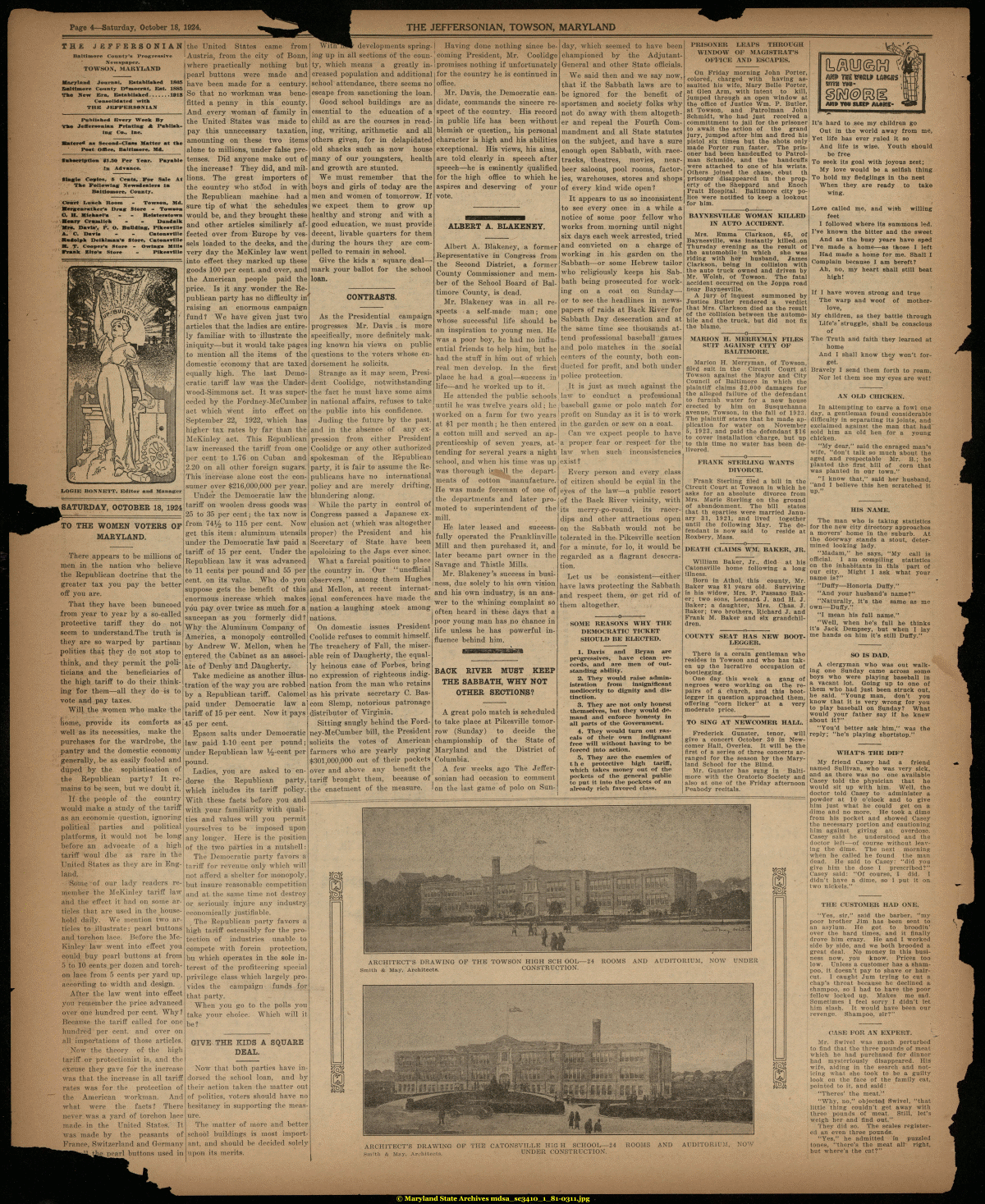
| Page 4r—Saturday, October 18, 1924. THE JEFFERSONIAN, TOWSON, MARYLAND THE JEFFERSONIAN Baltimore County's Progressive Newspaper. TOWSON, MARYLAND Maryland Journal, Katabllaaed 1865 Ktcltlmore County Democrat, Est. 1885 *Jae New Bra, Established.......191S Consolidated with. THEE JKFFBRS9NIAN PuhliHhed Every Week By *»e Jefleraonian Printing A Pabllah- ln»c Co., Inc. »tered M Second-Class Blatter at the Peat Office, Baltimore. Bid. •abaerlptlon 41.50 Per Year. In Advance. Payable •tajfle Copies, 5 Cents, , For Sale At '.- The Following Newsdealers in . t ,, Balttomore, County. Court Lunch Room - Towson, Md. MXers-enrather'a Drag Store - Towson 6. H. Michael's - - Relaterstown ¦enry Crnmllch - . Oundalk /Mia. Davla', P. O. Ball din ff. Pikesvllle A.:"C. Davis - - Catonsville Rudolph Delhlman'a Store, CatonsvUlr ¦. ,T. Cooper's Store - Owlaga Mills ¦"rank Sltp'p Store - Pikesvllle LOGIE BONNETT, Editor and Manager SATURDAY, OCTOBER 18, 1924 TO THE WOMEN VOTERS OF MARYLAND. There appears to be millions of men in the nation who believe the Republican doctrine that the greater tax you pay the better off you are. That they have been buncoed from year to year by a so-called protective tariff they do not seem to understand.The truth is they are so warped by partisan politics that \hej do not stop to think, and they permit the politicians and the beneficiaries of the high tariff to do their thinking for them—all they do is to vote and pay taxes. Will the women who make the home, provide its comforts as well as its necessities, make the purchases for the wardrobe, the pantry and the domestic economy generally, be as easily fooled and duped by the sophistication of the Republican party? It remains to be seen, but we doubt it, If the people of the country would make a study of the tariff as an economic question, ignoring political parties and political platforms, it would not be long before an advocate of a high tariff woul dbe as rare in the United States as they are in England. Some of our lady readers rein ember the McKinley tariff law and the effect it had on some articles that are used in the household daily. We mention two articles to illustrate: pearl buttons and torchon lace. Before the McKinley law went into effect you could buy pearl buttons at from 5 to 10 cents per dozen and torchon lace from 5 cents per yard up, according to width and design. After the law went into effect you remember the price advanced over one hundred per cent. Why'? Because the tariff called for one hundred per cent, and over on all importations of those articles. Now the theory of the high tariff or protectionist is, and the excuse they gave for the increase was that the increase in all tariff rates was for the protection of the American workman. And what were the facts? There never was a yard of torchon lace made in the United States. It was made by the peasants of Prance, Switzerland and Germany .tire pearl buttons used in the United States came from Austria, from the city of Bonn, where practically nothing but pearl buttons were made and have been made for a century. So that no workman was benefitted a penny in this county. And every woman of family in the United States was made to pay this unnecessary taxation, amounting on these two items alone to millions, under false pretenses. Did anyone make out of the increase? They did, and millions. The great importers of the country who sttfod in with the Republican machine had a sure tip of what the schedules would be, and they brought these and other articles similiarly affected over from Europe by vessels loaded to the decks, and the very day the McKinley law went into effect they marked up these goods 100 per cent, and over, and the American people paid the price. Is it any wonder the Republican party has no difficulty in" raising an enormous campaign fund? We have given just two articles that the ladies are entirely familiar with to illustrate the iniquity—but it would take pages to mention all the items of the domestic economy that are taxed equally high. The last Democratic tariff law was the Underwood-Simmons act. It was superceded by the Fordney-McCumber act which went into effect on September 22, 1922, which has higher tax rates by far than the McKinley act. This Rejpublican law increased the tariff from one per cent to 1.76 on Cuban and 2.20 on all other foreign sugars. This increase alone cost the consumer over $216,000,000 per year. Under the Democratic law the tariff on woolen dress goods was 25 to 35 per cent; the tax now is from 74!/2 to 115 per cent. Now get this item: aluminum utensils under the Democratic law paid a tariff of 15 per cent. Under the Republican law it was advanced to 11 cents per pound and 55 per cent, on its value. Who do you suppose gets the benefit of this enormous increase which makes you pay over twice as much for a saucepan as you formerly did? Why the Aluminum Company of America, a monopoly controlled by Andrew W. Mellon, when he entered the Cabinet as an associ- WitfiTIW- developments spring-1 Having done nothing since being up in all sections of the coun-! coming President, Mr. Coolidge ty, which means a greatly in-! promises nothing if unfortunately creased population and additional school attendance, there seems no escape from sanctioning the loan. Good school buildings are as essential to the education of a child as are the courses in reading, writing, arithmetic and all others given, for in dilapidated old shacks such as now house many of our youngsters, health and growth are stunted. We must remember that the boys and girls of today are the men and women of tomorrow. If we expect them to grow up healthy and strong and with a good education, we must provide decent, livable quarters for them during the hours they are compelled to remain in school. Give the kids a square deal—¦ mark your ballot for the school loan. CONTRASTS. As the Presidential progresses Mr. Davis campaign is more ate of Denby and Daugherty. Take medicine as another illustration of the way you are robbed specifically, more definitely making known his views on public questions to the voters whose endorsement he solicits. Strange as it may seem, President Coolidge, notwithstanding the fact he must have some aims in national affairs, refuses to take | the public into his confidence. Juding the future by the past, and in the absence of any expression from either President Coolidge or any other authorized spokesman of the Republican party, it is fair to assume the Republicans have no international policy and are merely drifting, blundering along. While the party in control of Congress passed a Japanese exclusion act (which was altogether proper) the President and his Secretary of State have been apoloizing to the Japs ever since. What a farcial position to place the country in. Our "unofficial observers," among them Hughes and Mellon, at recent international conferences have made the nation .a laughing stock nations. On domestic issues President Coolide refuses to commit himself. The treachery of Fall, the miserable rein of Daugherty, the equally heinous case of Forbes, bring no expression of righteous indignation from the man who retains for the country he is continued in office. Mr. Davis, the Democratic candidate, commands the sincere respect of the country. His record in public life has been without blemish or question,, his personal character is high and his abilities exceptional. His views, his aims, are told clearly in speech after speech—he is eminently qualified for the high office to which he aspires and deserving of your vote. ALBERT A. BLAKENEY. Albert A. Blakeney, a former Representative in Congress from the Second District, a former County Commissioner and member of the School Board of Baltimore County, is dead. Mr. Blakeney was in all respects a self-made man; one whose successful life should be an inspiration to young men. He was a poor boy, he had no influential friends to help him, but he had the stuff in him out of which real men develop. In the first place he had a goal—success in life—and he worked up to it. He attended the public schools [ law day, which seemed to have been championed by the Adjutant-General and other State officials. We said then and we say now, that if the Sabbath laws are to be ignored for the benefit of sportsmen and society folks why not do away with them altogether and repeal the Fourth Commandment and all State statutes on the subject, and have a sure enough open Sabbath, with racetracks, theatres, movies, near-beer saloons, pool rooms, factories, warehouses, stores and shops of every kind wide open? It appears to us so inconsistent to see every once in a while a notice of some poor fellow who works from morning until night six days each week arrested, tried and convicted on a charge of working in his garden on the Sabbath—or some Hebrew tailor who religiously keeps his Sabbath being prosecuted for working on a coat on Sunday— or to see the headlines in newspapers of raids at Back River for Sabbath Day desecration and at the same time see thousands attend professional baseball games and polo matches in the social centers of the county, both conducted for profit, and both under police protection. It is just as much against the to conduct a professional PRISONER LEAPS THROUGH WINDOW OP MAGISTRATES OFFICE AND ESCAPES. On Friday morning John Porter, colored, charged with having assaulted his wife, Mary Belle Porter, at Glen Arm, with intent to kill, jumped through an open window at the office of Justice Wm. P. Butler, at Towson, and Patrolman John Schmidt, who had just received a committment to jail for the prisoner to await the action of the grand jury, jumped after him and fired his pistol six times but the shots only made Porter run faster. The prisoner had been handcuffed to Patrolman Schmide, and the handcuffs were attached to one of his wrists. Others joined the chase, ebut th prisoner disappeared in the property of the Sheppard and Enoch Pratt Hospital. Baltimore city police were notified to keep a lookout for him. ----------o—------- BAYNESVILLE WOMAN KILLED IN AUTO ACCIDENT. Mrs. Emma Clarkson, 65, of Baynesville, was instantly killed on Thursday evening as the result of the automobile in which she was riding with her husband, James Clarkson, being in collision with the auto truck owned and driven by Mr. Wolsh, of Towson. The fatal accident occurred on the Joppa road near Baynesville. A jury of inquest summoned by Justice Butler rendered a verdict that Mrs. Clarkson died as the result of the collision between the automobile and the truck, but did not fix the blame. -------------------o-------------—¦ MARION H. MERRYMAN FILES SUIT AGAINST CITY OF BALTIMORE. (k/aajKaK) KfiTM Y90< AN» vev an? turns Marion H. Merryman, of Towson, filed suit in the Circuit Court at Towson against the Mayor and City Council of Baltimore in which the plaintiff claims $2,000 damages for the alleged failure of the defendant to furnish water for a new house until he was twelve years old; he, baseball game or polo match for erected by him on Susquehanna worked on a farm for two years I profit on Sunday as it is to WOrkiavenue' Towson, in the fall of 1923. „+ &-I .v ,' /, -i • .i j I Tne Plaintiff states that he made ap- at $1 per month; he then entered m the garden or sew on a coat. plication for water on November a cotton mill and served an ap-l Can we expect people to have 5> 1923> and paid the defendant $16 .• i • n '\ * , „ ,-, I to cover installation charge, but up prenticeship of seven years, at-; a proper fear or respect for the j to this time no water has been de-tending for several years a night law when such inconsistencies It's hard to see my children go Out in the world away from me, Yet life has ever ruled it so And life is wise. Youth should be free To seek its goal with joyous zest; My love would be a selfish thing To hold my fledglings in the nest When they are ready to take wing. Love called me, and wifch willing feet I followed where its summons led. I've known the bitter and the sweet And as the busy years have sped I've made a home—as those I left Had made a home for me. Shall I Complain because I am bereft? Ah, no, my heart shall still beat high! If I have woven strong and true The warp and woof of mother-love, My children, as they battle through Life's'struggle, shall be conscious of The Truth and faith they learned at home And I shall know they won't forget. Bravely I send them forth to roam. Nor let them see my eyes are wet! livered. school, and when his time was up was thorough j^.^ll the departments of cotton manufacture. He was made foreman of one of the departments and later promoted to superintendent of the mill. Hie later leased and successfully operated the Franklinville Mill and then purchased it, and later became part owner in the Savage and Thistle Mills. Mr. Blakeney's success in business, due solely to his own vision and his own industry, is an answer to the whining complaint so I often heard in these days that a poor young man has no chance in life unless he has powerful influence behind him. by a Republican tariff. Calomel las his private secretary C. Bas- paid under Democratic law a tariff of 15 per cent. Now it pays 45 per cent. Epsom salts under Democratic law paid 1-10 cent per pound; under Republican law ^-cent per pound. Ladies, you are asked to endorse the Republican party, which includes its tariff policy. With these facts before you and with your familiarity with qualities and values will you permit yourselves to be imposed upon any longer. Here is the position of the two parties in a nutshell: The Democratic party favors a tariff for revenue only which will not afford a shelter for monopoly, but insure reasonable competition and at the same time not destroy or seriously injure any industry economically justifiable. The Republican party favors a high tariff ostensibly for the protection of industries unable to compete with forein protection, bu which operates in the sole interest of the profiteering special privilege class which largely provides the campaign funds for that party. When you go to the polls you take your choice. Which Avill it be? GIVE THE KIDS A SQUARE DEAL. Now that both parties have indorsed the school loan, and by their action taken the matter out of politics, voters should have no hesitancy in supporting the measure. The matter of more and better school buildings is most important, and should be decided solely upon its merits. com Slemp, notorious patronage distributor of Virginia. Sitting snugly behind the Fordney-McCumber bill, the President solicits the votes of American farmers who are yearly paying $301,000,000 out of their pockets over and above any benefit the tariff brought them, BACK RIVER MUST KEEP THE SABBATH, WHY NOT OTHER SECTIONS? A great polo match is scheduled to take place at Pikesville tomorrow (Sunday) to decide the championship of the State of Maryland and the District of Columbia. A few weeks ago The Jeffer-because of sonian had occasion to comment the enactment of the measure. Ion the last game of polo on Sun- exist? Every person and every class of citizen should be equal in the eyes of the law—a public resort of the Back River vicinity, with its merry-go-round, its racer-dips and other attractions open on the Sabbath would not be tolerated in the Pikesville section for a minute, for lo, it would be regarded as a flagrant desecration. Let us be consistent—either have laws protecting the Sabbath and respect them, or get rid of them altogether. FRANK STERLING WANTS DIVORCE. SOME REASONS WHY THE DEMOCRATIC TICKET SHOULD BE ELECTED. 1. Davis and Bryan are progressives, have clean records, and are men of outstanding ability. 2. They would raise administration from insignificant mediocrity to dignity and distinction. 3. They are not only honest themselves, but they would demand and enforce honesty in all parts of the Government. 4. They would turn out rascals of their own indignant free will without having to be forced into action. 5. They are the enemies of the protective high tariff, which takes money out of the pockets of the general public to put it into the pockets of an already rich favored class. Frank Sterling filed a bill in the Circuit Court at Towson in which he asks for an absolute divorce from Mrs. Marie Sterling on the ground of abandonment. The bill states that th eparties were married January 31, 1921, and lived together until the following May. The defendant is now said to reside at Roxbery, Mass. ----------o---------- DEATH CLAIMS WM. BAKER, JR. William Baker, Jr., died at his Catonsville home following a long illness. Born in Athol, this county, Mr. Baker was 81 years old. Surviving is his widow, Mrs. P. Passano Baker; two sons, Leonard J. and H. J. Baker; a daughter, Mrs. Chas. J. Baker; two brothers, Richard J. and Frank M. Baker and six grandchildren. AN OLD CHICKEN. In attempting to carve a fowl one day, a gentleman found considerable difficulty in separating its joints, and exclaimed against the man that had sold him an old hen for a young chicken. "My dear," said the enraged man's wife, "don't talk so much about the aged and respectable Mr. B.; he planted the first hill of corn that was planted in our town." "I know that," said her husband, "and I believe this hen scratched it up." COUNTY SEAT HAS NEW BOOTLEGGER. There is a cerain gentleman who resides in Towson and who has taken up the lucrative occupation of bootlegging. One day this week a gang of negroes were working on the repairs of a church, and this bootlegger in question approached them, offering "corn licker" at a very moderate price. ----------o---------- TO SING AT NEWCOMER HALL. Frederick Gunster, tenor, will give a concert October 30 in Newcomer Hall, Overlea. It will be the first of a series of three concerts arranged for the season by the Maryland School for the Blind. Mr. Gunster has sung in Baltimore with the Oratorio Society and also at one of the Friday afternoon Peabody recitals. :-:-: ¦.-. -:,*. - "' HIS NAME. The man who is taking statistics for the new city directory approaches a movers' home in the suburb. At the doorway stands a stout, determined looking lady. "Madam," he says, "My call is official. I am compiling statistics on the inhabitants in this part of our city. Might I ask what your name is?" "Duffy—Honoria Duffy." "And your husband's name?" "Naturally, it's the same as me own—Duffy." "I mean his full name." "Well, when he's full he thinks it's Jack Dempsey, but when I lay me hands on him it's still Duffy." SO IS DAD. A clergyman who was out walking one Sunday came across some boys who were playing baseball in a vacant lot. Going up to one of them who had just been struck out, he said. "Young man, don't you know that it is very wrong for you to play baseball on Sunday? What would your father say if he knew about it?" "You'd better ask him," was the reply; "he's playing shortstop." ARCHITECT'S DRAWING OF Smith & May, Architects. THE TOWSON HIGH SCH OOL—24 CONSTRUCTION. ROOMS AND AUDITORIUM, UNDER WHAT'S THE DIF? My friend Casey had a friend named Sullivan, who was very sick, and as there was no one available Casey told the physician that he would sit up with him. Well, the doctor told Casey to administer a powder at 10 o'clock and to give him just what he could get on a dime and no more. He took a dime from his pocket and showed Casey the necessary portion and cautioning him against giving an overdose. Casey said he understood and the doctor left—of course without leaving the dime. The next morning when he called he found the man dead. He said to Casey: "did you give him the dose I prescribed?" Casey said: "Of course, I did. I didn't have a dime, so I put it on two nickels." THE CUSTOMER HAD ONE. "Yes, sir," said the barber, "my poor brother Jim has been sent to an asylum. He got to broodin' over the hard times, and it finally drove him crazy. He and I worked side by side, and we both brooded a great deal. No money in this business now, you know. Prices too low. Unless a customer has a shampoo, it doesn't pay to shave or haircut. I caught Jum trying to cut a chap's throat because he declined a shampoo, so I had to have the poor fellow locked up. Makes me sad. Sometimes I feel sorry I didn't let him slash. It would have been our revenge. Shampoo, sir?" ARCHITECT'S DRAWING OF Smith & May, Architects. THE CATONSVILLE HIGH SCHOOL—24 UNDER CONSTRUCTION. ROOMS AND AUDITORIUM, NOW CASE FOR AN EXPERT. Mr. Swivel was much perturbed to find that the three pounds of meat which he had purchased for dinner had mysteriously disappeared. His wife, aiding in the search and noticing what she took to be a guilty look on the face of the family cat, pointed to it, and said: "Theres' the meat." "Why, no," objected Swivel, "that little thing couldn't get away with three pounds of meat. Still, let's weigh her and find out." They did so. The scales registered an even three pounds. "Yes," he admitted in puzzled tones, "there's the meat all right, but where's the cat?" © Maryland State Archives mdsa_sc3410_1_81-0311.jpg |